
360 horsepower. That is the number that mattered in 1965, and it is still the number that matters when people argue about which GTO engine deserves the most credit for kicking off the muscle car era in earnest. The Tri-Power 389 did not just make the GTO faster. It made the whole segment take Pontiac seriously as the division that would not stop pushing.
Car Features
7 min read
1965 GTO: The 360-HP Tri-Power That Rewrote the Rules
The 1965 Tri-Power 389 pushed the GTO to a rated 360 horsepower, and real-world performance suggests the catalog number undersold it.
The number first
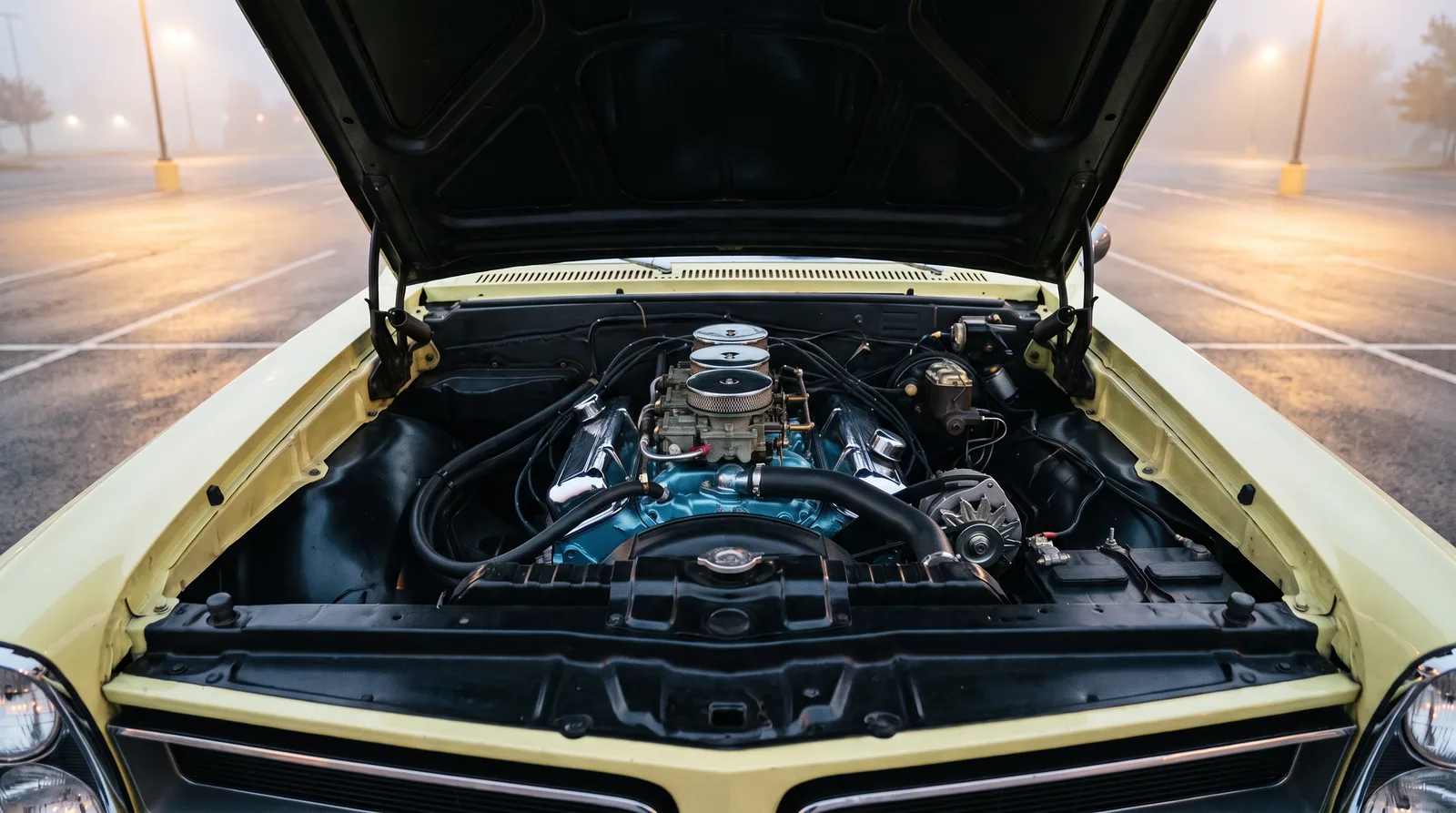
Start with the result, because that is how this engine earned its reputation. The 1965 GTO's optional Tri-Power setup, three two-barrel Rochester carburetors stacked across the intake, pushed the 389 V8's rated output to 360 horsepower, up from the 335 horsepower single four-barrel version. That is a 25-horsepower jump from carburetion alone, no displacement change, no head swap, just three carburetors doing a better job of feeding the engine than one could. On the street, the difference was not subtle. Cars ordered with Tri-Power ran quicker quarter-mile times and simply pulled harder through the middle of the rev range than the single four-barrel cars did.
Catalog numbers versus what the car actually did
Here is where I always push back on people who take factory horsepower ratings as gospel. Automakers in this era were notorious for underrating engines to keep insurance companies and racing sanctioning bodies from paying too much attention, and Pontiac was no exception. Independent testing and period magazine numbers on Tri-Power 389 cars consistently suggest real-world output ran ahead of that 360-horsepower catalog figure. Nobody has a clean factory document proving exactly how far off the rating was, so treat any specific alternate number with some skepticism, but the gap between advertised and actual was real, and it was not small.
Look at the compression ratio and you start to see why. The Tri-Power 389 ran a 10.75:1 compression ratio, the same figure used across all 1964-66 GTO 389s, high enough that Pontiac's engineers were clearly chasing real output, not just a number that would look good in a brochure. An engine built that way, fed by three carburetors instead of one, does not lose 25 horsepower to friction and accessory drag and land exactly on a round catalog number by coincidence. Round numbers in this era were marketing decisions as much as they were dyno results.
| Spec | 1965 GTO 389 4-bbl | 1965 GTO 389 Tri-Power |
|---|---|---|
| Carburetion | Single 4-barrel | 3x 2-barrel Rochester |
| Rated horsepower | 335 hp | 360 hp |
| Displacement | 389 cu in | 389 cu in |
| Compression ratio | 10.75:1 | 10.75:1 |
| Real-world output | Roughly at or slightly above rating | Widely believed to exceed catalog figure |
Why this engine set the tone for what followed
The 1965 Tri-Power 389 landed in the last year of the GTO's original Tempest-based body before the 1966 redesign brought the 1966-67 GTO and its Coke-bottle shape. In a very real sense, this engine set the performance bar that the redesigned car had to live up to. Pontiac dropped Tri-Power after 1966 in favor of a single four-barrel setup on the 1967 400, partly due to emissions and regulatory pressure building across the industry, which makes the 1965 and 1966 Tri-Power cars the last of a specific breed: multi-carb GTOs built before Detroit started backing away from that kind of complexity.
Part of what makes the 1965 car specifically interesting is that it represents Tri-Power at its most refined within the original body style. Pontiac had a full model year of feedback from the 1964 GTO's Tri-Power option to work from, and it shows in small mechanical details, carburetor linkage geometry, vacuum advance calibration, that got quietly improved between the two model years even though the horsepower rating stayed close. A well-sorted 1965 Tri-Power car drives noticeably cleaner off idle than an early 1964 example, something you only really notice if you have driven both back to back.
"Everybody wants to talk about the catalog number. I want to talk about what happened when the secondaries opened up. That is where this engine actually lived."
Dan Reeves
What to check if you are chasing a real one
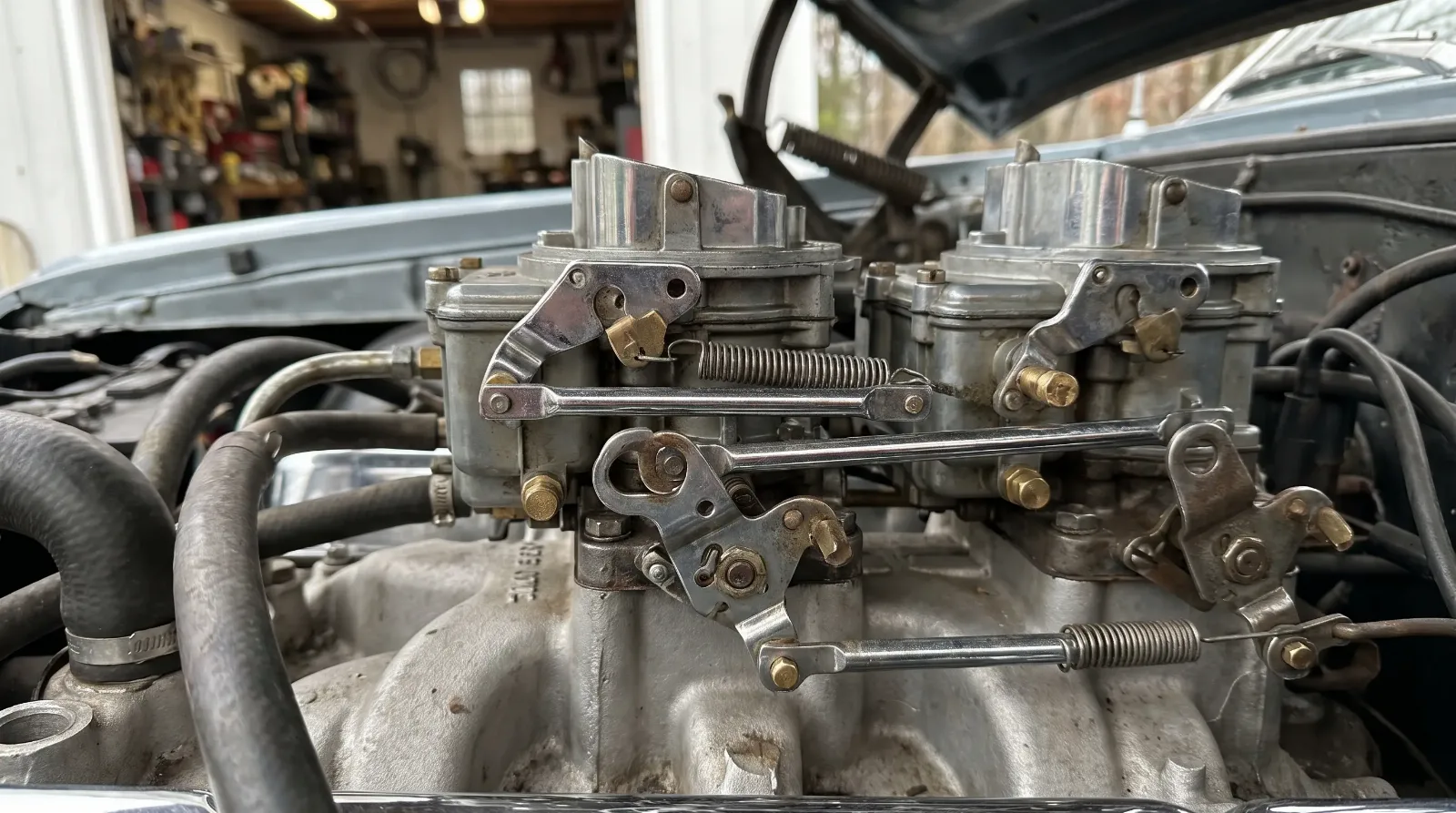
Tri-Power setups are among the most commonly faked options on surviving GTOs, because the visual drama of three carburetors under the hood is exactly the kind of thing that moves a car's price at a show or a sale. Casting numbers on the intake manifold, correct carburetor tags, and factory documentation matter enormously here. A car wearing a Tri-Power intake today is not automatically a car that left the factory that way.
Beyond the obvious visual check, pull the linkage apart if the seller allows it. Factory Tri-Power linkage has a specific progressive-opening geometry that aftermarket or reproduction setups do not always replicate correctly, and a system that opens all three carburetors at once instead of progressively is either misassembled or not a factory-correct unit. It is a five-minute check that tells you more about a Tri-Power car's authenticity than staring at the valve covers ever will.
None of this happens in isolation from the rest of the car, either. The Tri-Power 389 was usually ordered alongside other performance and comfort options, and the interior a buyer chose said almost as much about how the car was meant to be used as the engine bay did. That side of the story, and why collectors chase certain original interiors so hard today, is worth its own read, so read on. For the full arc of how this engine fits into the model's entire production run, the complete GTO story lays it all out.
How it stacked up against the competition
Put the Tri-Power 389 next to what the rest of Detroit was selling in 1965 and the picture gets clearer. Ford's 289 High Performance V8 in the Mustang was a genuinely capable engine, but it was giving up 100 cubic inches to the Pontiac and it showed in torque, where the 389 simply had more twist available lower in the rev range. Mopar's big-block options came closer on raw output, but they were not yet packaged into a mid-size car buyers could option as easily as the GTO. The Tri-Power 389 was not the biggest or the most powerful engine in America in 1965. It was the best-executed combination of displacement, carburetion, and chassis in a car a regular buyer could actually order and drive home, and that combination is what made it the engine other manufacturers spent the rest of the decade chasing.
Weight distribution mattered here too, more than people give it credit for. The 389 sat far enough back in the GTO's engine bay that the car did not suffer the nose-heavy handling some of its big-inch rivals struggled with. A Tri-Power GTO in period road tests consistently drew praise not just for straight-line pull but for how composed the car felt under hard braking and through a fast corner, a combination that a lot of raw horsepower numbers from this era simply did not deliver on their own.
Seeing one for yourself
Numbers on a page only tell you so much. If you want to see what a documented Tri-Power 1965 GTO actually looks like and what one costs in today's market, current listings are the fastest way to get a real answer: browse GTO listings.
Sources and notes
Related Reading

Have a
Pontiac GTO
for Sale?
Reach thousands of serious classic car collectors across the US.
Sell It Here →
Are You a Classic Car Dealer?
List your full inventory and connect with targeted classic car buyers.
Join as a Dealer →

About the author
Dan Reeves
Performance engine builder from North Carolina's motorsports corridor, focused on swaps, forced induction and making real, repeatable power.
Related Listings - Pontiac GTO




Comments
Be the first to comment on this article.