
The Mustang that showed up at the World's Fair in April 1964 came two ways, hardtop or convertible. The roof most people now picture when somebody says "classic Mustang" was not on the order form yet. It arrived about four months later, in August 1964, and Ford called it the 2+2. The 1965 Mustang fastback history is short on paper, two model years before the shape changed, but that roof did more for the car's reputation than almost any option Ford ever sold.
Car Features
7 min read
The 1965 Mustang 2+2: How the Fastback Roof Arrived
Added in August 1964, the 2+2 fastback outsold the convertible in its first year. The roof, the louvers, the codes and why Shelby built on it.
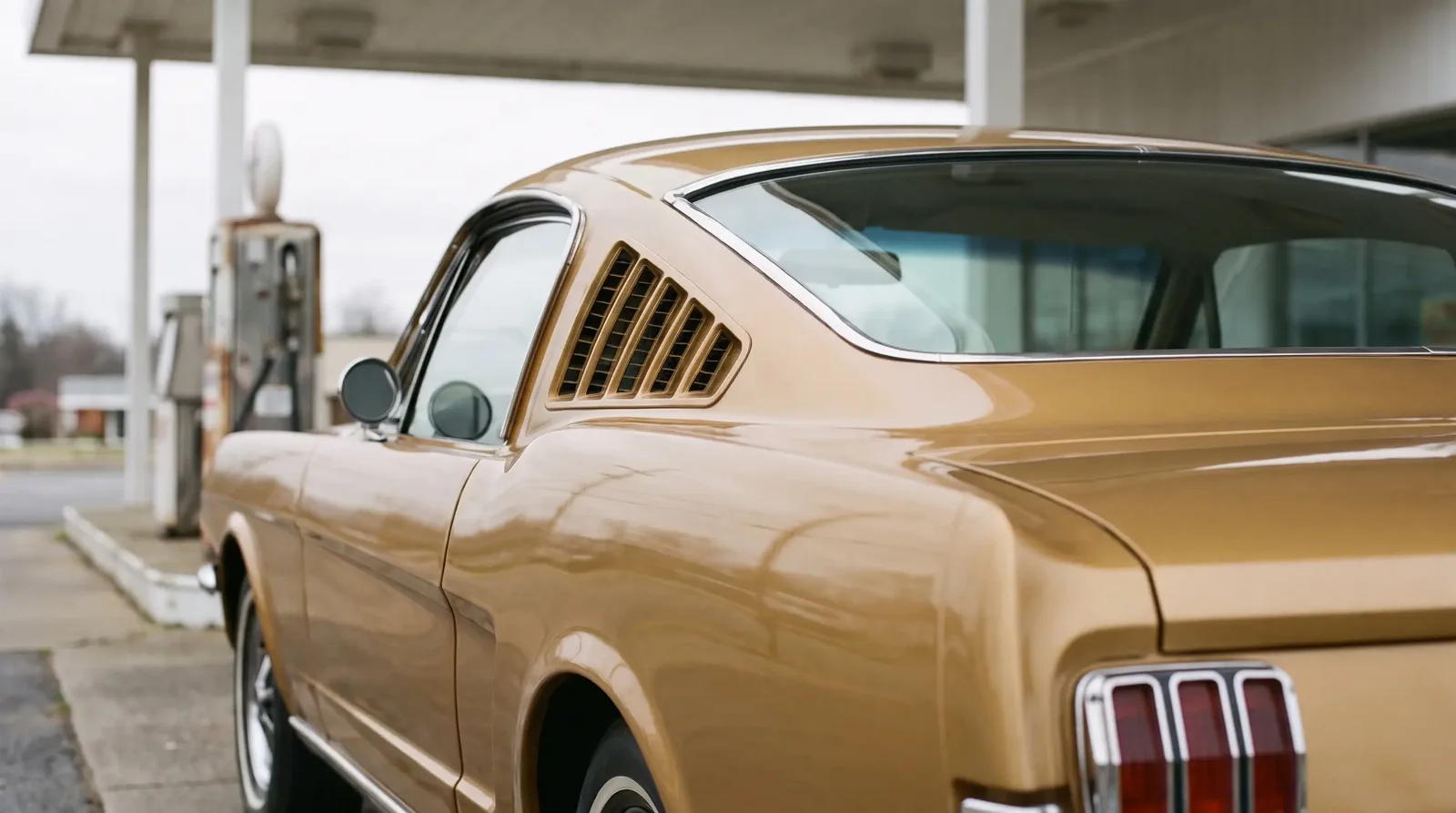
I look at cars from the body side first. Engines get swapped. Interiors get redone. A roofline is the one thing on a car that is very hard to fake well and very easy to spot when somebody tried. So this is a story about sheet metal, and about why a roof added a few months into production ended up carrying so much of the name.
August 1964: the third body style shows up
The 2+2 joined the hardtop and convertible in August 1964. Because it came after the early production run, there is no such thing as a 1964½ fastback. Every one of them was built as a 1965 model, which makes it the first Mustang body style with that distinction. If someone shows you a "1964½ fastback," what they are showing you is either a 1965 or a story.
It came out of the same package as the first generation Mustang it was built on. Same 108 inch wheelbase, same front end, same long hood. Everything that makes it a fastback happens behind the door glass, from the roof back.
The base price was $2,589, against $2,372 for the hardtop and $2,614 for the convertible. That put the fastback $217 above the hardtop and only $25 below the convertible, much closer to the open car than to the coupe. Under the hood it drew on the full 1965 engine list. The base engine was the same T-code 200 cubic inch six as in the other bodies, and six-cylinder 2+2s with a T in the fifth digit of the VIN still turn up at auction. Above it sat the 289 V8s, up to the 271 hp K-code.
What the 2+2 name actually meant
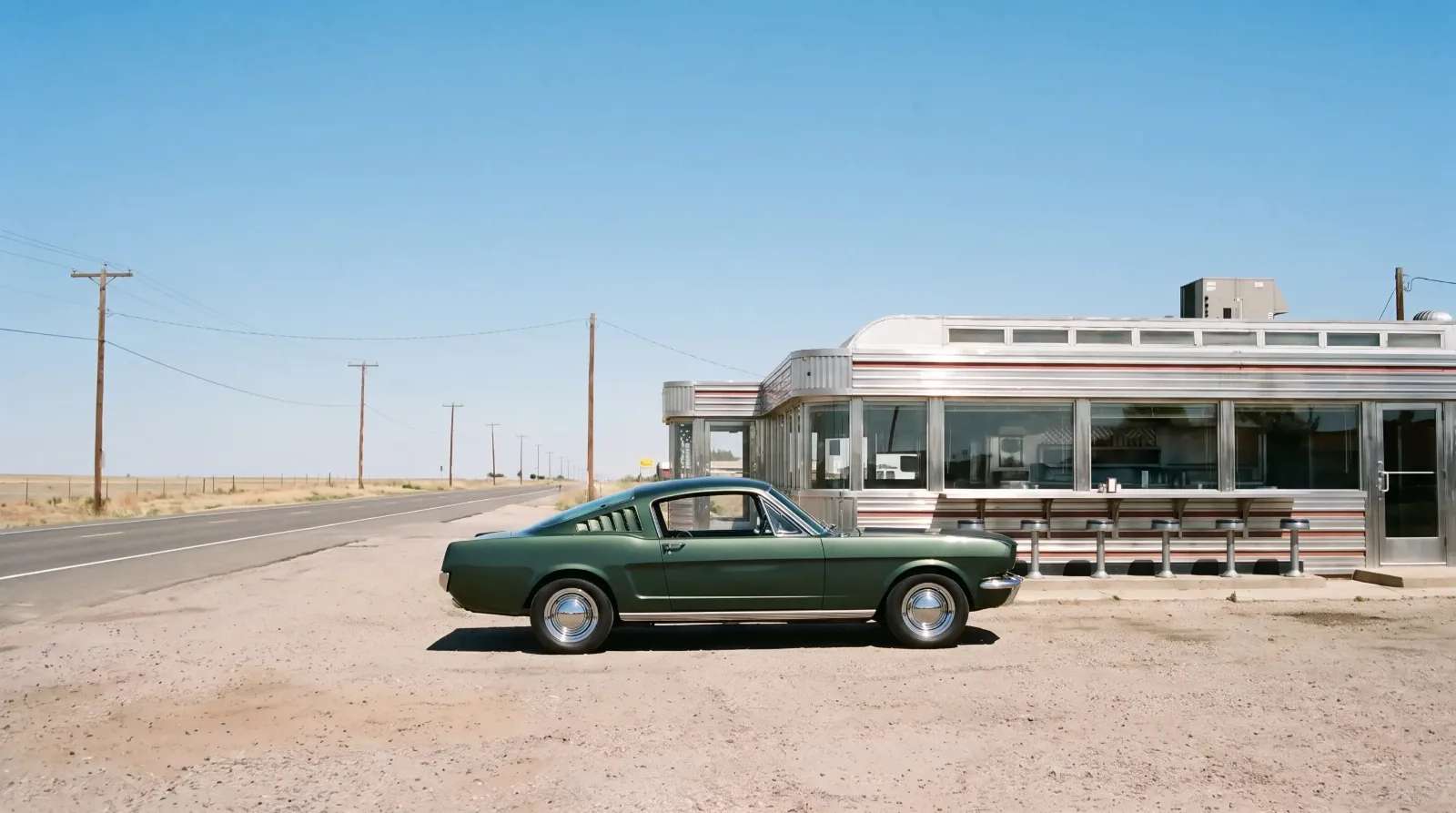
The name was a description, not a slogan. Two seats up front, two more in back, and the back two folded. The fold-down rear seat was standard, and with it down you got a carpeted cargo floor with chrome trim. That folding seat is the reason Ford marketed the car as a 2+2 instead of just calling it a fastback.
The other detail that belongs only to this car is on the C-pillar. Ford put louvered vents there, cabin air extractors, and they are the quickest way to tell a 1965 or 1966 fastback at a glance from across a parking lot. Look at a 2+2 in profile and the roof comes down in one long sweep from the windshield header, then drops onto a short decklid. The louvers sit right where the eye lands on that slope. They break up what would otherwise be a big, plain pillar, and that is good design, whether or not anyone on the team thought of it in those terms. It is a big part of why this roof, an addition rather than part of the launch car, now stands for original Mustang design in so many people's heads.
Weight and height barely moved against the coupe. The Henry Ford's archived spec pages list the 2+2 at 51.2 inches tall and 2,606 lb at the curb, against 51.1 inches and 2,556 lb for the hardtop. Fifty pounds and a tenth of an inch. The fastback looks lower because the line of the roof tells your eye it is lower. That is the whole trick, and it is a body man's trick.
The 1965 Mustang fastback history in numbers
The production figures surprise people. Ford built 77,079 fastbacks for 1965, which beat the 73,112 convertibles. The roof that was not even there at launch outsold the open car in its first year. Most of those were standard-interior cars, 71,303 of them, with 5,776 built with the luxury interior. There was no bench-seat 2+2, which makes sense once you think about how that fold-down rear seat and the cargo floor had to work.
| 1965 figure | Hardtop | 2+2 fastback |
|---|---|---|
| Base price | $2,372 | $2,589 |
| Production | 409,260 | 77,079 |
| Height | 51.1 in | 51.2 in |
| Curb weight (Henry Ford spec page) | 2,556 lb | 2,606 lb |
| Wheelbase | 108 in | 108 in |
| Data plate body code | 65A / 65B / 65C | 63A / 63B |
| VIN body code | 07 | 09 |
The codes in that table are what a builder checks before he checks anything else. On a 1965 or 1966 Mustang the VIN carries 09 for a fastback, and the data plate reads 63A for a standard interior or 63B for the luxury Interior Decor Group. Coupe-to-fastback conversions are a real thing, and some of them are good work. But the numbers do not change when the roof does. A car stamped 07 left the plant as a hardtop, whatever it looks like now.
Why Shelby built on the fastback
The roof's racing credentials came almost immediately. When Carroll Shelby turned the Mustang into the GT350, the base car was the 2+2. Ford gave the project the go-ahead in August 1964, the same month the fastback went on sale, and those first 110 white bodies from San Jose became the homologation run. All 562 of the 1965 GT350s were Wimbledon White with Guardsman Blue rocker stripes.
The racing version, the GT350R, shows what the body was made of once you strip it. Shelby threw out the rear seat entirely, the very thing the 2+2 name was built around, and fitted Plexiglas windows and a fiberglass front apron. Thirty-four customer R-models were built. The carryover went the other way too: the first 252 Shelbys sold as 1966 GT350s started life as 1965 K-code fastbacks.
I can't tell you what was said in the meetings at Shelby American. From the body side, though, the choice makes sense: a closed roof, a rear seat you could throw away, and a profile that read like a race car from a hundred feet off. A builder would make the same call today.
"Everybody talks about the 289. The 289 went in all three bodies. What made the 2+2 its own car was a roof and a pair of louvers, and you cannot bolt those on. Either the car left the plant with an 09 in the VIN or it didn't, and no amount of good metalwork changes that."
Jim Vasquez
How the roof changed after 1965
The 2+2 carried into 1966 with its roof and louvers intact, but its numbers did not. In the record year, when Mustang production climbed past 600,000, fastback output fell to 35,698, made up of 27,809 standard and 7,889 luxury-interior cars. The sheet I work from does not say why, and I am not going to make up a reason. It does make the 1966 the scarcer of the two 2+2 years by a wide margin, and 1966 was the last year for both the 2+2 name and this roof.
For 1967 the body was enlarged and the fastback roof was redrawn to run the full length of the car to the tail, instead of dropping onto a short decklid. Ford built 71,042 of those 1967 fastbacks, so the idea was clearly still selling. From 1969 the brochures stopped calling it a fastback and used the name SportsRoof. Each of those later roofs is a good car in its own right, but they are a different piece of work from the 1965 shape, and anyone who has stood between a 1965 and a 1967 can see it.
For anyone who wants to see how the shape holds up today, the 1965 Mustangs listed right now include all three bodies side by side. Put a 2+2 next to a hardtop and look at the C-pillar. That is where the whole story is.
Sources and notes
- Mac's Motor City Garage: introducing the 1965 Mustang 2+2 (August 1964 debut, folding seat, C-pillar vents)
- Wikipedia: Ford Mustang (first generation), 1965 and 1966 production by body
- RM Sotheby's: San Jose-built 1965 Mustang 2+2 with the T-code 200 six
- Classic Industries: 1964-1973 Mustang VIN decoder (body codes 07 and 09)
- Shelby American Collection: the 1965 Shelby Mustang GT350
- Newport Car Museum: 1965 Shelby GT350R specification
Related Reading
#1965 mustang
#Ford Mustang
#first generation Mustang
#mustang fastback
#Shelby GT350
#classic Mustang history
#Mustang 2+2

About the author
Jim Vasquez
Southern California hot rod and custom car builder with roots in the traditional kustom kulture scene.
Related Listings - Ford Mustang




Comments
Be the first to comment on this article.