
Pontiac dealers had a genuine hit on their hands after 1964, and for 1965 the factory did what any smart product planner does with a hit: it left the recipe alone and changed the packaging. The GTO was still an option package layered onto the Tempest and LeMans line, not yet its own model, and it would stay that way for one more year. But the car that rolled out for 1965 looked meaner, sold better, and quietly set up everything that came after it.
Car Features
6 min read
1965 GTO: Stacked Headlights and the First Big Refresh
Still just an option package on the Tempest, the 1965 GTO got a stacked-headlight facelift that set the tone for everything that followed.
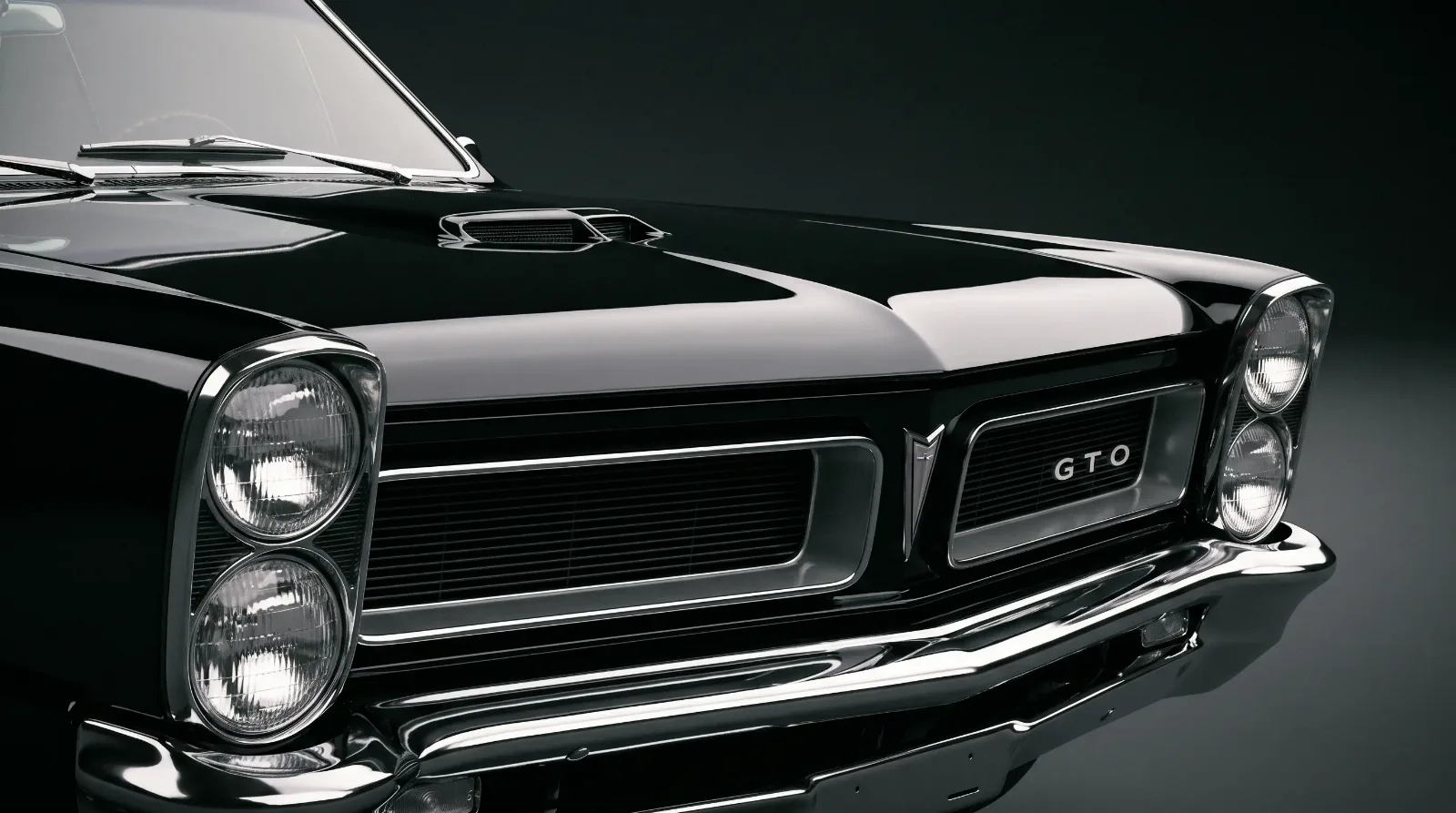
A running change year, not a redesign
Pontiac gave the full Tempest/LeMans/GTO line a substantial facelift for 1965 rather than an all-new body. The wheelbase and basic structure carried over from 1964, but the sheet metal, grille, and lighting were reworked enough that a 1965 GTO reads as a distinctly different car at a glance. This was standard Detroit practice in the mid-1960s: a new body every two or three years, with a heavy styling update in between to keep showroom traffic moving. GTO buyers in particular were young and style-conscious, and Pontiac's stylists under Bill Mitchell's GM umbrella understood that a fresh face mattered as much as another few horsepower.
This was also the last year the GTO existed purely as an option code on another car's order form before Pontiac spun it off as a model of its own for 1966. Everything discussed here, the styling, the running gear, the trim, has to be understood in that context: a $295.90 option box you checked on a Tempest or LeMans order, not a separate nameplate you walked up to on the lot.
Stacked headlights and the new face of the GTO
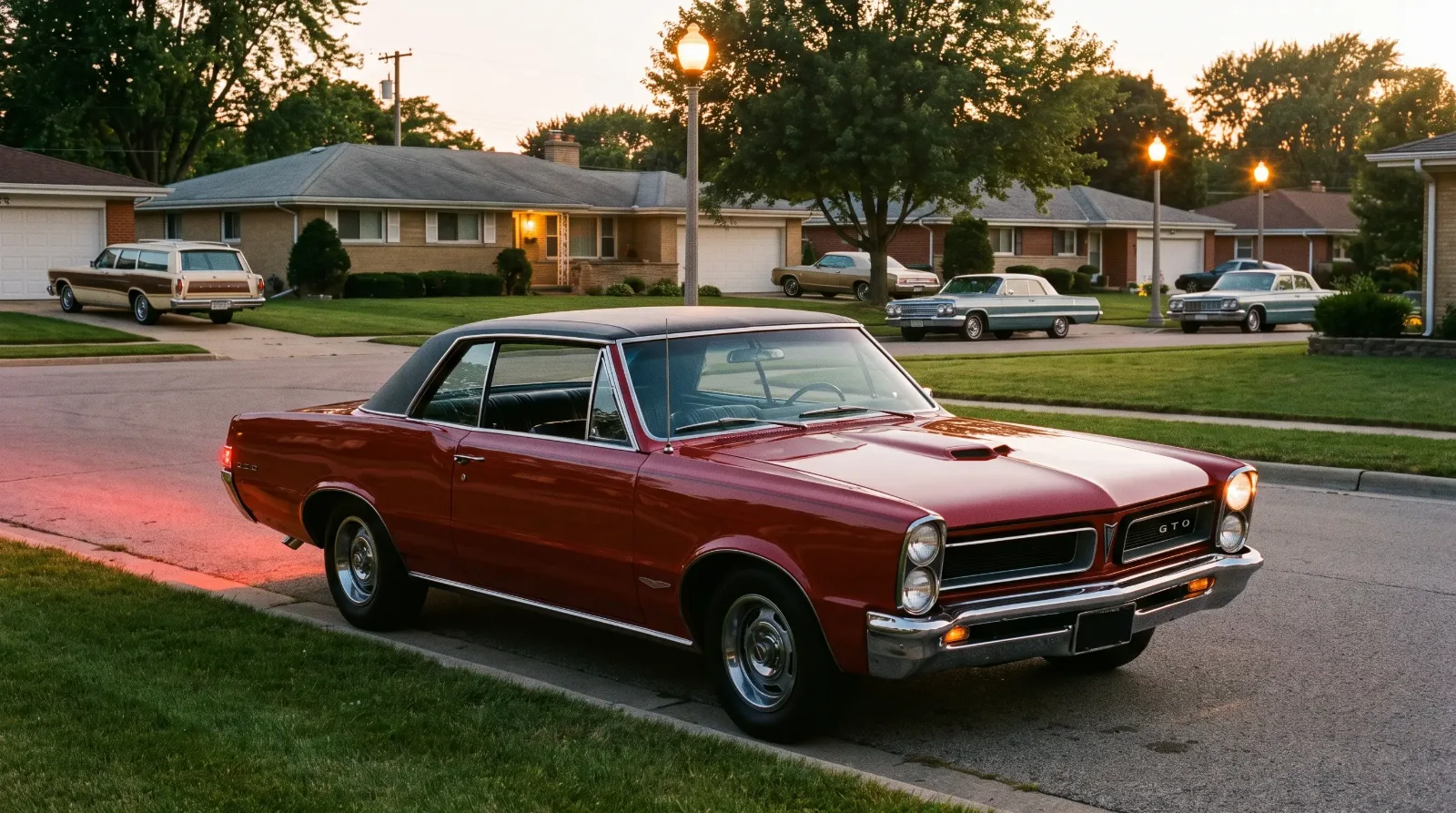
The most obvious change for 1965, and the one that gives this car its identity next to the single-headlight 1964, is the switch to stacked dual headlamps. Where the 1964 GTO ran one round headlight per side inside a fairly simple grille opening, the 1965 face stacked two lights vertically on each side, flanking a wider, more aggressive split grille. It gave the front end a taller, heavier look that suited the car's muscle-car reputation better than the comparatively plain 1964 face had.
The stacked-lamp treatment wasn't unique to the GTO. Pontiac used it across the full-size Catalina and Bonneville line as well, and it became something of a Pontiac signature through the back half of the 1960s. On the GTO specifically, it paired with a reworked hood, a more pronounced twin-scoop treatment, and vertical taillights out back to finish the update. The car also picked up a new dash layout with a full set of round gauges ahead of the driver, a detail GTO buyers noticed and appreciated after the more car-like instrument panel of 1964.
Under the hood: still the 389, still Tri-Power optional
Mechanically, 1965 was an evolution rather than a rewrite. The 389 cubic inch V8 carried over as the standard GTO engine, now rated at 335 hp with the standard four-barrel carburetor, a bump over the 325 hp rating for 1964. The Tri-Power option, three two-barrel carburetors on a factory aluminum intake, remained available and pushed output to 360 hp, making it the engine most enthusiasts point to when they talk about a "real" mid-60s Tri-Power GTO.
Transmission choices stayed familiar: a three-speed manual as standard, a wide-ratio four-speed Muncie as the enthusiast's pick, and a two-speed automatic for buyers who wanted the look without the clutch pedal. Suspension and brakes saw modest refinement rather than a leap forward, which is part of why period road testers treated the 1965 car as a sharper, more resolved version of 1964 rather than something new.
"People assume every big styling change on these cars came with a big mechanical change to match, but 1965 is a good reminder that Pontiac was perfectly happy to sell you the same drivetrain in a sharper suit. The engineering had already proven itself in 1964. What needed fixing was the way the car looked sitting next to a Chevelle SS on the showroom floor."
Tom Ramirez
| Spec | 1964 GTO | 1965 GTO |
|---|---|---|
| Headlights | Single round, per side | Stacked dual, per side |
| Grille | Simple split opening | Wider, more aggressive split grille |
| Hood | Mild twin scoop | More pronounced twin-scoop treatment |
| Instrument panel | Simpler, more car-like layout | Full round-gauge cluster |
| Base engine | 389 cu in, 4-bbl, 325 hp | 389 cu in, 4-bbl, 335 hp |
Production numbers and how 1965 fits the story
Sales tell the real story of 1965. After 32,450 units for the debut 1964 GTO, a number that surprised Pontiac's own sales planners, the option took off further in 1965 with production landing at 75,352 units. That growth is a big part of why GM's corporate brass stopped treating the GTO as a curiosity and let Pontiac spin it into a standalone model line for 1966, a move covered in detail in read on.
Body style availability stayed the same as 1964: hardtop coupe, pillared coupe, and convertible, with the hardtop taking the lion's share of orders. Paint and interior trim choices expanded slightly for 1965, and Pontiac continued to lean hard into the GTO's youth-market image in its advertising, a campaign strategy that becomes its own story a little later in this run.
Why the 1965 GTO gets overlooked
Ask a casual collector to picture a mid-60s GTO and they will usually describe the 1966 or 1967 car, the years that opened the Coke-bottle GTO years as a standalone model. The 1965 sits in an awkward spot in between: not the novelty of the 1964 original, not yet its own nameplate, and overshadowed by the more dramatic body that replaced it a year later. That's a shame, because the 1965 GTO is arguably the best-resolved version of the original Tempest-based formula, with the stacked headlights giving it real presence and the drivetrain fully sorted after a year of real-world feedback.
For collectors today, that obscurity translates into value. A well-documented 1965 GTO, particularly a Tri-Power hardtop or convertible, tends to sell for less than an equivalent 1966 or 1967 car despite comparable rarity and performance, simply because fewer buyers are actively hunting for it. If you want the full arc of how this option package became one of the most famous nameplates in American performance history, the Pontiac GTO story lays it out from the 1964 original through the end of the classic run in 1974. And if a 1965 has caught your eye specifically, you can browse GTO listings to see what's currently available.
Sources and notes
Related Reading
Have a
Pontiac GTO
for Sale?
Reach thousands of serious classic car collectors across the US.
Sell It Here →
Are You a Classic Car Dealer?
List your full inventory and connect with targeted classic car buyers.
Join as a Dealer →
#pontiac gto history
#gto tri-power
#1965 pontiac gto
#gto styling changes
#pontiac tempest gto
#classic muscle car

About the author
Tom Ramirez
Corvette researcher and historian based in Bowling Green, Kentucky. Two decades documenting Corvette production history from original factory records.
Related Listings - Pontiac GTO
Comments
Be the first to comment on this article.