
The 1965 vs 1966 Mustang question comes up every time one of these rolls into a shop, and the honest answer is that they are mostly the same car. Same 108 in wheelbase. Same body shell. Same hardtop, fastback and convertible. Same engine list, from the 200 six up to the 271 hp Hi-Po 289. Ford spent its 1966 money on details, which is great if you like puzzles and lousy if you are trying to date a car that somebody has been fixing for fifty years. Nearly every one of those details unbolts.
Car Features
7 min read
1965 vs 1966 Mustang: How to Tell Them Apart
Grille, side trim, gas cap, gauges and the VIN year digit: how to tell a 1965 Mustang from a 1966, and how to spot a 1964½.
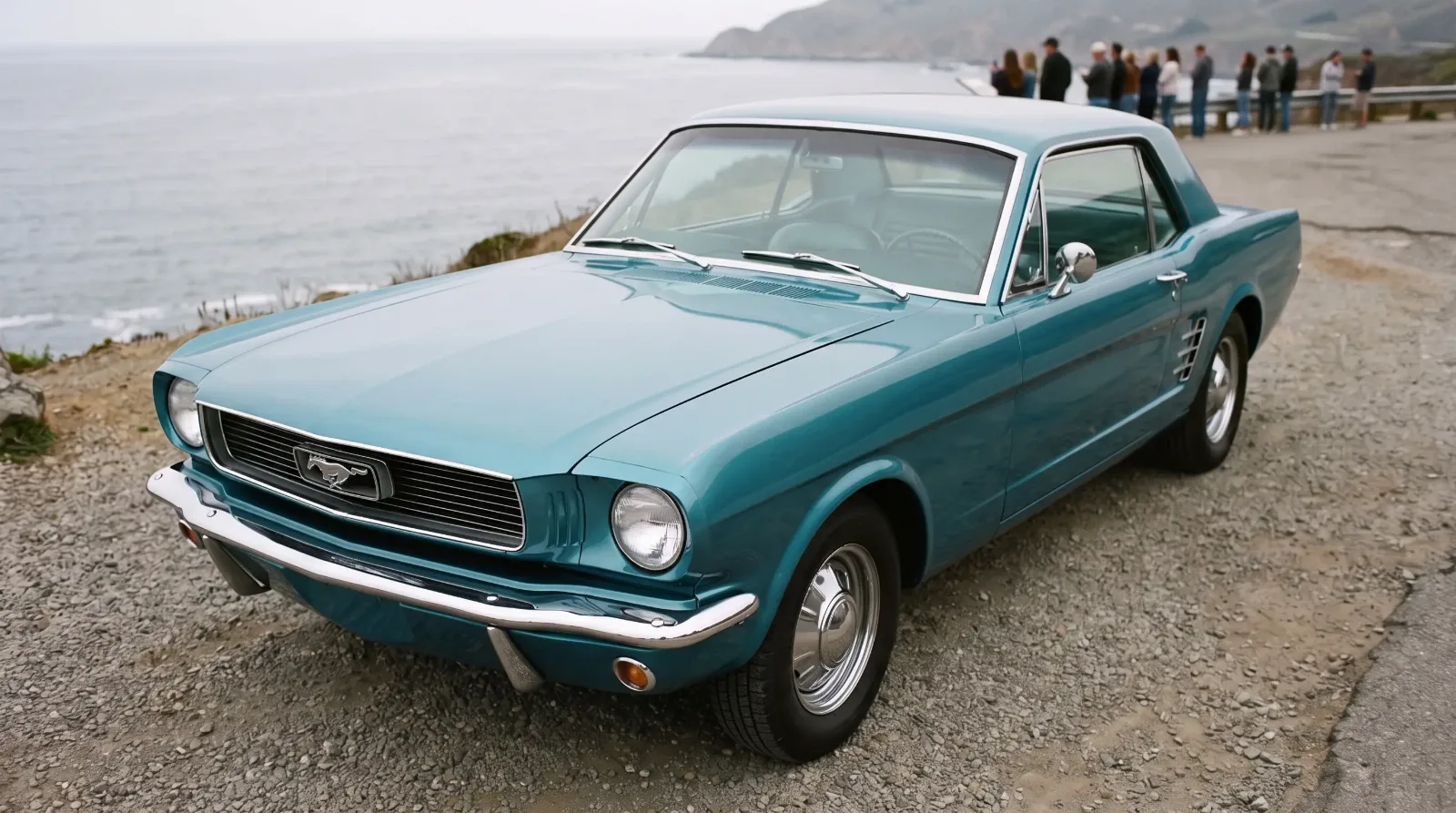
So here is the order I check things in, from the parts that get swapped most to the parts that almost never do. If you want the paperwork side in full, data plate and all, start with the guide to decoding a classic Mustang.
1965 vs 1966 Mustang: start at the grille, but don't trust it
The grille is the tell everybody knows. The 1965 has a honeycomb grille with horizontal bars running in from each side to the corral around the horse, four bars a side. For 1966 Ford went to a finer, slotted grille and took the bars out, so the horse and corral seem to float in the opening. From across a parking lot, that is the whole difference.
Now the bad news. A grille is a few screws and a weekend. I have seen plenty of 1965 cars wearing a 1966 grille because that is what the parts counter had, and the reverse too, usually because the owner liked the look of the bars. GT cars carry fog lamps in the grille in both years, so those don't settle anything either. Use the grille to make a guess. Then go prove it.
Side trim, gas cap and the small stuff
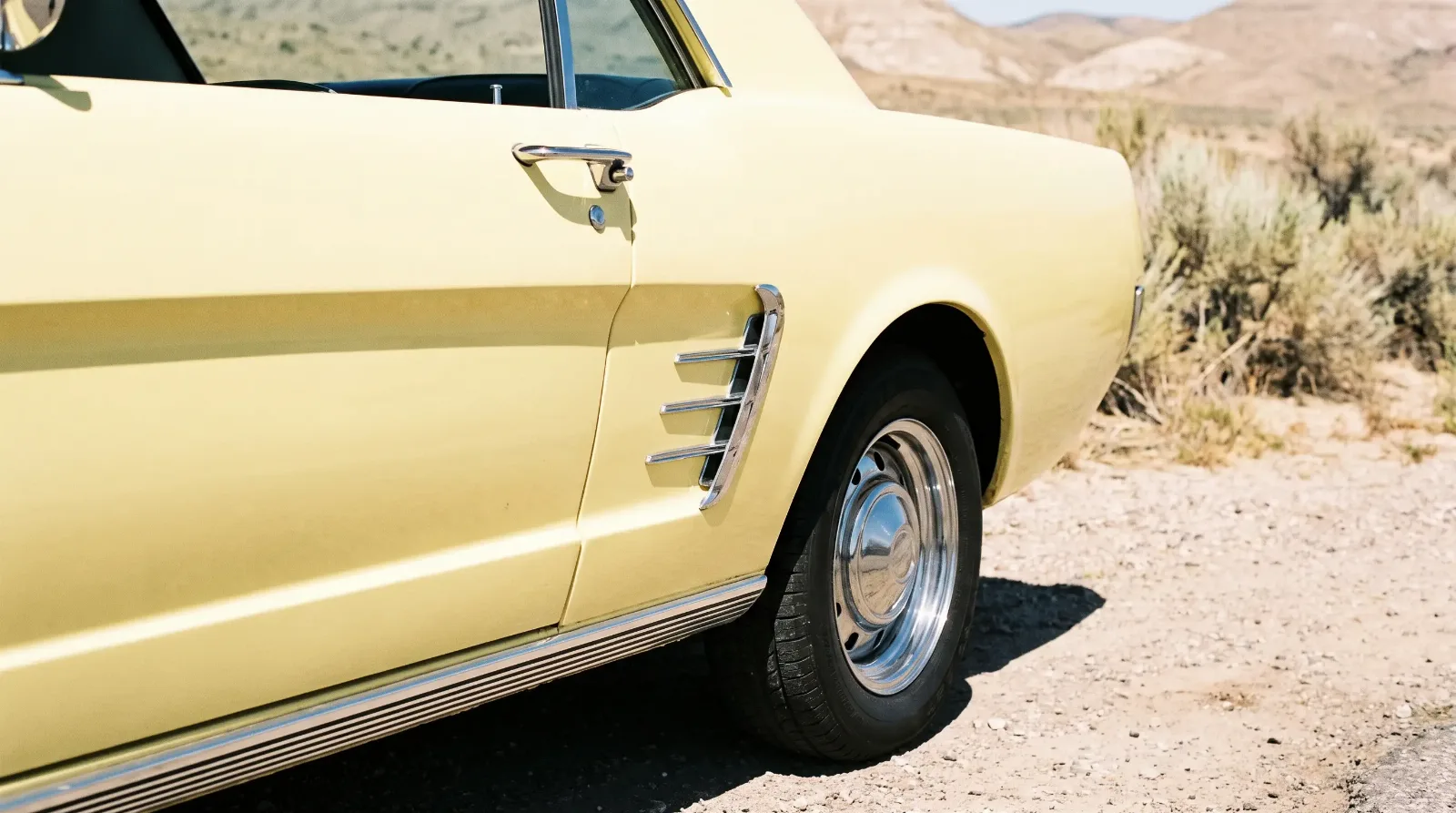
Walk down the side of the car. On a 1965 the scoop ahead of the rear wheel wears a single vertical chrome molding. The 1966 ornament is a horizontal piece with three bars, the one people call the three-bar. GT cars in both years skip that ornament and run a stripe along the rocker instead, so a GT with bare quarters is normal, not stripped.
The gas cap is a good second opinion. The 1965 cap has three notches around the edge and a recessed center logo. The 1966 cap has small ridges all the way around and a logo that stands proud of the surface, and the 1966 GT cap is marked GT. Caps walk off and get replaced, same as grilles, but a car with the right cap and the right side trim is starting to tell a consistent story.
A few more 1966 changes are worth knowing because they explain what you see. Back-up lights became standard in 1966; they were an option in 1965, so a 1965 with back-up lights is not wrong. Padded sun visors became standard too, and Ford brought in new wheel covers. The five-spoke styled steel wheel for V8 cars ran from 1965 through 1967, so it tells you nothing about this particular question.
Inside the car: the gauges settle most arguments
Open the door and look at the instrument cluster. This is the best cosmetic clue, because swapping a dash cluster is real work and most people don't bother. A standard 1965 has the Falcon-style cluster with a long horizontal sweep speedometer. For 1966 Ford made the five round dials standard on every Mustang.
There is one catch. Five dials were not new in 1966. They came on the 1965 GT and on cars with the Interior Decor Group, the luxury option the hobby calls the Pony interior for the running horses embossed on the seatbacks. Ford added that option partway through the 1965 model year. So the rule works one way only. A sweep cluster says 1965, unless somebody has been very busy. Five dials say 1966, or a 1965 GT, or a 1965 Pony car. Check for GT equipment and pony seats before you call it.
The Rally-Pac, the column-mounted tachometer and clock, was available in both years and was dropped after 1966, so it does not help you here either. The Pony interior also carried over into 1966; the embossed horses did not disappear until 1967.
"Don't date one of these by the grille. Date it by the tag and the dash, then figure out who changed the grille and why. Every one of these cars has a history, and the history is usually somebody's brother-in-law with a parts catalog."
Mike Sullivan
The VIN, the engines and the 1964½ problem
The VIN is where this stops being an opinion. The first digit is the model year: 5 for 1965, 6 for 1966. The plant letters are the same in both years (F for Dearborn, R for San Jose, T for Metuchen) and so are the body codes, 07 for the hardtop, 08 for the convertible and 09 for the fastback. That leaves the year digit as the only VIN difference, and it is stamped in places that are a lot harder to swap than a grille.
The engine letter in the VIN covers the same ground in both years: T for the 200 six at 120 hp, C for the 289 two-barrel at 200 hp, A for the 289 four-barrel at 225 hp, and K for the 271 hp Hi-Po. What changed for 1966 is that the Hi-Po could finally be ordered with the Cruise-O-Matic automatic. A K-code automatic claimed as a 1965 deserves a hard look, because Ford did not list that combination until 1966.
The real headache is the 1964½. Those early cars also carry a 5 as the year digit, so the VIN can't separate them from a 1965. The engine codes can: U for the 170 six, F for the 260 V8 and D for a 210 hp 289 four-barrel were 1964½ codes. Beyond that, look at the dash warning light, which reads GEN on the generator cars and ALT on the 1965 alternator cars. The 1964½ also has three extra battery vents in the core support, a hood with a skirt and no molding on the leading edge, and door lock knobs in body color instead of chrome. Parts got mixed at the changeover, so expect at least one cue to disagree. Sources also disagree on when the generator cars stopped: an RM Sotheby's catalog says the 1964½ cars were all built before July 31, 1964, while one club history gives August 17, 1964. One more thing: Marti Reports start with the 1967 model year, so for a 1965 or 1966 the car itself is most of the evidence you get.
How the two years compare on paper
Ford built 559,451 Mustangs for the 1965 model year, not counting the 1964½ cars, and 607,568 for 1966, the first generation's best regular-length model year. The mix shifted, too. The fastback fell by more than half, while GT sales rose by about 70 percent.
| Item | 1965 | 1966 |
|---|---|---|
| Grille | Honeycomb, four bars each side of the corral | Slotted, no bars, "floating" horse |
| Side ornament (non-GT) | Single vertical chrome molding | Horizontal three-bar molding |
| Standard instrument cluster | Falcon-style sweep speedometer | Five round dials |
| Back-up lights | Optional | Standard |
| VIN year digit | 5 (shared with 1964½) | 6 |
| Total production | 559,451 | 607,568 |
| Fastback production | 77,079 | 35,698 |
| Convertible production | 73,112 | 72,119 |
| GT Equipment Group sales | 15,079 | 25,517 |
| Base price, hardtop / fastback / convertible | $2,372 / $2,589 / $2,614 | $2,416 / $2,606 / $2,652 |
Those base prices barely moved, a few dozen dollars per body style. The 1966 convertible count was the best of any convertible sold in the United States that year. And 1966 was also the last year of the original fastback roof, which stops short of the tail, before the 1967 body arrived with a roof that ran all the way back. That restyle is where the first generation Mustang stops being a two-year spot-the-difference game. Later on, the same exercise gets harder: telling 1969 or 1970 apart involves headlamps, scoops and engines all at once.
Because Ford built more of them, 1966 Mustangs are the ones you will see more often at shows and in classified ads, and after fifty-plus years a fair number of them are wearing 1965 parts, and the other way around. That is fine. Just know which parts are which before you start telling people what year you are looking at.
Sources and notes
Related Reading
#1964 mustang
#1965 mustang
#mustang identification
#Ford Mustang
#first generation Mustang
#1966 Mustang

About the author
Mike Sullivan
Detroit-area muscle car enthusiast and restoration specialist with three decades of hands-on experience working on American iron.
Related Listings - Ford Mustang




Comments
Be the first to comment on this article.