
Ask ten people on a show field how many Mustang generations Ford built before 2000 and you will hear four, five, sometimes seven. The disagreement is honest. Ford sold one continuous nameplate from the April 17, 1964 launch at the New York World's Fair onward, but it reworked the car so often that the hobby has cut the years into sections that do not always match the factory's own platforms. What follows is the method I use when a car rolls past and I have about three seconds to place it: proportions first, then the nose, then the tail.
Car Features
7 min read
How to Tell Every Classic Mustang Generation Apart, 1964½–2000
Wheelbase, length, headlamps and taillights: a quick way to place any Mustang from 1964½ to 2000, from the first cars to the New Edge.
The people and the sales figures belong in the story of the classic Mustang. This piece is only about recognition, with a few paperwork clues for the cases where sheet metal is not enough.
How the Mustang generations break down
By platform, there are four classic Mustangs. The first generation ran from 1964½ through 1973 on a 108 in wheelbase that grew to 109 in for 1971. The Mustang II covered the 1974 to 1978 model years on a 96.2 in wheelbase derived from the Pinto. The Fox Body followed for 1979 and lasted until the last one was built on August 26, 1993. The SN95, Ford's internal code for the 1994 car, rode an updated Fox platform the engineers called Fox-4 and carried the name to the end of the century.
The complication is the first generation, which changed shape three times in nine model years. Ford never published a tidy generation chart, so the split below is the hobby's convention, not a factory document.
| Era | Model years | Wheelbase | Length | Fastest visual tell |
|---|---|---|---|---|
| First generation, early | 1964½ to 1966 | 108 in | 181.6 in | Short overhangs, horse inside a grille corral |
| First generation, 1967 body | 1967 to 1968 | 108 in | 183.6 in | Wider body, concave taillight panel |
| First generation, 1969 body | 1969 to 1970 | 108 in | 187.4 in (1969) | Four headlamps (1969) or two with side intakes (1970) |
| First generation, big body | 1971 to 1973 | 109 in | 189.5 in | Long flat hood, nearly flat SportsRoof glass |
| Mustang II | 1974 to 1978 | 96.2 in | 175.0 in | Compact notchback or three-door hatchback |
| Fox Body | 1979 to 1993 | 100.5 in | 179.6 in (1979) | Square, upright lines, no horse on the outside |
| SN95 | 1994 to 1998 | 101.3 in | 181.5 in | Rounded body, horse back in the grille |
| SN95, New Edge | 1999 to 2000 | 101.3 in | 183.2 in | Same car with sharp creases and flat planes |
Wheelbase tells you the platform. Length tells you where inside the first generation a car belongs. The sections below turn those numbers into things you can see from the curb.
The first generation in four faces
The early cars, 1964½ through 1966, are the smallest: short deck, long hood, a running horse in the chrome grille corral. The 1964½ cars and the 1965 cars share the same year digit, a 5, in the VIN. The quickest separator I know is the dash warning light, which reads GEN on the generator-equipped 1964½ cars and ALT on the 1965 models. Telling 1965 or 1966 is its own exercise, and it starts at the grille: honeycomb with horizontal bars running to the horse on the 1965, a finer slotted grille with a "floating" horse on the 1966.
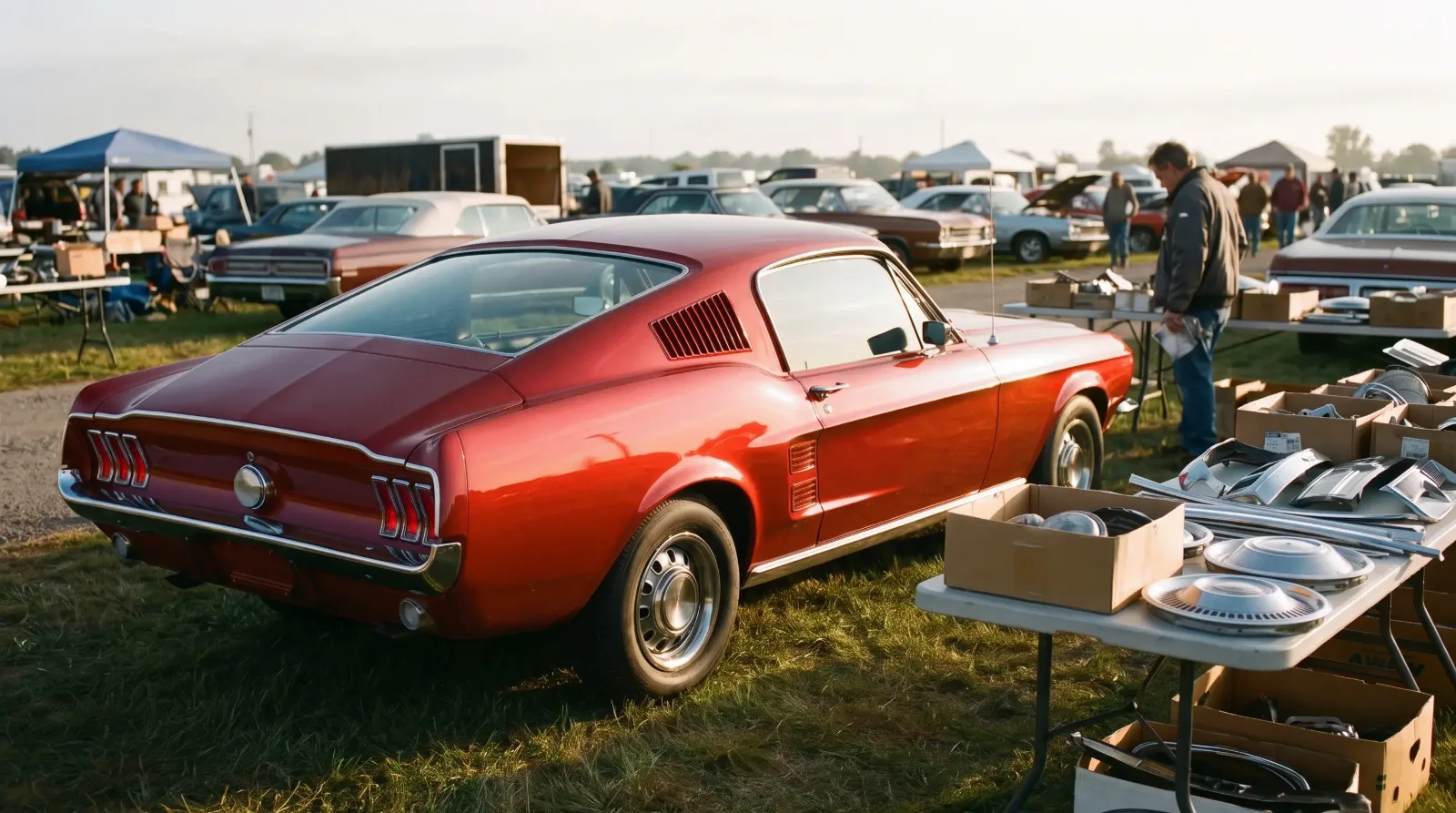
The 1967 restyle kept the 108 in wheelbase but added 2.0 in of length and 2.7 in of width, mostly so a big-block V8 would fit. The 1966 taillight lenses are convex; from 1967 the lenses and the panel around them are concave. The fastback roof now ran all the way to the tail, and side scoops sat ahead of the rear wheels. Separating 1967 from 1968 is a matter of small parts: the 1968 car added side marker lights front and rear, lost the FORD lettering on the hood, and traded the 1967 grille's horizontal crossbar for a bright halo ring around the opening.
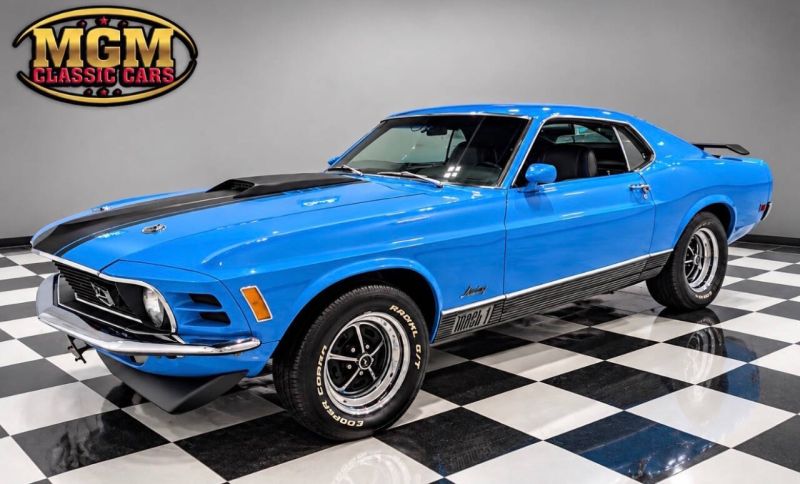
The 1969 car grew another 3.8 in and is the easiest to name from a distance. It is the only year with four headlamps, two inside the grille opening and two outside it, and the pony and tri-bar emblem moved off center to the driver's side. Ford literature also renamed the fastback the SportsRoof that year. For 1970 the outer lamps gave way to simulated intakes, leaving two headlamps inside the grille, the pony moved back to the center, the rear quarter scoops disappeared and the concave tail gave way to a flat panel with recessed lamps.
Then came 1971. The wheelbase went to 109 in, the length to 189.5 in and the width to 74.1 in. Against an early hardtop that is 7.9 in more length and 5.9 in more width, and base curb weight went from 2,445 lb to 3,560 lb. The SportsRoof rear glass lies so flat that you see mostly roof from the side. Some call these a separate generation. By platform they are the first-generation car at its largest.
"Most of the misidentified Mustangs I see are not fakes. They are honest cars wearing a grille or a set of taillights from the year next door, because the parts bolt right on. Read the body first and the trim second. The body is much harder to change."
Tom Ramirez
Mustang II, 1974 to 1978: the small one
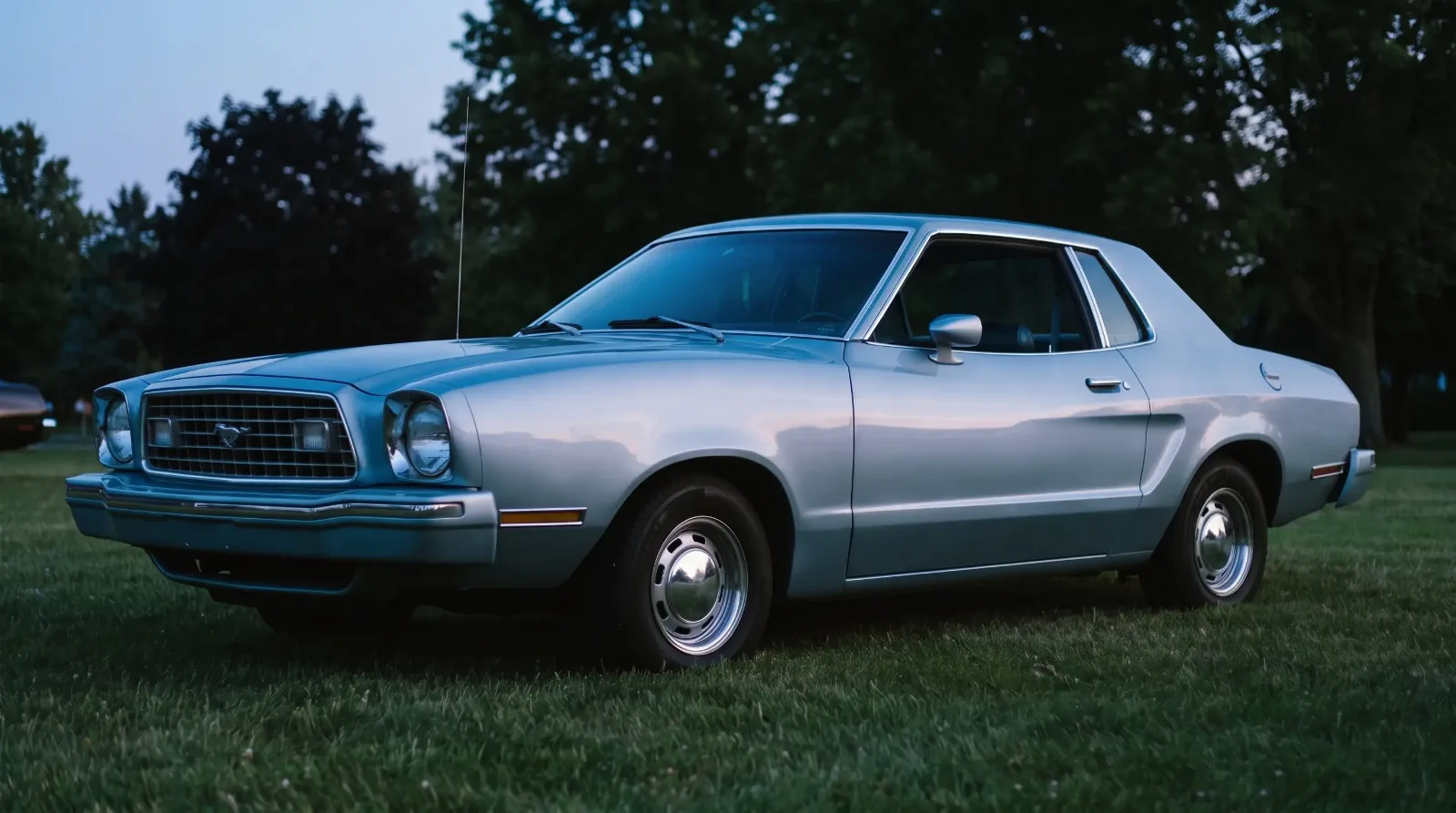
The Mustang II went on sale on September 21, 1973, and it is roughly 19 in shorter than the 1973 car it replaced. Ford offered two shapes: a two-door notchback and a three-door hatchback, with no factory convertible. A running horse still stood in the grille, and the sculpted side scoop molded into the flanks came from the Ghia studio's proposal.
Within the generation, look at the front end. The 1974 car had no V8 in the United States, only the 2.3 four and the 2.8 V6. When the 302 returned for 1975, Ford reworked the fenders, engine bay and header panel to fit it, and every Mustang II from then on has a thinner grille opening with a shallower grille. On the hatchback, a Cobra II (1976 to 1978) adds stripes, spoilers and quarter-window louvers.
Fox Body, 1979 to 1993: square lines and two noses
The 1979 Mustang, designed under Jack Telnack, shares its platform with the 1978 Fairmont and Zephyr and stretches the wheelbase to 100.5 in. The lines are upright and square, and no running horse appears on the outside for the whole Fox run. Ford put a Blue Oval on the exterior starting in 1983, a Mustang first. The body styles are a notchback and a hatchback, joined in 1983 by a convertible, the first Mustang convertible since 1973.
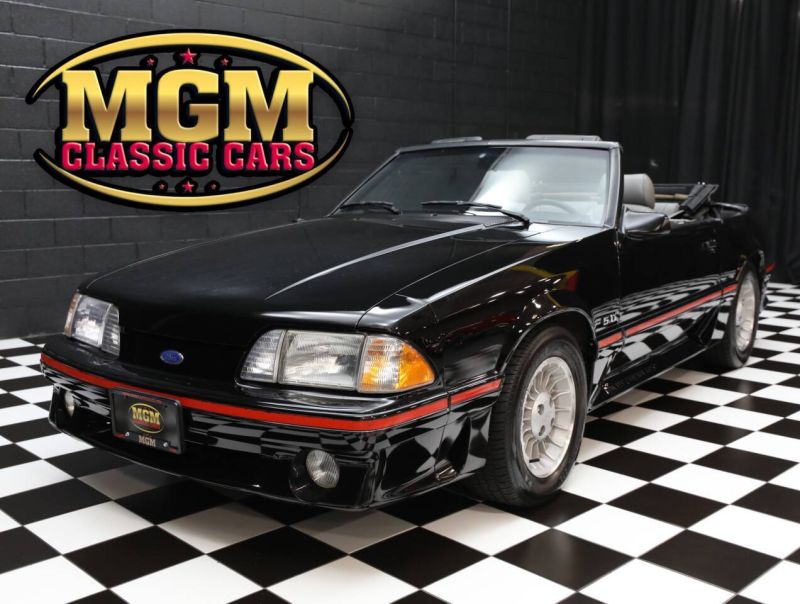
The Fox Body has two noses. From 1979 through 1986 the regular cars wear four rectangular sealed-beam headlamps, two on each side, the layout owners call the four-eye. The 1985 cars added a grille-less nose with a slot intake, and the 1985½ SVO got flush composite aero headlamps first. For 1987, announced in August 1986, the whole line moved to an SVO-style aero nose with a new dash. GT models of that era also wear ground effects and louvered taillights that owners nicknamed the cheese grater, plus 15 in turbine wheels through 1990. The full arc of the car is in the Fox Body story.
SN95, 1994 to 2000: the horse comes back
Production of the SN95 began on October 15, 1993, on a 101.3 in wheelbase. Ford dropped both the notchback and the hatchback, leaving a single coupe roofline and a convertible. Program manager Will Boddie set the goal of a car "recognizable as a Mustang, even without the badging," and the team used heritage cues: the running horse back in the grille, C-shaped side scoops and three-element taillights.
Inside the generation, the taillights date the car. The 1994 and 1995 lamps run horizontally; from 1996 they stand vertically, and the grille became a honeycomb the same year. Under the hood the GT changed engines at the same point, from the 5.0 pushrod V8 through 1995 to the 4.6 SOHC Modular from 1996. The 1999 New Edge restyle, built from November 1998, kept the platform but replaced the soft curves with sharp creases and grew the car to 183.2 in long and 73.1 in wide.
The SN95 was built until May 10, 2004, but the classic story ends here. After the generation come the year, the plant and the original engine, which is the work of a classic Mustang VIN decoder and the data plate. For practice, the classic Mustangs for sale in any given week cover most of these shapes. Try naming the year from the photos before you read the description. The descriptions are not always right.
Sources and notes
Related Reading

#mustang identification
#Ford Mustang
#first generation Mustang
#fox body mustang
#mustang ii
#SN95 Mustang
#Mustang generations

About the author
Tom Ramirez
Corvette researcher and historian based in Bowling Green, Kentucky. Two decades documenting Corvette production history from original factory records.
Related Listings - Ford Mustang




Comments
Be the first to comment on this article.