
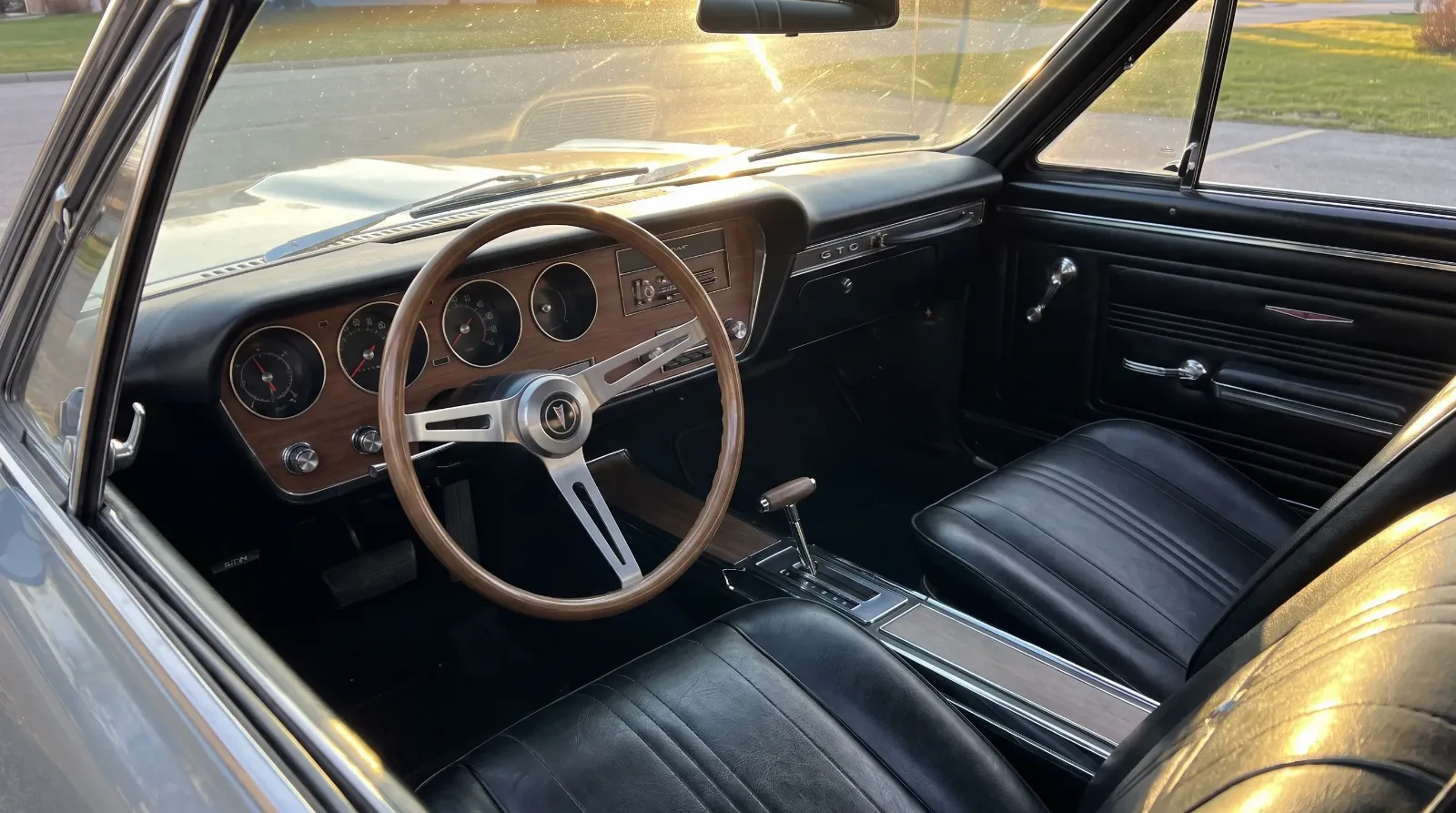
Ask a collector what makes a 1966-67 GTO genuinely special, and you will hear plenty about the Coke-bottle body and the engine options. What you will hear less about, and what actually moves the needle when a serious buyer is deciding between two similar cars, is the interior. An original, unmolested cabin from this era is quietly one of the harder things to find in this hobby, and the market has started to price that scarcity in.
Car Features
7 min read
Why Collectors Chase Original 1966-67 GTO Interiors
Original cabins from the 1966-67 GTO are harder to find than clean bodywork, and documented originality now commands a real collector premium.
What made the interior worth having in the first place
Pontiac positioned the GTO as a performance car with genuine cabin ambition, not a stripped-out econobox with a big engine bolted in. Bucket seats were standard, a deliberate signal that this was a driver's car, and the options list let a buyer dress the interior up considerably beyond that baseline: a console-mounted shifter for four-speed and automatic cars alike, simulated wood-grain trim on the dash and wheel, and a full instrumentation package that put real gauges in front of the driver instead of idiot lights. None of that was unique to the GTO in isolation, but the combination, applied to a genuinely quick car, was part of what separated the GTO from cheaper performance-adjacent competitors.
The seat design itself deserves more credit than it usually gets. Pontiac's bucket seats in this era had genuine lateral bolstering, not a lot by later standards, but enough that a driver working the wheel hard through a corner actually felt held in place rather than sliding across a flat bench. That detail mattered to the kind of buyer the GTO was chasing, somebody who wanted the car to feel like a driver's tool even when it was doing ordinary errands most of the week.
Why original condition is so hard to find
Interiors take abuse in ways sheet metal often does not. Vinyl and cloth dry out, crack, and fade under sun exposure over decades. Door panels warp. Dash pads split, particularly on cars that spent years parked outdoors without a garage. And because these cars were bought to be driven hard by young owners in period, a lot of original interiors simply wore out under normal use long before anyone thought to preserve them. By the time the collector market matured enough to value originality over a fresh reupholster job, a huge share of the surviving population had already been redone, sometimes correctly, often not.
Climate is a bigger factor here than most sellers acknowledge upfront. A GTO that spent its life in Arizona or a similarly dry climate has a real shot at retaining an original interior in presentable condition, while a car from the humid Southeast or the salt-belt Midwest almost never does, regardless of how well it was otherwise cared for. When you see an original-interior claim on a car with a documented Northern or coastal history, that claim deserves more scrutiny, not less, simply because the physical odds run against it.
| Detail | Notes |
|---|---|
| Standard seating | Bucket seats, front |
| Common upgrades | Console shifter, wood-grain trim, full instrumentation |
| Primary wear points | Seat vinyl/cloth, dash pad, door panels |
| Climate risk factor | Sun/heat cracks vinyl and dash pads; humidity accelerates rot and mildew |
| Originality premium | Documented factory-original cabins draw the strongest collector interest |
How this plays into value
Here is the honest appraisal: two mechanically identical 1966-67 GTOs, same engine, same transmission, same color, can land in very different price brackets once interior condition and originality enter the conversation. A car with its factory-original seats, dash, and door panels intact, even if worn, often outperforms a beautifully redone but non-original interior in the eyes of a documentation-focused buyer. That is a real reversal of how most people think about condition, where "fresh and clean" usually beats "worn but real." In this specific corner of the hobby, worn but real frequently wins, provided the wear is not so severe it threatens the car's structure or usability.
The gap widens further at the top of the market. On a well-documented, numbers-matching example already commanding strong money for its engine and body condition, an untouched original interior can add a meaningful percentage on top of what a comparable car with a redone cabin would bring. That premium is not really about the seats themselves, cloth and vinyl are replaceable at reasonable cost. It is about what an original interior tells a buyer regarding the rest of the car's history: a cabin nobody felt the need to touch is often a signal that nothing else major needed touching either.
"I have seen buyers pay more for a GTO with a tired original interior than for one with a flawless reproduction. Once you understand what you are actually buying, that stops being surprising."
Marcus Feld
What to check before you buy
If originality matters to you, or to the next buyer down the line, look past the obvious cosmetic condition and check details that are harder to fake convincingly: stitching patterns on seat upholstery, correct date codes or casting marks on interior hardware where applicable, and consistency between the interior color and the car's factory build documentation. A seller who cannot produce paperwork supporting an "all original interior" claim is not necessarily lying, but the burden of proof shifts, and pricing should reflect that uncertainty.
Interior originality connects to a broader authenticity question that runs through this entire model, one that started well before the Coke-bottle years with the car's earlier stacked-headlight design. That earlier chapter of the GTO's identity, and how collectors evaluate cars from that period, deserves its own look, so read on.
What restoration actually costs to get right
Anyone weighing whether to restore versus preserve should go in with realistic numbers. A full correct interior redo on a 1966-67 GTO, seats, door panels, dash pad, carpet, and headliner, done with quality reproduction parts and professional installation, runs into real money once labor is added on top of parts cost. That expense is part of why a car with a salvageable original interior often makes more financial sense to preserve carefully than to replace outright, even when the original material looks tired. A skilled upholsterer can often clean, condition, and stabilize original vinyl and cloth that looks past saving to an untrained eye, at a fraction of the cost of a full reproduction interior.
The takeaway for buyers
An interior does not photograph the way a fresh coat of paint does, and it rarely gets top billing in a for-sale listing. But for anyone shopping the classic Coke-bottle era of the GTO with an eye toward long-term value, the cabin deserves at least as much scrutiny as the engine bay. It is, quietly, one of the clearest signals of a car's honesty.
Sources and notes
Related Reading
Have a
Pontiac GTO
for Sale?
Reach thousands of serious classic car collectors across the US.
Sell It Here →
Selling a classic? Here's how: compare the places to sell classic cars
Are You a Classic Car Dealer?
List your full inventory and connect with targeted classic car buyers.
Join as a Dealer →

About the author
Marcus Feld
Accredited collector-car appraiser who reads the market through hammer prices, condition tiers and risk.
Related Listings - Pontiac GTO

Comments
Be the first to comment on this article.