
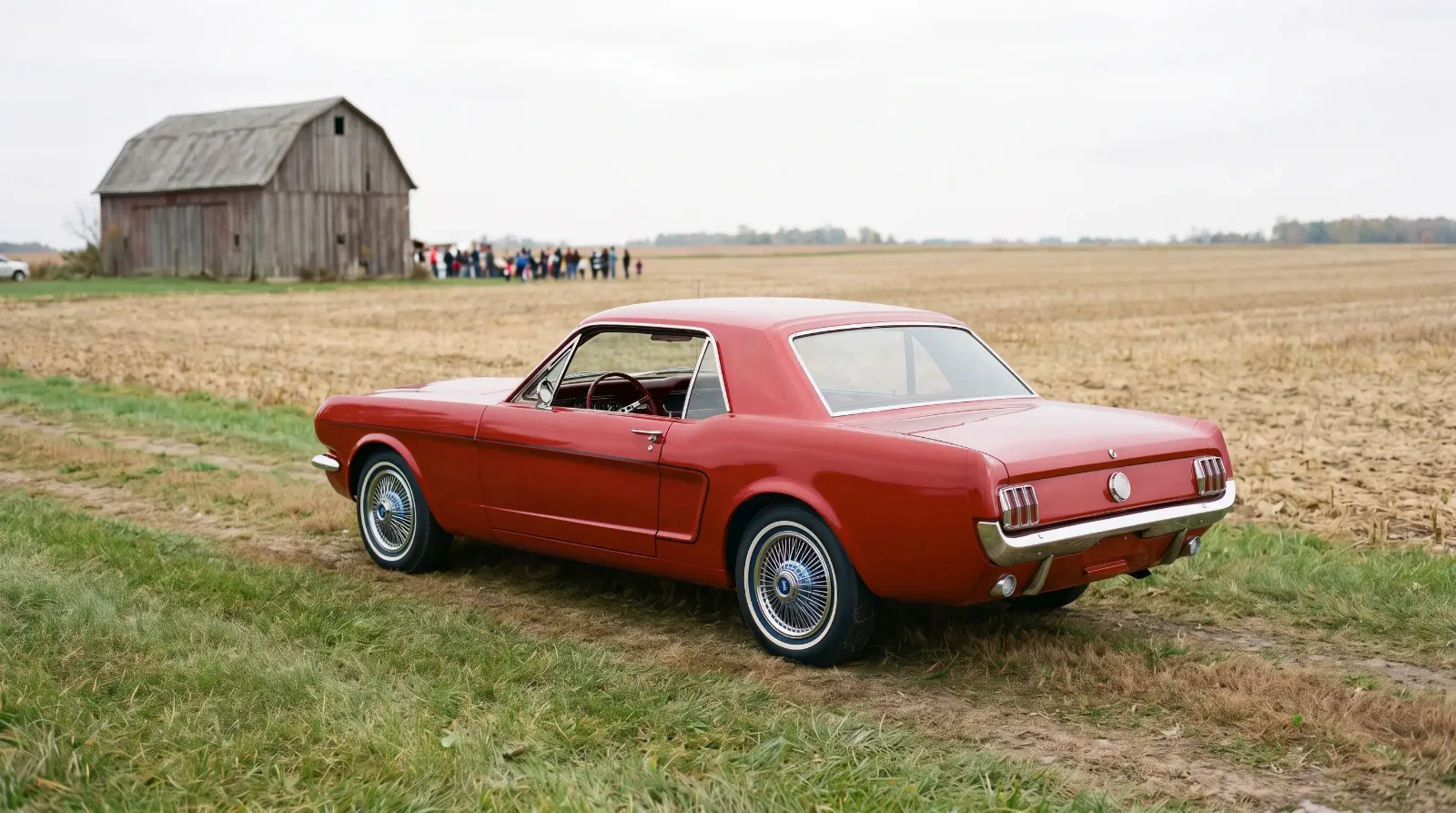
Ford built 607,568 Mustangs for the 1966 model year. Start there, because almost everything in 1966 Mustang history hangs off that one figure: the production record, the millionth car, the six-cylinder coupes that filled the order books, and the slide that began the very next season. The car itself changed very little from the 1965. What changed was the scale. By the end of 1966 the Mustang was no longer a novelty. It was simply what a huge share of Americans were buying.
Car Features
8 min read
The 1966 Mustang: The Record Year and the Millionth Car
607,568 cars, the millionth Mustang and the trade for Serial Number One: what the factory records say about the first generation's biggest year.
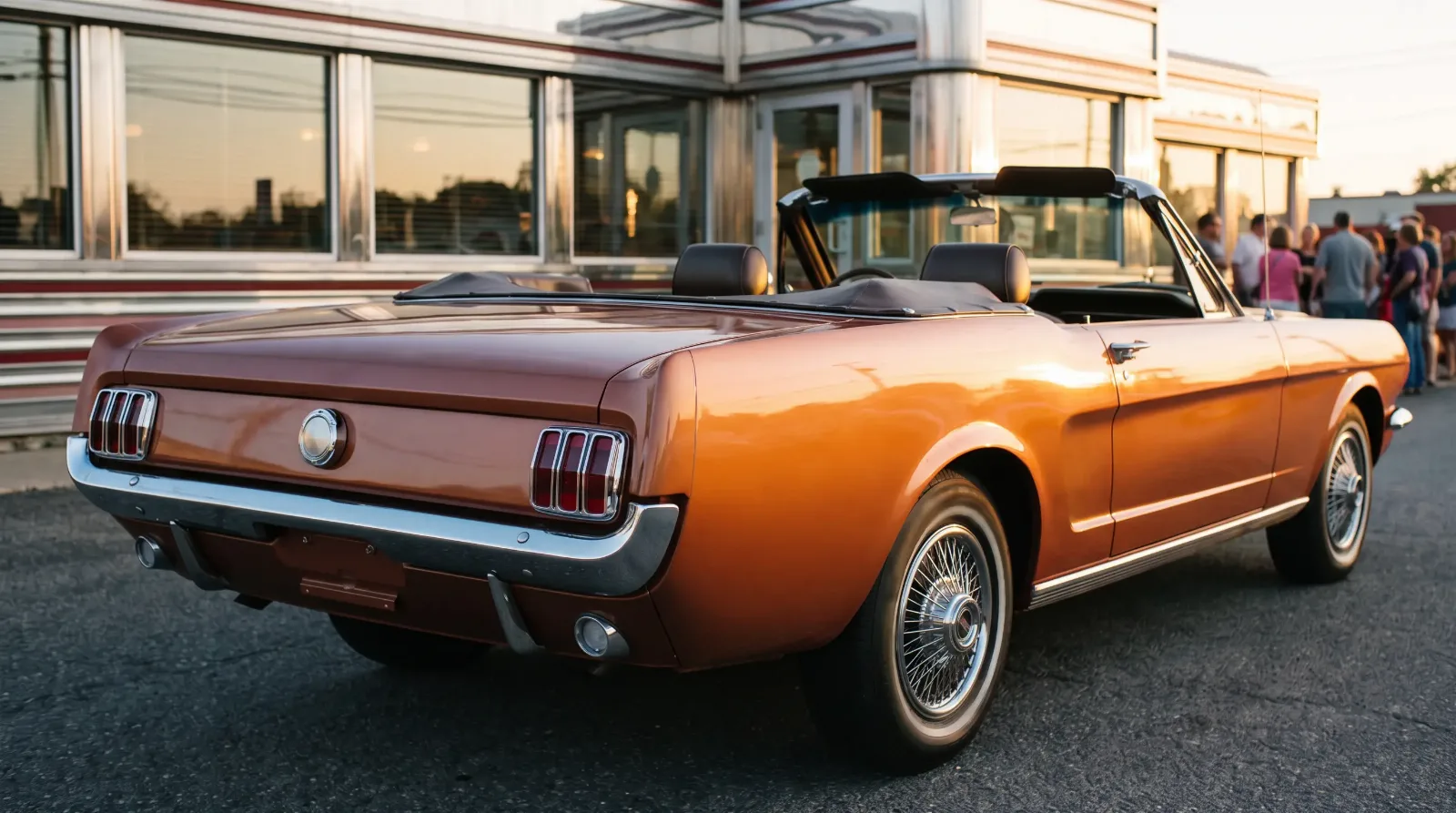
The full arc of the original Mustang years is a longer story, told in its own place. This one stays inside a single model year, and mostly inside the production records, because that is where the 1966 car explains itself best.
1966 Mustang history in one number
Here is how the 607,568 cars broke down, set against the base prices Ford charged that year and the year before. The prices moved a little. The volume moved a lot.
| Body style | 1966 production | 1966 base price | 1965 base price |
|---|---|---|---|
| Hardtop | 499,751 | $2,416 | $2,372 |
| Convertible | 72,119 | $2,652 | $2,614 |
| Fastback (2+2) | 35,698 | $2,606 | $2,589 |
| Total | 607,568 |
The hardtop did the heavy lifting. Of those 499,751 hardtops, 422,416 were standard cars, 21,397 had the bench seat and 55,938 had the luxury interior, the one people call the pony interior and Ford called the Interior Decor Group. Put another way, better than eight Mustangs in ten built for 1966 were hardtops. The fastback went the other way. Ford built 77,079 of them for 1965 and fewer than half that number for 1966, which tells you the 2+2 roof was still a niche taste at that point. The convertible held almost level, 72,119 against 73,112 the year before.
Calendar 1966 is a separate count from the model year, and I have not seen a calendar-year production total for it that I trust. What the sources do agree on is the market picture: the Mustang took about 7.1% of all US car sales in calendar 1966. One nameplate, one basic body, roughly one new car in fourteen.
Now the honest caveat on the word "record." The first Mustang run, which started on March 9, 1964 and included the 1964½ cars, reached almost 681,000 before it closed. That beats 1966. But that first run was far longer than a normal model year, and Ford titled every one of those cars as a 1965. Measured as an ordinary model year, 1966 is the biggest the first generation ever had, and Ford never built that many Mustangs in a single model year again. The closest any later year came was 1967, at 472,121, followed by the first Mustang II year, 1974, at 385,993. Both statements are true at once, and you will see people quote whichever one suits their argument.
What Ford changed for 1966, and what it left alone
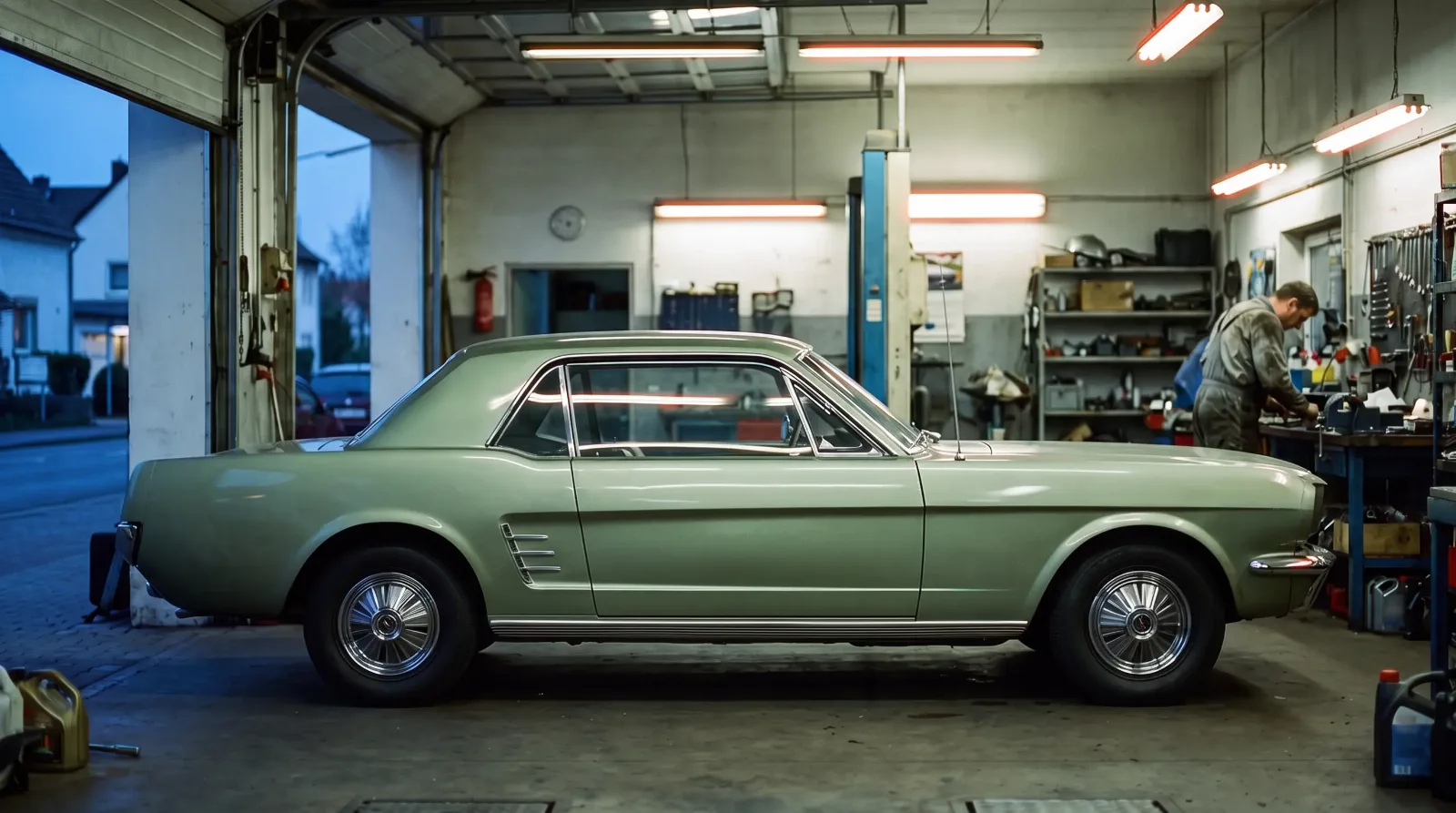
Ford did not need to touch a car that was selling this well, and mostly it didn't. For the background on how the lineup settled after the 1964½ cars, read the 1965 model-year story first. Everything there still applies: same 108-inch wheelbase, same three bodies, same engine list from the 200 six to the 271 hp Hi-Po 289.
The 1966 changes were detail work. A slotted grille with no bars, so the horse and corral appear to float. A horizontal three-bar ornament on the side scoop. The five-dial instrument cluster, which in 1965 came only with the GT package or the Interior Decor Group, became standard. Back-up lights and padded sun visors became standard too. And the 271 hp Hi-Po could now be ordered with the Cruise-O-Matic automatic, which widened its market well beyond the four-speed crowd. None of it was expensive, and none of it slowed the line. A factory running flat out does not want new tooling, and in 1966 it largely did not get any.
The millionth Mustang and the trade for car number one
Ford's own history puts the one millionth Mustang off the line at Dearborn Assembly on March 2, 1966. That was less than two years after the public introduction at the New York World's Fair on April 17, 1964. The three plants building Mustangs, Dearborn in Michigan, San Jose in California and Metuchen in New Jersey, had turned out almost 1.3 million cars by the end of those first two years.
The millionth car is tied to the story of the first one. Serial number 5F08F100001 was a Wimbledon White convertible, a pre-production car built at the Rouge between February 10 and March 5, 1964. It ended up at George Parsons Ford in St. John's, Newfoundland, and on April 14, 1964 it was sold to Captain Stanley Tucker, a 33-year-old pilot with Eastern Provincial Airlines. In early 1966 Ford wanted that car back. The offer was the One Millionth Mustang, built to Tucker's own specification, in exchange for Serial Number One. Tucker accepted. On March 2, 1966 he was in Dearborn, met Lee Iacocca, and drove away in a new 1966 convertible. Ford then donated car number one to The Henry Ford, which owns it today.
Here is where the records get thin, and I would rather say so than smooth it over. Popular accounts of the March 2 event describe a white convertible. The Henry Ford, which owns car number one and holds the paperwork on the trade, describes Tucker's car as Silver Frost. It is quite possible the car in the ceremony photographs and the car built to Tucker's order were two different vehicles. I have also never seen a document that settles which plant built Tucker's car. Until someone produces a build record, the millionth Mustang stays a milestone with a slightly blurry car attached to it.
"The millionth Mustang is a perfect example of how the hobby works. Everyone knows the date. Almost nobody can tell you the paint code with a document in hand. When the museum and the press release disagree, I go with whoever holds the paper."
Tom Ramirez
Sixes, V8s and the buyers who filled the order book
The 1966 record was not built on V8s alone, and this is the part of the year that gets forgotten. Of the 607,568 cars, about 253,200 had the six and about 354,400 had a V8. That is roughly 41.7% sixes. The standard engine was the 200 cubic-inch T-code six at 120 gross horsepower, and for a buyer watching the monthly payment it made complete sense. Stepping up to the 200 hp two-barrel 289 cost $105.63. The 225 hp four-barrel 289 cost $158.48. The 271 hp Hi-Po was $433.55, or $381.97 on a car already ordered with the GT package. Cruise-O-Matic on a six added $175.80.
The GT Equipment Group found its audience in 1966, its first full year. Ford sold 25,517 GT packages for 1966 against 15,079 the year before. At the other end of the market, Ford ran out of something it could not build fast enough. It was short of 289 V8s, and weak Falcon sales had left it holding surplus 200 sixes. The answer was a dressed-up six-cylinder Mustang sold during the mid-year "Million Mustang Sale," and the Sprint 200 has its own full write-up for that reason. A parts shortage, turned into a sale named after a production milestone.
The fringes were busy too. Shelby's 1966 GT350 softened into a more livable street car that year, and Hertz put about 1,000 GT350H fastbacks into its rental fleet. Those cars are famous, but in the context of 607,568 they are a rounding error. The 1966 Mustang was mostly a hardtop with a six or a two-barrel 289, bought new by someone who drove it to work.
Why 1966 was the high-water mark
For 1967 Ford brought out a larger, restyled Mustang, and production fell to 472,121. The drop is usually laid at the door of the new Chevrolet Camaro and Pontiac Firebird, which finally gave GM buyers a pony car of their own. That explanation is reasonable, and the timing fits. The Mustang did not lose its buyers to a bad car. It lost its monopoly.
That is what makes 1966 such a clean year to study. It is the last season when the Mustang had the market more or less to itself, the last year of the original body before the redesign, and the year the production figures peaked. A car that sold 607,568 copies also means survivors are relatively plentiful today, and the documentation trail, from data plates to dealer invoices, is deep. Look through the surviving 1966 Mustangs for sale and a large share of them are exactly what the records predict: hardtops, many with the six, many with the two-barrel 289. The production figures are a good reality check on what was common in 1966 and what was not.
The car barely changed in 1966. Its place in the market did, and the factory figures from that year are still the best record of how big the first pony car really got.
Sources and notes
- The Henry Ford: Stanley Tucker and Ford Mustang Serial Number One
- MustangSpecs: 1966 Ford Mustang production numbers
- Conceptcarz: 1966 Ford Mustang production by body style
- Over-Drive Magazine: 1966 Ford Mustang fact sheet
- Wikipedia: Ford Mustang (first generation)
- Wikipedia: Ford Mustang, production and sales by year
Related Reading
Have a
Ford Mustang
for Sale?
Reach thousands of serious classic car collectors across the US.
Sell It Here →
Selling a classic? Here's how: where to sell your classic car online
Are You a Classic Car Dealer?
List your full inventory and connect with targeted classic car buyers.
Join as a Dealer →
#Ford Mustang
#first generation Mustang
#mustang production numbers
#mustang gt
#1966 Mustang
#classic Mustang history
#millionth Mustang

About the author
Tom Ramirez
Corvette researcher and historian based in Bowling Green, Kentucky. Two decades documenting Corvette production history from original factory records.
Related Listings - Ford Mustang
Comments
Be the first to comment on this article.