
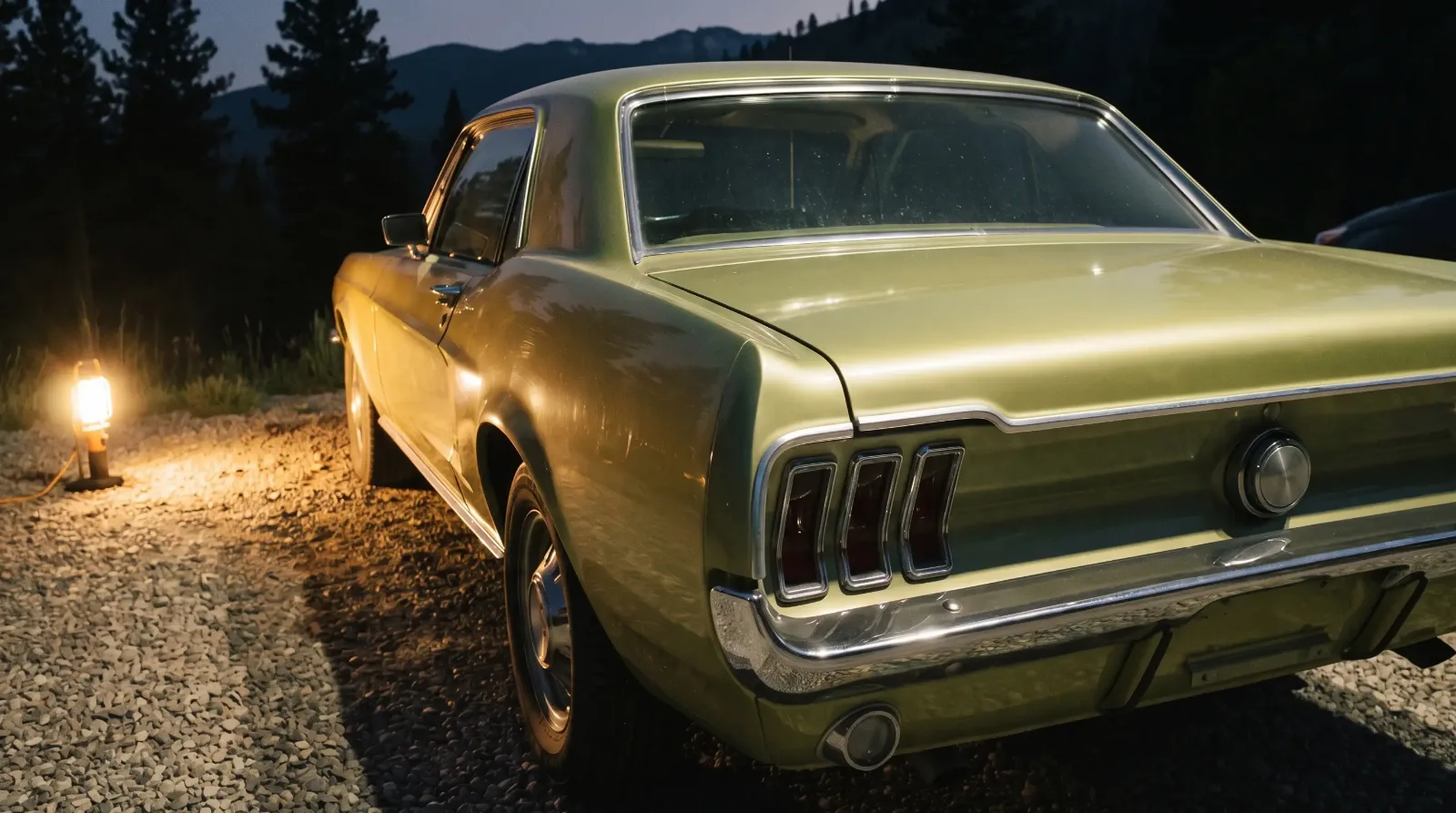
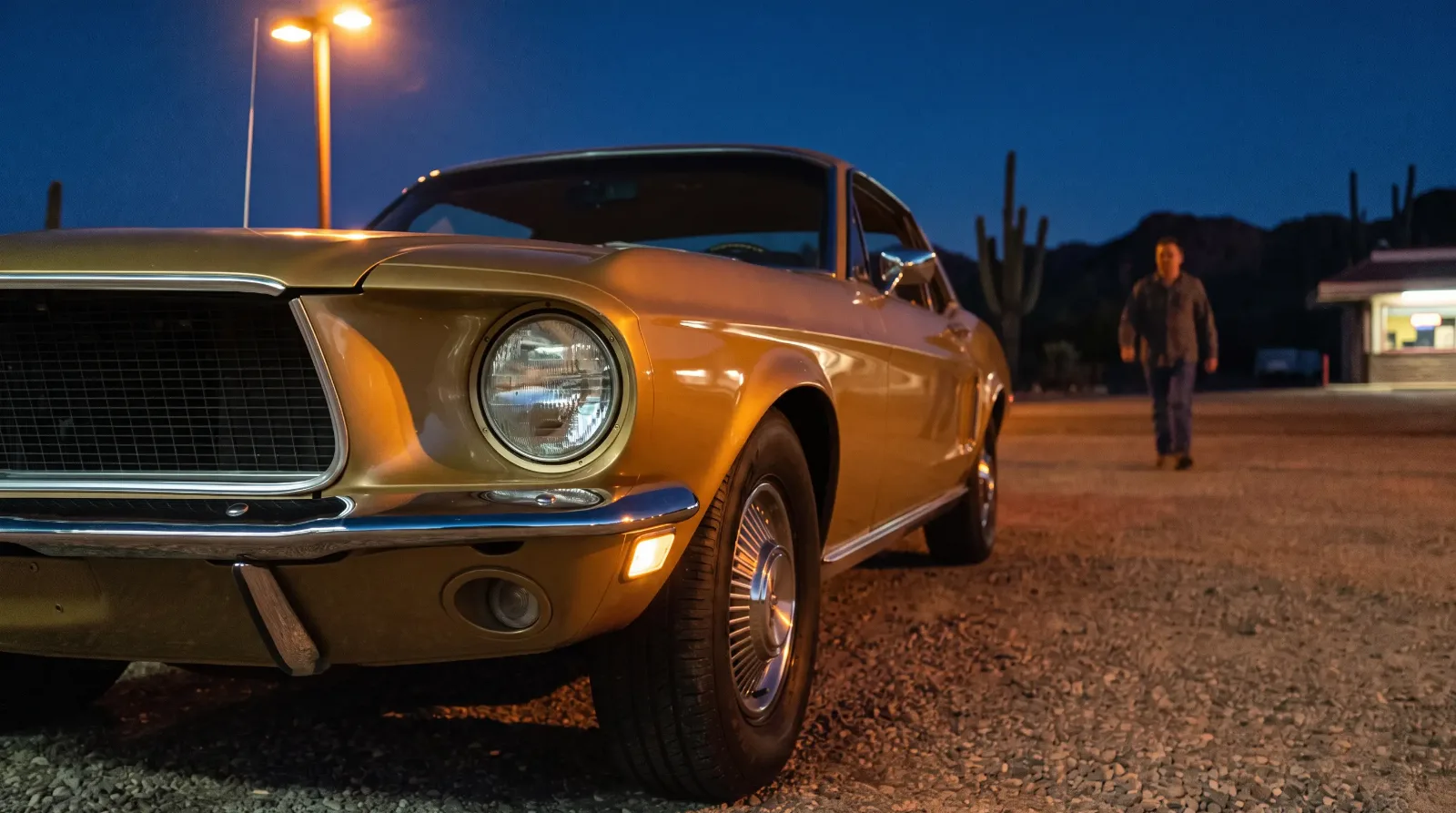
Walk any big Mustang show long enough and you will find a 1966 and a 1967 parked nose to nose. From thirty feet they read as the same car. Get closer and the 1967 starts to look like the older car's bigger brother. The grille opening is wider, the flanks are fuller, and the taillight panel curves inward instead of sitting flat. That was the 1967 Mustang redesign, the first major rework since the car went on sale, and nearly everything about it traces back to one decision. Ford wanted a big-block V8 under the hood, and the original car had no room for one.
Car Features
6 min read
The 1967 Mustang Redesign: Bigger Body, Big-Block Room
Why Ford reworked a record-selling car for 1967: a wider body for the 390 big-block, a full-length fastback roof, and how buyers answered.
Why the 1967 Mustang redesign started under the hood
It is easy to forget how bold the timing was. The Mustang had just finished its best year: Ford built 607,568 of them for 1966, the record for the first generation. Most companies would have left a car like that alone. Ford changed the body instead, and the reason was engineering, not fashion. The 1965 and 1966 cars were drawn around a six and the 289 small-block. The FE family of big-block V8s, which Ford had been building since 1958, was a physically larger engine, and fitting it meant a wider engine bay. Over-Drive's 1967 fact sheet notes that the V8 cars' front track went from 56.0 to 58.1 inches to make room for the FE.
So the body was enlarged to take big-block V8s. The wheelbase stayed at 108 inches, which kept the car's basic proportions. Everything around that wheelbase grew. This new shell carried the Mustang through two model years, built from August 1966 to August 1968, and it is the body most people picture when they think of the late sixties car. If you want the wider arc of the first generation Mustang years, this is the point where the car stopped being a sporty compact and started becoming something heavier.
Bigger in every direction but one
The growth was modest on paper and obvious in person. Two inches of length and almost three of width do not sound like much, but on a car this size they change how it sits on the road.
| Dimension | 1965 hardtop | 1967 hardtop | Change |
|---|---|---|---|
| Wheelbase | 108 in | 108 in | None |
| Overall length | 181.6 in | 183.6 in | +2.0 in |
| Width | 68.2 in | 70.9 in | +2.7 in |
| Height | 51.1 in | 51.6 in | +0.5 in |
| Base curb weight | 2,556 lb | 2,758 lb | About +200 lb |
Treat the weight row with some care. Published figures vary for both years: one widely used source puts the 1965 base car closer to 2,445 pounds, and Over-Drive's 1967 fact sheet lists the hardtop at 2,606 pounds. Whatever the exact gap, the direction is clear. The 1967 car was wider, a little longer, a little taller and heavier, and the width is the number that mattered most for what went between the fenders.
What changed on the outside and inside
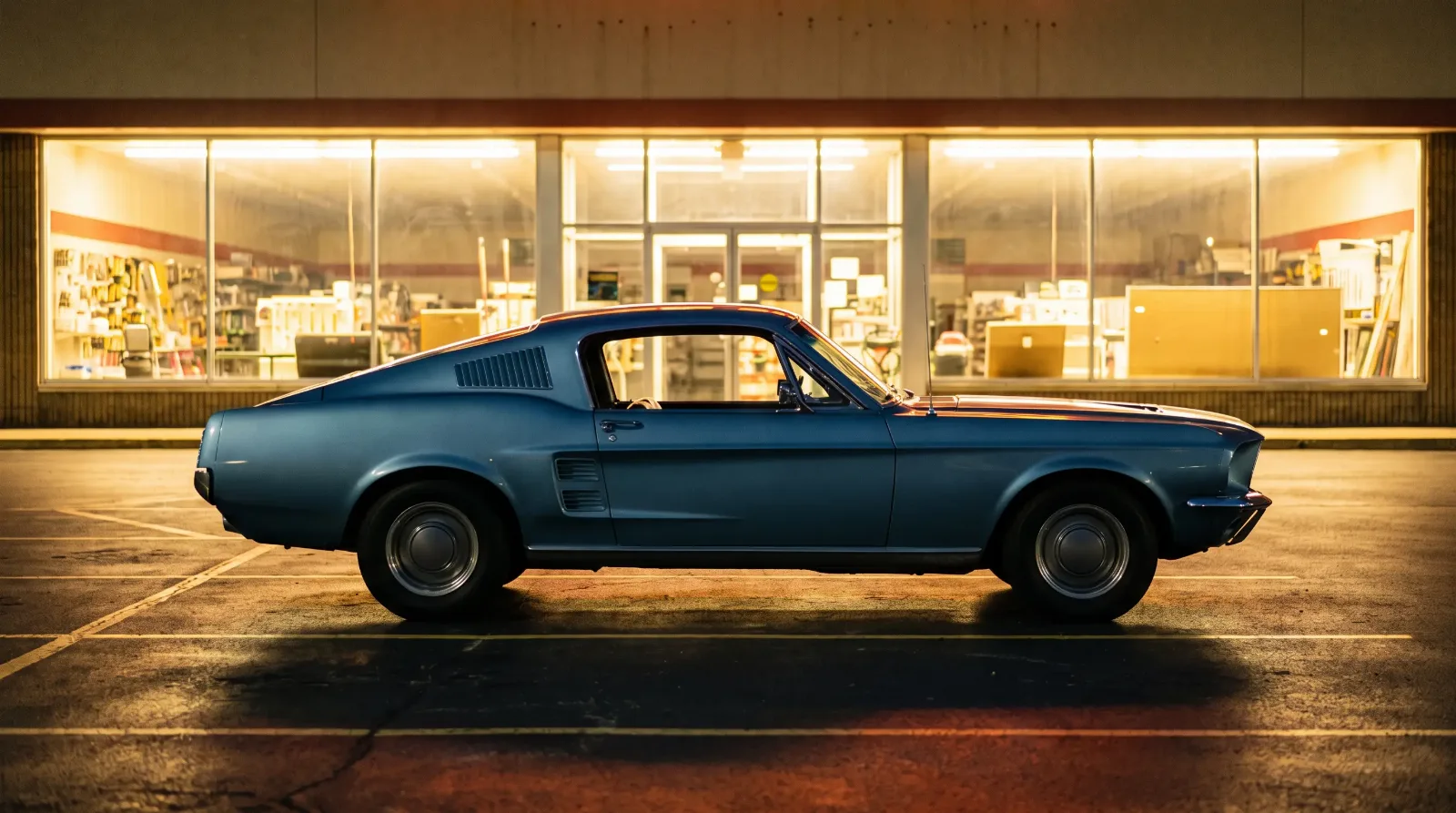
Ford kept the Mustang's face but gave it more presence. The grille opening grew, with a horizontal crossbar across it for 1967. Along the sides, the 1966 car's chrome ornament with three horizontal bars gave way to a side scoop in the body. At the back, the taillight panel became concave, where the 1966 lenses had been convex, and the three-bar lamps sat inside that recess.
The biggest change on the showroom floor was the fastback. On the 1965 and 1966 cars the roof broke before the tail. For 1967 the fastback roofline ran the full length of the car to the tail, a cleaner and more aggressive shape that set up the look of the next several years.
Inside, the dashboard was redesigned with air conditioning integrated into it. The embossed running-horse seat motif that gave the earlier luxury interior its nickname was dropped for 1967. The car was growing up, and its interior was starting to look more like a personal car than a toy.
The big-block and the GT in the new body
The engine that justified all of this was the 390 cubic inch FE with a four-barrel carburetor, coded S in the VIN. It was rated at 320 hp at 4,800 rpm and 427 lb-ft at 3,200 rpm, SAE gross, and it was the first big-block engine offered in a Mustang. About 28,800 buyers chose it for 1967. The six and the 289s stayed on the order sheet, and the 271 hp K-code Hi-Po had its last year, with 489 built.
The GT Equipment Group moved into the new body too, with fog lamps, power front disc brakes, a quad-outlet exhaust, F70x14 tires, a handling package and rocker-panel stripes. Ford built 24,079 GTs for 1967. Shelby used the same new body for its 1967 GT500, which carried a 428 Police Interceptor rated at 355 bhp. The redesign had opened the door, and the bigger engines kept coming through it.
The culture caught up a year later. The two cars built for Bullitt were 1968 Mustang GT fastbacks in Highland Green, with the S-code 390 and a four-speed, and they wore this body. When people picture the Bullitt chase, they are picturing the shape Ford drew for 1967.
"People like to say 1967 is where the Mustang started putting on weight, and they are right. But stand next to one at a show and you see why nobody at the time took it as a loss. The car finally looked like it could back up whatever Ford put under the hood."
Patrick Walsh
How buyers answered the 1967 car
Ford built 472,121 Mustangs for 1967: 356,271 hardtops, 71,042 fastbacks and 44,808 convertibles. That was well down from the 1966 record, and the usual explanation is competition. The Camaro and the Firebird arrived for 1967, and for the first time the Mustang shared the segment it had created with serious rivals from General Motors. The pony car market as a whole reached almost a million cars in 1967, so the pie was bigger even as Ford's slice shrank.
Look inside those numbers and the redesign has its own vote of approval. Fastback production went from 35,698 in 1966 to 71,042 in 1967, roughly double, in the year the roof was redrawn to run all the way to the tail. The other two body styles fell sharply between them; the new fastback found buyers. For the story of where all of this came from, the Fairlane-era planning and the original 1964 launch, the background is worth reading alongside this one.
The 1967 body did not last long in its pure form. For 1968 Ford kept the shell but added federal safety equipment, including side marker lights, and swapped the grille crossbar for a bright ring around the opening; the 1968 changes are their own story. For 1969 the car grew again, another 3.8 inches in length. Even so, the 1967 is the one designers kept returning to. When Ford introduced the 2005 Mustang, its own press release described a nose attitude "not seen since the 1967 model." If the redesign has you looking at the real thing, the 1967 Mustangs for sale show how many of these cars are still on the road.
Sources and notes
- Wikipedia: Ford Mustang (first generation)
- Over-Drive: 1967 Ford Mustang fact sheet
- Conceptcarz: 1967 Ford Mustang specifications and production
- RM Sotheby's: 1967 Ford Mustang GT S-Code fastback
- IndieAuto: pony car sales, 1967 to the early 1970s
- Ford press release on the 2005 Mustang (via The Auto Channel)
Related Reading
Have a
Ford Mustang
for Sale?
Reach thousands of serious classic car collectors across the US.
Sell It Here →
Selling a classic? Here's how: sell my classic car
Are You a Classic Car Dealer?
List your full inventory and connect with targeted classic car buyers.
Join as a Dealer →
#mustang history
#Ford Mustang
#1967 Mustang
#first generation Mustang
#390 big-block
#mustang fastback
#mustang gt
#1967 Mustang redesign

About the author
Patrick Walsh
Automotive journalist covering classic car shows, events, and the enthusiast community across North America.
Related Listings - Ford Mustang
Comments
Be the first to comment on this article.