
Ford did not have a sales problem going into 1968. The 1967 body was a year old, buyers liked it, and nobody at Ford was itching to spend money redrawing it. Then the federal government handed the industry a rulebook. The 1968 Mustang changes come down to three things: the safety equipment the new rules forced onto the car, a bigger small-block that pushed the 289 family aside, and a big-block that showed up in April and changed the car's reputation for good. Same sheetmetal. A very different car underneath, depending on which one you got.
Car Features
7 min read
The 1968 Mustang: Federal Safety Rules, the 302 and the Cobra Jet
Side markers, shoulder belts, the new 302 and the April 1968 Cobra Jet: what really changed on the 1968 Mustang under the same body.
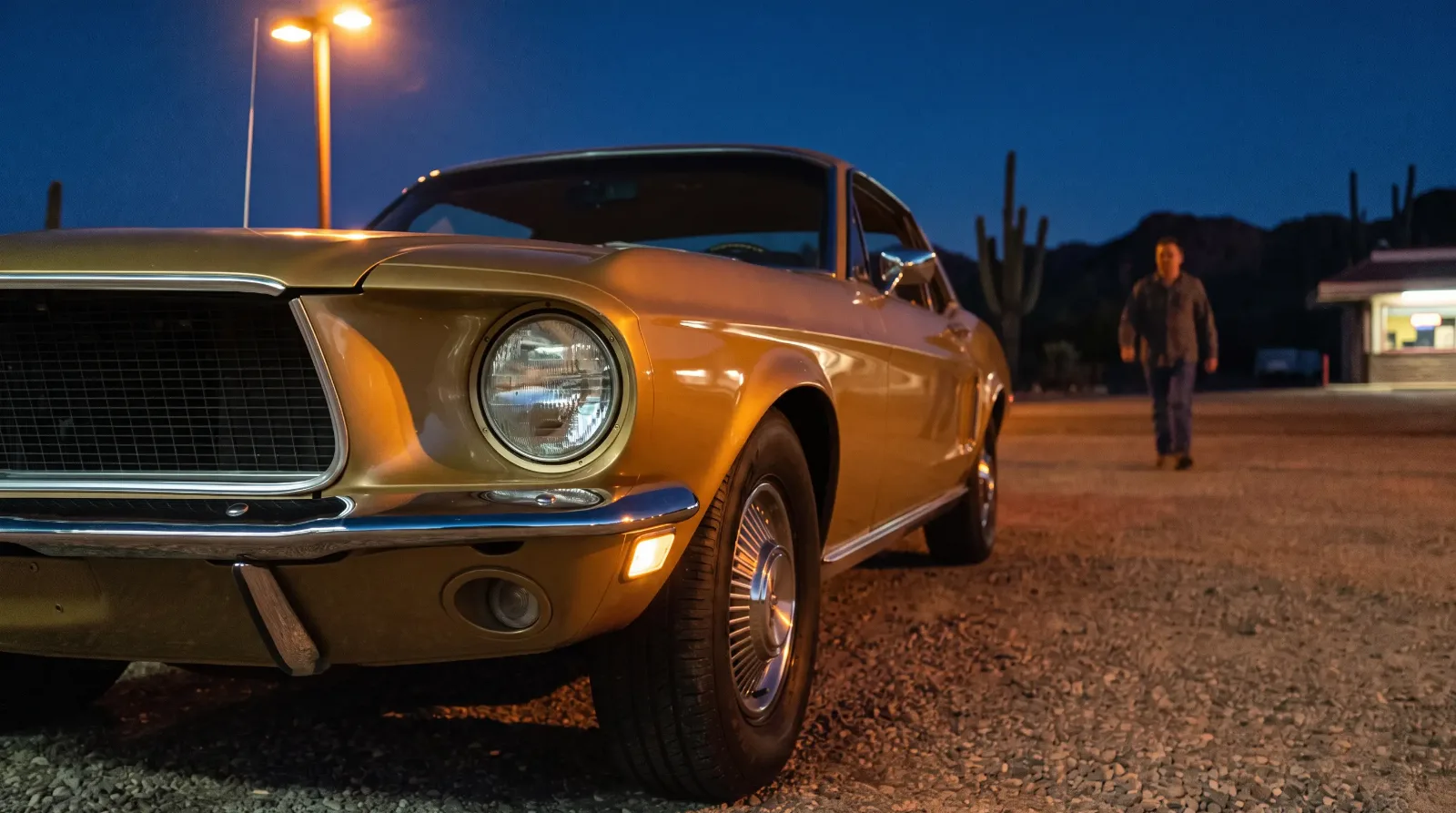
If you want the whole arc from the first cars to the last of the big ones, the first-gen Mustang history covers it. This piece stays on one model year and the parts of it that actually matter when one of these is sitting in front of you with the hood up.
Why the 1968 Mustang changes started with a rulebook
The body did not move. The shell that arrived for 1967 was built from August 1966 to August 1968, so a 1968 car shares its doors, roof and quarter panels with the year before. What changed was the equipment hung on it, and most of that came from Washington rather than the styling studio.
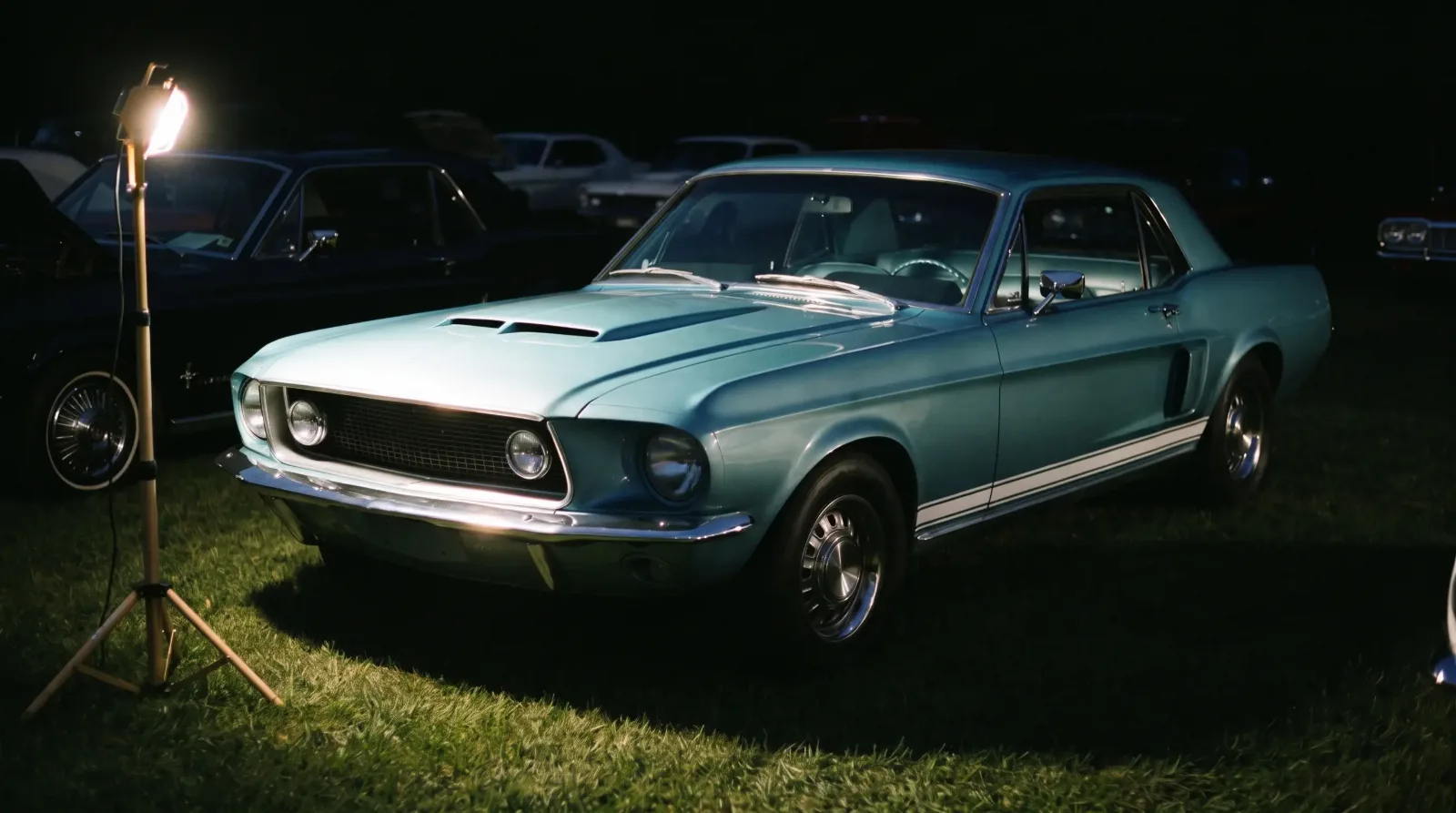
From the curb, the giveaway is the side marker lights. Every 1968 Mustang has them on the front fenders and the rear quarters, and no factory 1967 does. That alone settles most arguments at a car show. Inside, the steering wheel went to a two-spoke energy-absorbing design, built to give a little if your chest met it. Shoulder belts arrived too, but not on day one: they came in from January 1968 production. So two 1968 Mustangs can differ on belts depending on when they left the plant, and I have seen people swear a car was modified when it was simply built in the fall.
Ford also took the block letters spelling FORD off the front edge of the hood. Nobody misses them much. The grille lost the horizontal crossbar of 1967 and got a bright ring around the opening instead, and a C-shaped side stripe joined the option list. Small stuff, but it is the small stuff that tells you whether the fenders and grille on a car are the ones it was born with.
The 302 arrives and the 289 family thins out
Here is where the year gets interesting for anyone who turns wrenches. The 289 had been the Mustang's V8 since the start, in several flavors. By 1968 most of those flavors were gone. The K-code Hi-Po had already bowed out after 1967, a year in which only 489 were built. What survived was the C-code 289 two-barrel, now rated at 195 hp instead of the 200 it carried in 1965 and 1966.
Taking the 289's place was the 302. Ford got the extra displacement by lengthening the stroke rather than opening up the bore, so it is the same family with a longer reach, and most of what you know about a 289 carries over. It came two ways. The F-code two-barrel made 210 hp. The J-code four-barrel made 230 hp at 4,800 rpm and 310 lb-ft. Ford's 1969 engine code list has no J on it, so the four-barrel 302 was a one-year regular Mustang engine, and it is the one I would point a curious owner toward. It is lighter in the nose than any big-block and pulls well enough that you stop missing the Hi-Po's racket.
The six went the other way. The T-code 200 slipped from 120 hp to 115. Two years earlier Ford had dressed that same engine up and sold it hard as a model in its own right (more on that here), but by 1968 it was simply the price-leader engine. The 390 also split in two: the S-code four-barrel at 325 hp and a rare new X-code two-barrel, which most VIN decoders and auction records list at 280 hp (Wikipedia's table says 270).
| VIN code | Engine | Carburetor | Rated output (SAE gross) |
|---|---|---|---|
| T | 200 cu in six | 1-bbl | 115 hp |
| C | 289 V8 | 2-bbl | 195 hp |
| F | 302 V8 | 2-bbl | 210 hp |
| J | 302 V8 | 4-bbl | 230 hp @ 4,800 rpm; 310 lb-ft |
| X | 390 V8 | 2-bbl | 280 hp (some sources: 270) |
| S | 390 V8 | 4-bbl | 325 hp |
| R | 428 Cobra Jet (from April 1968) | 4-bbl, 735-cfm Holley | 335 hp @ 5,200 rpm; 440 lb-ft @ 3,400 rpm |
Read the fifth character of the VIN and you know which line of that table the car started life on. Then go look at the engine and see whether it agrees.
April 1968: the 428 Cobra Jet
The Cobra Jet won before you could buy one. At the NHRA Winternationals at Pomona, February 2 to 4, 1968, Ford backed five drivers in six 428 Cobra Jet Mustangs. Four of them reached their class finals, the SS/E class final came down to two Cobra Jets with Al Joniec beating Hubert Platt, and Joniec went on to win Super Stock Eliminator. That is a pretty good advertisement for an engine that was not yet on the order form.
It went on sale in April 1968. One source pins it to April 1, which I would treat as likely rather than settled. The important part is how it was built: on the regular production line, not as a hand-assembled special in some back room. The 428 was an FE big-block, the same family as the 390, fed by a 735-cfm Holley four-barrel, and it carried the R code in the VIN. Ford rated it at 335 hp at 5,200 rpm and 440 lb-ft at 3,400 rpm.
"Three hundred thirty-five is the number on the paper. I have never met anybody who drove a Cobra Jet and believed it. Ford had insurance companies and a racing class to think about, and a low number kept both of them calm."
Mike Sullivan
That gap between rating and reality is widely accepted, and it put the 390 in an awkward spot. On paper the Cobra Jet was only 10 hp ahead of the S-code. On the street it was not close. The same engine went into the Shelby GT500KR from April 1968, so for the last few months of the model year the most serious Mustang and the most serious Shelby shared an engine family and a rating.
One number I will not give you is how many 1968 Cobra Jet Mustangs Ford built. You will hear figures quoted with total confidence, and I have not seen one tied to a source I would bet a car on. Same goes for drag-car counts beyond the six that ran at Pomona. If a seller's story depends on a production number like that, ask where it came from.
How the 1968 Mustang sold, and the specials around it
Ford built 317,404 Mustangs for 1968: roughly 249,400 hardtops, 42,581 fastbacks and 25,376 convertibles. That is a long way off the 1966 record, and the hardtop doing most of the work tells you who was buying. Plenty of those cars were six-cylinder or two-barrel V8 coupes bought as daily transportation, which is exactly why a well-optioned 1968 stands out today.
Ford leaned on regional and seasonal specials to keep the showrooms busy. The spring Sprint promotion offered a Sprint A package with the C-stripe, wheel-lip moldings, full wheel covers and a pop-open gas cap, and a V8-only Sprint B that added styled steel wheels, wide whitewall tires and grille fog lamps. Ford built 25,012 Sprint A cars and 15,106 Sprint B cars, figures that come from a single source. Out west, the California Special went into production on February 17, 1968, with Shelby-derived styling parts on the hardtop body; 4,118 were built, 251 of them rebadged as High Country Specials for the Denver district.
Then the body was done. Production of this shell ended in August 1968, and the 1969 car grew 3.8 inches longer than the 1968's 183.6. That makes 1968 the last year of the tighter late-sixties shape, with the newer engines inside it. If you are looking at 1968 Mustangs for sale, start with the side markers, the dash VIN plate and that fifth VIN character. Those three tell you more about the car than the paint ever will.
Sources and notes
- Ford Mustang (first generation), Wikipedia: 1968 safety changes and engine table
- Ford FE engine, Wikipedia: 428 Cobra Jet and the 1968 Winternationals
- MustangSpecs: 1968 Ford Mustang engine ratings
- MustangSpecs: 1968 Mustang production numbers
- MustangSpecs: the 1968 Mustang Sprint A and Sprint B
- Classic Industries: 1968 Mustang VIN and data plate decoder
Related Reading
Have a
Ford Mustang
for Sale?
Reach thousands of serious classic car collectors across the US.
Sell It Here →
Selling a classic? Here's how: sell my classic car
Are You a Classic Car Dealer?
List your full inventory and connect with targeted classic car buyers.
Join as a Dealer →
#mustang history
#Ford Mustang
#1968 Mustang
#first generation Mustang
#428 Cobra Jet
#302 V8
#Mustang engine codes
#1968 Mustang changes

About the author
Mike Sullivan
Detroit-area muscle car enthusiast and restoration specialist with three decades of hands-on experience working on American iron.
Related Listings - Ford Mustang
Comments
Be the first to comment on this article.