
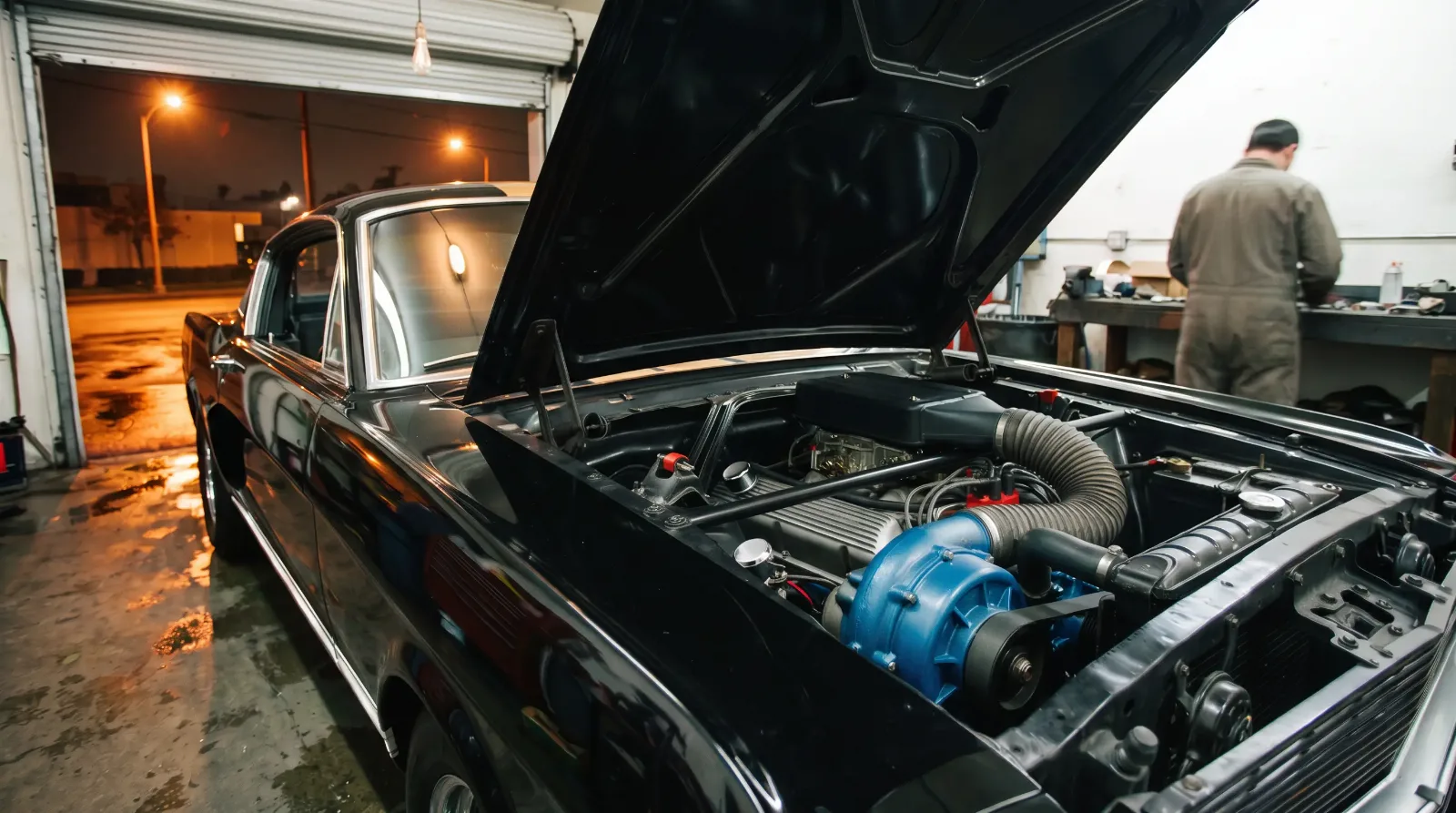
Lift the hood on a 1967 Shelby GT500 and the first thing you notice is how little daylight is left. Two Holley four-barrels sit side by side on an aluminum intake, on top of a 428 that fills the bay the way a man fills a phone booth. A lot of the 1967 Shelby GT500 history gets told by people standing over that engine, and I understand why. This was the first Shelby Mustang with a big block under the hood. It was also the Shelby that outsold its smaller brother by a wide margin in its first year, which tells you something about what buyers wanted in 1967.
Car Features
8 min read
The 1967 Shelby GT500: The First Big-Block Shelby Mustang
Why Shelby put a 428 in the 1967 Mustang: two Holleys, 355 hp, fiberglass styling, and 2,048 GT500s built against 1,175 GT350s.
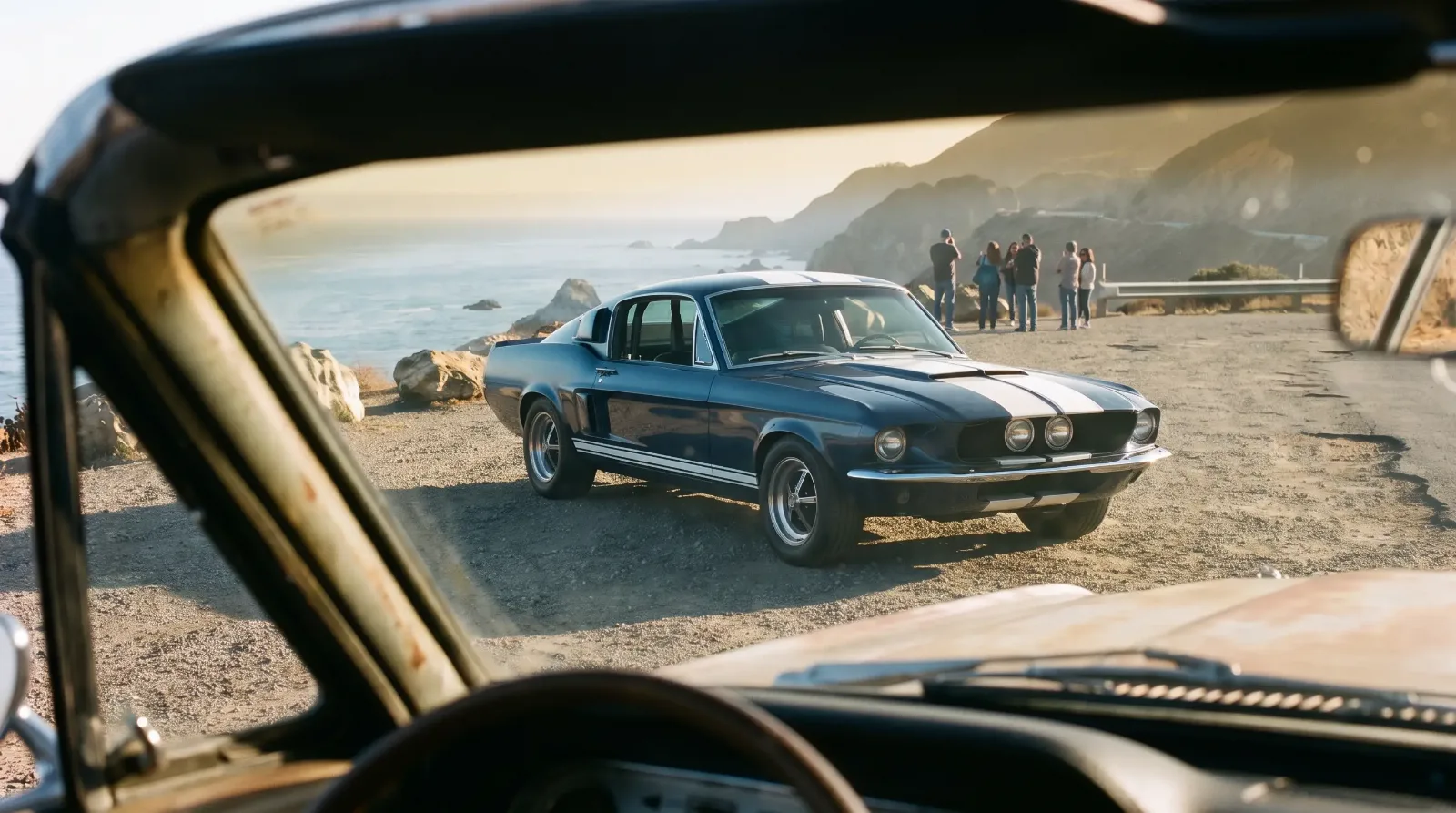
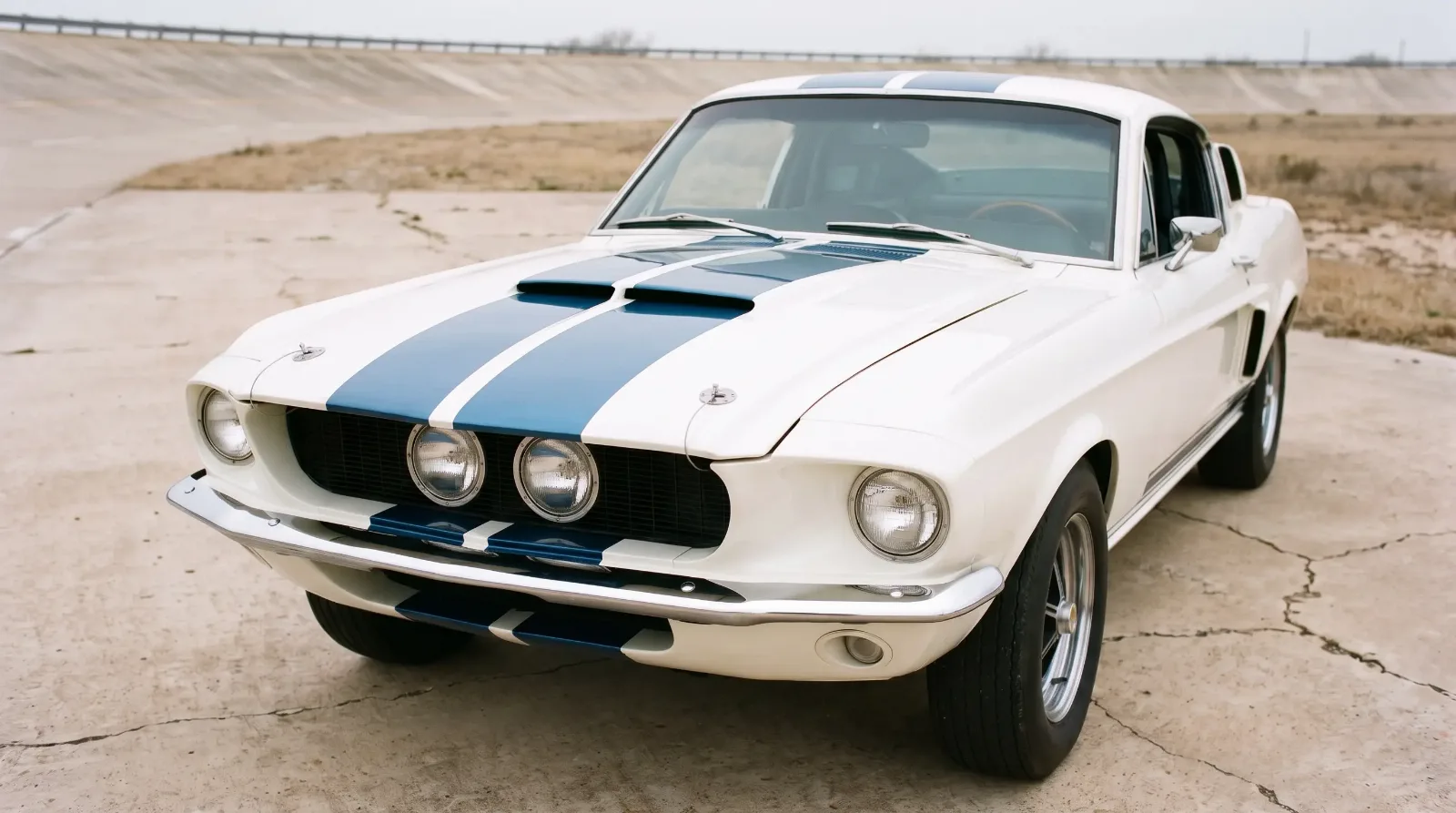
One correction before we go further, because the club bench-racers will make it for you. The GT500 was not the first big-block car to carry Carroll Shelby's name. The Cobra roadster had already gone big block, with the 427 Cobra introduced in 1965. What the GT500 did first was put a big block in a Shelby Mustang, and that is the story here. The wider family, from the first white GT350s to the last cars, is covered in the Shelby Mustang history.
Why Shelby needed a big block for 1967
The answer starts with Ford, not Shelby. For 1967 the Mustang got its first major redesign, and the body was enlarged on purpose so a big-block V8 would fit. The wheelbase stayed at 108 inches, but the car grew 2.7 inches wider, to 70.9 inches, and that extra room between the shock towers is what made the GT500 possible.
It also created a problem. The same redesign let Ford sell the 390 S-code in a regular Mustang, rated at 320 hp. For the first time a customer could walk into an ordinary Ford store and drive out in a big-block Mustang for a lot less money than any Shelby. The GT350 kept its 289. A small-block Shelby parked next to a 390 GT on a showroom floor was a hard thing to explain to a buyer who counted cubic inches, and plenty of buyers did.
There was a second shift going on behind the scenes. By October 1966, Ford had taken over engineering and purchasing on the Shelby program. The 1967 cars were built as Ford tightened its hold on the money and the parts list, and the GT500 reads like a car built for a bigger market than the race-bred 1965 GT350 ever aimed at.
The 428 Police Interceptor and its two Holleys
Shelby did not use the 390. The GT500 got the 428 Police Interceptor, an FE-family big block whose name tells you where Ford first aimed it, dressed up with an aluminum medium-rise intake and two 600-cfm Holley four-barrels. Ford rated it at 355 hp at 5,400 rpm and 420 lb-ft at 3,200 rpm, gross figures from an era when gross ratings were the norm.
Here is a detail I like to point out to people who think the dual quads made it a race motor. The 428 ran hydraulic lifters. No valve lash to set, no clatter at idle, no weekend spent with a feeler gauge. This was a street engine built to start every morning and pull hard from low rpm, and that peak torque arriving at 3,200 rpm says the same thing.
The other detail is one the paperwork hands you for free. The regular 390 GT was rated at 427 lb-ft, which on paper is more torque than the Shelby's 420. I have never met a GT500 owner who believes the 390 was the stronger engine, and I do not either, but the rating sheet says what it says. Two carburetors also mean two of everything to keep in tune, and a lot of tired GT500s I have seen run rich on one side because nobody bothered to balance them. A four-speed manual was standard, and Ford's C6 three-speed automatic was on the option list.
| 1967 Shelby GT500 | Factory figure |
|---|---|
| Engine | 428 Police Interceptor V8, hydraulic lifters |
| Induction | Two 600-cfm Holley four-barrels, aluminum medium-rise intake |
| Rated power (gross) | 355 hp at 5,400 rpm |
| Rated torque (gross) | 420 lb-ft at 3,200 rpm |
| Wheels | 15-inch 10-spoke cast aluminum |
| List price | $4,195 (GT350: $3,995) |
| Production | 2,048 fastbacks (GT350: 1,175) |
Fiberglass, a roll bar and Cougar taillamps
The 1967 Shelby looks nothing like the car it started as, and that was deliberate. Charles McHose is credited with the styling, working with Joe Farrer and Carl Nasson. They gave the fastback a fiberglass nose, a fiberglass hood, extra side scoops and a ducktail spoiler across the tail. The rear quarter scoops were functional, feeding cooling air to the rear brakes. Out back, the taillamps came from the Mercury Cougar, a part no regular 1967 Mustang shared.
Whether those Cougar lamps flashed in sequence on a 1967 Shelby is still argued about at every club meet I have been to. The sources disagree, and I would not bet a restoration on either answer without looking at the car's own wiring. What is not in dispute is that the fiberglass gave the factory headaches. Panel fit was poor enough that Ford brought in A.O. Smith to sort out the quality problems, a decision that mattered a great deal a year later. Anyone who has tried to gap a 1967 Shelby nose against a fender knows those headaches never fully went away.
Inside, the car carried a padded roll bar, and that roll bar did more than look serious. It anchored inertia-reel shoulder harnesses, which was not something you found in a showroom car in 1967.
The 1967 Shelby GT500 history in numbers
The price gap was small. The GT500 listed at $4,195 and the GT350 at $3,995, so the big block cost $200 more. Buyers took the deal. Shelby built 2,048 GT500 fastbacks for 1967 against 1,175 GT350s, a margin of 873 cars in the big block's favor in its very first year. Some sources give 2,050 and 1,173, but the 2,048 and 1,175 figures are the ones most registry-minded owners quote.
Performance figures from the period depend on which magazine you read. Car and Driver's 1967 test car, an automatic, ran 0 to 60 mph in 6.5 seconds and the quarter mile in 15.0 seconds at 95 mph. Road & Track's automatic car was slower, at 7.2 seconds to 60 and 15.5 seconds at 95 mph, and the magazine logged 9.8 mpg over 800 miles, the lowest economy figure it had ever recorded. Quicker numbers turn up in later compilations, but none of them names a period test, so I would stick with the two magazines.
"People like to say the GT500 was the soft Shelby. It weighed more and it rode easier, sure. But two hundred dollars bought you 428 cubic inches and two carburetors, and almost two buyers out of three took that deal. That is not soft. That is arithmetic."
Mike Sullivan
A handful of 1967 cars fall outside the production count. One GT500 convertible was built, car 0139. A notchback prototype was built as well. Up to three GT500s received 427 engines, and the best known of them is the Super Snake, a car with a story big enough for its own article. None of these tell you much about the regular GT500 a customer drove home, and that is the car most of the 1967 Shelby GT500 history should be about.
The last California Shelbys, and what came after
The 1967 model year closed a chapter. In May 1967, Ford decided to end the California operation, and in August 1967 the small Shelby and Ford engineering staff, along with the remaining cars, were sent to A.O. Smith in Ionia, Michigan. That made the 1967 GT500 the only big-block Shelby Mustang built in California. Every one that followed came out of Michigan.
The formula did not change much at first. The early 1968 GT500 kept the 428 Police Interceptor, now rated at 360 hp, and from April 1968 the 428 Cobra Jet took over in the GT500KR. Those cars have their own stories. The 1967 car is the one that proved a Shelby Mustang could sell on torque instead of track credentials, and Ford built the rest of the Shelby program around that lesson.
The 1967 GT500 also found a second life in front of a camera. For the 2000 remake of "Gone in 60 Seconds", illustrator Steve Stanford drew Eleanor as a customized 1967 GT500, and the film cars were built on regular 1967 Mustang fastbacks. In my opinion that film did more for the car's fame with younger enthusiasts than any road test ever did. If you want to see the regular cars every 1967 Shelby started as, have a look through the 1967 Mustangs for sale and compare them with the fiberglass, the scoops and the twin-carb 428 you have just read about. The difference is bigger in person than in any photo.
Sources and notes
- Shelby Mustang (Wikipedia)
- The 1967 Shelby GT500 428 (Silodrome)
- 1967 vs 2020 Shelby GT500, with the 1967 Car and Driver figures (Ford Authority)
- Vintage Road & Track review: 1967 Shelby GT 500 (Curbside Classic)
- 1967 Shelby GT500, lot description (RM Sotheby's)
- Original "Gone in 60 Seconds" Eleanor heads to auction (Top Gear Philippines)
Related Reading
Have a
Ford Mustang
for Sale?
Reach thousands of serious classic car collectors across the US.
Sell It Here →
Selling a classic? Here's how: compare the places to sell classic cars
Are You a Classic Car Dealer?
List your full inventory and connect with targeted classic car buyers.
Join as a Dealer →
#Ford Mustang
#1967 Mustang
#Carroll Shelby
#Shelby American
#shelby gt500
#1967 Shelby GT500
#428 Police Interceptor

About the author
Mike Sullivan
Detroit-area muscle car enthusiast and restoration specialist with three decades of hands-on experience working on American iron.
Related Listings - Ford Mustang




Comments
Be the first to comment on this article.