
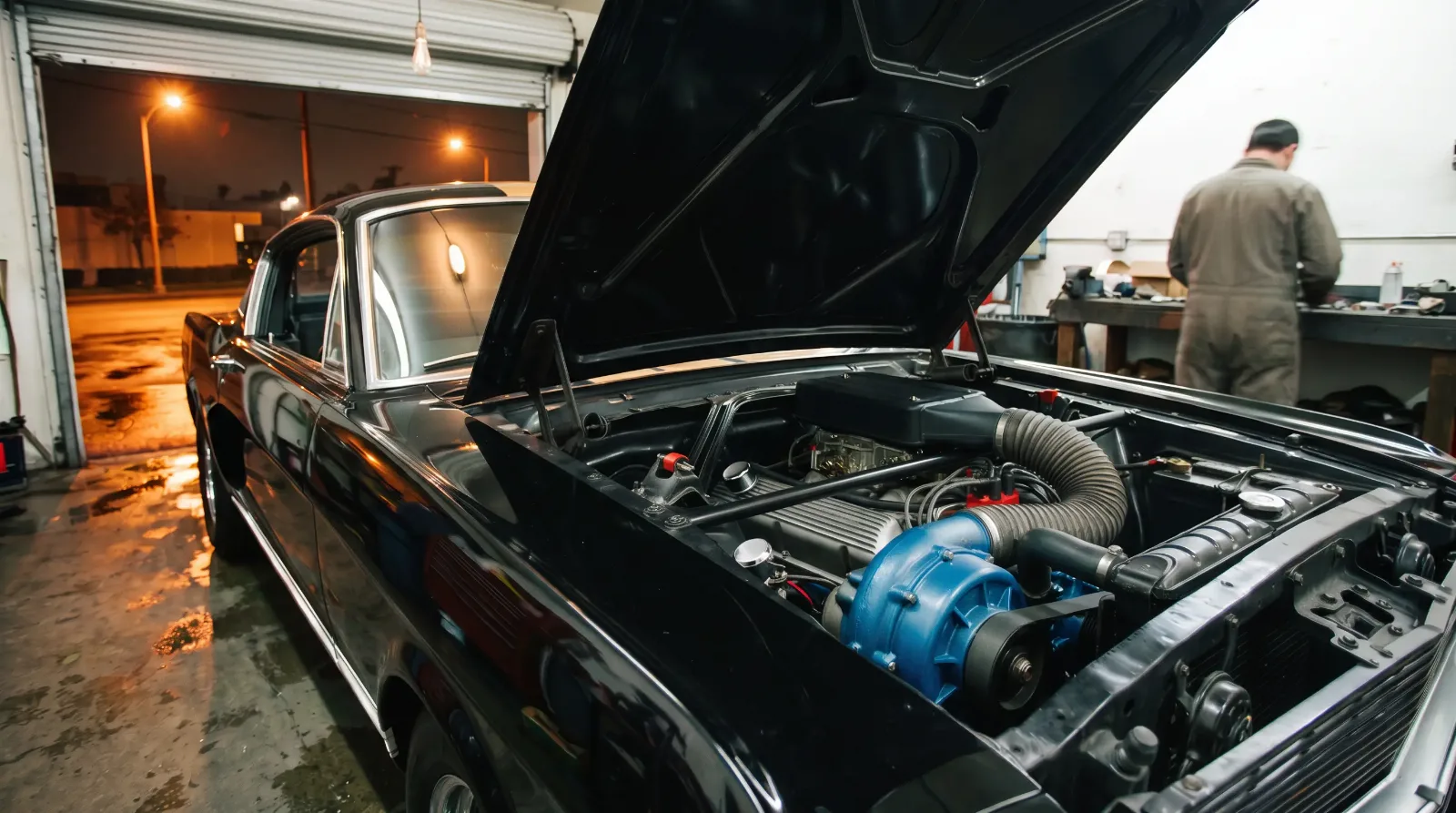
The Shelby Paxton supercharger was the rarest box on the GT350 order form, and the one with the widest gap between what people say about it and what the paperwork shows. For $670 in 1966, a buyer got a blower on top of a 289 that already made 306 hp, plus the fuel and gauge hardware to keep it alive. Shelby American built 2,378 cars of all types for 1966 and another 1,175 GT350s for 1967. About 46 of them left the shop with a Paxton. That ratio tells you most of the story.
Car Features
8 min read
The Paxton Supercharger Option
A $670 blower for a 306 hp GT350. About 46 factory cars in 1966 and 1967, and horsepower claims that do not agree.
If you want the whole Shelby lineage first, from the white homologation cars to the last re-VINned 1970 models, there is more on that here. This piece stays with one option and one question: what did the blower actually buy you?
How a supercharger maker got into Shelby's shop
Paxton was founded by Robert Paxton McCulloch. By the time it came knocking on Shelby's door it belonged to the Granatelli brothers, and Andy Granatelli was the one who approached Carroll Shelby, in January or early 1965 depending on the account. By the summer of 1965 a demonstrator car was running.
The timing matters. Shelby American was turning the GT350 from a homologation special into a car a dealer could sell to somebody with a commute. The 1966 car got Plexiglas rear quarter windows, rear brake cooling scoops, a quieter exhaust, suspension closer to stock and an optional automatic. The 289 stayed at 306 hp. A bolt-on blower fit that plan neatly. The base car got easier to live with, and the buyer who wanted more could pay for it as a line item.
That is my reading, not something Shelby put in a memo, but the engine math agrees. The GT350 ran the Shelby version of the K-code Hi-Po: 306 hp at 6,000 rpm and 329 lb-ft at 4,200, with a 715-cfm Holley, a Cobra high-rise intake and Tri-Y headers. That is already a lot of 289. Making more without a blower meant more cam and more compression, which is exactly the direction the 1966 car was moving away from.
What the Shelby Paxton supercharger kit included
The blower was the headline, but the kit was a system. Paxton's blower was a centrifugal unit, belt-driven off the front of the engine, and it came with an Autolite four-barrel in place of the Holley, a Carter high-volume fuel pump, and boost and vacuum gauges mounted under the dash. The $670 did not include the No-Spin differential, which stayed a separate item.
The fuel pump and gauges show what the people who specified it feared. A supercharged carbureted engine usually hurts itself by running lean first, and fuel supply at high rpm under load is where that starts. The gauges let the driver watch boost come up and, just as useful, watch vacuum on the cruise, which is how you know the engine is healthy when it is not working hard.
A centrifugal blower also changes how the car drives. Its boost climbs with engine speed, so around town the car feels close to stock and the extra pull arrives in the top half of the tach. On a 289 that already liked 6,000 rpm, that suited the engine.
| Item | Stock GT350 (1966 and 1967) | With the Paxton option |
|---|---|---|
| Engine | 289 V8, Shelby-modified Hi-Po | Same 289, supercharged |
| Rated output (gross) | 306 hp at 6,000 rpm | About 390 hp; Wikipedia says 440 |
| Torque | 329 lb-ft at 4,200 rpm | Not given in the sources used here |
| Carburetor | 715-cfm Holley four-barrel | Autolite four-barrel |
| Fuel pump | Standard | Carter high-volume |
| Extra instruments | None | Boost and vacuum gauges under the dash |
| Price | Base car | $670 extra in 1966; $549 in 1967 |
| Factory installations | Not applicable | About 11 (1966), about 35 (1967) |
306, 390 or 440: reading the horsepower claims
This is where I get suspicious. The numbers do not agree. The figure most sources repeat, including a museum that shows a 1967 car, is about 390 hp. Wikipedia says 440. One enthusiast publication notes that some claim 440 to 450 with tuning. Against the 306 hp base, 390 is a gain of about 27 percent. 440 would be 44 percent.
Twenty-seven percent from one blower on a carbureted small-block, at boost a street engine could live with on pump gas, is believable. Forty-four percent on the same hardware is a dyno sheet I would want to see before I signed off on it. My guess is that 440 is a tuned or best-case number that drifted into the reference books. I cannot prove that, and none of the sources behind this article includes a factory dyno sheet for a 1966 Paxton car to settle it.
The performance claims have the same problem. Supercharged GT350s are credited with 0 to 60 mph in the mid-five-second range and a top speed around 150 mph, but those figures come without a named road test. For comparison, a widely used Shelby owners' FAQ credits Car Life, July 1966, with 6.2 seconds to 60 and a 14.0-second quarter mile at 92 mph for a stock 1966 GT350. Half a second or more off the sprint is roughly what an extra 80-odd horsepower should buy in a car of that weight. The 150 mph number I would treat as a brochure figure until somebody shows me the timing slip.
Why only about 46 cars got one
Start with the volume. About 1,000 of the 1966 Shelbys went to Hertz as rental cars; the details of that program are a story of their own. Take those out and roughly 1,370 GT350s went to private buyers that year. About 11 of them got the factory Paxton; one auction catalog says ten. Either way, that is under one percent. For 1967 the count rose to about 35 out of 1,175 GT350s, or roughly 3 percent.
Then look at the price. A buyer of a regular 1966 Mustang paid $327.92 for the 271 hp Hi-Po engine, on top of the base V8 upgrade. The Paxton cost $670, about twice that, on a car that already had the hot engine. One documented 1966 GT350 dealer invoice shows $3,547 for the car itself, which puts the blower at around 19 percent of the car. That is a lot of money for horsepower that mostly showed up high in the rev range.
The 1967 numbers add a twist. That year Shelby also offered the first GT500, with a 428 big-block, at $4,195 against $3,995 for the GT350. Two hundred dollars bought 139 more cubic inches with no boost to manage. The Paxton option had come down to $549 for 1967, still more than twice the step from GT350 to GT500, and the blower struggled to make sense next to that sticker. And yet Paxton installations roughly tripled. My read: the buyers who checked the box in 1967 wanted a GT350 that kept the lighter small-block nose and still pulled hard at the top end, and they were willing to pay for it.
"A blower on a 289 makes real power. It also makes heat and a much bigger appetite for fuel. About 46 people in two years decided that trade was worth it. I respect every one of them, and I would still want to see the dyno sheet."
Dan Reeves
Over the counter, and what that means today
The kit was not only a factory option. Paxton also sold it over the counter for any GT350, and for any Mustang with a 289 V8. A GT350 wearing a period Paxton today proves only that somebody, at some point, bolted one on. It does not prove the car left Shelby American that way.
For a car presented as a factory Paxton GT350, the documentation carries the weight: the original order and invoice paperwork, and the car's recorded history with the Shelby registry. Matching hardware, including the Autolite carburetor, the Carter pump and the under-dash gauges, is a starting point and nothing more, because a dealer or owner could add the same kind of parts later.
The documented factory installations cover two model years, 1966 and 1967, though some sources list the blower as available later. By the end of the decade Ford went after power with displacement and factory-built performance engines rather than bolt-on boost. Read the Boss and Mach 1 chapter next to this one, because the contrast is the point: the Paxton was a small shop's answer to a power question that Dearborn later answered with cubic inches.
Strip away the folklore and the option comes down to this. If you accept the 390 figure, buyers paid $670, or $549 a year later, for about 84 extra gross horsepower. Shelby built a few thousand GT350s in those two years, and about 46 buyers took the deal. The power was real. The club was just very small.
Sources and notes
Related Reading
Have a
Ford Mustang
for Sale?
Reach thousands of serious classic car collectors across the US.
Sell It Here →
Selling a classic? Here's how: the best sites to sell a classic car
Are You a Classic Car Dealer?
List your full inventory and connect with targeted classic car buyers.
Join as a Dealer →
#Ford Mustang
#Shelby GT350
#Shelby American
#1966 Shelby GT350
#Paxton supercharger
#1967 Shelby GT350
#Supercharging

About the author
Dan Reeves
Performance engine builder from North Carolina's motorsports corridor, focused on swaps, forced induction and making real, repeatable power.
Related Listings - Ford Mustang




Comments
Be the first to comment on this article.