
Hidden headlights were an option on the 1968 and 1969 GTO, not standard equipment, and that surprises people who only know the model from magazine covers where every car seems to have them. What you're actually seeing on those cars is vacuum-operated doors, painted to match the Endura nose, that rotate down to reveal the sealed-beam headlights when you need them and disappear flush into the front end when you don't. It's one of the cleanest pieces of engineering on the Endura nose years GTO, and it's also one of the more common sources of headaches for owners who don't know how the system actually works.
Car Features
7 min read
Hidden Headlights: The 1968-69 GTO's Disappearing-Act Front End
Hidden headlights were optional, not standard, on the Endura-nose GTO. Here's how the vacuum system works and what tends to fail.
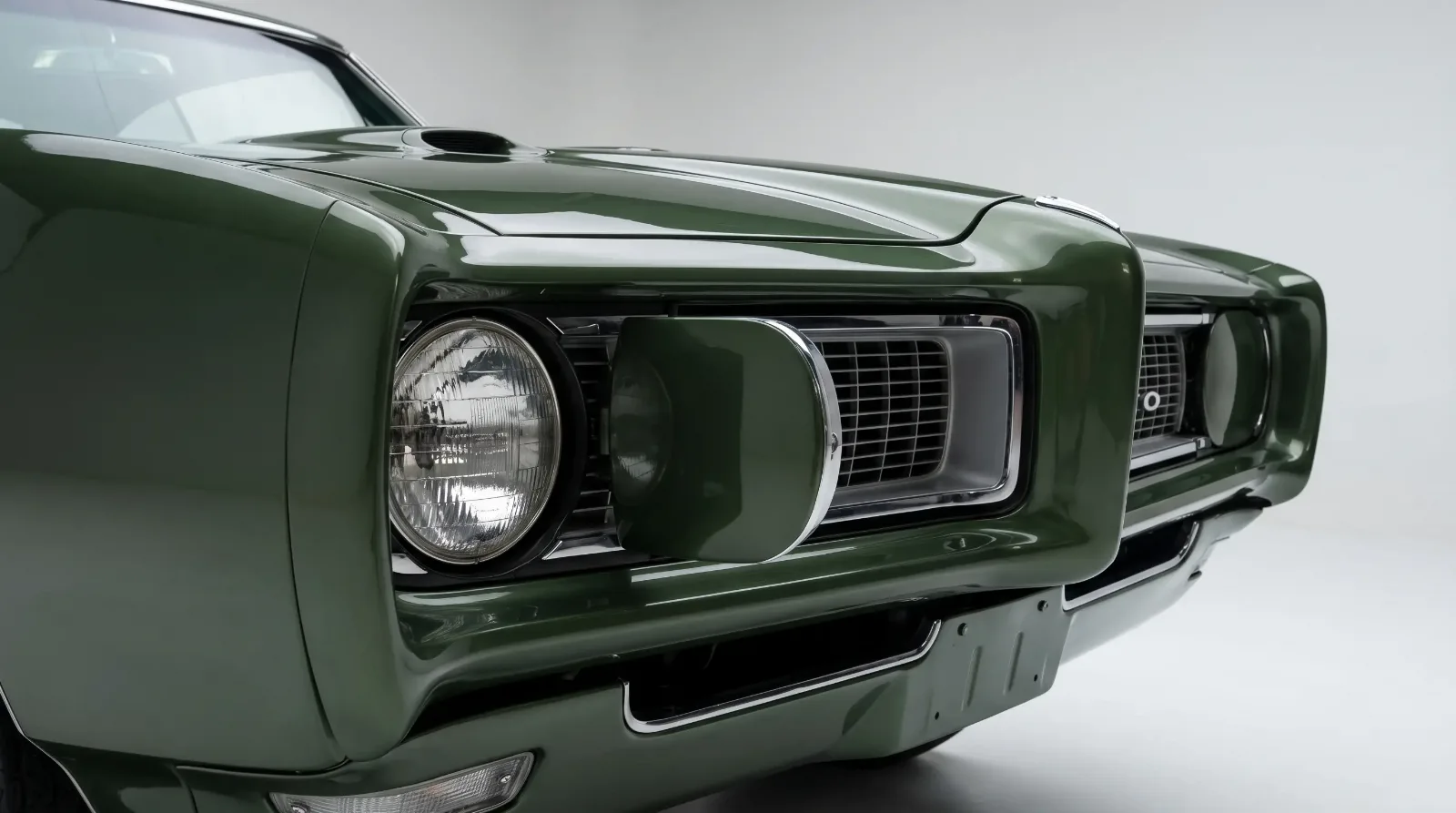
How the vacuum system actually operates
The doors are driven by engine vacuum, routed through a system of hoses, a vacuum reservoir tank (so the doors still work briefly if engine vacuum drops under hard acceleration), and vacuum-actuated motors mounted behind each headlight bucket. Flip the headlight switch, and vacuum pulls the doors open in a smooth rotating motion rather than a pop-up. It's a different mechanism from the pop-up headlights people associate with later cars like the Corvette or the Firebird, and it's arguably more elegant, since the doors follow the contour of the Endura nose rather than flipping up out of it.
The catch is that any vacuum system ages the same way, regardless of what it's operating. Hoses crack, harden, and develop leaks. Check valves stick. The vacuum reservoir tank corrodes from the inside. On a fifty-plus-year-old car, a headlight door that won't open, won't close, or opens unevenly compared to its partner is almost always a vacuum problem, not a motor or linkage failure, and that's good news because vacuum problems are cheap and straightforward to diagnose if you know where to look.
Tracing the hose routing under the hood
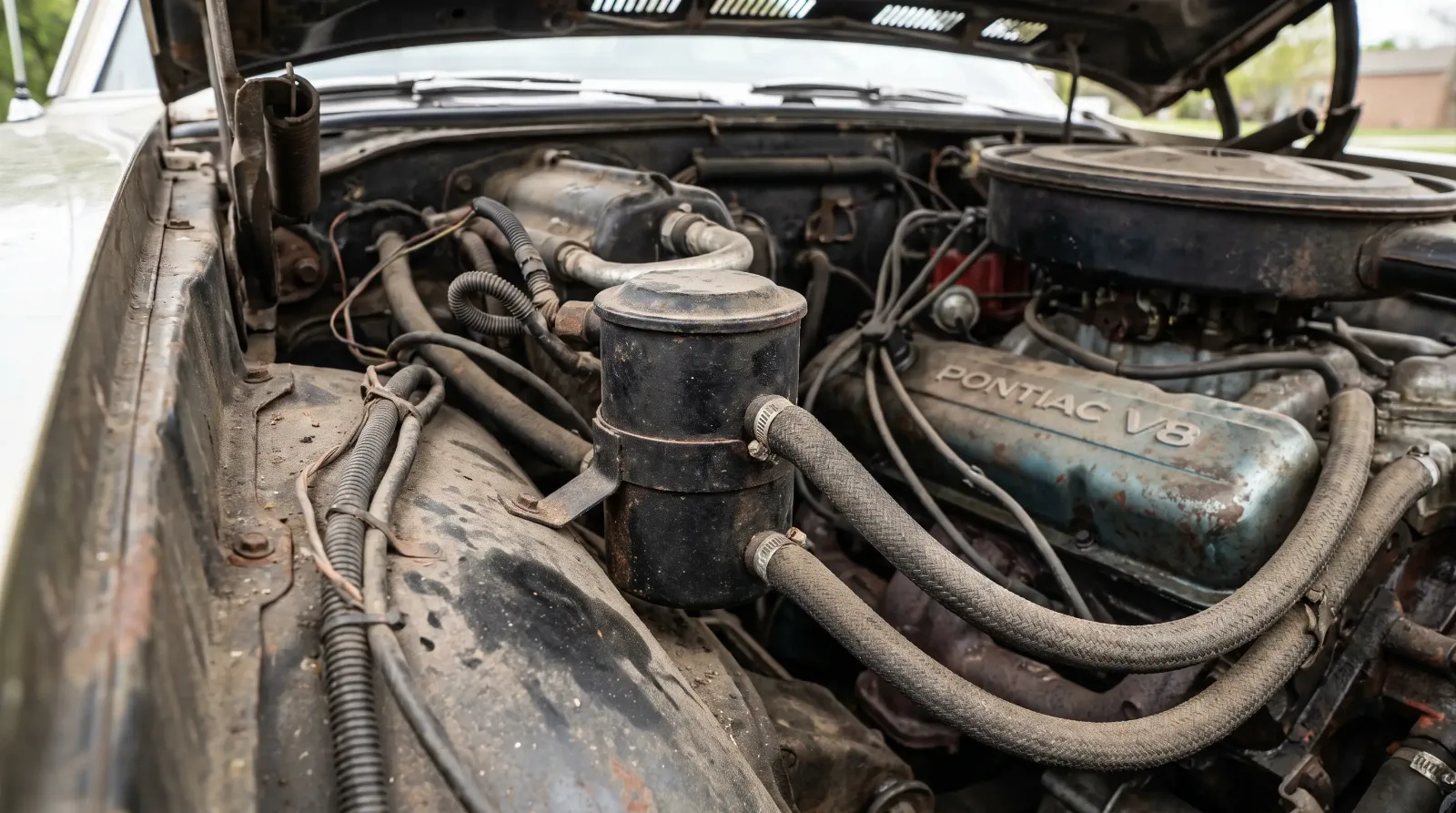
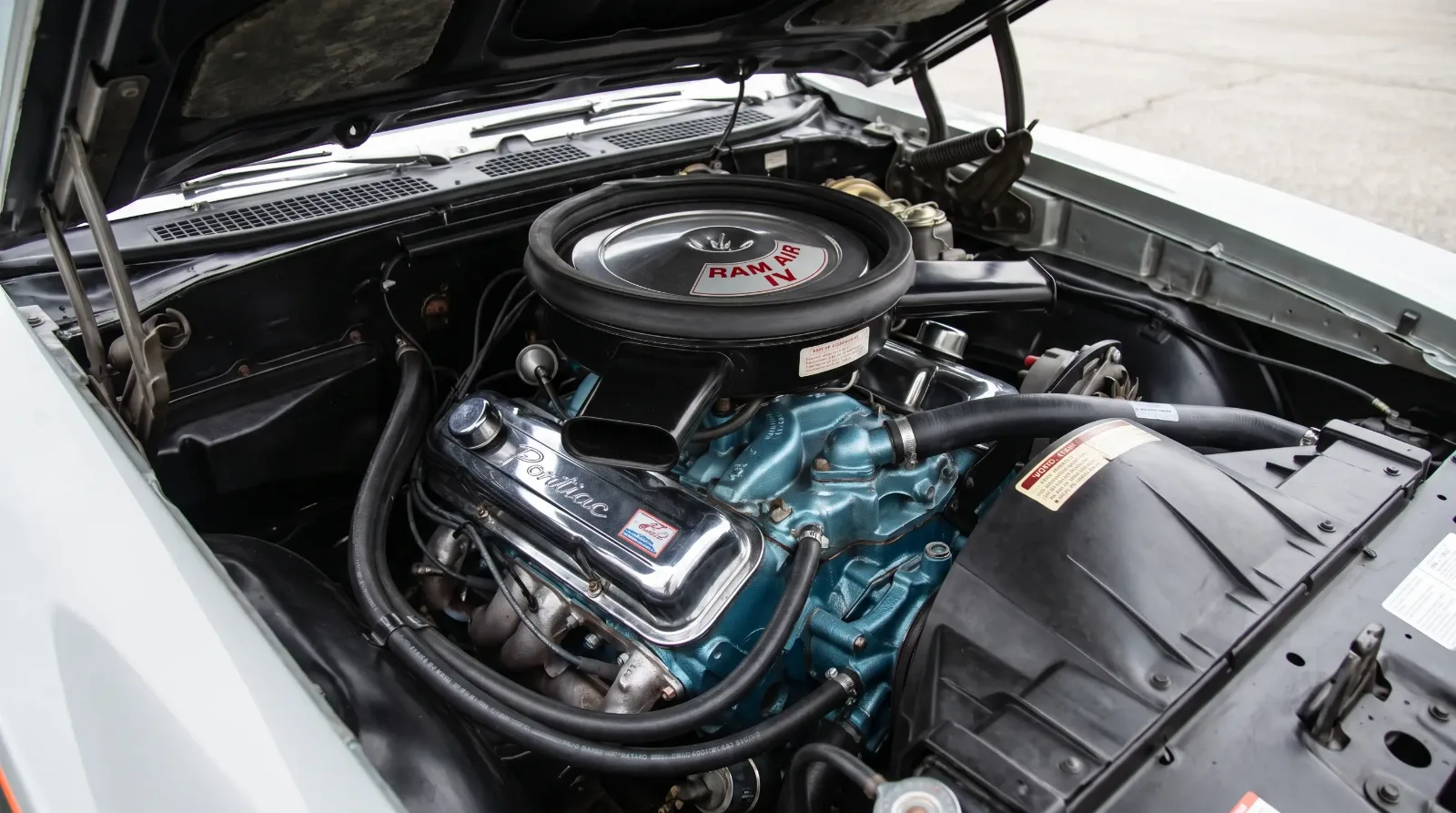
If you're chasing a hidden-headlight problem for the first time, start at the source. Engine vacuum feeds a check valve near the intake, which keeps vacuum on the reservoir tank from bleeding back into the engine when manifold vacuum drops under load. From the tank, individual hoses run forward to each headlight door motor, usually routed along the inner fender and through a factory grommet in the radiator support. Every one of those connection points is a place a fifty-year-old hose can crack, and every grommet is a place road grime and heat cycling can turn rubber brittle.
My habit on any car I'm inspecting is to pull the hood and just look at hose color and texture before I even try the switch. Hoses that are shiny black and pliable are probably newer replacements. Hoses that are dull gray, stiff, or cracked at the bends are original or close to it, and I budget for a full set regardless of whether the doors are working that day. A hose can look fine and still be porous enough to leak vacuum slowly, which is exactly the kind of problem that shows up as a door that opens a half-second slower than its partner rather than one that fails outright.
🔧 Inspection Priorities
- Cycle the headlights several times and watch both doors together. Uneven timing between the two sides usually points to a leaking hose or a weak reservoir, not a failed motor. Budget for a full hose replacement if the car hasn't had one recently.
- Check for aftermarket "fixes" that bypass the vacuum system entirely. Some owners have converted to electric actuators over the decades. That's not original, and it affects both authenticity and value on a numbers-conscious buyer's checklist.
- Inspect the door alignment with the nose closed. Gaps or a door that sits proud of the Endura surface usually means the mounting hardware has loosened or the Endura material itself has shrunk around the opening.
- Ask about the reservoir tank's condition. It's tucked under the hood and easy to ignore, but a rusted-through tank kills vacuum reserve and makes the doors sluggish under load.
- Listen for the motors themselves. A healthy vacuum motor moves the door with a quiet, controlled sweep. A motor with a torn diaphragm will hiss audibly and the door will move slowly or not fully seat, even with good hoses feeding it.
Why Pontiac offered it as an option, not standard
Hidden headlights added cost and complexity Pontiac didn't want to force onto every GTO buyer, especially the ones cross-shopping a Chevelle SS or a Road Runner on price. Offering it as an option let Pontiac sell the same base car to a budget-conscious buyer and a styling-conscious buyer without pricing either one out. It also let Pontiac use the hidden-headlight cars as the image leaders in advertising and press photography, even though plenty of GTOs left the factory with conventional exposed headlights integrated cleanly into the Endura nose.
There's also a practical reason the option didn't sell as universally as the ad campaigns might suggest. Any added mechanical system on a muscle car is one more thing that can fail, and plenty of buyers in 1968 and 1969 were shopping on the strength of the drivetrain, not the front-end theatrics. A base GTO with exposed headlights integrated into the Endura nose still had the same 400 cubic inch V8 and the same underlying toughness the sledgehammer ads were selling. For a segment of buyers, that was enough, and it's why exposed-headlight cars from these two years are actually more common in the surviving population than the hidden-headlight option would suggest from how often it shows up in period photography.
"I always tell people shopping a hidden-headlight car, don't just check that the doors open. Check that they open together, at the same speed, and seat flush when they close. If one door is lagging, you're not looking at a five-dollar fix, you're looking at a full afternoon under the hood chasing vacuum leaks."
Mike Sullivan
💡 Did You Know?
The hidden-headlight vacuum system draws from the same vacuum tree at the back of the carburetor that feeds the power brake booster, and on air-conditioned cars the A/C system taps off that line too. A leak that starts in the headlight hoses can pull down vacuum shared by those other systems, which is why a car with a soft brake pedal or a sluggish A/C alongside slow headlight doors is often chasing one underlying vacuum leak, not three separate problems.
Living with the system today
The honest truth is that hidden headlights are one more system to maintain on a car that already has plenty to look after, and a lot of long-term owners have their own opinions about whether the added style is worth the added fuss. My take, having wrenched on more than a few of these, is that the system is genuinely reliable once it's been properly gone through with fresh hoses, a sound reservoir, and clean vacuum motors. Most of the "unreliable hidden headlights" reputation comes from cars that simply haven't had that basic service done in twenty or thirty years, not from any real design flaw in the system itself.
Parts availability is better than you'd expect for a fifty-plus-year-old vacuum system. Reproduction hoses, check valves, and even reservoir tanks are out there through the usual muscle car parts channels, and none of it requires exotic fabrication. The doors themselves and their hinge mechanisms are the pieces to watch for wear, since a worn hinge pin can let a door sag even when the vacuum side of things is working perfectly. If you're restoring one from scratch, do the whole system at once rather than chasing individual failures one at a time, because the labor to access these components is largely the same whether you're replacing one hose or all of them.
If you're weighing a hidden-headlight 1968 or 1969 car against the more common exposed-headlight version, the styling difference is real, but so is the maintenance difference. For the rest of what defines these model years mechanically, read on for a full look at the drivetrain lineup that came under that Endura nose.
Sources and notes
Related Reading
Have a
Pontiac GTO
for Sale?
Reach thousands of serious classic car collectors across the US.
Sell It Here →
Are You a Classic Car Dealer?
List your full inventory and connect with targeted classic car buyers.
Join as a Dealer →

About the author
Mike Sullivan
Detroit-area muscle car enthusiast and restoration specialist with three decades of hands-on experience working on American iron.
Related Listings - Pontiac GTO


Comments
Be the first to comment on this article.