
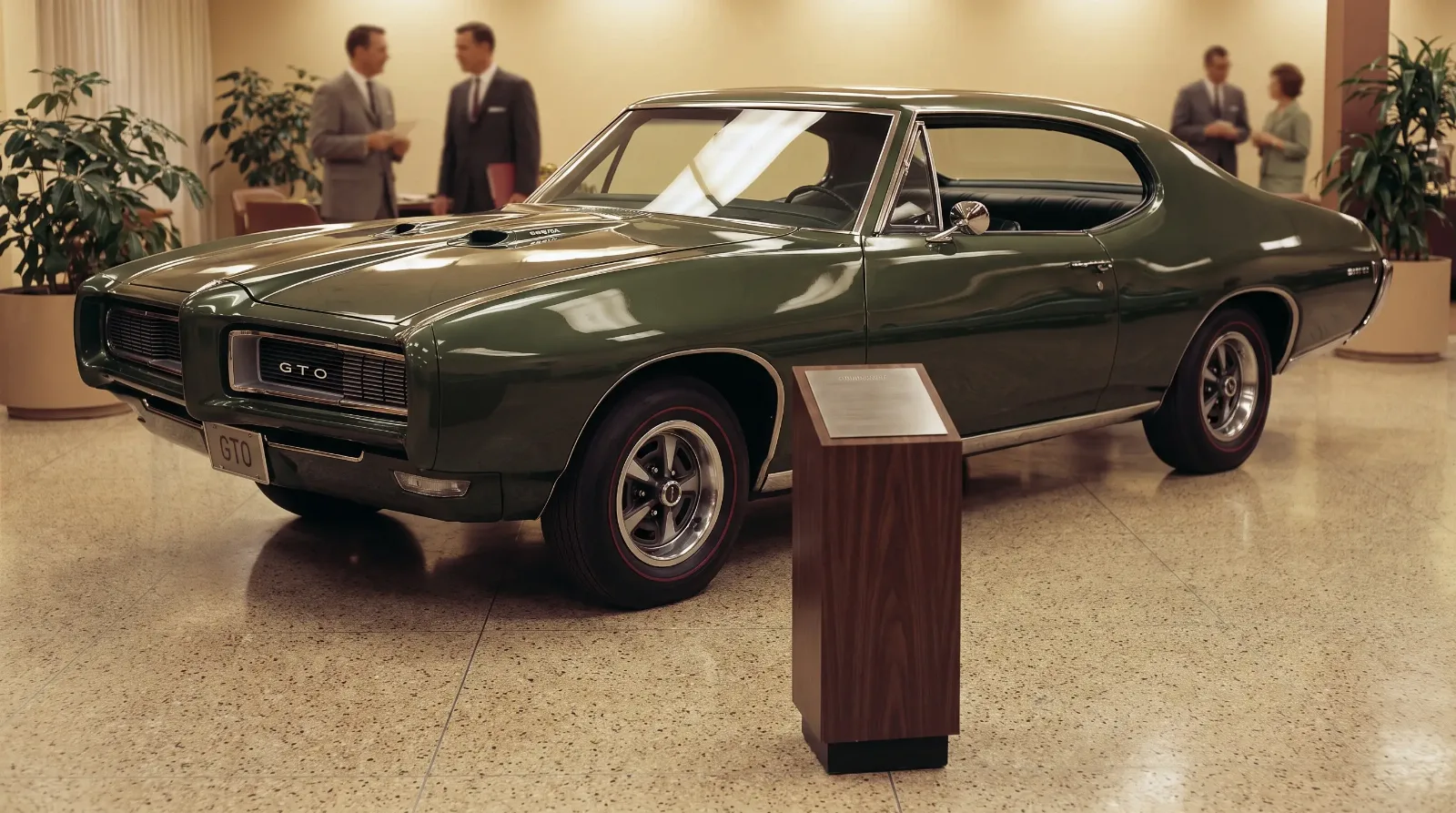
The man in the photograph is standing at the front of a 1968 GTO with a sledgehammer raised over one shoulder, and he is about to swing it into the car's nose like he means it. That image ran in Pontiac's print advertising the year the Endura front end debuted, and it is one of those pictures that tells you everything about how a company felt about its own engineering. You don't hand a stranger a sledgehammer and point him at your product unless you already know what's going to happen when he swings.
Car Features
7 min read
The Hood-Hinge Sledgehammer Ad: Selling the Endura's Toughness
A man, a sledgehammer, and a GTO nose that wouldn't crack. Here's the story behind Pontiac's boldest proof-of-durability ad.
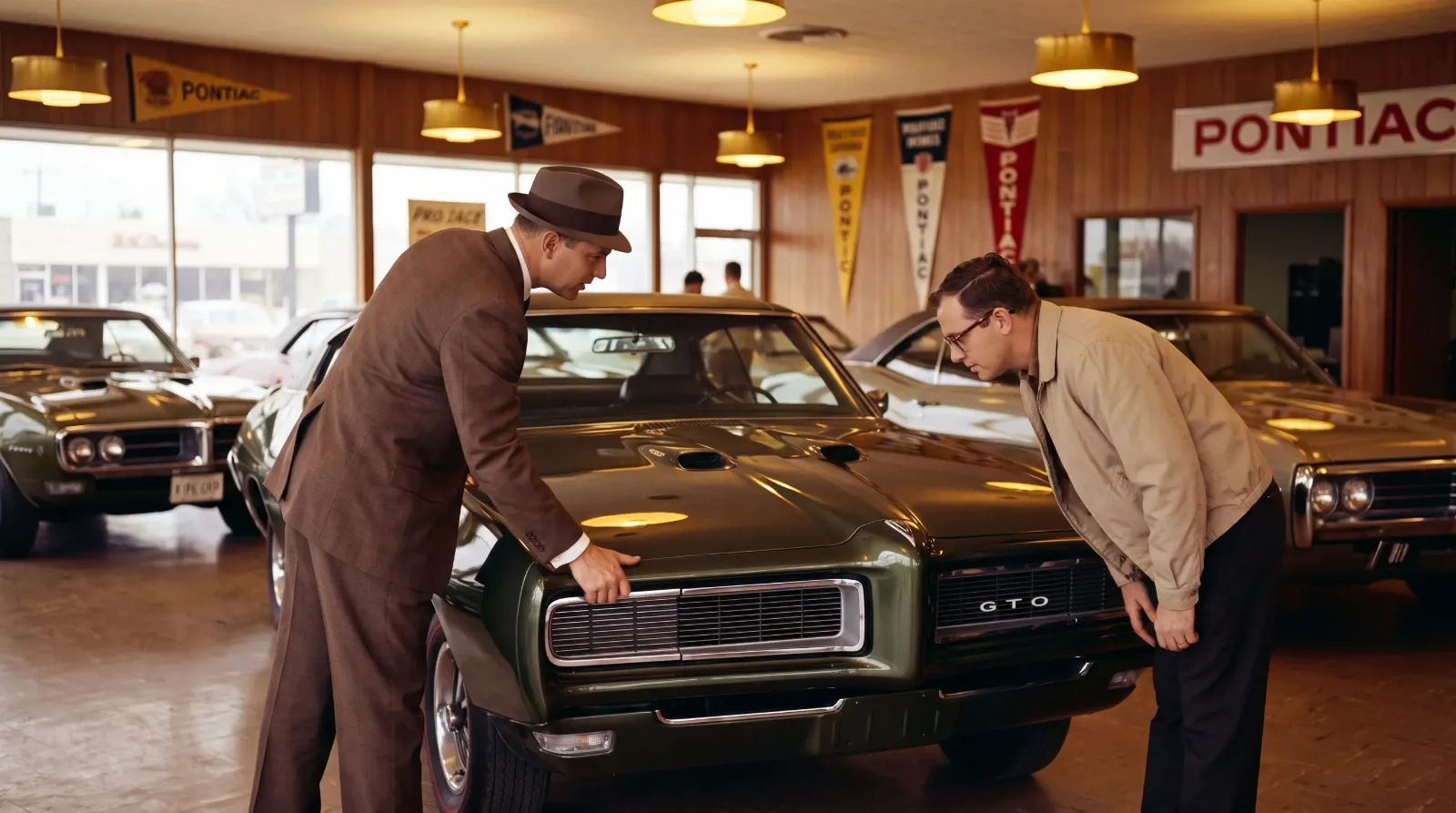
The ad wasn't a metaphor. Pontiac genuinely wanted people to believe, and to see for themselves, that the 1968-69 GTO could take a real hit to the front end and shrug it off, while every chrome-nosed competitor in the showroom would dent, crease, or crack.
A car built to sell its own toughness
Pontiac's marketing team, still working under John DeLorean, who remained Pontiac's general manager through the 1968 model year and would not move over to run Chevrolet until 1969, understood something about the customer they were chasing. This wasn't a buyer who wanted a subtle argument about polymer chemistry. He wanted proof, delivered in the most direct language possible. So the campaign built around Endura leaned into demonstration rather than description. Show a man hitting the car with a hammer. Let the reader draw the conclusion.
The sledgehammer ad worked because it made a genuinely novel piece of engineering, a body-colored, energy-absorbing front end molded from a semi-rigid urethane material, feel like something you could understand in your gut rather than something you had to take an engineer's word for. It reduced a materials-science breakthrough to a single, visceral image. A car that gets hit and comes back for more.
The image itself, held a little longer
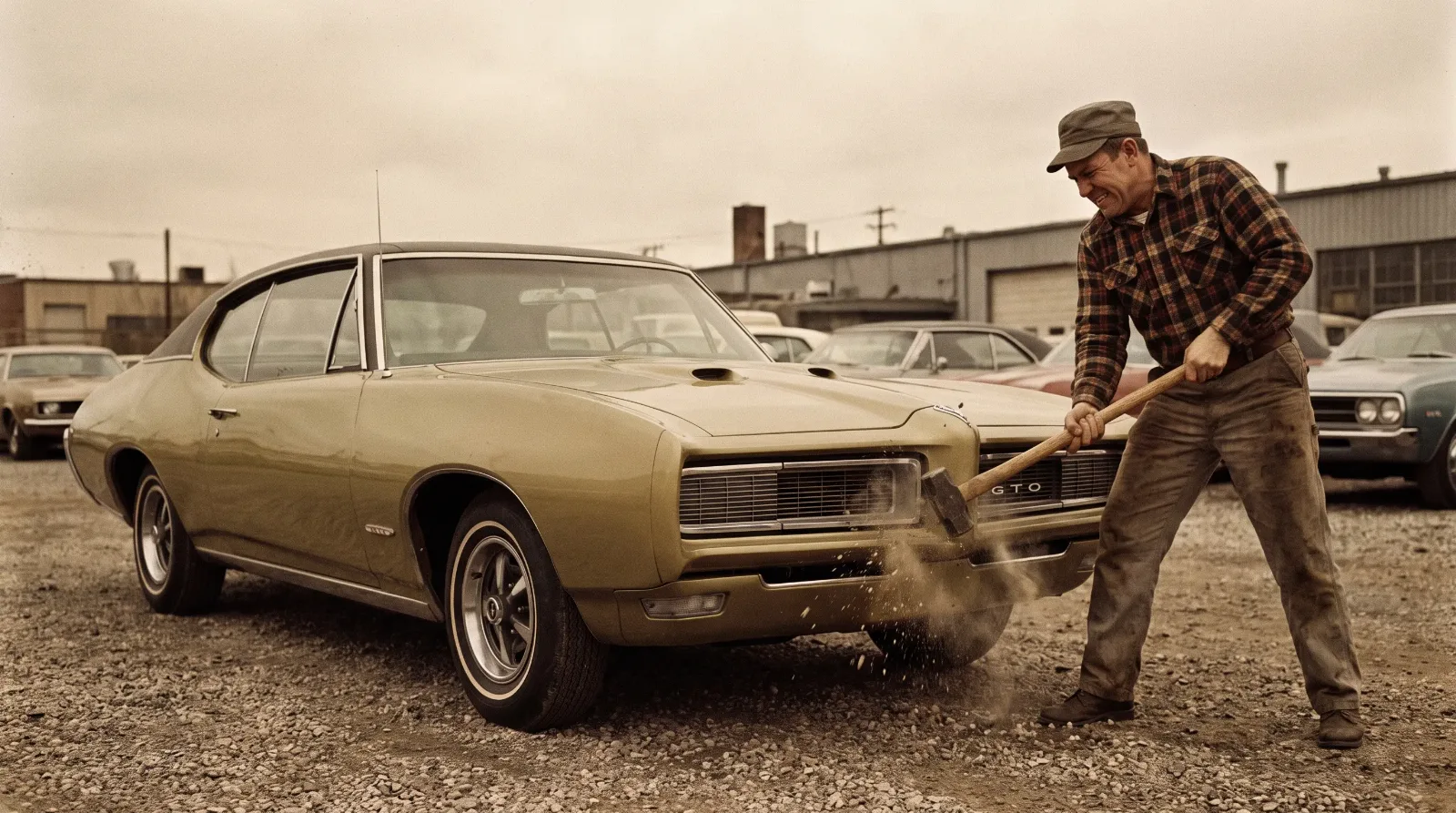
Look at the photograph again, past the headline. The man swinging the hammer isn't wearing a lab coat and he isn't posed like a stuntman. He looks like someone's neighbor, someone who might have wandered over from the sidewalk to see what all the fuss was about. That casting choice wasn't an accident. Pontiac wanted the viewer to see themselves in that stance, arm cocked, ready to test a claim most people had never thought to question before, because nobody had ever dared them to swing at a bumper. The whole composition asks a quiet question underneath the loud one. If this were your car, would you trust it enough to let a stranger take a swing?
"I think about that ad every time I watch someone lean against a modern car's plastic bumper without thinking twice about it. That casualness, the assumption that a bumper can take a knock and not shatter, started somewhere. For a lot of buyers in 1968, this GTO ad was the first time anyone had shown them a bumper could work that way."
Nora Beckett
The showroom theater it created
Dealers picked up on the energy of the campaign and ran with it. There are period accounts of salesmen doing their own small versions of the demonstration on the showroom floor, tapping the Endura nose with a fist or a light object in front of a skeptical customer, letting the material's give do the convincing. It's the kind of showroom moment that doesn't happen with a car today, not because the engineering isn't there, but because nobody advertises a bumper as an event anymore. In 1968, Pontiac made it one.
The ad's success also says something about the mood of the muscle car market at that exact moment. Buyers wanted swagger, and they wanted proof that swagger had substance behind it. A fast car with a nose that could take a hit fit the persona the GTO had built since 1964. It wasn't a delicate machine. It was a car that could go 0-60 with real urgency and then absorb a parking lot mistake without a trip to the body shop.
💡 Did You Know?
Print ads weren't the only place the sledgehammer demonstration showed up. Pontiac dealers received promotional materials built around the same stunt for in-store use, and period accounts describe some regional dealerships staging their own live versions of the demonstration at auto shows, letting a salesman or even a curious customer take an actual swing at a display nose panel.
What the demonstration didn't tell you
What the ad didn't show, and couldn't easily show in a single photograph, is how the material aged. Endura held up beautifully to a single dramatic hammer strike in a studio, filmed for one perfect shot. It held up less beautifully to decades of sun, cold, and flexing, and original Endura noses today are known for shrinkage and paint cracking that has nothing to do with impact damage. That's a separate story, but it's worth knowing the demonstration was honest about impact resistance and silent about long-term material fatigue.
There's a quiet irony in that gap between the ad's promise and the material's long life, one that only becomes visible with fifty years of hindsight. The sledgehammer never lied. A brand-new Endura nose really could take that hit and spring back, and the footage wasn't a trick of editing. But nobody in 1968 was advertising what a bumper looks like after three decades of Michigan winters, because nobody making the ad had any way to know. That's not dishonesty so much as the limit of what a single photograph can promise. It sold the car it was, not the car it would become.
Still, the campaign did something advertising rarely manages. It made an engineering decision feel like a personality trait of the car itself. Fifty years later, the sledgehammer ad is still the image people reach for when they explain what made the Endura-nosed GTO different, more than any spec sheet ever could.
What it competed against on the same magazine page
Turn the page in a 1968 issue of any car enthusiast magazine and the sledgehammer ad sat alongside a familiar parade of chrome-bumper promises from every other Detroit manufacturer, most of them still leaning on horsepower figures and racing lineage to make their case. Those ads told you what a car could do in a straight line. The sledgehammer ad told you what the car could survive on an ordinary Tuesday, in a parking lot, in traffic, in the version of driving that actually fills up most of a car's life. That distinction mattered more than it might seem. Muscle car buyers in this era weren't only weekend racers. Plenty of them drove these cars to work, to the grocery store, to pick up a date, and an ad that spoke to that daily reality carried a different kind of weight than one more quarter-mile brag.
The contrast also worked in Pontiac's favor because nobody else in the segment could run the same ad. A Road Runner or a Chevelle SS with a conventional chrome bumper had nothing comparable to demonstrate. Hit a chrome bumper with a sledgehammer and you get a dent, a crease, maybe a cracked grille behind it, and none of that photographs as a victory. Pontiac had built something its rivals structurally could not copy on short notice, and the ad campaign made sure buyers understood that gap wasn't cosmetic. It was a genuine engineering advantage translated into showroom language everyone could understand without an engineering degree.
Why the image endures
Car people trade in stories more than numbers, and the sledgehammer ad is one of the best stories the GTO ever told about itself. It's blunt, it's a little theatrical, and it's completely true to what the car actually was in 1968: a machine built by people who wanted you to test it, not just trust it. If you haven't traced the rest of that model year's story, from the hidden headlights to the numbers under the hood, read on for how the whole package came together.
Sources and notes
- Mac's Motor City Garage - Soft Revolution: the 1968 GTO Endura nose
- Wikipedia - John DeLorean
- GTO Association of America - 1968 Pontiac GTO
- YouTube - 1968 Pontiac GTO period commercial
- Ate Up With Motor - Pontiac Wide Track history, Knudsen/Estes/DeLorean era
- Hagerty - definitive Pontiac GTO buyer's guide
Related Reading
Have a
Pontiac GTO
for Sale?
Reach thousands of serious classic car collectors across the US.
Sell It Here →
Are You a Classic Car Dealer?
List your full inventory and connect with targeted classic car buyers.
Join as a Dealer →

About the author
Nora Beckett
Automotive features writer and photographer who tells the human stories behind the cars, from show fields to cross-country road trips.
Related Listings - Pontiac GTO


Comments
Be the first to comment on this article.