
Every big Mustang show has the same moment. A crowd forms around a Mach 1 or a Boss, and two spaces down sits a 1969 SportsRoof with a six-cylinder, a plain interior and a small badge on the rear quarter that reads "Mustang E." Most people walk past it. Then somebody who knows stops, crouches down to read the badge, and asks the owner the only question that matters: "Have you got the paperwork?" The 1969 Ford Mustang E was built in tiny numbers, and it is almost impossible to tell from a common one at a glance.
Car Features
6 min read
The 1969 Mustang E: Ford's Rare Economy Pony
A 250 six, a C4 with a high-stall converter and a 2.33 axle, built for an economy run that never happened. How to prove a 1969 Mustang E is real.
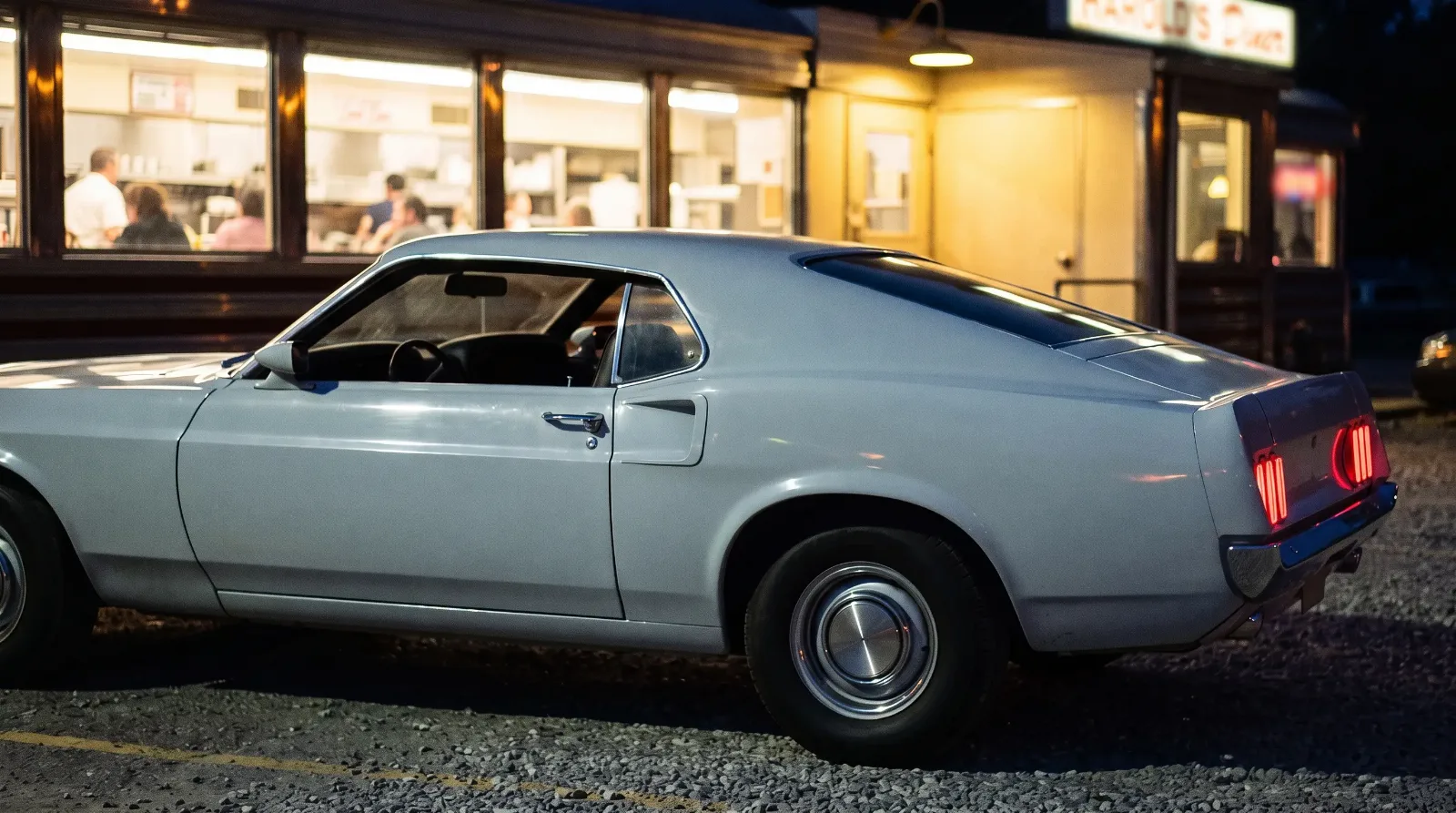
That makes it a car built for club arguments. It also makes it a car where the documents carry more weight than the sheet metal, which is where this story ends up, as these stories usually do.
Why Ford built an economy Mustang in 1969
The timing looks strange at first. 1969 was the year Ford loaded the Mustang with muscle: the Mach 1, the Boss 302 and the Boss 429 all arrived, along with the luxury Grandé. The longer, wider body with four headlights is covered here, and it was mostly sold on performance.
The Mustang E came from a different direction. Ford built it for the Mobilgas Economy Run, a fuel-economy event whose rules called for 50 production cars. The cars had to be production Mustangs, not hand-built specials. Then, in December 1968, Mobil cancelled the 1969 run, and the event was never held again. Ford had an economy Mustang ready, and the event it was built for never happened that year.
So the E became an orphan the moment it existed. No event to win, no headline to grab, and a product line busy shouting about horsepower. You can see why so few were built, and why so few people remember them.
What made a Mustang E different
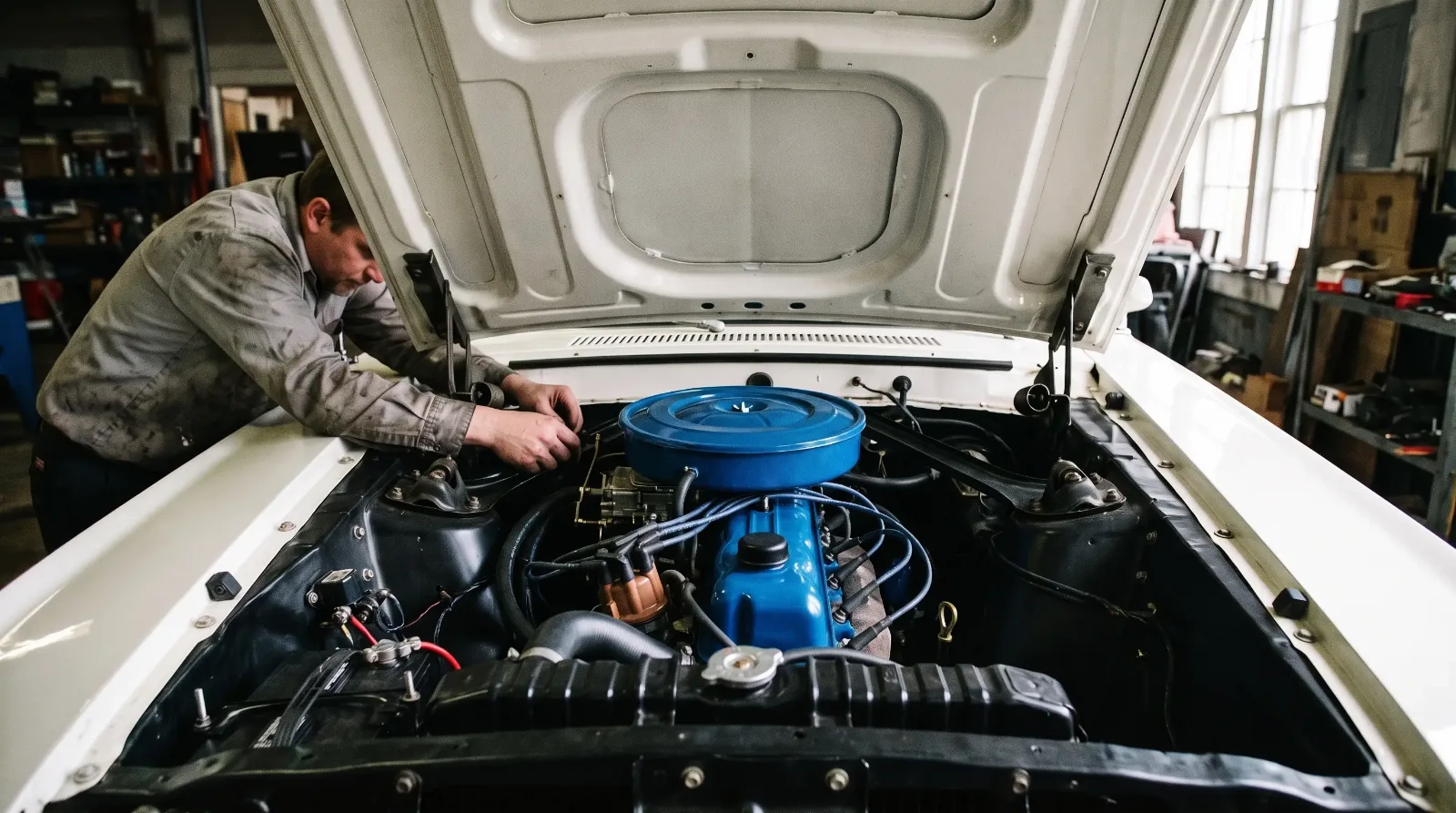
On paper, nothing about the E sounds exotic. Look closer and every part was chosen to keep engine speed down. It used the new 250 six, rated at 155 hp at 4,000 rpm and 240 lb-ft at 2,600 rpm (SAE gross). Behind it sat a C4 automatic with a high-stall torque converter, and out back a 2.33:1 axle ratio.
That axle is the heart of the car. A 2.33 is very tall gearing, so the six turned slowly at highway speed. The high-stall converter was there to help the car get moving from a stop, since that tall gear did it no favors off the line. Ford was trading acceleration for cruising economy, plainly and on purpose.
Every Mustang E was a SportsRoof, the name Ford's 1969 literature gave the fastback. Each wore the "Mustang E" badge on the rear quarter. Air conditioning was not available, which made sense for a car built to save fuel and makes less sense if you live somewhere hot.
| Item | 1969 Mustang E |
|---|---|
| Body | SportsRoof only |
| Engine | 250 six (VIN engine code L), 155 hp, 240 lb-ft gross |
| Transmission | C4 automatic, high-stall converter |
| Axle ratio | 2.33:1 |
| Air conditioning | Not available |
| Identification | "Mustang E" rear-quarter badge |
| Production | About 50 or 96, sources disagree |
How many 1969 Ford Mustang E cars were built?
This is where the club conversation usually gets loud. Wikipedia and MustangSpecs say about 50, which lines up neatly with the 50 cars the economy run required. Kevin Marti, who works from Ford's production data, told Fox News the number was 96. A 2024 history from the MotorCities National Heritage Area also gives 96, all built at Dearborn. Both figures get repeated at shows with total confidence. I lean toward 96 because of where it comes from, but neither number has a Ford document I can point you to, and that is worth admitting.
Either way, put it next to the 61,980 SportsRoofs and 72,458 Mach 1s Ford built for 1969. Even at 96, the E is a rounding error in that year's production.
The performance figures are shakier still. Fox News and the MotorCities history both repeat the same numbers for the E: about 19 mpg on the highway, and 0 to 60 mph in about 13.3 seconds, nearly three seconds slower than a regular six. Fox credits them to a journalist's blog, and neither piece ties them to a period road test or a Ford document. There was no EPA in 1969 to rate anyone's fuel economy, so treat them as estimates, not factory ratings.
"I've heard a dozen great stories about Mustang E cars, and I believe the ones that came with a build report. The badge is a piece of trim. The paperwork is the car."
Wayne Coburn
Proving a Mustang E is the real thing
Here is the punchline that every Mustang E story builds toward. The badge proves nothing. Anyone can buy one and stick it on a six-cylinder SportsRoof, and the rest of the car looks just like thousands of ordinary 1969 sixes. A plain car with a rare badge is the easiest kind of fake to make and the hardest to spot from the curb.
What settles it is the build data. A Marti Report draws on Ford's production database for every model year from 1967 on, which covers 1969 nicely. It lists what the car left the factory with. It will not tell you whether a car is genuine or in good condition, only what Ford recorded, and that is exactly the evidence you need.
The orphan's place in the family
The Mustang E never got a second year. When Ford moved on to the 1970 Mustang, with its return to two headlights, the economy experiment simply was not part of the plan. The economy run it was built for had been cancelled before the E ever turned a wheel in it.
That is part of its charm now. Collectors usually chase the loudest Mustangs, and the E is the quietest of the lot: a six, an automatic and gearing meant for long, patient highway miles. It shows that even in the year of the Boss 429, someone at Ford was thinking about fuel economy. For more on the first-generation Mustang cars, the bigger story runs from 1964½ to 1973. If you find a Mustang E with its paperwork intact, you have found something most Mustang people have only heard about.
Sources and notes
- Before the Mustang Mach-E, the rare 1969 Mustang E, Fox News
- Remembering the 1969 Ford Mustang "E", MotorCities National Heritage Area
- 1969 Ford Mustang E guide, MustangSpecs
- Ford Mustang (first generation), Wikipedia
- 1969 Ford Mustang specifications and production, MustangSpecs
- Marti Auto Works: Ford build reports, 1967 onward
Related Reading
Have a
Ford Mustang
for Sale?
Reach thousands of serious classic car collectors across the US.
Sell It Here →
Selling a classic? Here's how: where to sell your classic car online
Are You a Classic Car Dealer?
List your full inventory and connect with targeted classic car buyers.
Join as a Dealer →

About the author
Wayne Coburn
Longtime Corvette owner, judge and club figure who knows the cars, the records and the people behind them.
Related Listings - Ford Mustang

Comments
Be the first to comment on this article.