
The Rubicon Trail does not care what you drive today, but for most of the twentieth century the answer was a Jeep CJ. Twenty two miles of granite slabs and boulder fields between Loon Lake and Lake Tahoe, California, the trail has been humbling vehicles since before it had an official name, and the classic CJ, in its CJ-2A, CJ-3B and CJ-5 forms, is the machine that proved it could be driven rather than just endured on foot or by mule.
Car Features
8 min read
The Rubicon Trail and the CJ That Conquered It
Long before the Wrangler Rubicon borrowed its name, the classic Jeep CJ and the Jeepers Jamboree turned a brutal granite trail into the proving ground that defined off road culture.
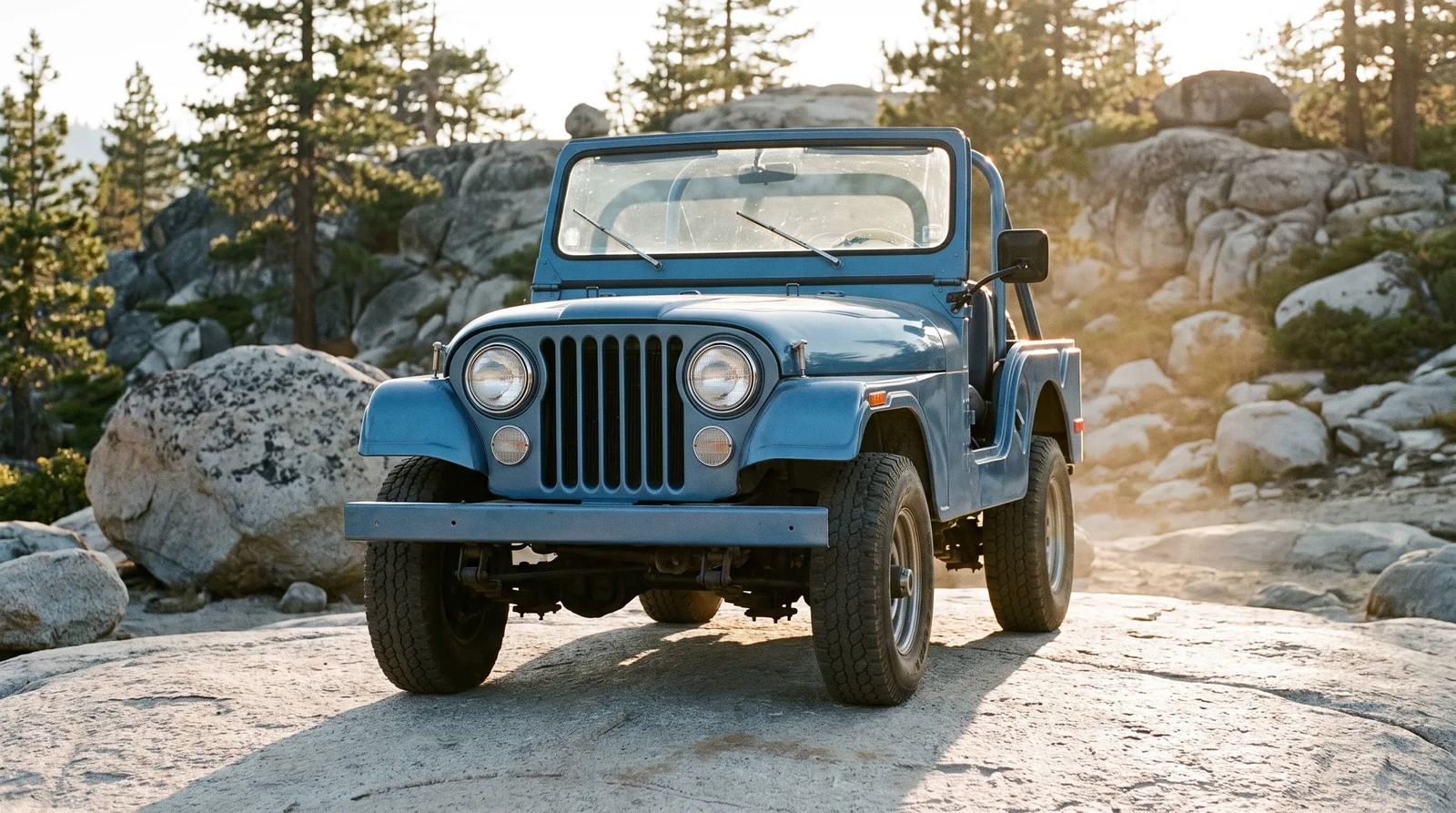
Understanding why the Rubicon matters to Jeep CJ culture rubicon trail history means going back to 1953, when a group of Georgetown, California businessmen organized the first Jeepers Jamboree as a way to bring tourism dollars into the Sierra foothills. Fifty five vehicles and about 155 people, most of them war surplus and early civilian Jeeps and their owners, made the run that first year. It was slow, it broke axles, and it worked. The event survived, and so did the idea that a short wheelbase four wheel drive vehicle with low range gearing could go places that no sedan, and few trucks, would attempt.
A trail shaped by granite, not by planners
The Rubicon was never engineered as an off road proving ground. It began as a stagecoach and cattle route across the Sierra Nevada, later used by loggers and miners, and its surface is largely exposed granite bedrock, polished in places and jagged in others, that shifts and cracks with the seasons. There is no soil to grade and no gravel to spread evenly, which means the trail has stayed close to its natural, brutal state for over a century. Drivers do not so much choose a line as negotiate with the rock.
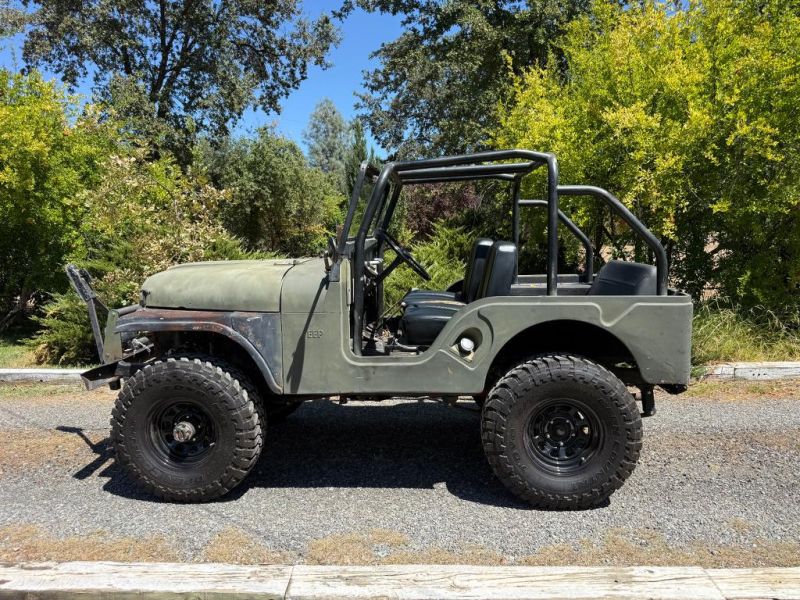
For a CJ with its narrow track, tight turning radius, and low curb weight, that terrain was a genuine advantage in the 1950s and 1960s, when most competing off road options were converted farm trucks or oversized military surplus. The CJ's compact dimensions let it thread between boulders that stopped wider vehicles cold, and its solid front and rear axles, inherited straight from the wartime MB, gave it the articulation to keep three wheels on the rock even when the fourth was hanging in space.
The Jamboree turns a trail into an institution
What made the Rubicon central to CJ culture was not a single crossing but a repeated, organized one. The Jeepers Jamboree ran the trail annually, and by the 1960s it had grown from a chamber of commerce publicity stunt into a genuine subculture, complete with its own traditions, its own veterans, and its own vocabulary of obstacles that drivers still argue about today. Owners who might never off road anywhere else made a pilgrimage to Georgetown once in their lives, and many came back every year in the same CJ, patched and welded a little more each season.
The trail also produced its own mythology within the wider Jeep world. Stories of CJs winched over granite steps, of axles left behind and replaced trailside, of a Jamboree veteran who drove the same CJ-3B across the trail for three decades, circulated at truck stops and swap meets long before internet forums existed to record them. That oral history is part of why the Rubicon still carries weight in the jeep cj renegade story, where the trail's reputation for toughness became shorthand for what a properly built CJ was supposed to be able to survive.
What the trail demanded of a stock CJ
The Rubicon's obstacles, later given names like Little Sluice, Big Sluice, and Cadillac Hill by generations of Jamboree participants, were rarely survivable on street tires and stock gearing without careful line selection and a good spotter. Ground clearance mattered more than horsepower. A CJ's factory approach and departure angles, combined with its short wheelbase, meant drivers could point the front tires nearly straight up a ledge without the rear bumper catching, something a longer wagon or pickup could not manage without modification.
That said, the trail was hard on equipment. Broken axle shafts, torn u joints, and cracked oil pans were common enough that Jamboree organizers eventually built a support infrastructure, trailing mechanics and parts trucks, into the event itself. Owners learned to carry spares because the nearest tow truck was, in practical terms, hours and a helicopter away. That culture of self reliance on the trail fed directly into how CJ owners approached their vehicles everywhere else.
"You did not really know your Jeep until the Rubicon had tried to take it apart. Every rattle, every weak weld, every bolt you forgot to torque, that trail found it, and then you fixed it in a parking lot in Georgetown surrounded by fifty other people doing the same thing."
- Patrick Walsh
A trail that outlasted the vehicle it made famous
The CJ went out of production in 1986, replaced by the Wrangler YJ, but the Rubicon Trail kept running, and so did the Jamboree. What changed was the mix of vehicles attempting it, modern trucks and SUVs with far more suspension travel and far less mechanical simplicity than a CJ ever had. Yet the CJ's association with the trail never fully faded. Restored CJ-5s and CJ-7s still show up at Jeepers Jamboree events, driven by owners who want to prove the old formula still works, and often it does, provided the axles have been rebuilt and the driver respects the granite.
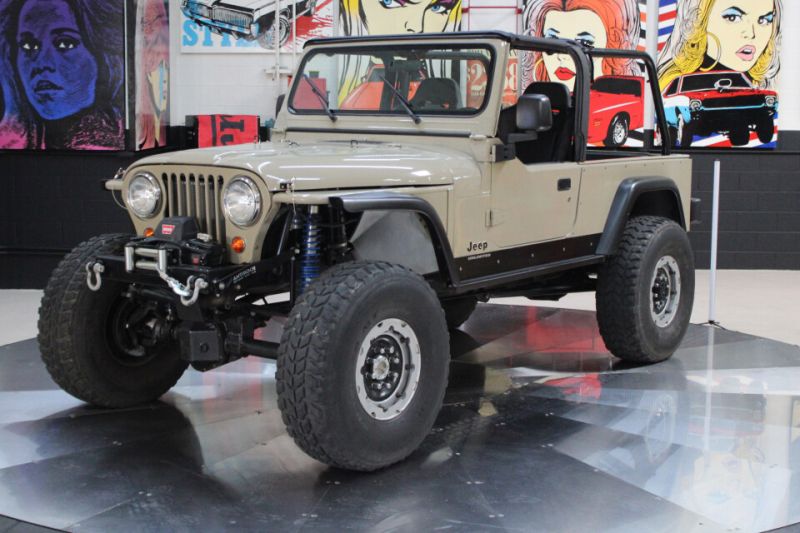
The trail's importance to Jeep CJ culture rubicon trail history is really a story about proof. Advertising copy could claim a vehicle was capable, but the Rubicon made drivers demonstrate it in public, in front of other owners, on terrain that offered no shortcuts. That kind of proving ground is rare, and it is a large part of why the CJ's reputation for toughness has outlived the vehicle's production run by nearly four decades. Anyone curious about how that reputation was built model by model can read the full story of the CJ line, and anyone who wants to see what a trail proven CJ looks like today can browse classic CJs on the market to compare restored examples against the originals that first climbed Cadillac Hill.
Why the trail still matters to collectors
For today's buyers, a documented Jeepers Jamboree history on a CJ, complete with dash plaques, event patches, and photographs, adds a layer of provenance that a purely cosmetic restoration cannot replicate. It signals a vehicle that was used as its designers intended, not just preserved in a garage. That distinction matters more every year, as fewer CJs with genuine trail history remain unmodified, and as the Rubicon itself continues to separate vehicles that are built to go somewhere from vehicles that are only built to look like they could.
The trail has also changed how some owners approach restoration decisions. A CJ that spent decades doing real Rubicon crossings usually shows it, in axle housings that have been rebuilt more than once, in frame rails that carry old weld repairs, in a drivetrain that has clearly been maintained by someone who understood the vehicle rather than simply admired it. Buyers chasing a numbers matching, showroom correct restoration sometimes overlook these vehicles in favor of cleaner, less used examples, but collectors who value the trail history specifically tend to see those repairs as part of the story rather than a flaw to be erased.
Access to the Rubicon itself has also become more regulated over the decades, with permits, seasonal closures, and conservation concerns shaping how and when the trail can be run today. That shift has, if anything, increased the value placed on CJs with pre regulation trail history, vehicles that crossed the granite during the decades when the Jeepers Jamboree operated with far fewer restrictions than it does now. Owners researching a CJ's background often find that early Jamboree participation, documented through club records or period photographs, is one of the more reliably verifiable forms of provenance available for a vehicle this old.
Sources and notes
Related Reading
Have a
Jeep CJ
for Sale?
Reach thousands of serious classic car collectors across the US.
Sell It Here →
Selling a classic? Here's how: compare the places to sell classic cars
Are You a Classic Car Dealer?
List your full inventory and connect with targeted classic car buyers.
Join as a Dealer →

About the author
Patrick Walsh
Automotive journalist covering classic car shows, events, and the enthusiast community across North America.
Related Listings - Jeep CJ

Comments
Be the first to comment on this article.