
Ford built 190,727 Mustangs for the 1970 model year. That is a respectable number for most cars and a worrying one for this car, which had built 299,824 the year before. The 1970 Mustang history is usually told as a styling story, the year the four headlights went back to two, but the production records tell a second story underneath it. This was the last year of the original 108 inch wheelbase, the last year of the Boss 302 and Boss 429, and the last year the car still had roughly the proportions it was born with. The full first-generation arc is covered here. This piece stays with the 1970 cars and what the paperwork says about them.
Car Features
7 min read
The 1970 Mustang: Back to Two Headlights, Last of the Golden Years
The 1970 Mustang went back to two headlights, got the 351 Cleveland, closed out the Boss 302 and Boss 429, and saw production fall to 190,727.
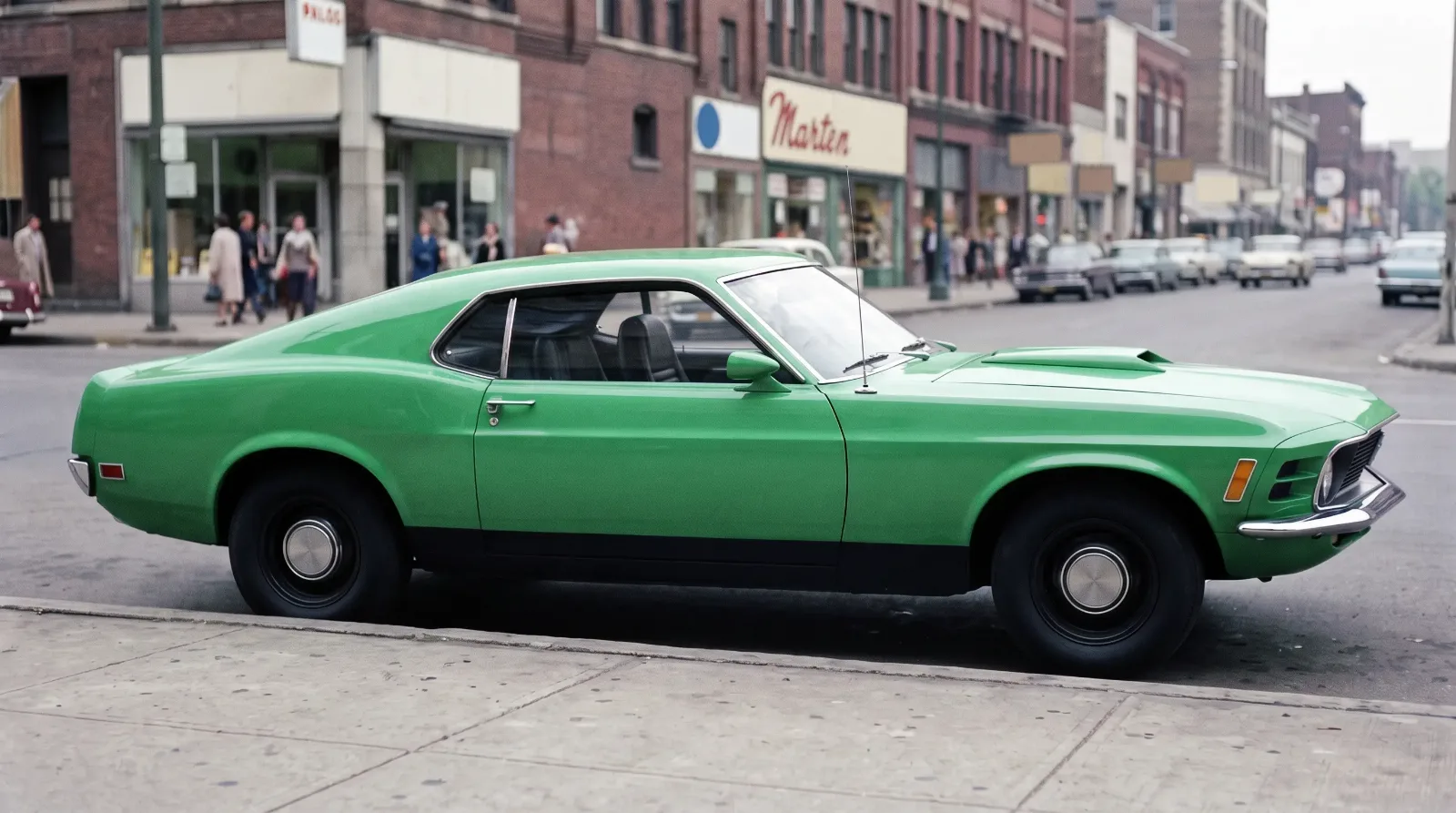
Two headlights again: the 1970 face and tail
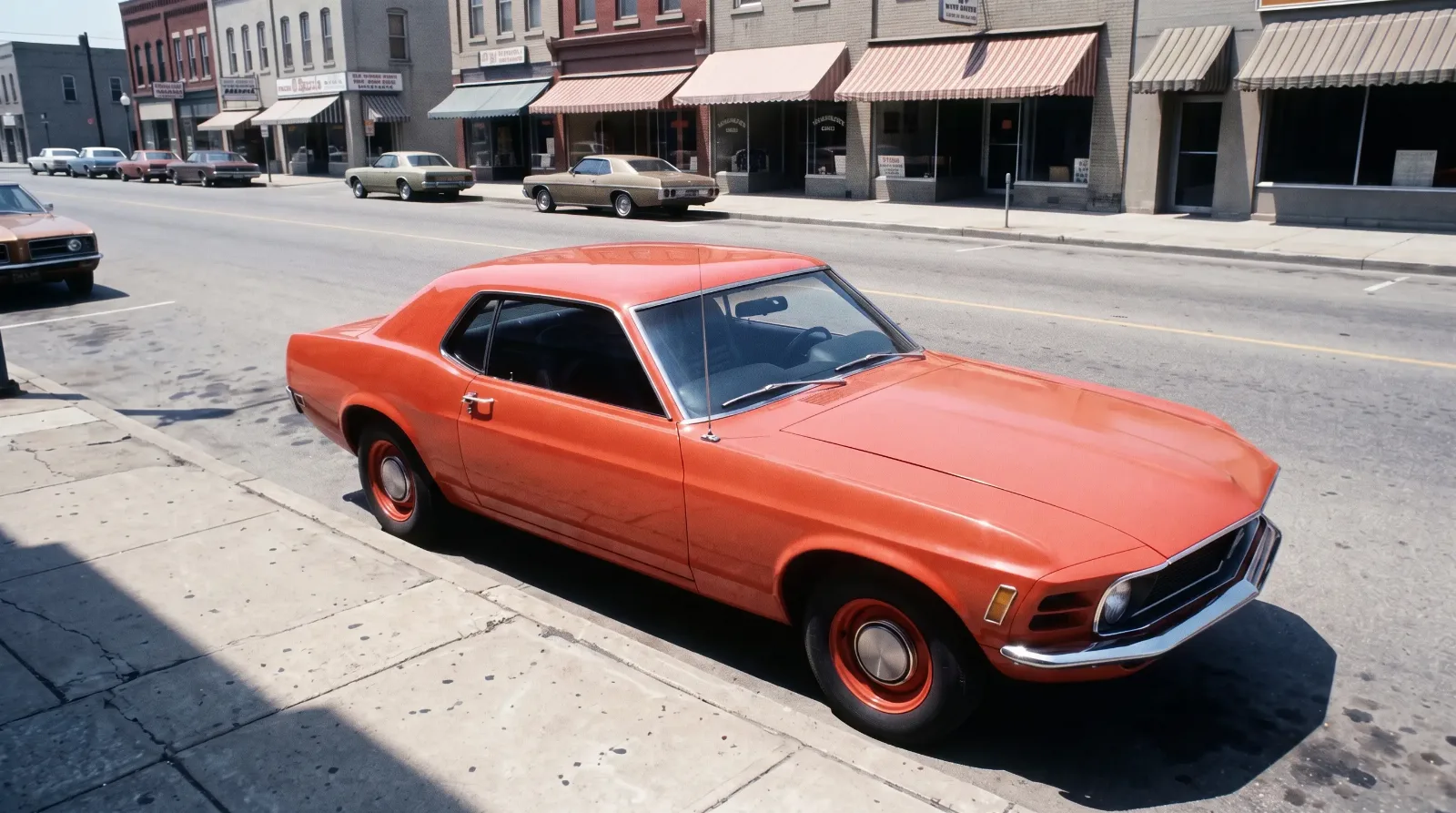
The 1969 restyle had given the Mustang four headlamps. For 1970, Ford went back to two, set inside the grille opening, and filled the outer positions with simulated intakes. The running horse moved back to the center of the grille, where it had been before 1969 put it off to the driver's side next to a tri-bar emblem. From the front, a 1970 is the easiest first-generation car to tell from its predecessor.
The rear changed too. The concave taillight panel used from 1967 through 1969 gave way to a flat panel with the lamps recessed into it. The 1969 SportsRoof's high-mounted rear-quarter scoops were deleted. Inside, high-back bucket seats became standard, and the ignition switch moved to a locking position on the steering column.
None of this was a new body. The 1970 car shares its sheet metal and its 108 inch wheelbase with the 1969. What changed was the trim and the face, which is why a 1969 and a 1970 parked side by side read as close relatives rather than different generations.
Engines for 1970: the Cleveland arrives, the 390 leaves
The engine list changed more than the body did. The headline was the 351 Cleveland. The M-code four-barrel version was rated at 300 hp at 5,400 rpm and 385 lb-ft, with about 11.0:1 compression. The H-code two-barrel 351 was rated at 250 hp. The Cleveland replaced the 351 Windsor, though not on day one: some early 1970 cars still received the Windsor two-barrel before the Cleveland took over. Both readings of the record are correct, which is a useful thing to know before arguing with a seller about which 351 belongs in an early car.
The 390 four-barrel, the Mustang's first big-block, was dropped for 1970. The GT Equipment Group did not return either. At the bottom of the range, the 200 six went back up to 120 hp after being rated at 115 hp from 1968. The 250 six continued, and the 302 two-barrel remained the base V8.
At the top, the 428 Cobra Jet carried on at 335 hp gross and 440 lb-ft, in Q-code form without Ram Air and R-code form with it. One period fact sheet gives P as the 1970 Cobra Jet code instead; the decoder most collectors use, which agrees with the 1969 usage, gives Q and R. The 428 was a $376 option on a Mach 1 and $421 on other Mustangs. The 351 Cleveland four-barrel cost $48 on a Mach 1 and $93 on other models.
Mach 1, Boss and Grabber: the 1970 performance cars
The Mach 1 got its own set of changes. It received a new grille with two lamps in it (the period fact sheet lists them as simulated driving lamps, a detail often misremembered as working fog lights), an argent lower body panel with MACH 1 lettering, a black honeycomb rear panel, and twist-type hood locks in place of the 1969 pins. Its standard engine was the H-code 351 two-barrel at 250 hp. The Shaker hood scoop, offered on several engines in 1969, was available across more of the range for 1970, including the Boss 302.
The 1970 Boss 302 was the high point of that model. Ford built 7,013 by the count most sources use, though one fact sheet gives 6,318, and the difference has not been settled from primary records. The G-code 302 was rated at 290 hp, and the car listed at $3,720. Parnelli Jones, driving for Bud Moore's team, won the 1970 Trans-Am in one.
The Boss 429 ran a second and final season, with 499 built for 1970 after 859 for 1969. The 1970 engines switched from hydraulic to solid lifters. Base list was $4,087, a figure that grew considerably once the mandatory options were added.
For buyers who wanted the look without the Boss price, Ford offered the Grabber colors: Grabber Blue, Grabber Orange, Grabber Green and Grabber Yellow. A Grabber Special Value Package was sold on the SportsRoof only, and about 5,120 were built. Regional dealer promotions added a few more rarities, such as the Twister Special Mach 1 built for the Kansas City district.
1970 Mustang history in the production records
Here is how the 190,727 cars broke down by model, with the base list prices Ford quoted for the year.
| Model | 1970 production | Base price |
|---|---|---|
| Hardtop | 82,569 | $2,822 |
| Grande | 13,581 | $2,926 (six) |
| SportsRoof (incl. Boss) | 45,934 | $2,872 |
| Mach 1 | 40,970 | $3,271 |
| Convertible | 7,673 | $3,126 |
| Boss 302 (within SportsRoof) | 7,013 | $3,720 |
| Boss 429 (within SportsRoof) | 499 | $4,087 |
| Total | 190,727 |
The Grande figure is the six-cylinder base price the price guides quote for it. The Mach 1 came only with a V8, starting with the 351 two-barrel.
Two things stand out. First, the drop. Production fell by 109,097 cars from 1969, about 36 percent, and every body style shared in it. The Mach 1 went from 72,458 to 40,970. The convertible went from 14,746 to 7,673, about half. Second, the mix. Take the Boss cars out and the regular SportsRoof accounts for 38,422 cars, fewer than the Mach 1. In 1970 the buyer who chose the fastback roof increasingly chose the dressed-up version of it.
A note for anyone checking a car against these figures. From 1970 the Mach 1 has its own VIN body code, 05, and the Grande has 04. On a 1969 car the Mach 1 shares code 02 with every other fastback, so the VIN alone proves more on a 1970 than on a 1969.
Why 1970 closed the golden years
The decisions that ended this era were made before the 1970 cars reached showrooms. Semon "Bunkie" Knudsen, who had come from GM to run Ford in February 1968 and given the Boss cars their name through Larry Shinoda's phrase "the boss's car", was fired by Henry Ford II on September 11, 1969. Shinoda was fired days later. Knudsen had already approved Gale Halderman's proposal for a larger 1971 Mustang, and the 1970 lineup was introduced by John Naughton, Ford vice president and Ford Division general manager.
"The 1970 is the car people describe as a 1969 with two headlights. The records say more than that. It is the last year of the Boss 302, the last Boss 429, the last original wheelbase, and the first year the sales numbers told Ford something it did not want to hear."
Tom Ramirez
The replacement debuted on August 20, 1970, and went on sale that September. It was more than two inches longer and almost two and a half inches wider, and the reasons behind that are a separate story: why the 1971 grew comes down to a 429 big-block and a president who had already left the company. Production kept falling in 1971 and 1972, and the Mustang II followed for 1974.
That leaves the 1970 in a particular spot. It has the late first-generation engines, including the 351 Cleveland and the 428 Cobra Jet, in the body that started in 1969, and it has the last of the Boss cars. If you are shopping, the Boss and Cobra Jet cars carry the documentation questions, and a Marti Report is the usual starting point for checking one. Current listings of 1970 Mustangs for sale show the range, from six-cylinder hardtops to R-code Mach 1s.
Sources and notes
- MustangSpecs: 1970 Ford Mustang
- MustangSpecs: 1970 Mustang production numbers
- Over-Drive: 1970 Ford Mustang fact sheet
- Sports Car Market: 1970 Mustang Mach 1 428 SCJ (original list price)
- Wikipedia: Ford Mustang (first generation)
- Mac's Motor City Garage: Bunkie Knudsen's big horse, the 1971-73 Mustang
Related Reading
Have a
Ford Mustang
for Sale?
Reach thousands of serious classic car collectors across the US.
Sell It Here →
Selling a classic? Here's how: the best sites to sell a classic car
Are You a Classic Car Dealer?
List your full inventory and connect with targeted classic car buyers.
Join as a Dealer →
#boss 302
#Ford Mustang
#first generation Mustang
#1970 mustang
#Boss 429
#Mach 1
#351 Cleveland
#mustang production numbers

About the author
Tom Ramirez
Corvette researcher and historian based in Bowling Green, Kentucky. Two decades documenting Corvette production history from original factory records.
Related Listings - Ford Mustang


Comments
Be the first to comment on this article.