
Picture a Ford dealer's lot in the spring of 1978. The Mustang II is in its fifth and final season, and most of what sits in the row is sensible: notchback coupes, Ghia coupes, four-cylinder hatchbacks. Then there is one car that looks like it wandered in from a different decade. It has a deep air dam under the nose, flares on the wheel openings, a spoiler on the tail and a cobra painted across the whole hood, coiled and ready to strike. That was the Mustang II King Cobra, built for one model year only, and it was the loudest thing Ford put a Mustang badge on between the Boss cars and the Fox body.
Car Features
6 min read
The 1978 King Cobra: The Mustang II's Wildest Version
The 1978-only King Cobra put a hood-wide snake, flares and a V8-only rule on the Mustang II. 4,313 were built in the car's final year.
The broader story of the small Mustang is in the details. This piece is about the one version of it that went all in.
What the Mustang II King Cobra was
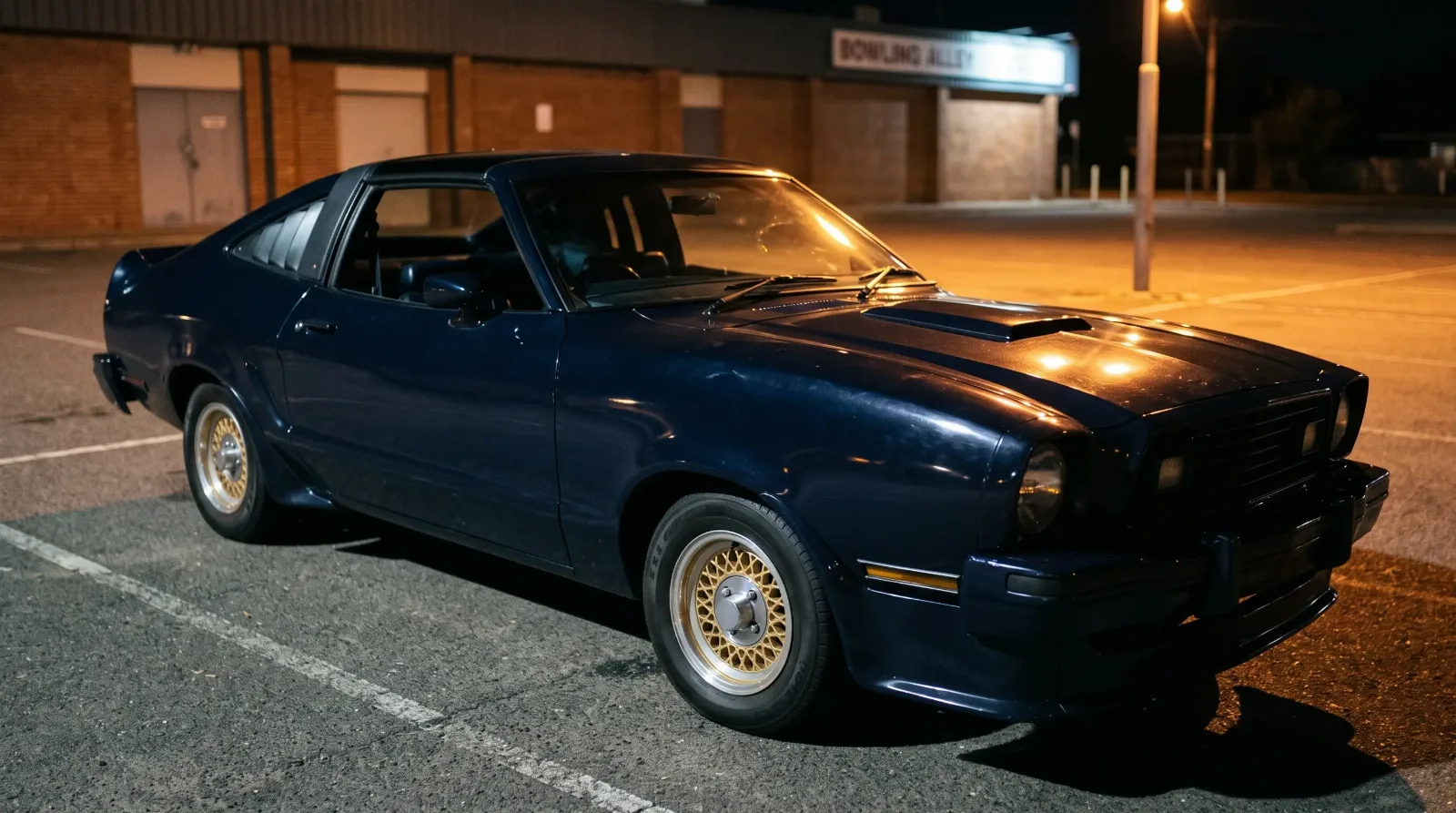
The King Cobra was a 1978-only limited edition, and it came with one engine: the 302 V8. You could not order it with the 2.3 four or the 2.8 V6, which already set it apart from the Cobra II it grew out of. Ford built 4,313 of them by the figure most sources agree on, although Old Cars Weekly gives 4,960.
The package was mostly visual, and it did not hold back. It added a deep front air dam, a rear spoiler, wheel-opening flares, a reverse-facing hood scoop with "5.0L" on it, the large cobra hood decal, pinstriping, blacked-out trim, lacy-spoke wheels and raised-white-letter radials. Underneath, the King Cobra got the Rallye suspension parts: heavy-duty springs, adjustable shocks and a rear stabilizer bar. The package was offered on the three-door hatchback only, the same body the Cobra II used, and it could be ordered with the T-roof that Ford had added to the Mustang II line in mid-1977.
It was not cheap. The King Cobra package cost $1,277, which was more than the Cobra II package's $677 for 1978. Old Cars Weekly gives the car's base price as $5,638.
From Cobra II to King Cobra: the snake gets bigger
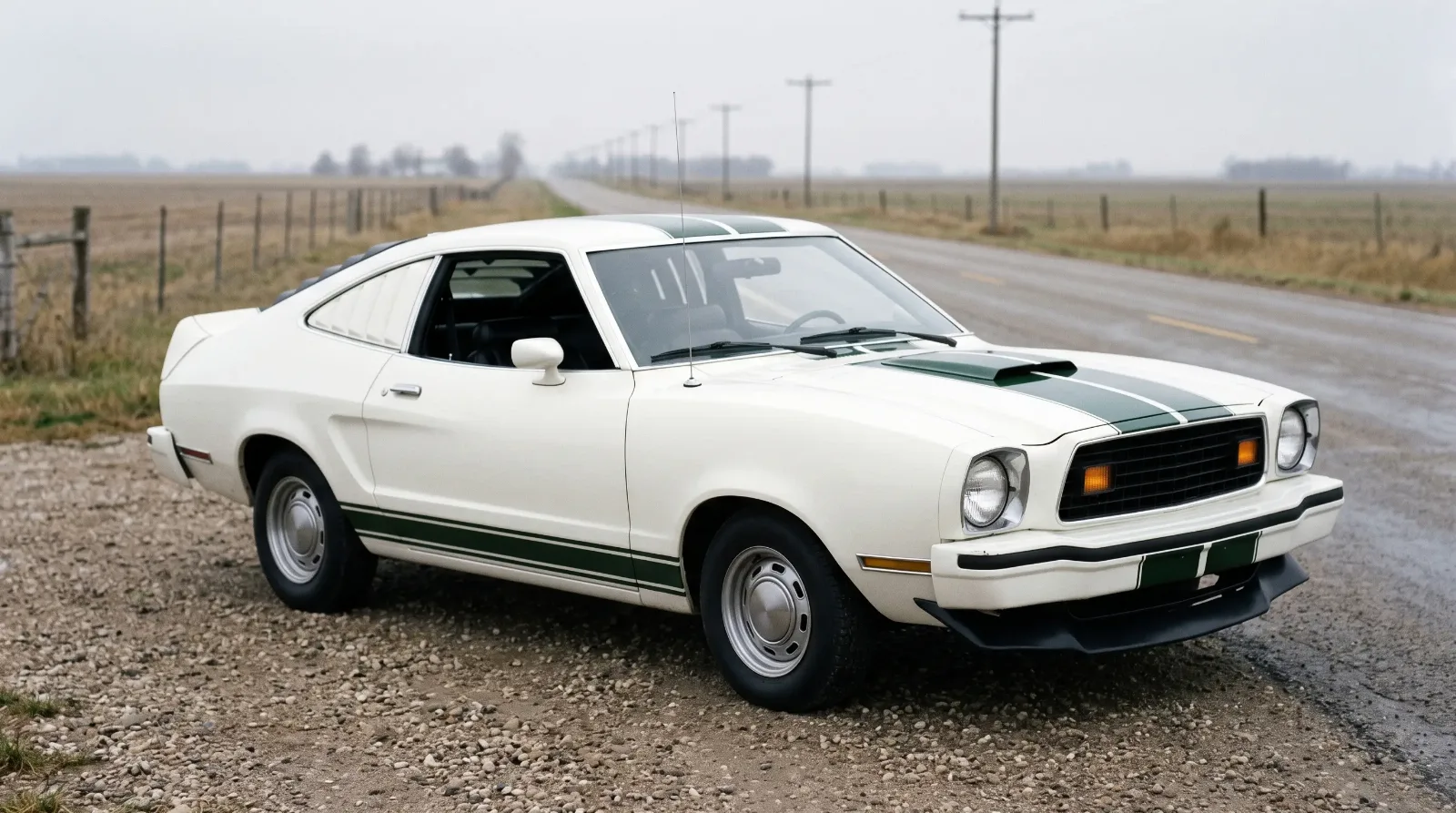
To understand the King Cobra you have to start two years earlier, with a man who knew how to sell a look. Jim Wangers, who came from Pontiac, designed the Cobra II appearance package for 1976, and his company, Motortown, applied the parts that first year. The Cobra II had a black grille, a simulated hood scoop, front and rear spoilers, louvers over the quarter windows, stripes over the top and cobra emblems. It was a hatchback-only package, and you could order it with any engine.
Buyers liked it. Consumer Guide called the Cobra II an "instant success." Ford brought the work in-house for 1977 and 1978, and by mid-1977 had revised it with a reversed hood scoop, a single wide stripe and COBRA lettering on the sides.
The King Cobra took that idea and pushed it as far as the Mustang II body would go. Where the Cobra II wore stripes, the King Cobra wore an entire snake. Where the Cobra II could be had with a four-cylinder, the King Cobra insisted on the V8. It was Ford admitting that the stripe-and-spoiler crowd wanted more, and giving it to them in the last year it could.
Under the hood: 139 horsepower and a 5.0 badge
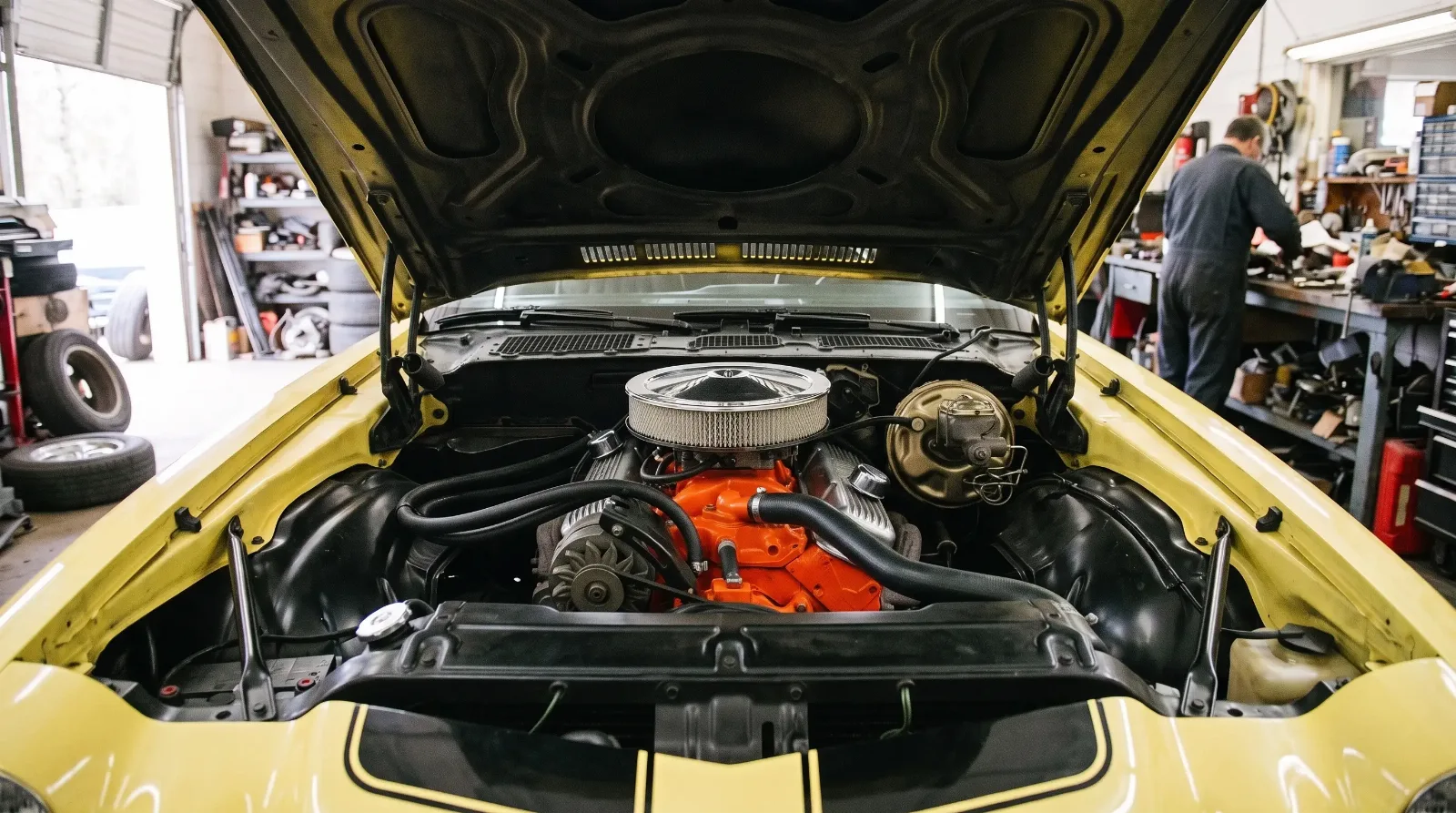
The "5.0L" on the hood scoop deserves a small footnote. The engine was the 302 cubic inch Windsor V8, which works out to 4.9 liters, and Ford marketed it as a 5.0. In King Cobra trim it breathed through a Motorcraft 2150 two-barrel and was rated at 139 hp at 3,600 rpm and 250 lb-ft at 1,600 rpm in net terms. The general 1978 Mustang listings give a lower figure for the same engine, 134 hp at 4,000 rpm and 213 lb-ft, so expect to see both numbers quoted.
Either way, this was the late 1970s. When the 302 returned to the Mustang II for 1975, Road & Track measured 0 to 60 mph in 10.5 seconds and a top speed of 106 mph. No comparable road test of the King Cobra itself appears in my records. The car's job was to look like the fastest thing on the street, and in 1978 that was a meaningful achievement on its own.
A four-speed manual was standard and the C4 automatic was optional. One breakdown puts the split at 2,017 manuals and 2,289 automatics. Those add up to 4,306, seven short of the 4,313 total, which tells you how loose the records from this period can be.
| 1978 version | Engines | 1978 production | Price |
|---|---|---|---|
| King Cobra | 302 V8 only | 4,313 (one source: 4,960) | $1,277 package |
| Cobra II | Any engine | 8,009 (one source: 4,049) | $677 package |
| Mach 1 (separate model) | 2.8 V6 standard | 7,968 | $4,430 base price |
For how the King Cobra's count sits against every other Mustang II model, see the production numbers. Ford built 192,410 Mustang IIs for 1978, so the King Cobra was a little over 2 percent of the year's output.
The last snake of the Mustang II era
The timing gave the King Cobra a curious place in Ford history. The last cars were built in July 1978, the same month Henry Ford II fired Lee Iacocca, the executive who had pushed the original Mustang and then the smaller Mustang II into being. A few months later the Fox-body Mustang arrived for 1979, the Mach 1 name was dropped, and the King Cobra had no successor on the new car.
"The King Cobra was Ford's way of saying the Mustang still had some swagger left, right up to the last day the Mustang II was in production. You can argue about what was under the hood. You cannot argue that people noticed it."
Patrick Walsh
The car is often lumped in with the other option groups of the period, but it was a different idea. The Stallion and Rallye packages added parts to an ordinary Mustang II; the King Cobra was close to a separate model, with its own engine rule and its own buck-tag code. If you want to see how the other packages compared, this piece lays them out.
Today the King Cobra sits on the short list of Mustang IIs people actually seek out, alongside the Cobra II, the Ghia and the Mach 1. Reliable market values for it are hard to pin down, so condition and documentation matter more than any price guide. If you are looking, current listings of 1978 Mustangs for sale are the place to start, and the buck tag is the first thing to check.
Sources and notes
Related Reading
Have a
Ford Mustang
for Sale?
Reach thousands of serious classic car collectors across the US.
Sell It Here →
Selling a classic? Here's how: the best sites to sell a classic car
Are You a Classic Car Dealer?
List your full inventory and connect with targeted classic car buyers.
Join as a Dealer →
#Ford Mustang
#302 V8
#mustang ii
#king cobra
#cobra ii
#Jim Wangers
#Mustang special editions
#1978 Mustang

About the author
Patrick Walsh
Automotive journalist covering classic car shows, events, and the enthusiast community across North America.
Related Listings - Ford Mustang

Comments
Be the first to comment on this article.