
Close the door on a 1973 Camaro Type LT and the first thing you notice is what you cannot hear. The road noise drops to a murmur. Under your feet the carpet is deep and soft, the door panel at your elbow carries a strip of woodgrain, and in front of you a full set of gauges looks back. A year earlier, the most exciting Camaro in the brochure had been the SS, a car sold on what it could do with its right pedal. For 1973 the featured Camaro was sold on how it made you feel when you were sitting still.
Car Features
6 min read
The 1973 Type LT: The Camaro Goes Upscale
For 1973 the SS gave way to the Camaro Type LT, a Luxury Touring trim with a hushed cabin. What it added, how it sold and how to spot a real one.
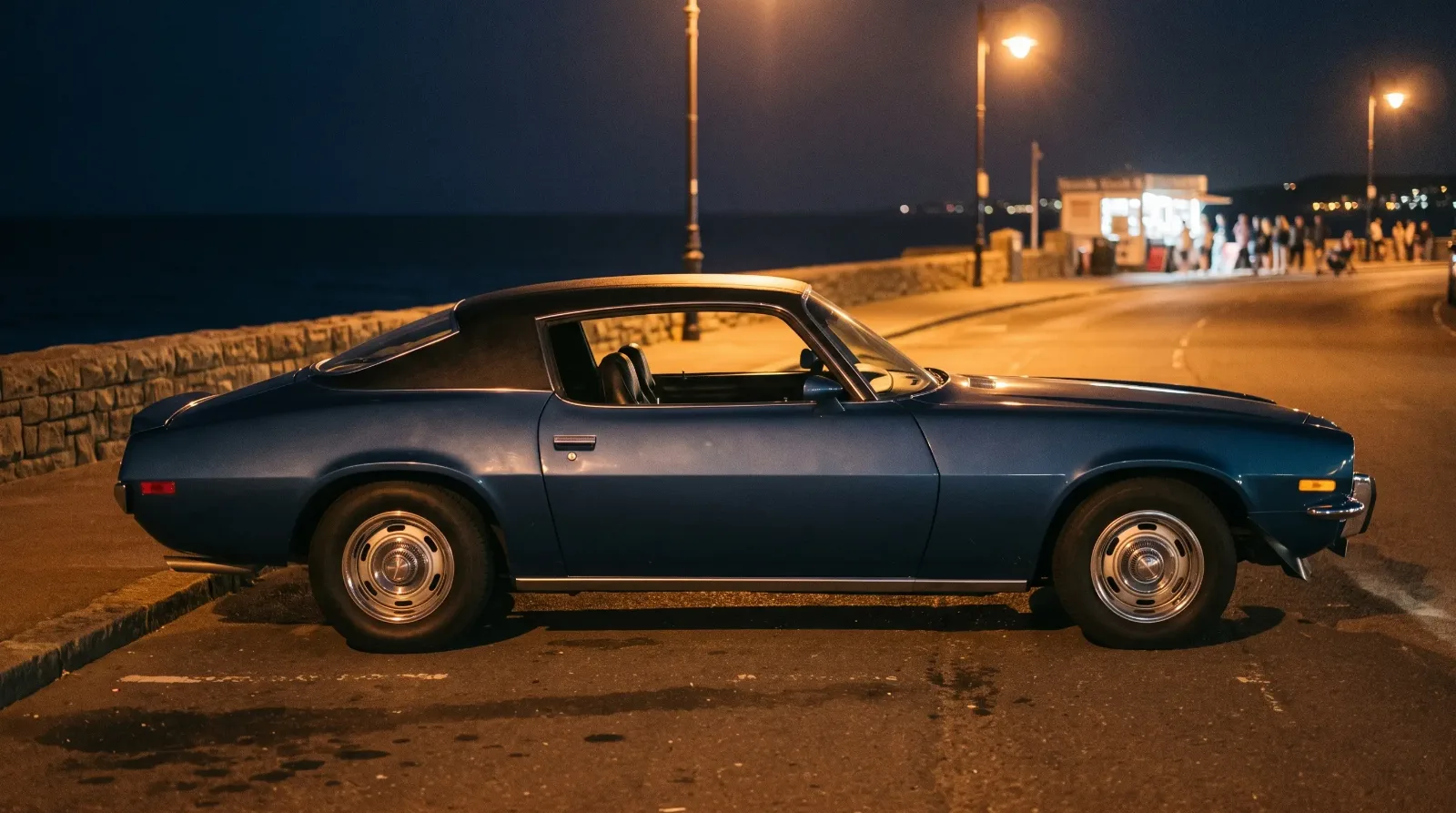
That was a deliberate turn. Chevrolet dropped the Super Sport package for 1973 and put the Type LT, short for Luxury Touring, in its place. The Super Sport name would not return on a Camaro until 1996. In between, the LT and its successor carried the idea that a Camaro could be a comfortable car first, and the buying public went along with it in numbers nobody could ignore.
The year the SS stepped aside
The timing tells part of the story. The second-generation car had been on sale since 1970, and it was still one of the best-looking shapes on an American road. But 1972 had been a hard year: a strike had cut production well below 100,000 cars, and 1973 would again finish under six figures, at 96,751. Emissions rules and insurance costs were pressing on every performance car Detroit sold.
A luxury trim answered a different question. Instead of asking how fast the Camaro could go, it asked how pleasant the Camaro could be. Chevrolet's own print advertising for the LT that year carried the headline "You deserve a car this good." It is a sentence about reward, not speed, and it fit the moment.
The wider arc of the second-gen Camaro story is often told through its Z28s. The LT belongs in it for a quieter reason. It showed that the same long-hooded coupe could sell on comfort, and that lesson shaped the Camaro for the rest of the decade.
Inside the Camaro Type LT
Most of what made the Camaro Type LT different lived inside the car. The Décor and Quiet Sound Group came standard, the package that did so much to hush the cabin. The seats were full foam. The carpet was deep-twist. The doors carried woodgrain trim, and the dash had full instrumentation rather than the plainer cluster of a basic Sport Coupe. Underneath it all, variable-ratio steering rounded out the package.
None of these items was dramatic on its own. Together they changed the way the car felt at the end of a long drive. A Camaro had always looked expensive. Now it sounded and felt that way from the inside, and that is where owners spent their time.
The trim also carried its own identity in the paperwork. On the cowl tag and in the VIN, a Type LT used the series letter S, where a regular Sport Coupe used Q. That single letter still matters to anyone checking a car today.
A luxury car that could still carry a Z28
Luxury did not mean giving up the fast parts. From 1973 to 1978 the LT could be combined with the Z28, the Rally Sport or both. A recorded 1973 VIN, 1S87T3N182396, decodes as a Type LT coupe with the T engine, the Z28's 350, built at Norwood. It is a car with woodgrain on the doors and the year's strongest engine under the hood. When the two were combined, the usual Z28 stripes and badges were left off, so an LT Z28 looked like a quiet luxury coupe from the curb.
That 1973 Z28 engine was the L82, a 350 with hydraulic lifters, and 1973 was also the first year a Z28 could be ordered with air conditioning. For a buyer who wanted both comfort and speed, the combination was more practical than it had ever been.
| VIN engine letter | 1973 Camaro engine | Rated output (SAE net) |
|---|---|---|
| D | 250 six | 100 hp |
| F | 307 V8 | 115 hp |
| H | 350 (L65) | 145 hp |
| K | 350 (L48) | 175 hp |
| T | 350 (L82, Z28) | 245 hp |
The LT itself came standard with the 350 two-barrel, the 145 hp L65, rather than the six or the 307 of a basic Sport Coupe. The Powerglide automatic was deleted for 1973, so these engines met the market with a narrower list of transmissions than before.
How the LT grew, 1974 to 1978
The car around the LT changed sharply the next year. With the 1974 restyle came a new nose and the bumpers that federal rules demanded, and the LT moved with it. The trim kept evolving in small, tactile ways. The woodgrain became meridian walnut for 1974 and bird's-eye maple for 1975, and for 1976 the LT gained a brushed-aluminum rear panel.
Prices climbed with it. The LT listed at $3,715 in 1974 and $4,320 in 1976. The 1973 starting price is usually given as a little over $3,200.
Sales rose faster than prices. In 1976 Chevrolet built 52,421 LT coupes, against 114,683 Sport Coupes and 15,855 Rally Sports. The 305 V8, new that year at 140 hp, was standard in the LT. For 1977 the 250 six became the standard engine in both the Sport Coupe and the LT, a sign of how far the market's priorities had moved toward economy.
The LT's run ended after 1978. For 1979 the Berlinetta replaced it, carrying the same idea of a quieter, better-trimmed Camaro into a new decade under a new name.
"The LT asked a Camaro owner to slow down and notice the car. A lot of people were ready to be asked."
Nora Beckett
Finding a real Type LT today
Because the LT was mostly an interior and equipment package, it is easy to imitate and easy to lose. Interiors get swapped, woodgrain gets replaced, and over five decades a car can drift a long way from how it left the plant. The surviving evidence is in the numbers stamped and riveted on the car.
A real LT is not a muscle car, and it was never meant to be. Its appeal is gentler: a well-made cabin in one of the most graceful shapes Chevrolet ever drew, from a year when the Camaro learned it could be loved for its comfort as much as its speed.
Sources and notes
- Hagerty: 1970 to 1981 Chevrolet Camaro buyer's guide (production, 1973 engines, LT trim changes)
- Wikipedia: Chevrolet Camaro (second generation)
- RM Sotheby's: 1973 Chevrolet Camaro Type LT (standard 350 two-barrel, 1973 LT production)
- Classic Industries: the 1973 Camaro Type LT
- Chevy Hardcore: decoding a 1973 Camaro VIN and cowl tag
- Click Americana: 1970s Chevrolet Camaro advertising
Related Reading

Have a
Chevrolet Camaro
for Sale?
Reach thousands of serious classic car collectors across the US.
Sell It Here →
Selling a classic? Here's how: sell my classic car
Are You a Classic Car Dealer?
List your full inventory and connect with targeted classic car buyers.
Join as a Dealer →
#camaro z28
#chevrolet camaro
#second generation Camaro
#1973 Camaro
#Camaro Type LT
#Luxury Touring

About the author
Nora Beckett
Automotive features writer and photographer who tells the human stories behind the cars, from show fields to cross-country road trips.
Related Listings - Chevrolet Camaro




Comments
Be the first to comment on this article.