
The 1974 Camaro restyle is usually remembered as the year the bumpers got big. The records say something more specific. Chevrolet kept the 1970 body shell, the 108 inch wheelbase and the roofline, and changed both ends of the car to meet federal bumper rules. The result was a Camaro seven inches longer than the 1973, with aluminum bumpers front and rear, a new fiberglass nose and wraparound taillamps. It was also, by a wide margin, the best-selling Camaro of the second generation to that point.
Car Features
6 min read
The 1974 Camaro Restyle and the 5 mph Bumpers
Why the 1974 Camaro restyle happened: aluminum bumpers, a fiberglass nose, seven more inches, wraparound taillamps and a second-gen high of 151,008 cars.

The broader arc of the generation is covered in our second-gen Camaro history. This piece stays with one model year: what the regulations demanded, what Chevrolet changed to meet them, what else changed while the engineers had the car apart, and what the 1974 means for anyone reading one today.
What forced the 1974 Camaro restyle
The pressure started before 1974. Federal bumper standards were tightening in steps through the early seventies, and the elegant split bumpers of the 1970 Rally Sport were not built for them. The cost of that showed up early. During the long 1972 strike at Norwood, about 1,100 partly built Camaros and Firebirds sat unfinished, and they were scrapped because they could not meet the 1973 federal bumper and safety standards. The full story of that year is the background to everything that followed.
For 1973 Chevrolet bought itself one more year. The rule in force was Federal Motor Vehicle Safety Standard 215, which for the 1973 model year asked that the lights and safety equipment survive a 5 mph barrier impact at the front and a 2.5 mph impact at the rear. The 1973 was the last split-bumper Camaro, and the only one with extra reinforcement to meet that first test. That was a patch, not a solution. For 1974 the rear requirement rose to 5 mph as well, and a reinforced chrome bumper on brackets would not stretch that far.
The rules did not ask for a new car. They asked for new bumpers and the structure to carry them. Chevrolet's answer was to redesign the ends and leave the middle alone, which is why the 1974 is listed as one of only two cosmetic updates in the second generation's twelve model years, the other being 1978.
Aluminum bumpers, a fiberglass nose and seven more inches
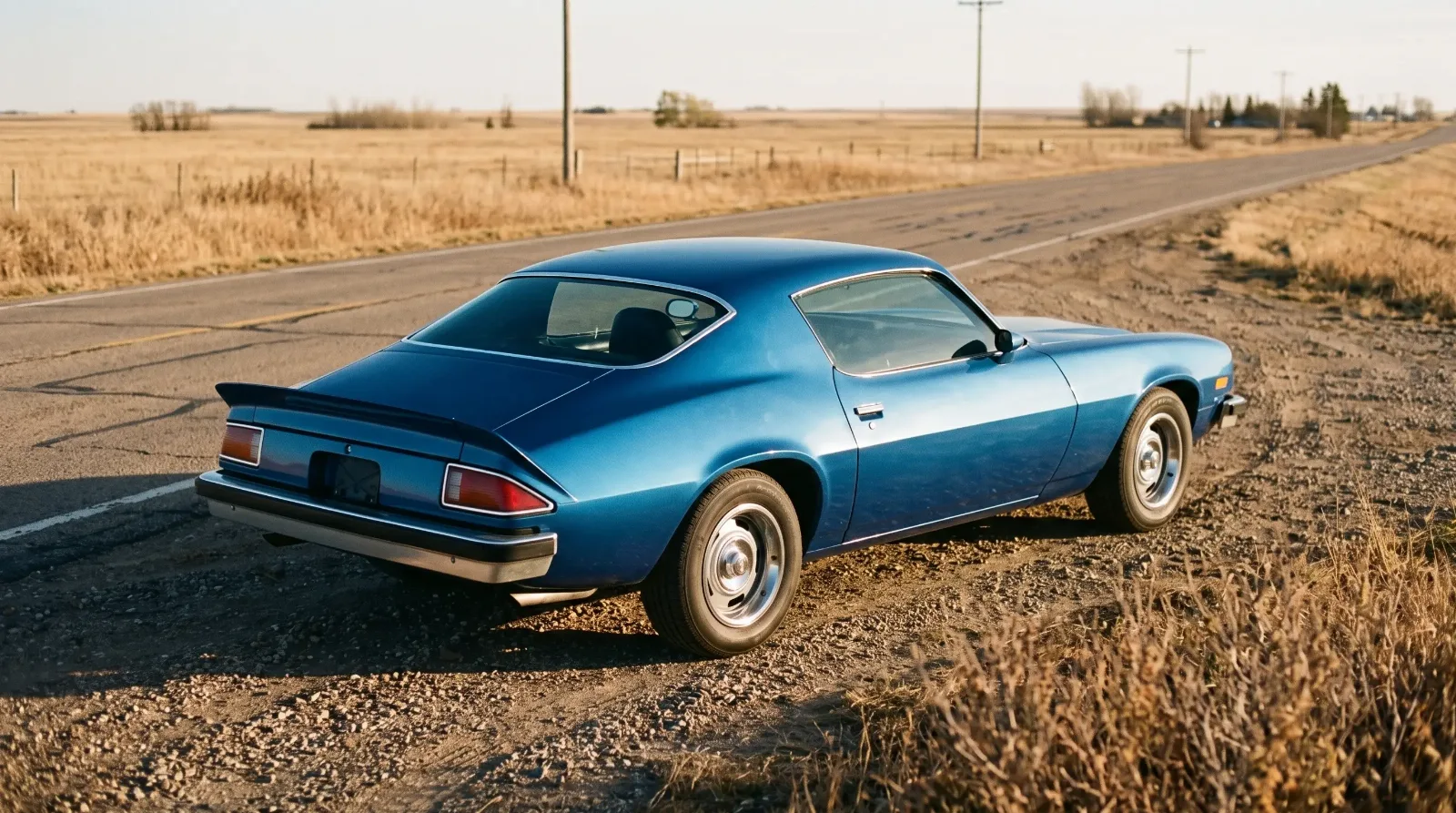
The new front end is the part everyone notices. Chevrolet fitted aluminum bumpers front and rear. Behind the front bumper sat a new fiberglass nose with deep headlamp buckets and a forward-sloping grille. The face lost the low, European look of 1970 and gained a blunter one.
The car also grew. Overall length went up by seven inches (180 mm). On a body that measured 188 inches long in 1970, that is a visible change, and the growth came with the new bumpers and the room they needed.
At the back, the round taillamps gave way to wraparound rectangular units. The roof did not change. The 1974 keeps the flat rear window and the thick roof pillars of the original 1970 design, and it was the last year to do so; the wraparound rear window arrived for 1975.
| Item | 1973 | 1974 |
|---|---|---|
| Bumpers | Split front on the RS; reinforced for the first federal test (5 mph front, 2.5 mph rear) | Aluminum, front and rear |
| Nose | 1970 front end | New fiberglass nose, deep headlamp buckets, forward-sloping grille |
| Overall length | 7 in shorter | Up 7 in (180 mm) |
| Taillamps | Round | Wraparound rectangular |
| Rear window | Flat | Flat (last year) |
| Fuel tank | 18 gal | 21 gal |
| Model-year production | 96,751 | 151,008 |
What else changed for 1974
Restyles rarely travel alone, and 1974 brought a short list of mechanical changes. Power steering became standard on V8 cars. The fuel tank grew from 18 to 21 gallons. The 307 V8 was dropped and replaced by a two-barrel 350. On the Z28, the L82 350 picked up HEI ignition.
Prices stayed modest. The base 1974 coupe listed at $3,160, and the Type LT, in its second year as the upscale model, listed at $3,715. The LT's 1974 interior moved to meridian walnut trim, before bird's-eye maple took its place in 1975.
The Z28 is where a myth needs gentle correcting. It is often said that the Z28 was fading by the time it was dropped. The production records say the opposite. Chevrolet built 13,802 Z28s for 1974, the best second-generation Z28 year to that point, with the L82 350 rated at 245 hp net. One source records 13,803; the difference is a single car. The stated reason for dropping it afterward was tight emission regulations, not a lack of buyers, and why the Z28 went away is a story of its own.
A second-generation high in a difficult decade
The production figures are the clearest measure of how the restyle landed. After the strike year of 1972 and the partial recovery of 1973, the 1974 more than doubled the 1972 total and became the best-selling second-generation year so far. It was not an all-time record: the 1969 had sold more, and the 1979 would set the Camaro record with 282,571 cars. The table below uses the most widely supported figure for each year.
| Model year | Camaros built | Note |
|---|---|---|
| 1972 | 68,656 | Norwood strike year |
| 1973 | 96,751 | Last split bumper; Type LT introduced |
| 1974 | 151,008 | Restyle; 128,798 V8s |
| 1975 | 145,770 | Wraparound rear window; catalytic converter |
A note on that 1974 number. One source gives 146,595, but that figure counts domestic cars only; with 4,142 exports added, the totals come within a few hundred cars of each other. The 151,008 figure is the one most sources agree on. The sales story is plain either way: the bigger bumpers did not hurt the car in the showroom. Chevrolet's own advertising that year leaned into the mood, with the headline "With Camaro, you can be practical. Or go bananas."
"The 1974 is often filed as the year the Camaro gave in to regulation. The production ledger files it differently: 151,008 cars, and the strongest second-generation Z28 year yet."
Tom Ramirez
Reading a 1974 today
For a restorer or a buyer, the 1974 sits on a dividing line in the parts catalog. The car grew seven inches with its new bumpers, and later changes followed: the wraparound rear window for 1975 and body-color urethane bumpers for 1978. That is why 1970 to 1973 and 1974 to 1981 quarter and rear panels are not interchangeable in the catalog, and why a 1974 shopper should confirm which panels a seller's "new sheet metal" actually came from.
The cowl tag is another small detail. On most second-generation years the tag was riveted, but 1973 and 1974 tags were fixed with sheet-metal screws. A 1974 with screws is not, on that point alone, a warning sign.
The 1974 also stands alone in one respect. It is the only year that combines the new aluminum-bumper front end with the original flat rear window and thick pillars. For collectors who like a transitional car, that one-year combination is the appeal. Supply is reasonable, given the production run, and 1974 Camaros for sale turn up in every condition from driver to concours. Judge each on its documents, its panels and its tag, in that order.
Sources and notes
Related Reading

Have a
Chevrolet Camaro
for Sale?
Reach thousands of serious classic car collectors across the US.
Sell It Here →
Selling a classic? Here's how: sell my classic car
Are You a Classic Car Dealer?
List your full inventory and connect with targeted classic car buyers.
Join as a Dealer →
#camaro z28
#chevrolet camaro
#camaro production
#1970s cars
#5 mph bumpers
#second generation Camaro
#1974 Camaro

About the author
Tom Ramirez
Corvette researcher and historian based in Bowling Green, Kentucky. Two decades documenting Corvette production history from original factory records.
Related Listings - Chevrolet Camaro




Comments
Be the first to comment on this article.