
The number that matters is 200, roughly, and that number tells you almost nothing by itself. That's the problem with judging the 1974 GTO's 350 V8 on horsepower alone. You have to know how Detroit was counting horsepower that year before the figure means anything at all.
Car Features
7 min read
The 1974 GTO's 350 and the New Math of Net Horsepower
The 1974 GTO's 350 V8 rating looks like a steep decline until you understand how Detroit's switch to net horsepower changed the numbers industry-wide.
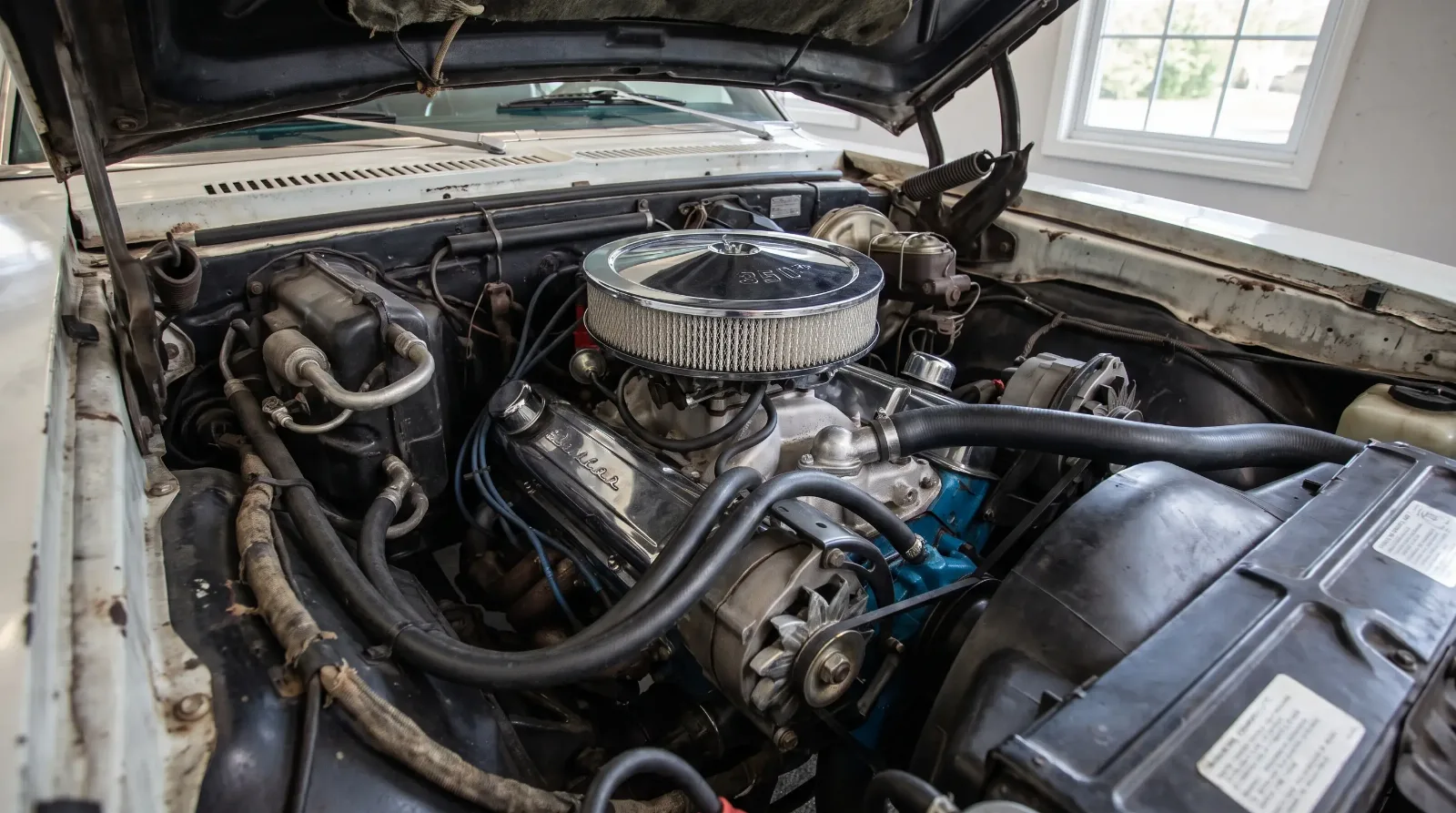
Gross versus net, and why it matters here
Through 1971, every domestic manufacturer rated engines on a gross basis, tested on a stand with no accessories bolted on, no exhaust restriction, no alternator load, nothing. Starting with the 1972 model year, the industry switched to net ratings, measured with the engine dressed exactly as it would sit in the car, full exhaust system, emissions equipment, accessories, everything drawing power the way it actually would on the road. That single accounting change alone knocked 20 to 30 percent off most engines' published numbers without a single bolt being loosened under the hood. A 1971 350 rated at a certain gross figure and a 1972 version of the same engine rated at a lower net figure could be producing nearly identical real-world output. The number on the window sticker just stopped meaning what it used to mean.
So when the 1974 GTO's standard 350 cubic inch V8 shows a rating of 200 net horsepower, that's not a fair comparison against a 1966 389's 335 gross-rated horsepower. It's two different measuring systems applied to two very different regulatory environments. The 1974 number is closer to honest. The 1966 number was always a little generous.
"Everybody wants to compare a 1974 net number to a 1966 gross number and call it decline. That's not a fair fight and it never was. Compare the two cars on the same measuring stick and the gap closes fast."
Dan Reeves
What actually cut real output
None of this means the 350 wasn't genuinely weaker than earlier GTO engines. It was, and the reasons are concrete rather than accounting tricks. Compression ratios across the entire industry dropped through the early 1970s to accommodate lower-octane unleaded fuel, which was being phased in ahead of the 1975 catalytic converter mandate that required lead-free gas to avoid poisoning the catalyst. Lower compression means less thermal efficiency and less real power, full stop. Exhaust gas recirculation valves, required to cut nitrogen oxide emissions, recirculated a portion of spent exhaust back into the intake charge, which reduced combustion temperature and further cut output. Add leaner carburetor jetting calibrated for emissions compliance rather than performance, and you have an engine genuinely detuned from what the same displacement could have produced a few years earlier, net-rating math aside.
Weight changes the equation too
The 1974 GTO's move to the compact X-body platform, sharing its architecture with the Ventura and Chevrolet Nova, cut a meaningful amount of weight compared to the 1973 Colonnade-bodied car. A 350 pushing a lighter compact body doesn't need to match a 400's output to deliver comparable real-world acceleration. Power-to-weight is the number that actually predicts how a car feels from the driver's seat, and on that measure the 1974 GTO closes some of the gap that the raw horsepower figure alone suggests. It was never going to embarrass a 1970 Ram Air 455, but it wasn't the punchline some enthusiasts treat it as either.
Transmission choices also affected how the 350's output translated to real acceleration. The GTO's standard three-speed manual, optional four-speed, and Turbo Hydra-Matic automatic all delivered that power differently, and gearing choices mattered more on a lighter compact platform than they had on the heavier midsize cars this engine's predecessors were built for. A well-optioned four-speed car with a numerically taller rear gear could feel noticeably livelier off the line than an automatic car running a taller, economy-oriented ratio, even with identical engines under the hood. That's another reason raw horsepower comparisons across model years miss so much of the real picture. Two 1974 GTOs with the same engine and different drivetrain specs could feel like meaningfully different cars in daily driving.
| Year | Rating System | Engine | Published HP |
|---|---|---|---|
| 1966 | Gross | 389 Tri-Power | 360 hp |
| 1970 | Gross | 455 HO | 360 hp |
| 1973 | Net | 400 4-bbl | 230 hp |
| 1974 | Net | 350 4-bbl | 200 hp |
What a dyno actually tells you
Chassis dyno numbers on well-tuned surviving 1974 350s tend to land in a range that supports the real-world case better than the catalog rating alone. A healthy example with correct carburetor jetting, a properly functioning Shaker cold-air system, and headers or a less-restrictive exhaust than the stock manifolds can often show meaningfully more rear-wheel output than the factory 200 net horsepower figure implies once drivetrain loss is accounted for. That's not evidence Pontiac was sandbagging the rating, it's evidence that a catalog number measured on an engine dyno under controlled conditions and a chassis dyno number measured through a full drivetrain years later, with decades of small tuning refinements applied, are never going to line up perfectly. What it does confirm is that the 350 had more in it than its reputation suggests, and a properly sorted example rewards anyone willing to put real tuning time into it rather than assuming the engine is maxed out from the factory.
None of this changes what the engine was built to do. Pontiac wasn't chasing quarter-mile numbers with this application, and nobody buying a 1974 GTO new was cross-shopping it against a genuine drag car. The point of understanding the dyno numbers is to separate what the engine can actually do from what a decade of secondhand reputation has assumed about it. A lot of that reputation was built by people comparing a net-rated 1974 number against a gross-rated 1969 number without knowing the difference, and that comparison has done more to damage this engine's standing than anything about its actual engineering.
Comparing it fairly to its true peers
The more useful comparison for the 1974 GTO's 350 isn't a 1966 GTO at all. It's other net-rated, emissions-era engines from the same one or two model years, Chevrolet's own 350s in the Nova and Camaro, Ford's smaller-displacement V8s in the Mustang II lineup, engines built under the exact same regulatory constraints. Measured against that peer group rather than against a decade-old catalog fantasy, the Pontiac 350 holds up reasonably well. It wasn't the strongest engine in its class, but it wasn't an embarrassment either, and buyers cross-shopping compact performance-oriented coupes in 1974 were choosing between engines that all told a similar story of compression and output sacrificed to the same regulatory pressures.
What it means for a buyer today
If you're cross-shopping a 1974 GTO against earlier cars purely on a horsepower spreadsheet, you're measuring the wrong thing. Drive one before you decide the 350 is a disappointment. It's an honestly-rated engine in a lighter car, built during a period when Detroit was solving problems that had nothing to do with straight-line speed. The catalog fantasy died with the gross-rating era. What replaced it was a more accurate, less flattering number, and the 1974 GTO happened to be one of the first GTOs forced to wear it.
This engine sits at the center of the Goat's last chapter, the two-year stretch where Pontiac fought harder against regulation than most of the muscle car field and still managed to keep a real V8 under the hood through the very end. The regulatory pressure that shaped this engine's tune didn't start or stop with Pontiac. It reshaped the entire industry, and read on for how emissions rules and unleaded fuel standards took the air out of the whole muscle car era, not just this one engine.
Sources and notes
Related Reading


Have a
Pontiac GTO
for Sale?
Reach thousands of serious classic car collectors across the US.
Sell It Here →
Are You a Classic Car Dealer?
List your full inventory and connect with targeted classic car buyers.
Join as a Dealer →

About the author
Dan Reeves
Performance engine builder from North Carolina's motorsports corridor, focused on swaps, forced induction and making real, repeatable power.
Related Listings - Pontiac GTO




Comments
Be the first to comment on this article.