
The 1974 Mustang II had one of the strangest debuts any Mustang has ever had. It was smaller than the 1965 original, it had no V8 at all, and most enthusiasts who had grown up on Boss 302s and Mach 1 big blocks were ready to dislike it on sight. Then Ford built close to three times as many of them as it had 1973 Mustangs, and the car won Motor Trend's Car of the Year. Both of those things are true, and the second one still surprises people. This is the story of that first model year, from the introduction in September 1973 to the end of the 1974 production run.
Car Features
8 min read
The 1974 Mustang II Launch and Car of the Year
No V8, a smaller body, and 385,993 built: how the 1974 Mustang II launched in September 1973 and won Motor Trend's Car of the Year.
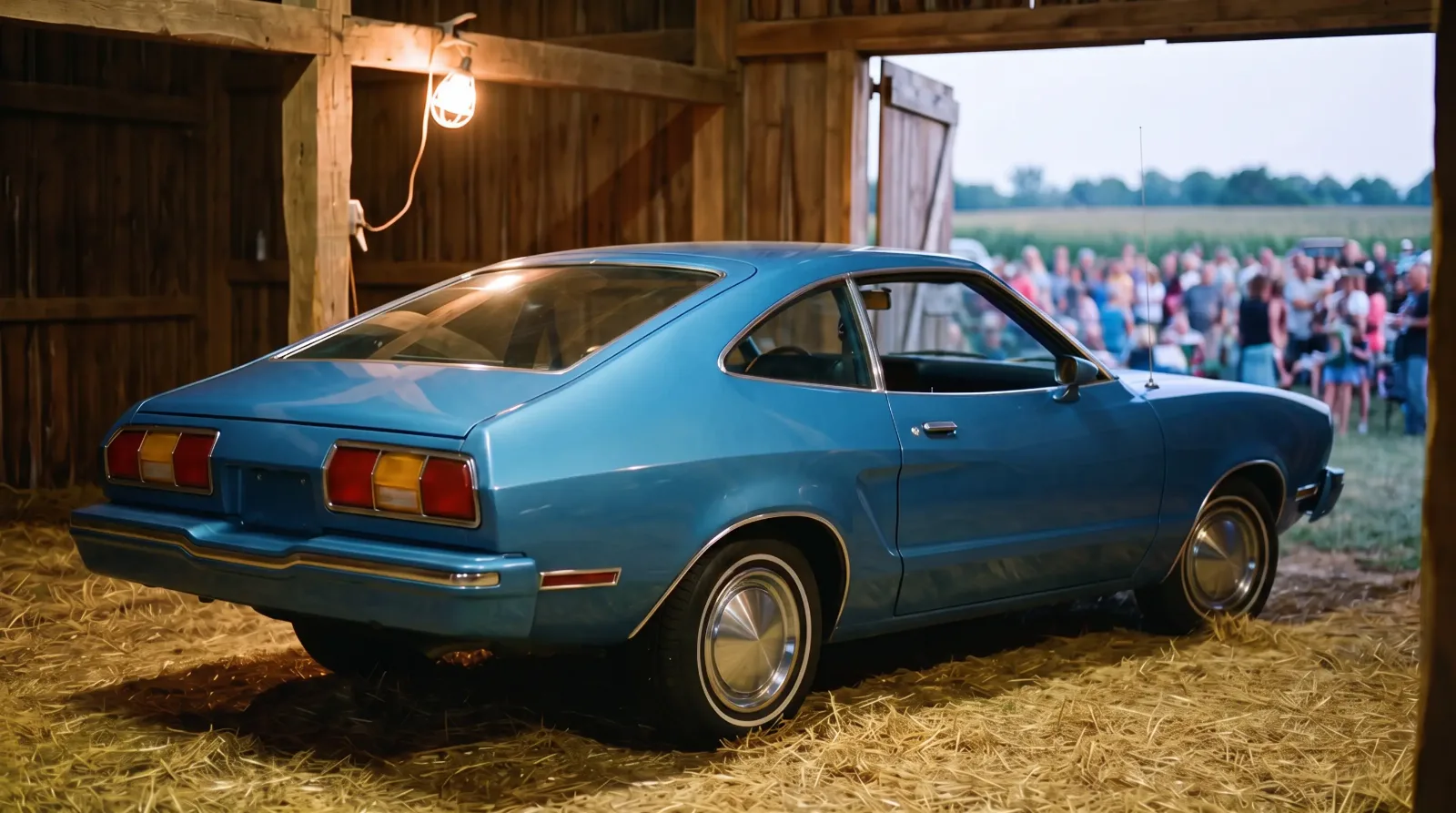
The 1974 Mustang II arrives
Ford introduced the car to the public on September 21, 1973, as a 1974 model. You will see August 1973 in some histories, and that may reflect press previews ahead of the public date. I use September 21 because it is the specific date in the most complete record, but I would not argue hard with anyone who has a dated press kit saying otherwise. Before launch, Ford also showed a targa-roofed concept called the Mustang Sportiva II, built from a pre-production 1974 car, to get the new shape in front of people early.
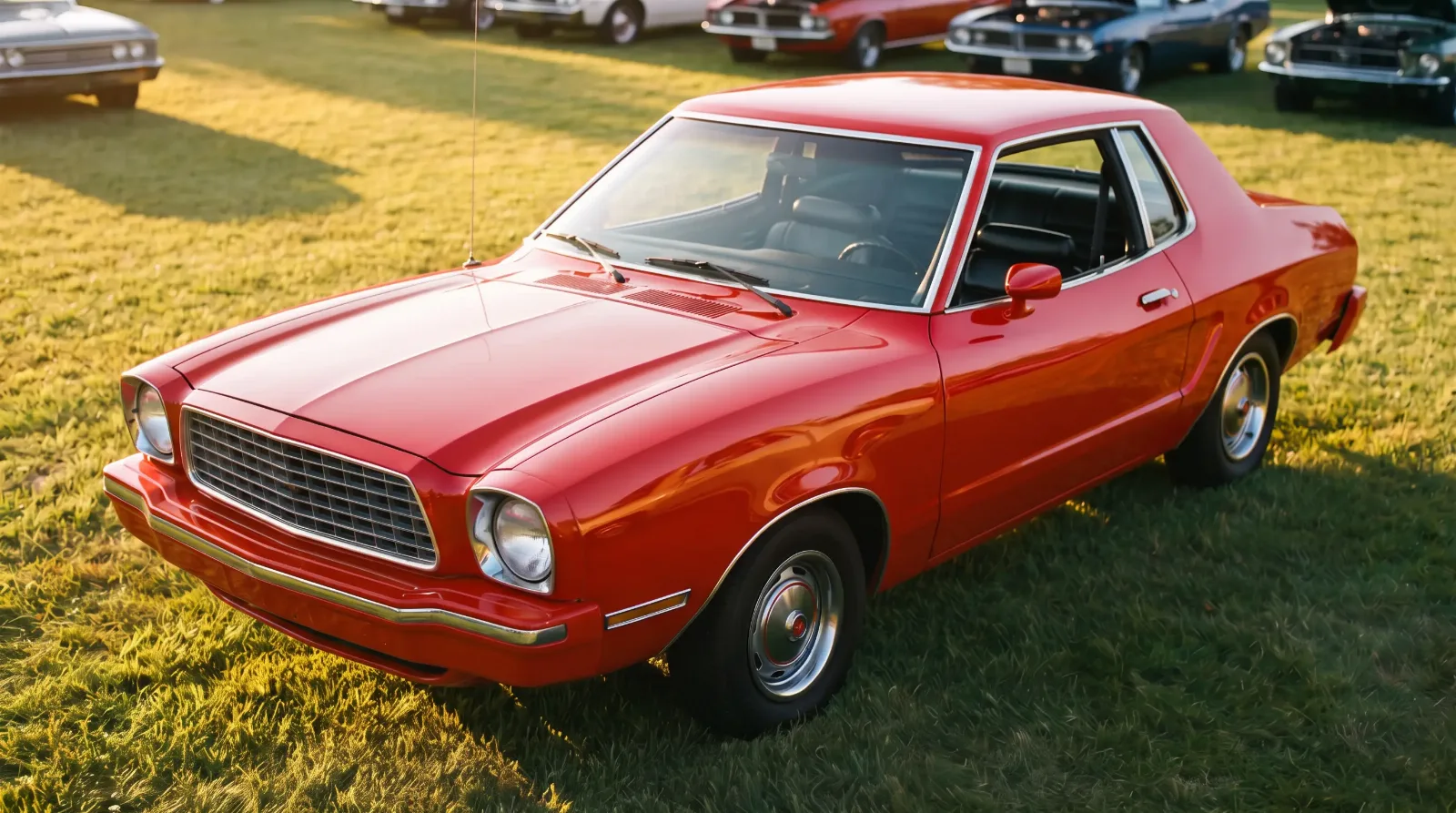
What buyers found in the showroom was a much smaller car. The new Mustang II rode a 96.2-inch wheelbase and measured 175.0 inches long and 70.2 inches wide. Against the 1973 Mustang it was about 19 inches shorter, about 4 inches narrower and somewhere between 450 and 490 pounds lighter, depending on which 1973 model you compare it with. There were two bodies: a 2-door notchback Ford called the Hardtop, and a 3-door 2+2 hatchback. There was no convertible, and there would not be another factory Mustang convertible until 1983.
Cars came from Dearborn and San Jose, which is what U.S. Mustang II VINs show with their F and R plant codes. Other plants are sometimes listed for the generation, but I have not seen a U.S. VIN that supports them.
Four models and no V8
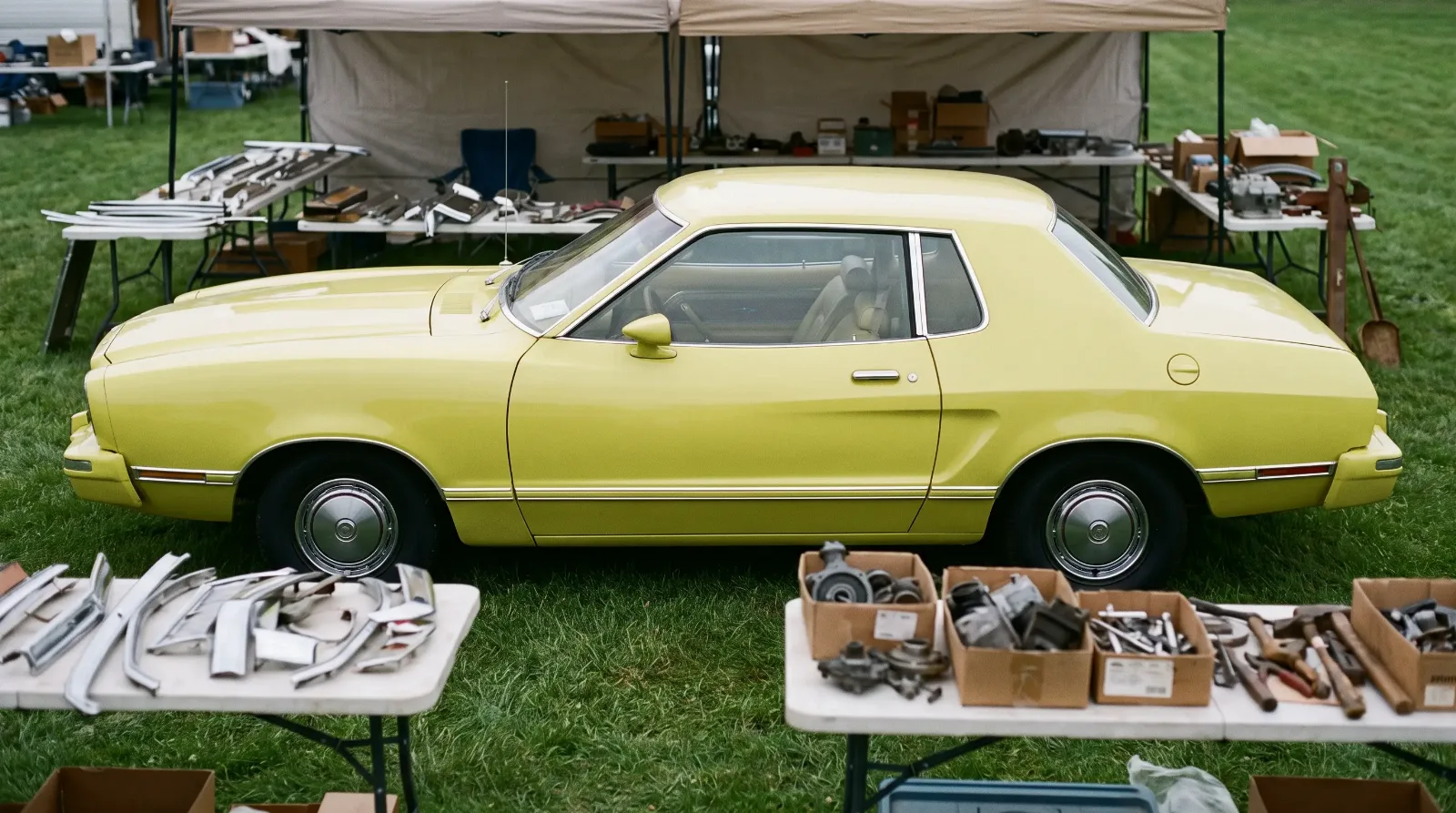
The 1974 lineup had four models. The Hardtop and the 2+2 were the base cars. The Ghia was the luxury notchback, with a vinyl roof, spoke-style wheel covers, color-keyed belts, a Super Sound package, shag carpet, wood-tone door accents, a digital clock, and a choice of vinyl or Westminster cloth. The Mach 1 was the sporty hatchback, with the 2.8 V6 standard, a paint treatment that blacked out the lower body and the rear deck, styled steel wheels with trim rings and remote racing mirrors.
| 1974 model | Body | Production |
|---|---|---|
| Hardtop | 2-door notchback | 177,671 |
| Ghia | 2-door notchback | 89,477 |
| 2+2 | 3-door hatchback | 74,799 |
| Mach 1 | 3-door hatchback | 44,046 |
| Total | 385,993 |
Under the hood there were two choices. The smaller engine was a 2.3-liter (140 cubic inch) overhead-cam four from Ford's Lima, Ohio plant, rated at 88 net horsepower. The option was a 2.8-liter (171 cubic inch) Cologne V6, rated at 105 net horsepower. Transmissions were a 4-speed manual or a 3-speed C3 automatic. That was the whole list. For the first time since the Mustang was introduced, a U.S. buyer could not order a V8. Ford brought the 302 back for 1975.
Pricing is one area where the records do not line up neatly. Ford's own Car of the Year advertisement quoted a base sticker price of $2,895 for the 2-door Hardtop, excluding dealer prep, destination charges, title and taxes. Reference lists give $3,134 for the Hardtop and $3,328 for the 2+2 with the four-cylinder, and a second MustangSpecs table shows $3,363 and $3,557, which appear to be the same two cars with the V6 rather than prices with destination added. I have not found a dated Ford price sheet that explains the gap between the advertised figure and the reference lists, so I treat all of them as approximate.
How the 1974 Mustang II won Car of the Year
Motor Trend named the 1974 Mustang II its Car of the Year. I have not seen the original issue, so I will not give you a cover date I cannot stand behind. Ford's own advertising that year quoted the editors calling the car "an outstanding concept of affordable luxury and prestige in a small package." What I can do is point to what the car offered that a 1973 small car usually did not, because the award makes more sense once you look at the engineering instead of the horsepower.
The big item was the front end. Engineers Bob Negstad and Jim Kennedy developed a U-shaped front subframe, nicknamed the "toilet seat," that carried the suspension and engine on isolated mounts. That isolation is why the car felt quieter and more refined than its size suggested. The Mustang II also used rack-and-pinion steering, still uncommon on American cars of the period, and it is often credited as the first American car offered with power-assisted rack-and-pinion. On paper it was a small car built to a higher standard than the small cars around it, and that matches the "little jewel" brief Ford set for the program. Critics at the time, and owners since, have asked how much Pinto was underneath all of that. The short answer is the platform, but far fewer of the parts than the reputation suggests.
The car had real weaknesses, and they were visible in 1974. With the V6, about 58 percent of the weight sat on the front wheels, and some sources list a 59/41 split. The four-cylinder cars were slow by any Mustang measure. None of that cost it the award. Car of the Year judged the 1974 field, and the 1974 field was full of cars weighed down by new bumper and emissions rules.
"A Car of the Year award is a snapshot. It judges one model year against the other cars on sale that year, not against a Boss 429 from five years earlier. Judged against its own field, the 1974 Mustang II was quiet, well trimmed and new. That is why it won, and it is also why the award reads so oddly to people who only know the car's later reputation."
Tom Ramirez
The award has a footnote that tells you something too. The next Mustang to win Motor Trend's Car of the Year was the 1994 model, twenty years later. They remain the Mustang's only two Car of the Year wins.
Launch timing and the oil embargo
The Mustang II had been on sale for only a few weeks when the Arab oil embargo began in October 1973. Ford had not planned the car around the embargo; the small-car decision dated back to 1969. But the timing changed how buyers saw it. A small Mustang with a four-cylinder engine suddenly looked less like a compromise and more like good sense.
The start was not instant. MustangSpecs puts first-month sales below 18,000 cars, with fewer still the month after, and I have not found a second record to confirm or correct that. The full model year leaves no doubt, though. Ford built 385,993 Mustang IIs for 1974, close to three times the 134,867 Mustangs built for 1973. It was the best Mustang year since 1967 and it ranks as the sixth-best Mustang model year. You will sometimes see 296,041 quoted for 1974; the body-style figures in the table above add up to 385,993, and that is the number I use.
What the launch year means now
1974 turned out to be the high point of the Mustang II run. Production fell to 188,575 for 1975 and never came back near the first-year figure. The reviews also cooled once the novelty wore off. By 1975, Consumer Guide ranked the V8 Mustang II last in its Low-Priced Sport Car class, and Consumer Reports told readers there were better subcompacts. That later reputation tends to get read backward onto the 1974 car, which is unfair to what the car was when it was new.
For collectors, the 1974 cars carry a few distinctions the later ones do not. They are the only Mustang IIs without a V8 option, the only ones with the original deeper grille before Ford reshaped the front end for 1975, and the ones that carried the Car of the Year title. Surviving 1974 Mustangs show the original brief at its purest: a small, quiet, well-trimmed car that Ford bet would sell on refinement rather than horsepower. For one model year, buyers agreed.
Sources and notes
- Ford Mustang (second generation), Wikipedia
- 1974 Ford Mustang: production, prices and equipment, MustangSpecs
- Ford's 1974 Mustang II Mach 1 advertisement, Motor Trend, October 1973 (scan), Flickr
- Ford's 1974 "Motor Trend Car of the Year" Mustang II advertisement (scan), Flickr
- Motor Trend Car of the Year winners, Wikipedia
- Preserving the breed: the 1974-78 Mustang II, Mac's Motor City Garage
Related Reading
#mustang history
#Ford Mustang
#mustang ii
#mustang mach 1
#1974 mustang
#motor trend car of the year
#Mustang Ghia

About the author
Tom Ramirez
Corvette researcher and historian based in Bowling Green, Kentucky. Two decades documenting Corvette production history from original factory records.
Related Listings - Ford Mustang




Comments
Be the first to comment on this article.