
Is the Mustang II a Pinto? Partly. Ford built it from the Pinto's platform and never pretended otherwise. But "a Pinto with a pony on the grille" is the kind of line that sounds right in a parking lot and falls apart once both cars are on a lift. The basic architecture and the base four-cylinder line up with the small car. The front structure, the suspension mounting, the wheelbase, the bodywork and the V8 do not.
Car Features
8 min read
How Much Pinto Is in a Mustang II?
The Mustang II started on the Pinto platform, but its wheelbase, isolated front subframe, body and V8 were its own. What was shared and what was not.
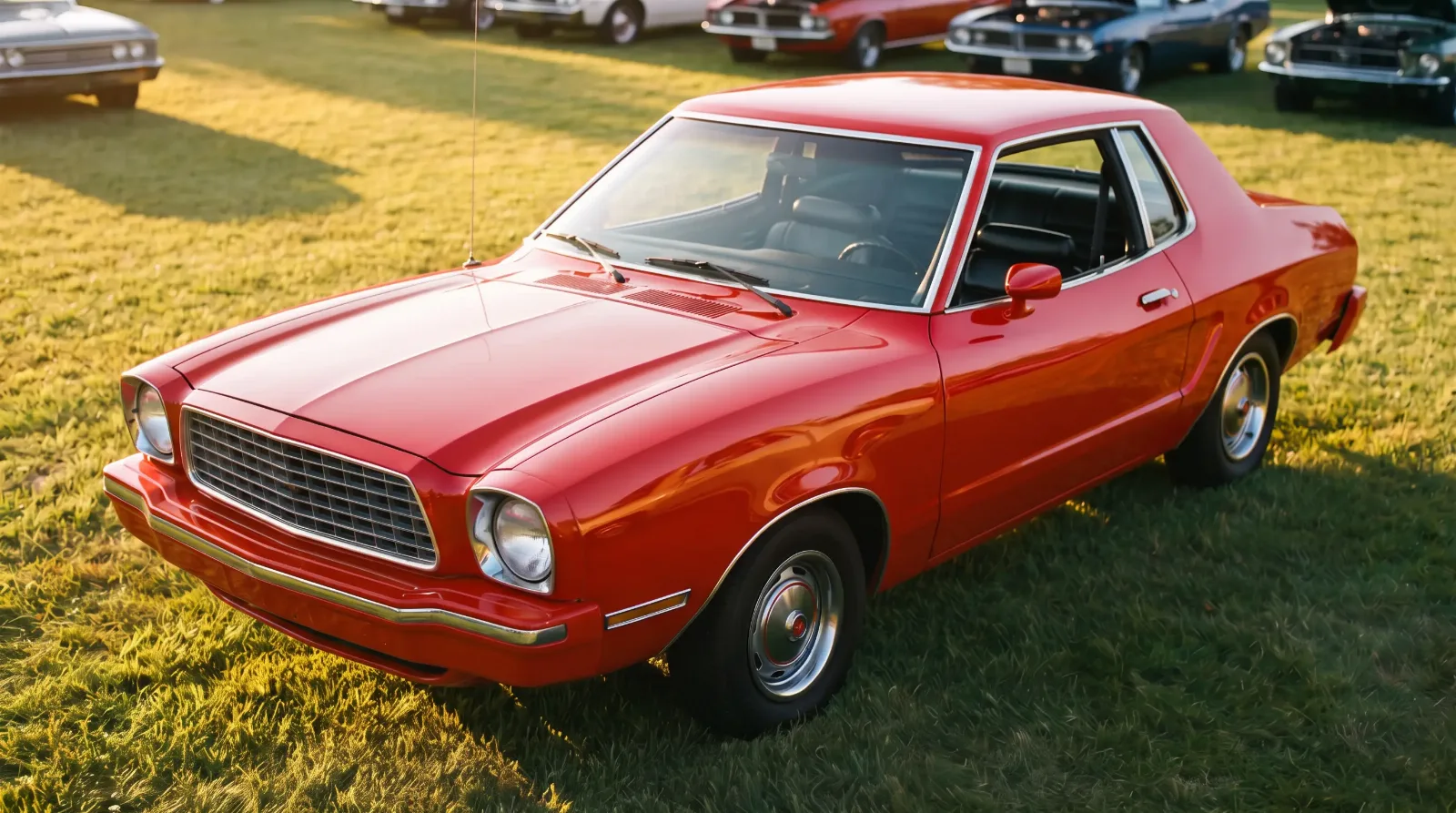
This piece sticks to that one question: what crossed over, what Ford built new, and why the label stuck anyway. For the whole arc of the car, from the first sketches to the last King Cobra, start with the Mustang II story.
Is the Mustang II a Pinto? The short answer
No. It is related to one. The Mustang II is derived from the Pinto platform, but it is not a rebodied Pinto, and the sources that went through the engineering agree on that. The two cars shared a limited number of actual components. Lee Iacocca, Ford's president at the time, is reported to have insisted that they share few of them.
The quickest proof is a tape measure. The Pinto rode on a 94.0-inch wheelbase. The Mustang II rode on 96.2 inches. That is 2.2 inches of stretch between the axles, and you do not get there by swapping fenders. Ford had to lengthen the structure, and a stretched structure means a body that fits nothing on a Pinto.
Then there is the front end, which is where the real money went. More on that below. First, why Ford reached for the Pinto at all, because the decision makes more sense than the reputation suggests. It is one of those cases, like a few others covered in what people get wrong about Mustangs, where the shorthand outran the record.
Why Ford started from the Pinto
Start with the sales chart. Mustang production fell from 299,824 in 1969 to 190,727 in 1970, then 149,678 in 1971 and 125,093 in 1972. The car had grown with every redesign and the buyers had stopped following it. Iacocca pushed for a smaller Mustang at a management meeting in November 1969. His brief was a 1974 model-year launch and an upscale small car he called a "little jewel."
Ford ran two programs to get there. One, code-named "Ohio," was based on the Maverick. The other, "Arizona," was based on the Pinto. In July 1971 Arizona won. The Maverick was the bigger, older compact. The Pinto was the newer, smaller package, and small was the entire point of the exercise.
The result came out about 19 inches shorter and 4 inches narrower than the 1973 Mustang, and somewhere between 450 and 490 pounds lighter depending on which 1973 model you compare it to. Stuart M. Frey was the chief engineer. You cannot hit those numbers starting from a big car. You start from a small one and spend your budget making it feel expensive.
What the Mustang II shares with the Pinto
The architecture comes first: the general layout of the floor and body structure traces back to the Pinto. That is the honest core of the claim, and it is why the comparison never goes away.
The 2.3-liter four is the second shared piece, and it is usually told backward. People say the Mustang II got "the Pinto engine." In fact the 2.3 Lima four debuted in 1974 in both the Pinto and the Mustang, built at Ford's engine plant in Lima, Ohio. Neither car handed it to the other. In the 1974 Mustang II it made 88 hp net. That is the engine that gets the blame, and on paper it earns some of it.
Third, trim. In 1976 Ford sold a Stallion appearance group that went on the Mustang, the Pinto and the Maverick alike: black grille, black moldings and lower body, styled steel wheels, decals. If you want a single fact that fed the Pinto talk, that is a good candidate. Same decals, same year, same showroom.
| Item | Mustang II (1974 to 1978) | Shared with the Pinto? |
|---|---|---|
| Platform basis | Pinto-derived "Arizona" program | Yes, in architecture |
| Wheelbase | 96.2 in | No (Pinto 94.0 in) |
| Front subframe | U-shaped isolated subframe | No, exclusive to the Mustang II |
| Engine mounts | Isolated | No, exclusive to the Mustang II |
| 2.3 Lima four | 88 hp net (1974) | Yes, launched in both cars for 1974 |
| 2.8 Cologne V6 | 105 hp net (1974) | No, the Pinto got it only from 1975 |
| 302 V8 | From 1975, automatic only at first | No, the Pinto never had a factory V8 |
| Body styles | 2-door notchback, 3-door 2+2 hatchback | No, unique sheet metal |
| Stallion group | 1976 appearance package | Yes, also on Pinto and Maverick |
What Ford built new: the "toilet seat" subframe
Here is where the Pinto story breaks. Ford engineers Bob Negstad and Jim Kennedy developed a U-shaped front subframe for the Mustang II. The front suspension and the engine mounts bolted to that subframe, and the subframe was isolated from the body. That layout was exclusive to the Mustang II. The goal was not speed. It was quiet. A small car that rides like a small car is a Pinto. A small car that keeps road noise and engine shake out of the cabin is closer to the "little jewel" Iacocca asked for.
Steering was rack-and-pinion, as it was on the Pinto, with power assist available. Weight sat about 58 percent on the front wheels with the 1974 V6. The V6 itself was the 2.8 Cologne, rated at 105 hp net that first year, and it was the standard engine in the Mach 1. The Pinto did not offer that V6 until 1975, a year after the Mustang II had it.
The V8 tells the same story from the other direction. When the 302 came back for 1975, Ford had to modify the front fenders, the engine bay and the header panel to fit it. The grille opening got thinner on every model as a result. You do not reshape the nose of a car for an engine its supposed donor never carried.
The body was its own job as well. The shape came out of an internal contest with the Ford-owned Ghia studio in Turin feeding ideas into the mix, and the people who drew it are covered in the piece on the designers. Nothing from the beltline up looks like a Pinto, because nothing from the beltline up is one.
One more point for the swap crowd. The Mustang II front suspension later found a second career under street rods. Hot rodder Chuck Lombardo is credited with adapting it in 1974, and builders liked it for a track width close to old Fords, rack-and-pinion steering and disc brakes. Pinto parts went into the same trade too: Ford supplied Pinto suspension parts for Bob Shay's Model A replicas, and when Shay's company failed, that surplus was sold off cheaply to hot rodders. Even so, the parts world settled on one name, "Mustang II front end," and kept it long after the car itself went out of fashion.
Why the Pinto label stuck, and what it misses
Timing did most of the damage. The Mustang II was introduced on September 21, 1973, and the Arab oil embargo hit in October. For 1974 there was no V8 at all in U.S. cars, the first Mustang year without one. The buyers who wanted a muscle car saw a four-cylinder hatchback the size of a compact and drew their own conclusion.
The numbers did not help once the V8 returned. After catalytic converters arrived for 1975, the four dropped to 83 hp and the V6 to 97. The 302 was rated at 122 hp that year. Road & Track timed a 1975 V8 at 10.5 seconds to 60 mph with a 106 mph top speed. Consumer Guide ranked the 1975 V8 last in its low-priced sport car class. Consumer Reports put it more simply: "there are better subcompacts."
"Put a Mustang II and a Pinto side by side with the hoods up and the front ends tell you everything. One has an isolated subframe carrying the suspension and the engine. The other does without it. The four was the same, sure. The rest of the argument is a bumper sticker."
Dan Reeves
Here is the part the label misses. Buyers bought it. The 1974 Mustang II sold 385,993 units, the sixth-best model year the Mustang had seen and the best since 1967. It was Motor Trend's 1974 Car of the Year. Across five model years Ford built 1,107,718 of them. People who thought they were buying a dressed-up Pinto would not have lined up like that.
The Mustang has borrowed a platform in every era. The original was built on the Falcon. The Mustang II came off the Pinto. The 1979 car that replaced it rode on the Fox platform first used by the 1978 Fairmont and Zephyr. Nobody calls a 1965 Mustang "a Falcon," even though the parentage is closer. The Pinto label is about reputation, not engineering. If you want to know why Ford went this small in the first place, the story of the downsizing decision is worth reading next.
Sources and notes
- Ford Mustang (second generation), Wikipedia
- Ford Pinto: engines, steering and the 1976 Stallion package, Wikipedia
- The 2nd generation Ford Mustang overview, MustangSpecs
- Preserving the breed: the 1974-78 Mustang II, Mac's Motor City Garage
- Looking back: the 1974-78 Mustang goes back to basics, FordMuscle
- Why Mustang II front suspension became so popular with hot rodders, Jalopnik
Related Reading

About the author
Dan Reeves
Performance engine builder from North Carolina's motorsports corridor, focused on swaps, forced induction and making real, repeatable power.
Related Listings - Ford Mustang




Comments
Be the first to comment on this article.