
Why was the Mustang II made? Ask that at any Mustang show and you will usually get a two-word answer: oil crisis. It is a fair guess. The car went on sale in the fall of 1973, the Arab oil embargo began that October, and a small Mustang with a four-cylinder engine looks like Ford reacting to the evening news. The dates do not support it. Ford decided to shrink the Mustang almost four years before the first gas line, and the evidence it acted on was its own production figures, not anything happening in the Middle East.
Car Features
8 min read
Iacocca's "Little Jewel": Why Ford Shrank the Mustang
Ford chose to shrink the Mustang in 1969, four years before the oil embargo. Falling production and Iacocca's little jewel brief drove it.
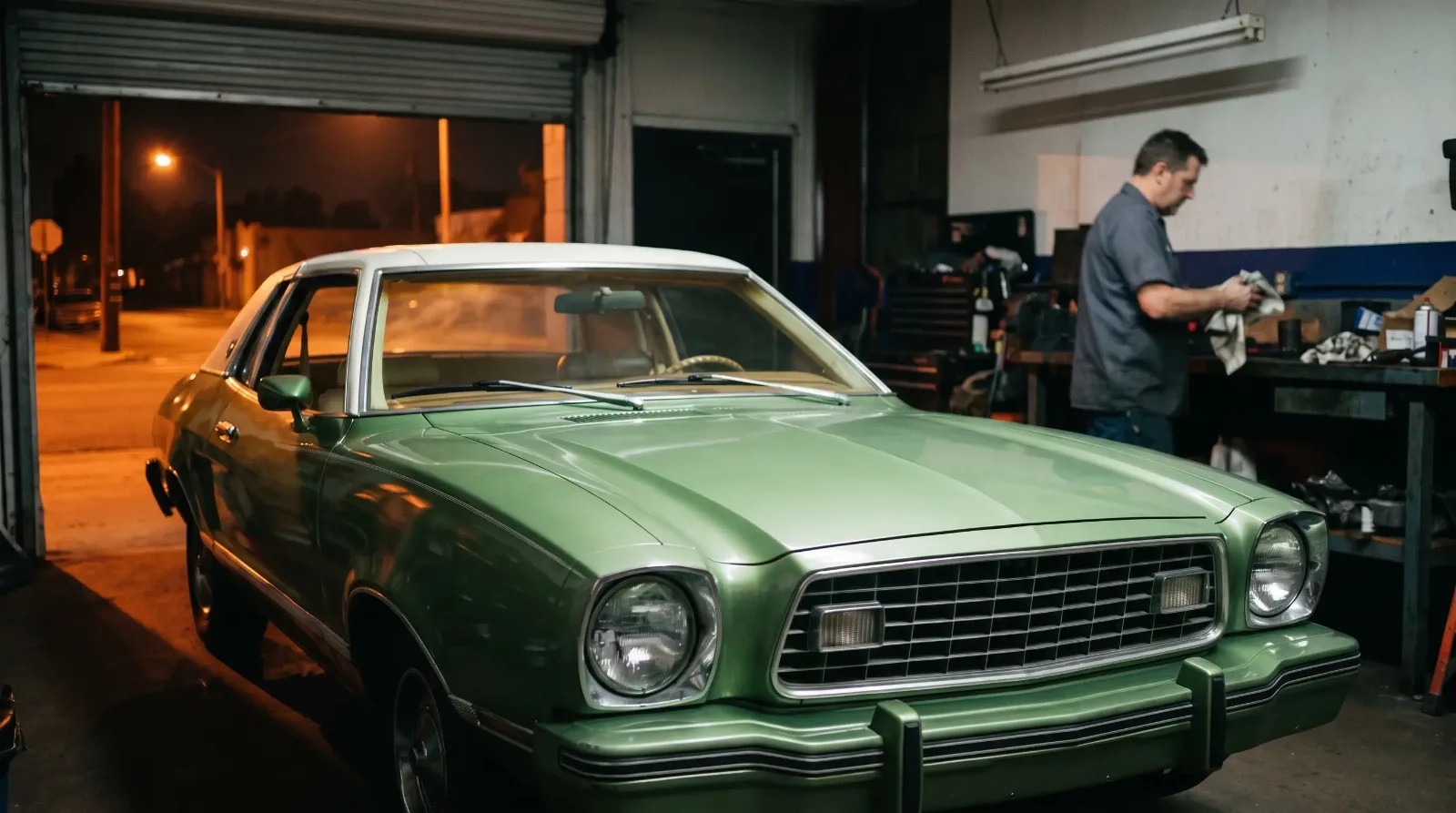
This article stays with one question: who made the call, when, and on what evidence. For the full run of the car from 1974 to 1978, read more here.
The production slide Ford could not ignore
Start with the numbers, because Ford's product planners certainly did. The Mustang built 299,824 cars for the 1969 model year. For 1970 the figure fell to 190,727. The 1971 car, the biggest Mustang yet, came in at 149,678, and 1972 slipped again to 125,093. In three model years the Mustang had lost more than half its volume.
| Model year | Mustang production | What was happening |
|---|---|---|
| 1969 | 299,824 | Restyled, larger car; Bunkie Knudsen fired in September 1969 |
| 1970 | 190,727 | Iacocca's downsizing push already under way |
| 1971 | 149,678 | Largest Mustang body to date; Pinto-based platform chosen in July 1971 |
| 1972 | 125,093 | Low point of the big-car era |
| 1973 | 134,867 | Last year of the big car and the last convertible until 1983 |
| 1974 | 385,993 | Mustang II on sale from September 21, 1973 |
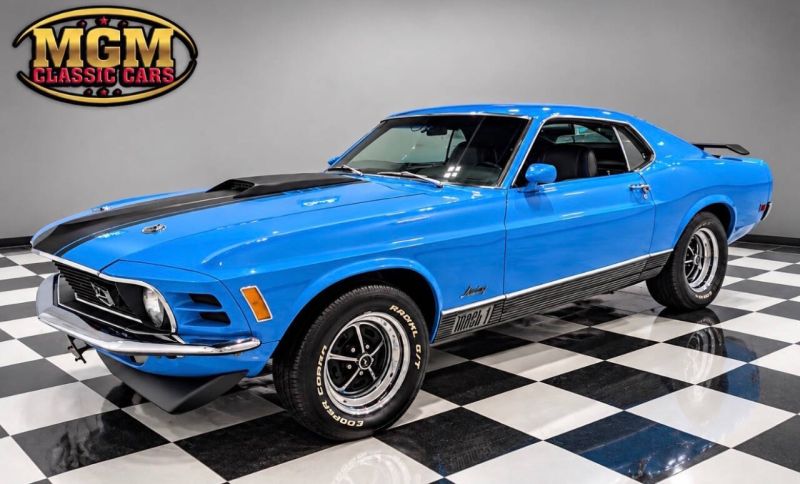
Size was the obvious suspect. The 1971 Mustang rode a 109-inch wheelbase, measured 189.5 inches long and 74.1 inches wide, and a SportsRoof weighed 3,560 pounds. The 1965 hardtop that started everything was 181.6 inches long, 68.2 inches wide and weighed 2,556 pounds. Part of the extra width had a specific purpose: the body was widened about 3 inches so the 429 big block would fit without the shock-tower surgery the Boss 429 needed. That suited the muscle-car buyer. It did nothing for the larger group who had bought the original as a small, affordable coupe. How far the car had drifted from 1965 is easiest to see in our complete Mustang story.
Some owners said so out loud. At the 1968 shareholders' meeting, a shareholder named Anna Muccioli (the name also appears as Muciolli) reportedly asked why the Mustang had moved away from its "light and lean" beginnings. I have found that story in only one account. One question from the floor proves little, but the complaint was in the room years before the embargo. I also will not pretend that size explains the entire slide. The wider pony car market was cooling at the same time, and soaring insurance rates were pushing would-be pony car buyers toward compacts and imported coupes. Ford did not control those. It did control the size of its car.
Iacocca's little jewel brief, November 1969
The turn came at a Ford management meeting in November 1969. Bunkie Knudsen, the former GM executive whose program produced the 1971 car, had been fired by Henry Ford II on September 11 of that year. With Knudsen gone, Lee Iacocca pushed for a smaller Mustang, and the directives that came out of that period were specific. The new car would launch for the 1974 model year. And it would be an upscale "little jewel," not a stripped economy car.
A note on that phrase. Most accounts tie it to Iacocca's brief, but the best known version reaches us through Stuart M. Frey, the program's chief engineer, recalling what Iacocca expected. The brief was Iacocca's. I cannot prove the exact words were. What is certain is that Ford adopted them: its own 1974 Car of the Year advertisement told readers, "We built Mustang II to be a little jewel of a car." Iacocca became president of Ford on December 10, 1970, which gave the small-car program a sponsor at the very top while it was still on paper.
"Little jewel" is the part people forget. Ford already sold cheap small cars. What Iacocca wanted was small and well finished: a car a buyer would pay extra for because of its trim and quietness, not in spite of its size. The plan showed up most clearly in the Ghia notchback, the luxury model of the line. In 1974 Ford built 89,477 Ghias out of 385,993 Mustang IIs, almost one car in four. Buyers took the luxury half of the brief at face value.
Why was the Mustang II made on the Pinto and not the Maverick?
Once the size was settled, Ford needed a platform, and there were two candidates. Early planning ran through a Maverick-based program known internally as "Ohio." A competing Pinto-based program, "Arizona," won out in July 1971. The Maverick had the more Mustang-like proportions on paper, since it rode on the chassis of the Falcon, the compact the original Mustang had been built from. The Pinto was smaller and newer, and it got the program closer to the size Iacocca had asked for.
Choosing the Pinto did not mean dressing up a Pinto. The Mustang II rode a 96.2-inch wheelbase against the Pinto's 94.0, and accounts of the program say Iacocca insisted the two cars share as few components as possible. The most important difference sat under the front end. Engineers Bob Negstad and Jim Kennedy developed a U-shaped front subframe, nicknamed the "toilet seat," that isolated the suspension and engine mounts from the body. That is where much of the "jewel" quietness came from.
What shrinking actually took off the car
The finished car was about 19 inches shorter than the 1973 Mustang, about 4 inches narrower, and somewhere between 450 and 490 pounds lighter. The spread on that weight figure is honest: it depends on which 1973 model you compare it with. The Mustang II measured 175.0 inches long and 70.2 inches wide, on that 96.2-inch wheelbase.
| Dimension | 1965 hardtop | 1971 SportsRoof | 1974 Mustang II |
|---|---|---|---|
| Wheelbase | 108 in | 109 in | 96.2 in |
| Length | 181.6 in | 189.5 in | 175.0 in |
| Width | 68.2 in | 74.1 in | 70.2 in |
| Weight | 2,556 lb | 3,560 lb | 450 to 490 lb under the 1973 car |
Read the first and last columns together. The Mustang II was shorter than the 1965 car by more than 6 inches and gave up nearly a foot of wheelbase, but it was 2 inches wider. Ford did not simply return to the original. It went past it, toward a size class the original never competed in.
The cost of that shrinking was the engine bay. For 1974 there was no V8 in a U.S. Mustang, the first model year without one, and the choices were a 2.3-liter four and a 2.8-liter V6. The V8 came back for 1975. Ford's public relations staff proposed the "Mustang II" name in August 1972, and Henry Ford II approved it, a sign the company wanted the new car read as a fresh start rather than a cut-down version of the old one.
"People want the Mustang II to have been a panic move, because a panic move is easier to forgive or easier to mock. The record shows a plan. The brief was written in November 1969, the platform was picked in July 1971, and the embargo arrived after the cars were already in showrooms. You can dislike the car. You cannot honestly call it a reaction to 1973."
Tom Ramirez
The oil embargo: good timing, not the cause
The Mustang II was introduced on September 21, 1973. The Arab oil embargo began in October 1973. Ford had spent four years building a smaller, lighter, thriftier Mustang for reasons of its own, and it landed in showrooms just as fuel suddenly became the thing every buyer was asking about. No planner can claim credit for that timing, and it is why the oil-crisis story stuck: from the buyer's side of the counter in late 1973, it looked exactly like an answer to the news.
The results backed the decision, whatever the reason. Ford built 385,993 Mustangs for 1974, close to three times the 1973 total and the best Mustang year since 1967. How that first year unfolded, from the introduction to the Car of the Year award, is covered in our piece on the 1974 launch.
The Mustang II was not meant to last forever. In October 1974, barely a year after the launch, Ford confirmed that a Fox-based car would replace it, and that car arrived for 1979. The small Mustang still did its job. It kept the name in showrooms through a period when a bigger Mustang might have been quietly dropped, which is the core of the case for the Mustang II.
So the honest answer to the question is less dramatic than the legend. Ford shrank the Mustang because its own buyers had walked away from the big one, and because Iacocca believed a small car could still feel expensive. The oil embargo only made him look prescient.
Sources and notes
- Ford Mustang (second generation), Wikipedia
- The 2nd generation Ford Mustang overview, MustangSpecs
- Ford's 1974 "Motor Trend Car of the Year" Mustang II advertisement (scan), Flickr
- The misjudged big 1971 Mustang and the 1968 shareholder question, The Autopian
- Which high-performance pony cars sold best in the early 1970s, IndieAuto
- Ford Maverick (Americas), Wikipedia
Related Reading

About the author
Tom Ramirez
Corvette researcher and historian based in Bowling Green, Kentucky. Two decades documenting Corvette production history from original factory records.
Related Listings - Ford Mustang




Comments
Be the first to comment on this article.