
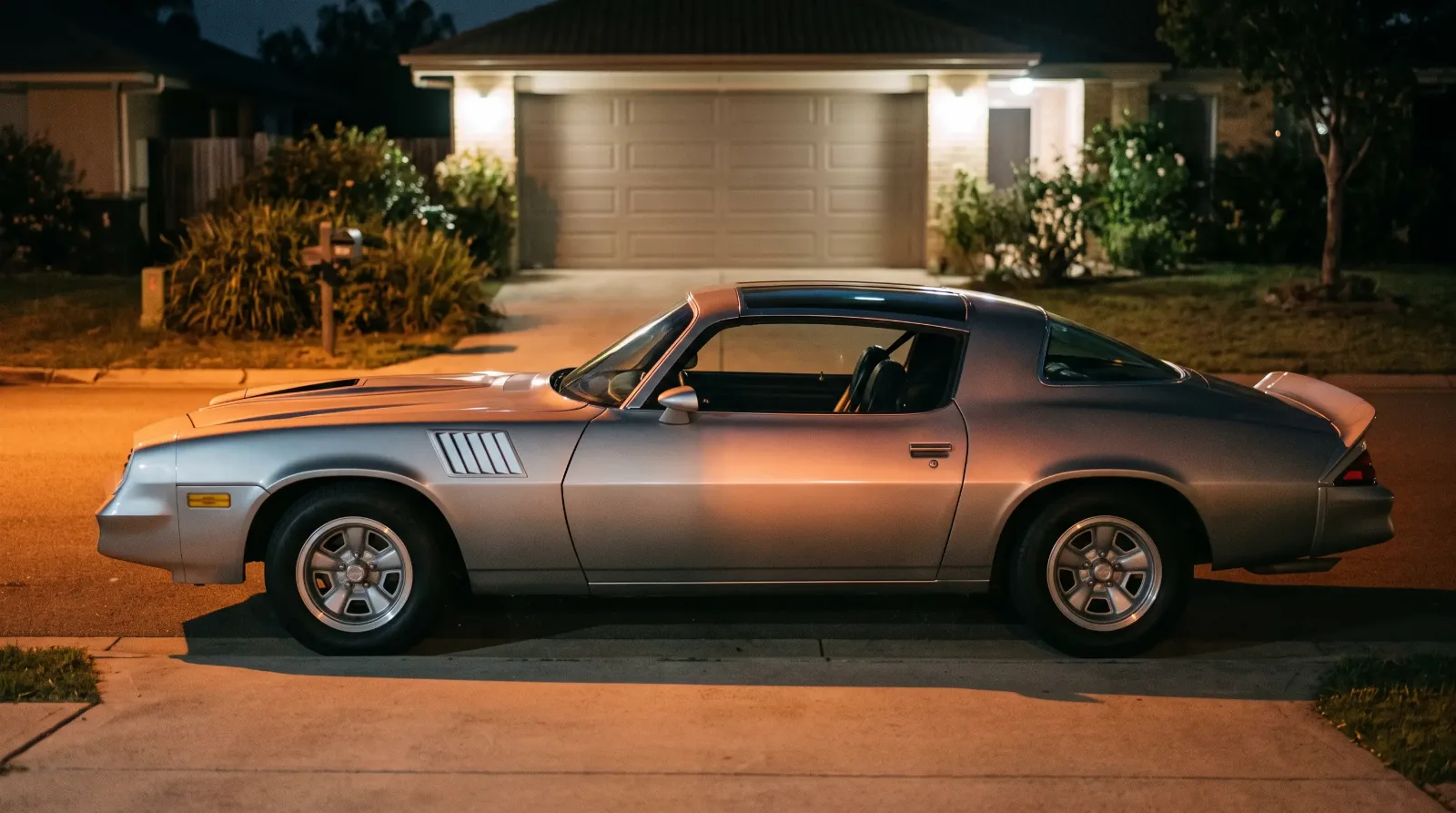
In February 1977, at Daytona, Chevrolet rolled out a car it had walked away from three years earlier. The Z28 was back, with stripes, a four-speed and a stiffer chassis, and it arrived in the middle of the best year the Camaro had enjoyed since 1969. By the time the model year closed, something had happened that had never happened before: the Camaro had finished ahead of the Mustang. The 1977 Camaro sales story is not one of a single hero car, though. It is about ordinary coupes, a changing market and a rival that fell further than anyone expected. For the generation around it, start with the second-gen Camaro story.
Car Features
6 min read
1977: The Year the Camaro Outsold the Mustang
In 1977 the Camaro beat the Mustang for the first time: 218,853 cars to 153,117. Ordinary coupes, not the returning Z28, did most of the work.
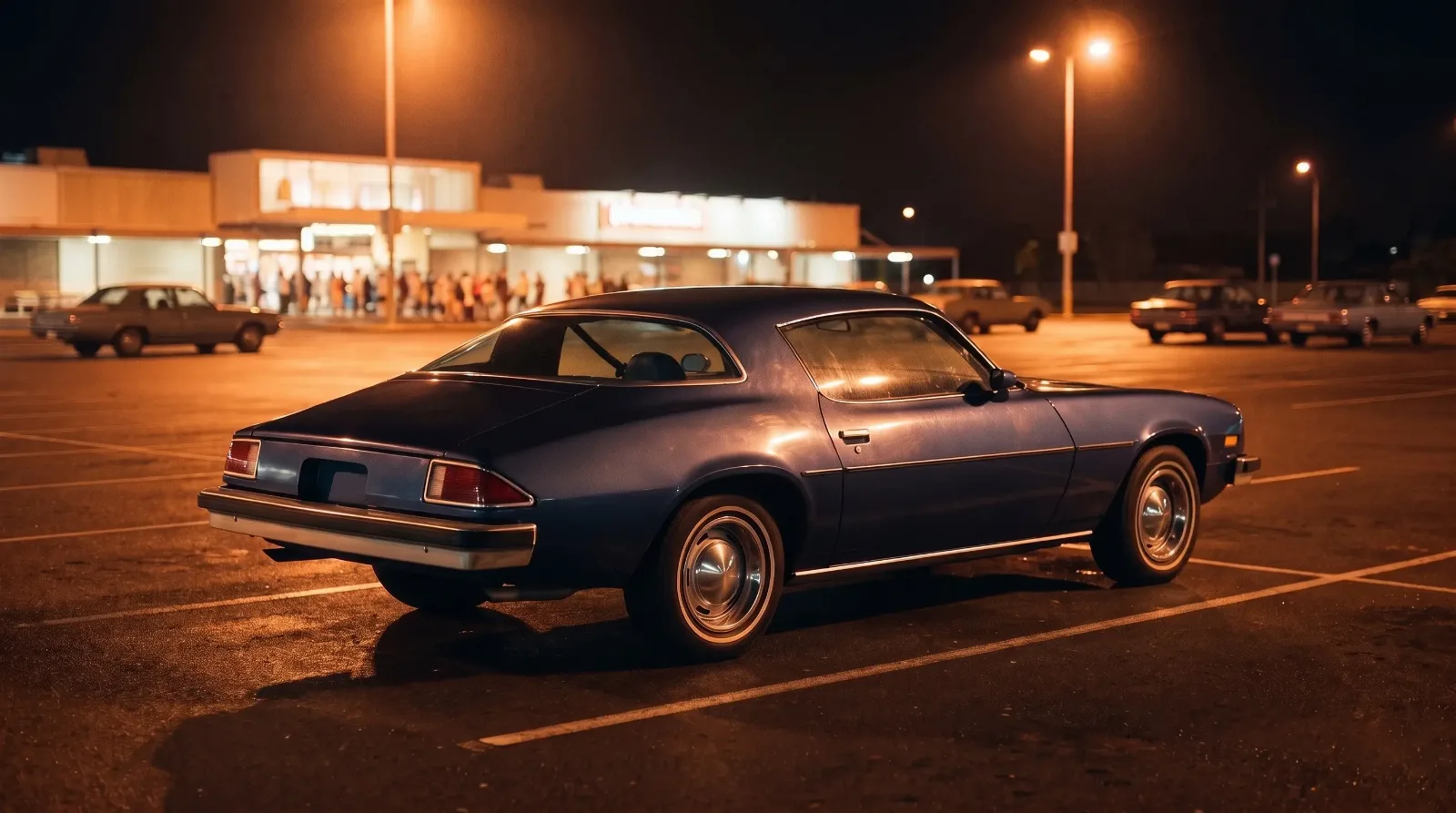
1977 Camaro sales by the numbers
The scoreboard first. These are model-year production figures, the yardstick most often used for this rivalry, and they tell the story in two lines.
| Model year | Camaro | Mustang | Ahead |
|---|---|---|---|
| 1976 | 182,959 | 187,567 | Mustang, by 4,608 |
| 1977 | 218,853 | 153,117 | Camaro, by 65,736 |
In 1976 the Mustang still led, narrowly. A year later the Camaro was ahead by more than 65,000 cars. It was the first time the Camaro had outsold its Ford rival since the two began trading punches in the 1960s, and it is the reason 1977 matters more to Camaro people than its specifications alone would suggest.
One footnote for the careful reader. Wikipedia, citing Edmunds, gives 153,117 for the 1977 Mustang, while MustangSpecs and other enthusiast references give 153,173. Fifty-six cars either way does not change the result.
How the gap opened in one year
The swing came from both directions at once. The Camaro grew by about 36,000 cars, from 182,959 to 218,853, which was its highest total since 1969. The Mustang shrank by more than 34,000, from 187,567 to 153,117. Either change on its own would have closed most of the gap. Together they turned a near-tie into a rout.
The Camaro's climb had been building for a while. Production had sat at 68,656 in the strike-hit 1972 model year. It reached 151,008 in 1974, dipped to 145,770 in 1975, then jumped to 182,959 in 1976. The car Chevrolet had nearly cancelled was selling better every season, even with its performance at a low ebb and five-mph bumpers to carry. The 1977 total was simply the next step on a staircase.
What buyers were actually buying
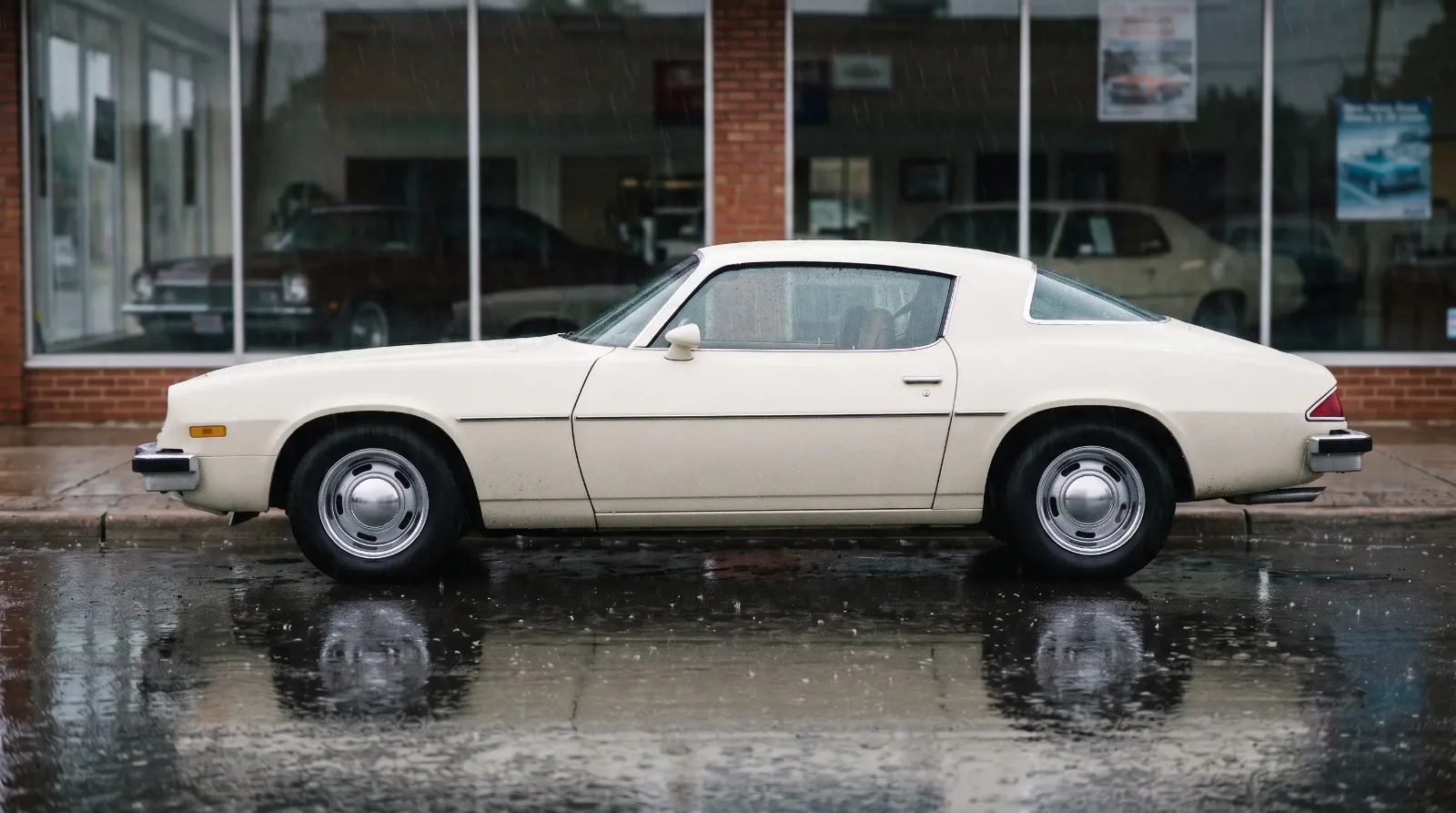
It is tempting to credit the Z28 for the win. The numbers say otherwise. Of the 218,853 Camaros built for 1977, Chevrolet built 14,349 Z28s, well under a tenth of the total. The bulk of the year's volume was the Sport Coupe and the more upscale LT, many of them carrying engines that would embarrass a 1970 owner.
For 1977 the 250 six became the standard engine on both the Sport Coupe and the LT. Six-cylinder cars accounted for 31,389 of the total and V8 cars for 187,464, so the six was a price point more than a choice most buyers made. The V8 options were the 305 at 145 hp and the 350 at 170 hp. Prices started at $4,115 at the bottom of the range and ran to $5,170 for the Z28 at the top. Even the small changes reached the people buying these cars on payments: intermittent wipers were new for 1977.
That is the real portrait of the 1977 buyer. Someone who wanted the long hood and the fastback roof, a comfortable interior and a V8 badge on the fender, and who was not about to pay for horsepower the decade had taken away. The Camaro gave that buyer the look of 1970 at a 1977 price. Ford's Mustang II answered the same buyer differently, and by this measure the market chose Chevrolet's answer.
"People forget that the Camaro won 1977 on the showroom floor, not on the drag strip. The coupe in the driveway was a Sport Coupe with a 305, and there were a great many of them."
Patrick Walsh
A Trans Am, a movie and the Z28 comeback
The Camaro did not climb in isolation. Its corporate twin had been showing the way. In 1976 about 47,000 of 110,000 Firebirds were Trans Ams, and chief engineer Tom Zimmer demanded the Z28's return after seeing those Trans Am sales. Engineer Jack Turner led the revival, reportedly with the Porsche 924 as his yardstick for how it should drive.
The 1977 Z28 used a 350 four-barrel rated at 185 hp (175 hp in California) and 280 lb-ft, a Borg-Warner Super T10 four-speed with a 3.73 axle, and front springs more than 20 percent stiffer than the 1970 to 1974 cars, with rear springs about 30 percent stiffer. In its April 1977 test, Car and Driver ran it from 0 to 60 mph in 8.6 seconds, quicker than the W72 Trans Am it tested at 9.3 seconds. In a decade of slow cars, that was a headline.
Then there was the movie. Smokey and the Bandit came out in 1977 and gave the whole sporty-coupe segment a lift, though the car that starred in it was a Pontiac Trans Am, the Camaro's corporate twin. A rising tide in that segment helped every long-hooded coupe, the Camaro included.
What came after the first win
The 1977 result was not a one-off. It was the start of the Camaro's biggest run. Production rose to 272,631 for 1978 and 282,571 for 1979, and the three model years from 1977 to 1979 together added up to more than three quarters of a million cars (774,055 by the yearly figures). The second generation that had been written off in 1972 ended the decade as Chevrolet's sporty-car success story.
For 1978 the car got a new urethane nose and the T-top option, and you can read about the 1978 facelift in detail. For the full 1967 to 2002 view of the rivalry and every generation in between, the classic Camaro guide picks up the thread.
It is worth remembering what 1977 really was. Not the fastest Camaro, and not the rarest. Just the year a great many people walked into a Chevrolet store, looked at the coupe on the floor, and decided it was the one they wanted.
Sources and notes
- Hagerty: 1970-81 Chevrolet Camaro buyer's guide (production by year)
- Hagerty: the 1977 Z28's return and the Car and Driver test
- Wikipedia: Chevrolet Camaro (second generation)
- Wikipedia: Ford Mustang (second generation), 1976 and 1977 production
- MustangSpecs: 1977 Ford Mustang production numbers
- Tran-Zam: 1976 Firebird and Trans Am production
Related Reading
Have a
Chevrolet Camaro
for Sale?
Reach thousands of serious classic car collectors across the US.
Sell It Here →
Selling a classic? Here's how: compare the places to sell classic cars
Are You a Classic Car Dealer?
List your full inventory and connect with targeted classic car buyers.
Join as a Dealer →
#chevrolet camaro
#second gen camaro
#camaro production
#camaro vs mustang
#1977 Z28
#1977 Camaro
#Camaro sales

About the author
Patrick Walsh
Automotive journalist covering classic car shows, events, and the enthusiast community across North America.
Related Listings - Chevrolet Camaro




Comments
Be the first to comment on this article.