
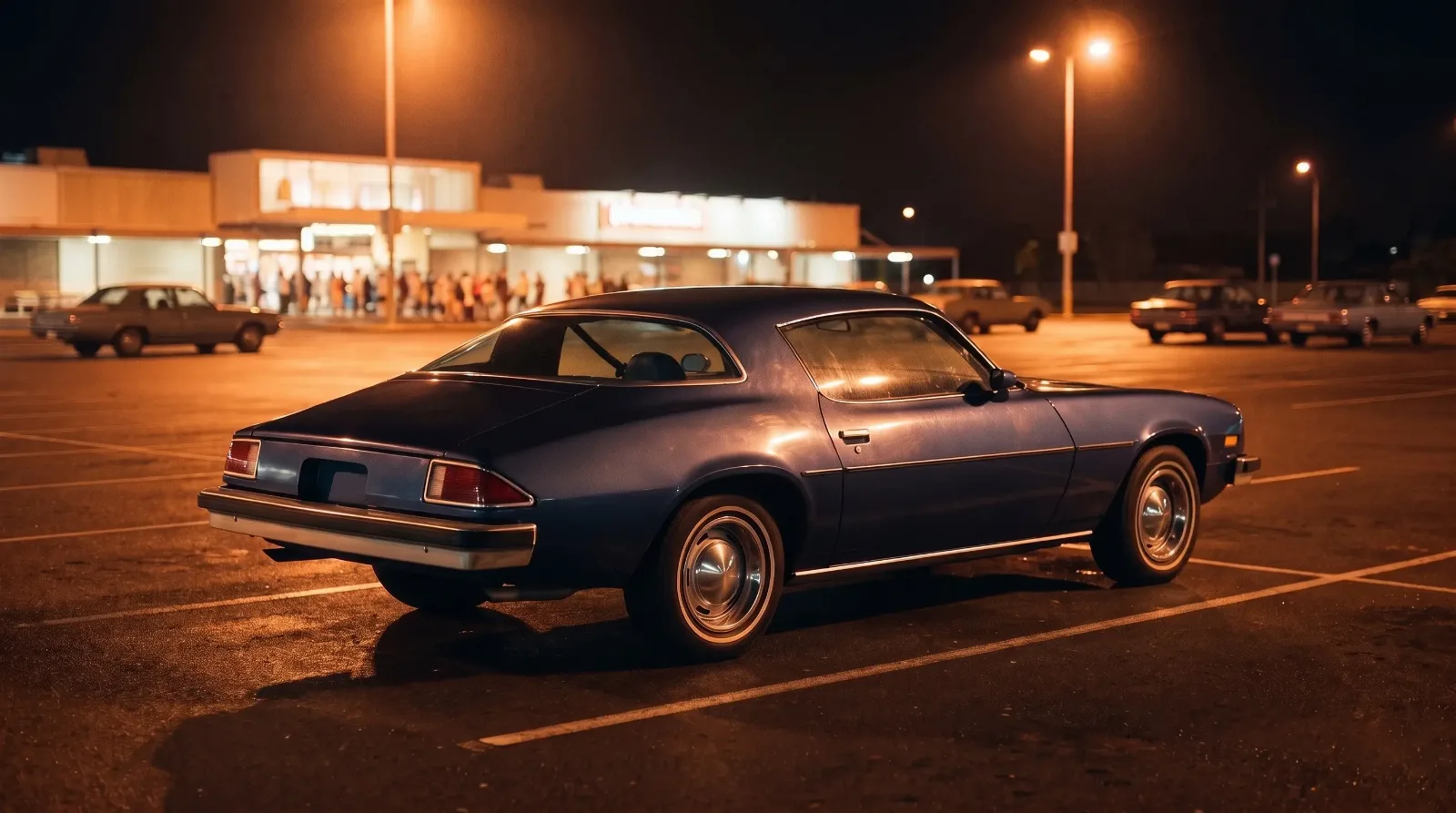
Once a year at any club meet, somebody new walks up to a late second-gen Z28, reads the owner's display card and asks why it says "1977½." The owner always smiles, because he has been waiting for the question. The answer is simple. The 1977 Camaro Z28 did not exist when the 1977 model year began. It arrived in the spring, as a mid-year car, after two full seasons with no Z28 in the catalog at all. That half on the card is the whole story in one character, and it is the best conversation starter a Camaro owner can print.
Car Features
6 min read
The 1977½ Z28 Comeback
Why the 1977 Camaro Z28 carries a half in its name: two years gone, a spring 1977 return, 185 hp, 14,349 built, and the paperwork to ask for today.
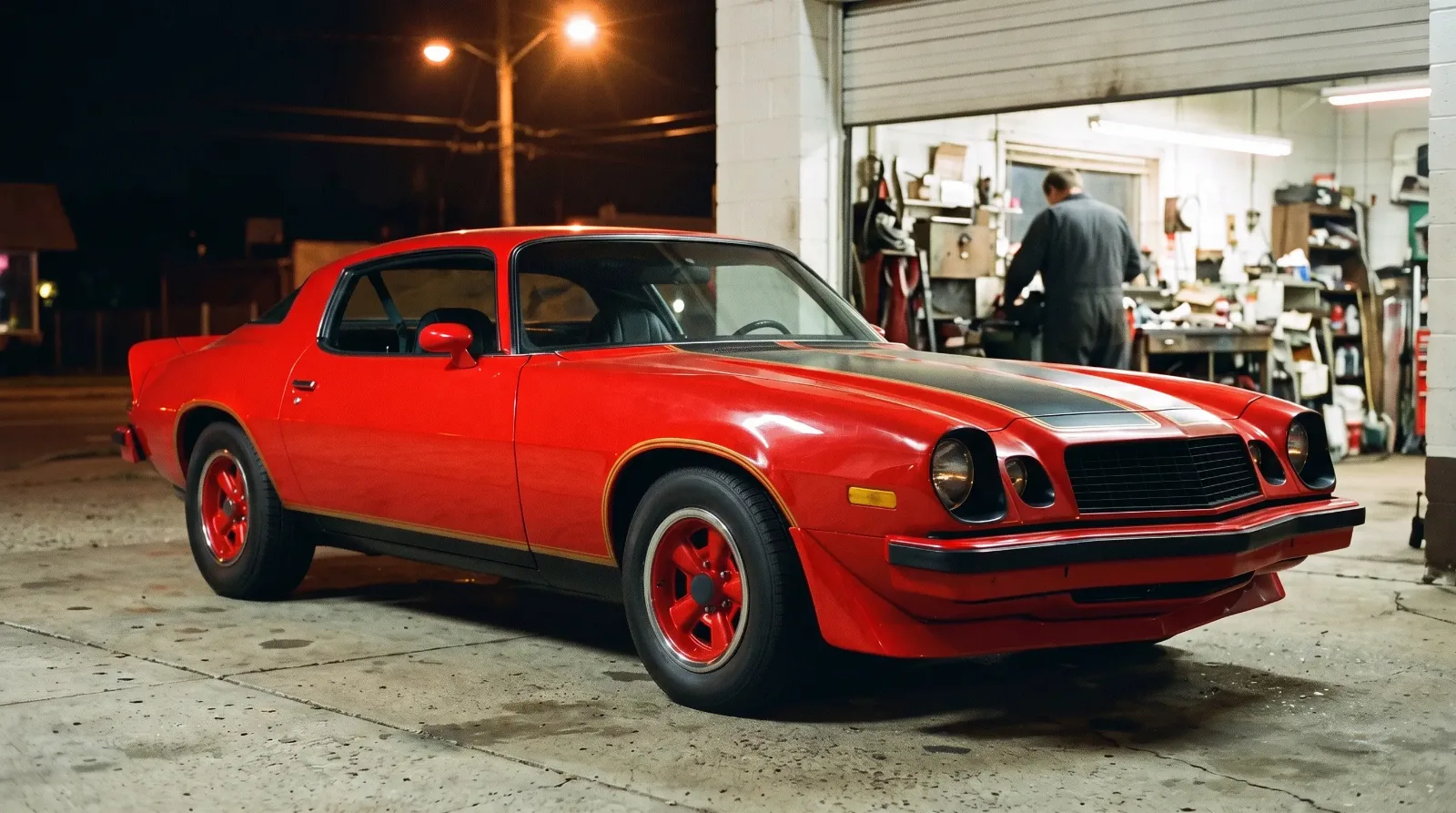
The Z28 had a long run inside the long second generation, and the 1977 car is the hinge in the middle of it. This is how it came back, what it really was, and what to ask for when one is for sale.
Two years without a Z28
The odd part of the Z28's disappearance is that it was selling. Chevrolet built 13,802 Z28s for 1974, the best second-generation Z28 year up to that point, with the L82 350 rated at 245 hp net. Then the name was gone. The stated reason was tight emission regulations, and there was no Z28 for 1975 or for 1976. If you want the full account of how a car selling better than ever got cancelled anyway, here are the details.
Two model years is a long time in a showroom. A buyer who wanted a Camaro with some attitude in 1975 or 1976 had to build one from the option sheet and hope. Meanwhile, across the GM lot, a different F-body was doing very well indeed.
Why the 1977 Camaro Z28 came back in the spring
That other F-body was the Pontiac Firebird Trans Am, and its sales are the reason the Z28 returned. Chevrolet chief engineer Tom Zimmer demanded the Z28 come back after watching what the Trans Am was selling. The engineer who led the revival was Jack Turner. In Car and Driver's April 1977 report, Turner compared the feel he was after to the Porsche 924, which tells you this was meant to be a driver's car, not a decal package.
The car debuted at Daytona in February 1977. Chevrolet press releases from the time, kept in the Free Library of Philadelphia's automobile collection, set a showing for reporters at Daytona International Speedway on February 17 and the public debut at the Chicago Auto Show on February 26. Either way, it reached buyers well after the regular 1977s, hence the half.
One more detail matters for owners and judges. From 1967 to 1974 the Z28 had been an option package on a Camaro. The 1977 car returned as a separate model. Owners and judges care about that distinction, so get it right on the display card.
What the comeback car really was
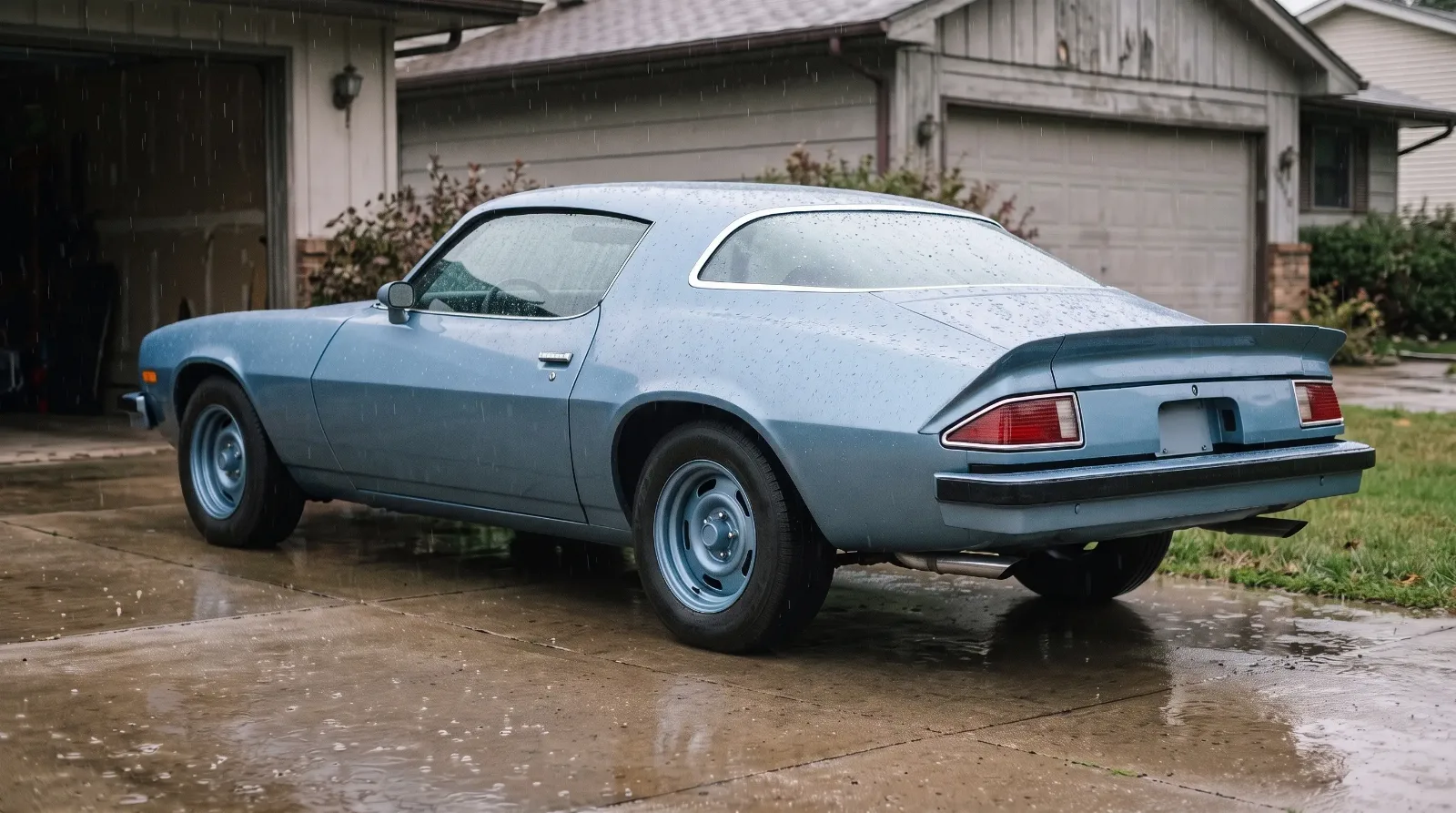
The 1977 Z28 was a handling car first. Chevrolet stiffened the front springs by more than 20 percent and the rear by about 30 percent compared with the 1970 to 1974 cars, fitted quicker 13:1 power steering and put it on GR70-15 radials. The engine was the LM1 350 four-barrel at 8.5:1 compression, rated at 185 hp at 4,000 rpm and 280 lb-ft at 2,400. That is 60 hp less than the last 1974 Z28 on paper, and the chassis work was meant to make up for it.
| Item | 1977 Z28 |
|---|---|
| Introduced | Spring 1977 (Daytona debut, February 1977) |
| Engine | LM1 350 four-barrel, 8.5:1 |
| Rating | 185 hp at 4,000 rpm, 280 lb-ft at 2,400 rpm (175 hp California) |
| Manual | Borg-Warner Super T10 four-speed, 2.64 first, 3.73 axle |
| Automatic | 3.42 axle; the only choice in California |
| Chassis | Front springs over 20% stiffer, rear about 30% stiffer than 1970 to 1974; 13:1 power steering; GR70-15 radials |
| Price | $5,170, top of the 1977 Camaro range |
| Production | 14,349 |
The manual car got the Borg-Warner Super T10 four-speed with a 2.64 first gear and a 3.73 axle. Automatic cars ran a 3.42. At $5,170 it was the most expensive Camaro of 1977. And a 350 stayed the Z28's main engine through 1981, although the last year's manual and California cars got a 305.
Quicker than the Trans Am in a straight line, and how many were built
Car and Driver put the new Z28 against a W72 Trans Am in that April 1977 test, both cars with four-speeds. The Z28 ran the quarter mile in 16.3 seconds at 83.1 mph, against the Trans Am's 16.9 seconds at 82.0 mph, and the magazine called the Chevrolet the winner in straight-ahead performance. Hagerty's retelling of the same test gives 8.6 seconds to 60 mph for the Z28 and 9.3 for the Trans Am. The Pontiac did win on top speed, 110 mph to the Camaro's 105, and it pulled more grip on the skidpad, 0.80 g to the Z28's 0.74 g. So the comeback car was quicker where buyers felt it, at the stoplight, and gave up a little in the places few of them ever pushed it.
Now the production number, because you will hear two. Three sources give 14,349 Z28s for 1977. Wikipedia says "about 13,000." The exact figure from three sources wins, and 14,349 is the number to quote at the show field. For a car that only had part of a model year, it beat the 13,802 of 1974.
The Z28 also arrived in the right year. Chevrolet built 218,853 Camaros for 1977, and that was the year it outsold the Mustang for the first time. The Z28 was a small slice of that total, but it was the one carrying the performance name.
"A 1977 Z28 with a story and no paper is a Sport Coupe with ambitions. Bring the envelope, not the anecdote, and the judges will listen."
Wayne Coburn
Buying a 1977½ today: the paperwork is the car
Every club has heard the line: "It's a real '77 Z28, the old man bought it new." Maybe so. The old man's word is not documentation, and neither is a set of reproduction decals. What a seller can show you is the window sticker, the dealer invoice, a build sheet if one survived, and any owner history with names and dates. A car with those is a 1977½ Z28. A car without them is a conversation.
Mechanically, ask the questions the specification table answers. Does a 49-state car still have its four-speed and 3.73 axle, or has it been swapped? Does a California car with a manual have paperwork explaining the change, since the factory did not offer one there? Is the engine an LM1 350 or a later small-block? None of these makes a car fake on its own, but each one is a question, and a seller with the envelope answers it in a minute.
The 1977 car sits in a bigger family of performance Camaros, and there is more on that here. When you are ready to look at real cars, browse 1977 Camaros for sale, and when you find a Z28, ask about the paper before you ask about the price. The half in the name is the easy part. Proving the rest is what makes it worth owning.
Sources and notes
- Car and Driver, April 1977: Camaro Z/28 vs Pontiac Firebird Trans-Am (reprint)
- Hagerty: Original Owner, the Camaro Z28's return
- Hagerty: 1970 to 1981 Chevrolet Camaro buyer's guide
- Jalopnik: A brief history of the Camaro Z/28
- Conceptcarz: 1977 Chevrolet Camaro
- Wikipedia: Chevrolet Camaro (second generation)
Related Reading
Have a
Chevrolet Camaro
for Sale?
Reach thousands of serious classic car collectors across the US.
Sell It Here →
Selling a classic? Here's how: sell my classic car
Are You a Classic Car Dealer?
List your full inventory and connect with targeted classic car buyers.
Join as a Dealer →

About the author
Wayne Coburn
Longtime Corvette owner, judge and club figure who knows the cars, the records and the people behind them.
Related Listings - Chevrolet Camaro




Comments
Be the first to comment on this article.