
Twenty horsepower. That is what the Cross-Fire Injection Camaro gave a 1982 Z28 buyer over the carbureted 305, and it cost $450 plus the right to choose a manual gearbox. The LU5 made 165 hp at 4,200 rpm. The four-barrel LG4 made 145 hp at 4,000. Both made 240 lb-ft of torque. On paper the system was the headline of the new Z28: fuel injection, computer control and hood flaps that actually opened. The numbers tell a smaller story, and the people who drove the cars tell a harsher one. Here is what the twin throttle bodies did, what they did not, and why they lasted two model years.
Car Features
6 min read
Cross-Fire Injection: The 1982 and 1983 Z28's Twin Throttle Bodies
The Cross-Fire Injection Camaro added 20 hp over the carbureted 305 in 1982. Here is how the twin throttle bodies worked and why they lasted two years.
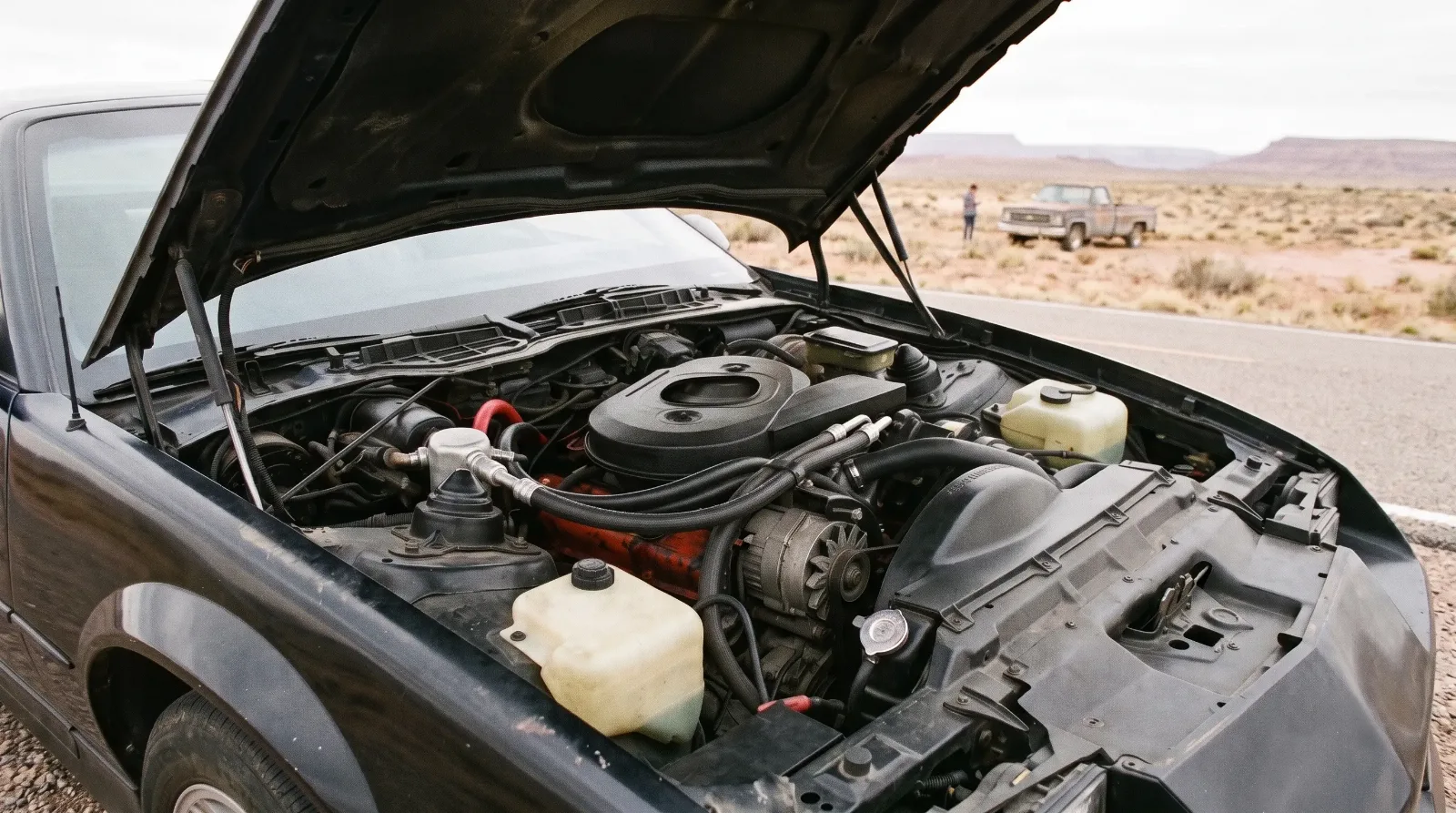
How Cross-Fire Injection worked on the Camaro
The hardware looks more exotic than it is. Cross-Fire put two 48 mm Rochester throttle bodies on a cross-ram aluminum intake, one throttle body per cylinder bank, set on the diagonal across the top of the engine. Combined, the two throttle bodies were rated at 750 cfm. The injectors were batch-fired, one bank and then the other, under GM's Computer Command Control.
That is throttle-body injection, not port injection. Fuel still went in above the throttle plates and still had to travel the length of the manifold to reach the valves, the same basic job a carburetor does. The difference was metering. A computer, not a set of jets and a power valve, decided how much fuel went in. It was the same family of idea that Chevrolet used on the Camaro's smallest engine that year, the Iron Duke four, which also used throttle-body injection. On the V8 there were simply two throttle bodies, and a manifold shaped to look like racing hardware.
The numbers, 1982 and 1983
Here is the whole Z28 V8 lineup across the two Cross-Fire years, catalog ratings only. Everything in this table is a net figure from Chevrolet's own numbers, not a dyno sheet.
| Engine | Year | Induction | Power | Torque | Transmission |
|---|---|---|---|---|---|
| LG4 305 | 1982 | Four-barrel | 145 hp at 4,000 rpm | 240 lb-ft at 2,000 rpm | Four-speed manual or three-speed automatic |
| LU5 305 | 1982 | Cross-Fire, twin TBI | 165 hp at 4,200 rpm | 240 lb-ft at 2,400 rpm | Three-speed automatic only |
| LG4 305 | 1983 | Four-barrel | 150 hp | Not confirmed | Five-speed manual or four-speed automatic |
| LU5 305 | 1983 | Cross-Fire, twin TBI | 175 hp | 250 lb-ft | Automatic only ($295, required) |
| L69 H.O. 305 | 1983 (from April) | Four-barrel | 190 hp | 240 lb-ft | Five-speed manual only |
Read the 1982 rows carefully. The LU5 gained 20 hp at the top and nothing at all in torque, and its torque peak came 400 rpm later than the carbureted engine's. On the street, where a Z28 spends most of its time well below its power peak, that is close to a wash. Then the automatic requirement took some of it back. In 1982 the only gearbox behind the LU5 was a three-speed automatic.
For 1983 Chevrolet found 10 more horsepower and 10 more lb-ft for the LU5, and the automatic it required became the four-speed TH700-R4, which helped. The LU5 option stayed at $450, with $295 more for the mandatory automatic. The carbureted LG4 also moved up, to 150 hp. The gap between the two engines grew from 20 hp to 25 hp on paper, which is to say it barely moved.
What the road tests actually found
Three major magazines tested the 1982 LU5 Z28 in their January 1982 issues, and they did not agree. Car and Driver ran 0 to 60 mph in 7.9 seconds and the quarter mile in 16.0 seconds at 85.0 mph. Motor Trend got 9.4 seconds and 17.1 at 80.7 mph. Road & Track got 9.7 seconds and 17.5 at 80.0 mph.
Two of those three numbers live in the same neighborhood. The Car and Driver run is the outlier, about a second and a half quicker than the other two, and I would not build an argument on it. The broader rule of thumb for 1982 holds up better: a carbureted Z28 with the four-speed manual ran 0 to 60 in just under 10 seconds, and an LU5 car with the automatic ran it in about 9. One second for $450 and your clutch pedal. That was the real trade.
"Twenty horsepower on the window sticker, an automatic you didn't ask for, and a manifold that ran out of breath around 4,000 rpm. By April 1983 Chevrolet was selling a four-barrel 305 making 190. That's the whole review."
Dan Reeves
Why owners called it "Cease-Fire"
The nickname stuck for a reason. The problem was not the injection. The injectors and the electronics were reliable enough. The problem was the manifold. To clear the Z28's hood, the runners were shorter than they wanted to be, and the plenum flowed about 475 cfm, far below the 750 cfm the two throttle bodies could pass. You can bolt on all the throttle you like; the air still has to get through the smallest door.
The result was low intake velocity and uneven fuel distribution between cylinders, and an engine that went flat above about 4,000 rpm. Put that next to the 1982 rating, with its 165 hp peak at 4,200 rpm, and you see the shape of it: the LU5 made its best power right at the edge of where its intake stopped cooperating. Drivers who expected the fuel-injection badge to mean a top-end pull did not get one.
Corvette owners got the same lesson with a bigger engine. The Corvette's L83 350 was standard with Cross-Fire in 1982 and again for 1984 (there was no 1983 Corvette). On the Corvette it gained only 10 hp and 5 lb-ft over the 1981 carbureted engine, and when Tuned Port Injection replaced it for 1985, TPI added about 25 hp over the Cross-Fire car. Different engine, same verdict.
The end of Cross-Fire and what it means for buyers now

The LU5 was effectively beaten in its own showroom. In April 1983 Chevrolet added the L69 H.O. 305 to the Z28, a four-barrel engine rated at 190 hp, five-speed manual only, at $505. That was 15 hp more than the 1983 LU5 with a clutch pedal attached. Cross-Fire was gone from the Camaro (and the Firebird) for 1984, and port injection arrived in 1985. The fuller story of how the third generation got there runs through the 1982 to 1992 cars, and Cross-Fire is the first and least flattering chapter of it.
How many 1982 and 1983 Z28s left the factory with the LU5 is a number I have not seen documented. So if a seller tells you his car is "one of only a few," ask him where he got the count. You can confirm the engine itself, though. A 1982 Cross-Fire car carries a 7 as its VIN engine digit, where a carbureted 305 shows an H. An LU5 car should also have the SMC hood with the working air-induction flaps, and an automatic behind the engine. If one of those is missing, the car has been changed since it left the plant.
None of this makes a Cross-Fire Z28 a bad car to own. It makes it a period piece: a fuel-injected V8 from the first year of a new body, and honest about what 1982 emissions engineering could do. For the rest of what Chevrolet changed in that downsized first year, there is more on that here. Just buy one for what it is. The hood flaps open. The extra horsepower mostly does not show up.
Sources and notes
- GM Cross-Fire Injection history and reliability (Jalopnik)
- Cross-Fire Injection explained (In The Garage Media)
- Chevrolet Camaro, third generation (Wikipedia)
- 1983 Chevrolet Camaro Z28 hatchback coupe (Eighties Cars)
- 1982 Camaro production and road tests (Muscle Car Facts)
- 1982 Camaro VIN codes (Camarotech)
Related Reading
Have a
Chevrolet Camaro
for Sale?
Reach thousands of serious classic car collectors across the US.
Sell It Here →
Are You a Classic Car Dealer?
List your full inventory and connect with targeted classic car buyers.
Join as a Dealer →
#camaro z28
#chevrolet camaro
#Cross-Fire Injection
#third generation Camaro
#1982 Camaro
#LU5 305
#1983 Camaro

About the author
Dan Reeves
Performance engine builder from North Carolina's motorsports corridor, focused on swaps, forced induction and making real, repeatable power.
Related Listings - Chevrolet Camaro

Comments
Be the first to comment on this article.