
Ask a room full of Mustang people how Saleen started and you will hear a dozen versions, most of them involving a supercharger and a race win. The record is quieter than that. The first Saleen Fox body Mustang was one of three hatchbacks built in 1984, and none of the three had a modified engine. They were stock Ford powertrains wrapped in an aero, suspension and interior package designed by a road racer who wanted his name on a car. That is where the badge begins.
Car Features
7 min read
The 1984 Saleen: Steve Saleen's First Mustang
Saleen began with three 1984 Fox hatchbacks: stock engines, new aero, suspension and interior. What the record shows about the first cars.
The big picture of Ford's factory specials and the tuners who worked alongside them is covered in our look at Ford's special-vehicle Mustangs. This piece stays with the first three cars, the man who built them and what the paperwork can and cannot tell us about them.
Who Steve Saleen was in 1984
Stephen Mark Saleen was born on April 2, 1949, in Inglewood, California. He earned a business degree from the University of Southern California, and then he went racing. By 1980 he was good enough to finish third in Formula Atlantic. From 1982 he raced a Mustang in the SCCA Trans-Am series.
That last detail matters more than the rest. A Trans-Am driver spends his weekends learning exactly what a Fox Mustang does wrong at the limit: where it pushes, where it rolls, where the brakes give up. Saleen had two years of that education before he built a road car. A business degree and a racer's notebook is a fair description of the company that followed.
The company itself came first, on paper. Saleen Autosport was formed in 1983. The first cars followed in 1984. Some histories give 1984 as the founding year, and the difference is real rather than a mistake: one date is the incorporation, the other is the first car out the door. If you hear both at a show, nobody is lying.
Building the first Saleen Fox body Mustang
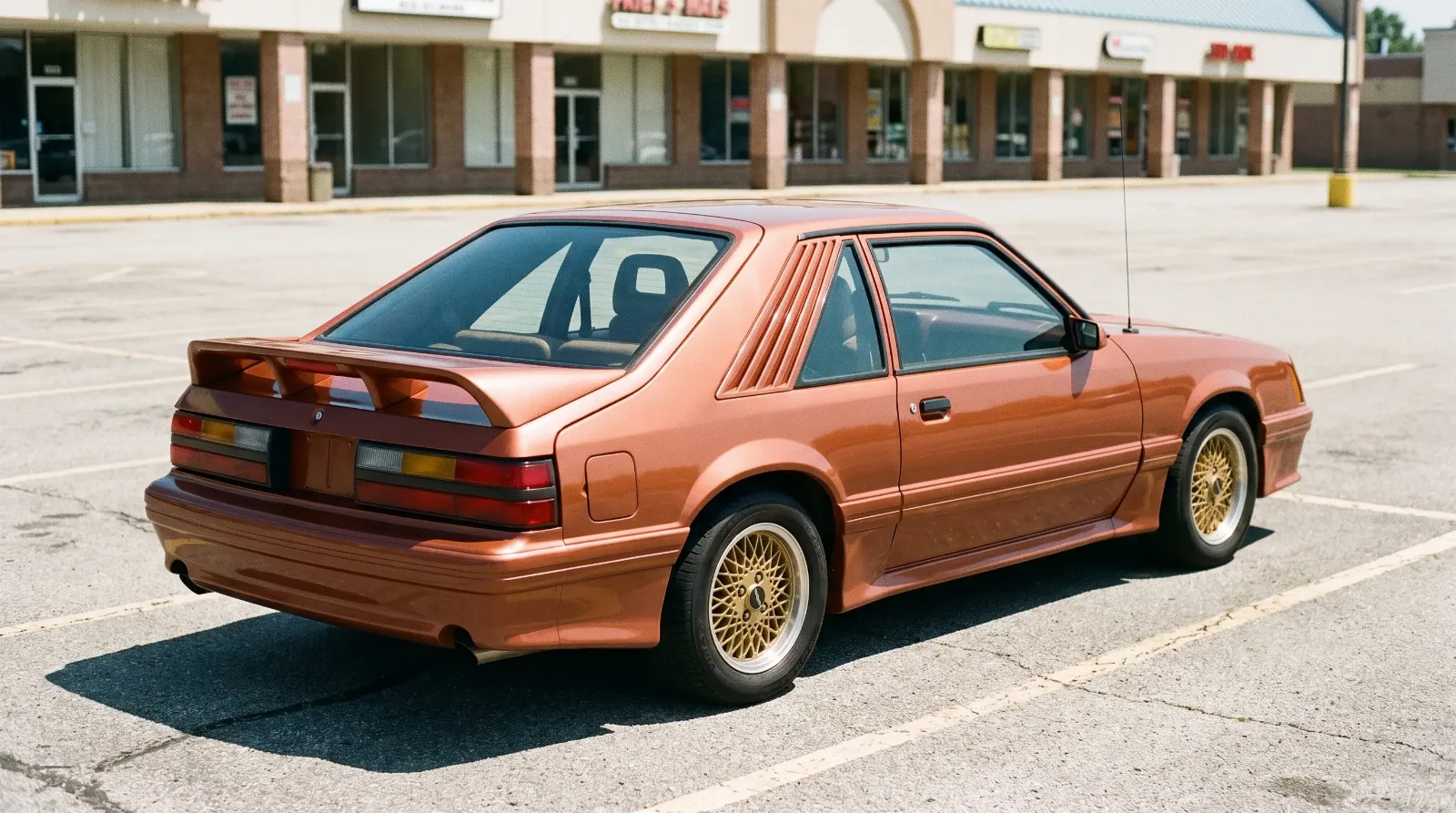
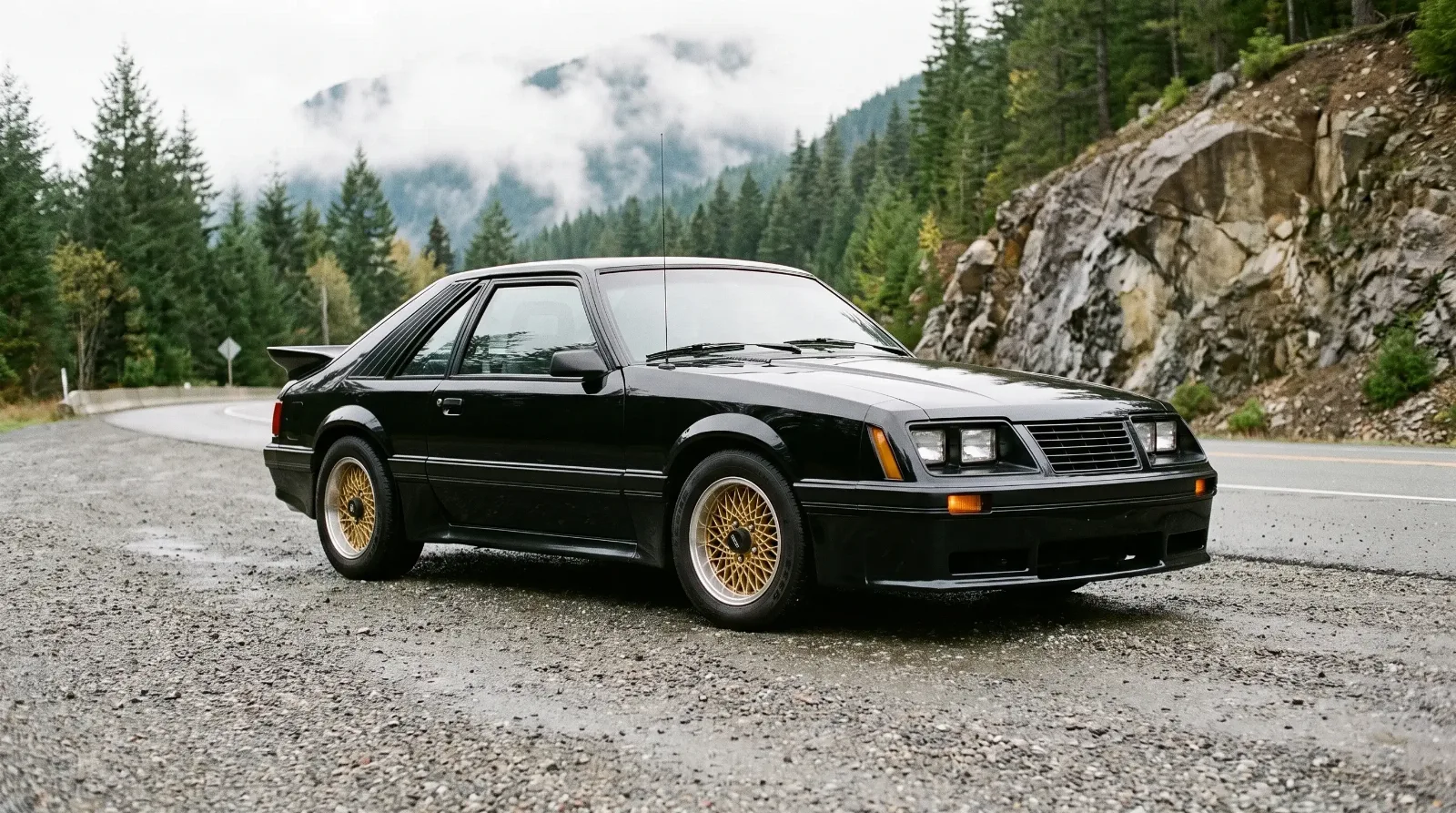
The 1984 run was three hatchbacks. One was white. One was a copper glow car with a five-speed. One was black. That is the whole production for the first year, and it is a number that bears repeating when somebody at a car show says their uncle had a 1984 Saleen.
What Saleen sold was a package rather than an engine. Aero pieces changed how the car looked and moved air. Suspension changes addressed what Trans-Am had taught him about the Fox chassis. The interior got its own treatment. Under the hood sat a stock Ford engine. Ford Authority, which photographed the first car at the Saleen exhibit in LeMay, America's Car Museum, says its 5.0 V8 was left exactly as Ford built it, and Old Cars Weekly describes the 1984 run as three 175-hp hatchbacks. That is the factory rating of Ford's 1984 5.0 with the four-barrel, which is what an untouched engine should make.
Why no engine work? Ford Authority's account gives the reason in two words: emissions purposes. A car with a modified engine has to satisfy emissions rules, and a new shop in its first year of building cars had good reason not to take that on. Handling and appearance carried no such burden. The proof that certification was the hurdle came a year later, when Saleen's first certified supercharger appeared in 1985. You only celebrate certifying something if certifying it was hard.
It is worth noting how different this was from Ford's own approach that same year. Ford's Special Vehicle Operations group built the SVO around a turbocharged four and a long list of chassis hardware. Saleen started from the other end, with the chassis and the look, and left the engine alone. SVO had also worked with McLaren on a turbo Mustang a few years earlier; the McLaren article has the details on that car.
What the record says, and what it does not
Here is where the bench-racing has to stop and the paperwork takes over. The documented facts on the 1984 cars are short: three hatchbacks, three colors, a package of aero, suspension and interior parts, stock engines. Two things people always ask about, price and power, have only recently firmed up, and both come from secondary sources rather than a factory document.
The price first. Ford Authority gives the first Saleen Mustang an original price of $14,300. Old Cars Weekly quotes the same $14,300, which it puts at $4,526 more than a standard Mustang GT, though it does not tie that figure to a model year. Power is the 175 hp of a stock 1984 5.0, as above. Neither is backed by a published window sticker or invoice for an individual car, so if you own one of the three and have the original paperwork, you still hold information the hobby does not.
Some perspective on scale helps. Ford built 141,480 Mustangs for the 1984 model year. Saleen built three. That is roughly one car for every 47,000 Fords. Any claim of a "1984 Saleen" in a classified ad deserves the same treatment any rare Mustang gets: show the documents, then we talk.
From three cars to a race-winning name
The early years moved fast. This table puts the documented milestones in order.
| Year | Milestone |
|---|---|
| 1982 | Steve Saleen begins racing a Mustang in SCCA Trans-Am |
| 1983 | Saleen Autosport formed |
| 1984 | First three Saleen Mustangs: white, copper glow (five-speed), black hatchbacks with stock engines |
| 1985 | First certified supercharger on a Saleen Mustang |
| 1986 | Win at the 24 Hours of Mosport in the SCCA Endurance series |
| 1987 | SCCA Drivers', Team, Manufacturer and Tire championships |
| 1989 | SSC listed as a production model |
| 1990 | Saleen Performance Parts founded |
The racing results are the part people remember, and they earned the attention. In 1986 a Saleen Mustang won the 24 Hours of Mosport in the SCCA Endurance series. In 1987 came the SCCA Drivers', Team, Manufacturer and Tire championships, and the names attached to that season were Saleen himself plus two that any Mustang fan knows: Parnelli Jones and George Follmer. Two years earlier the cars had been dress-up and handling packages. Now they were winning endurance races.
The road cars grew up alongside the race program. By 1989 the lineup listed a production model of its own, the SSC, and in 1990 Saleen Performance Parts was set up to sell the hardware separately. As I read it, the pattern set in 1984 held: chassis first, looks second, power when the paperwork allowed it.
Why the first three cars still matter
The 1984 cars are not important because they were fast. They were not meant to be. They matter because they set the order of operations. Saleen built a business on the idea that a Fox Mustang's weaknesses were in the suspension and the aerodynamics before they were in the engine, and he sold that idea before he had the certification to sell horsepower. The Trans-Am years taught him what to fix. The 1984 cars were the first time he fixed it for a customer.
"Everybody wants the Saleen story to start with a supercharger. It starts with three hatchbacks, stock motors and a racer who knew where the Fox chassis gave up. The paperwork is thin, and that is exactly why I would not trust anyone who claims to know more than it says."
Wayne Coburn
From there the company kept building on Mustangs through the 1990s, by then based in Corona, California, and in 1996 Steve Saleen went into the Mustang Club of America Hall of Fame alongside Carroll Shelby. Not bad for a shop whose entire first year fit in three parking spaces.
Sources and notes
- Saleen (Wikipedia): founding, the first three cars, 1985 supercharger, 1986 Mosport and 1987 titles
- Steve Saleen (Wikipedia): biography and Trans-Am years
- This Is The First-Ever Saleen Mustang (Ford Authority): stock 5.0 and the $14,300 price
- Car of the Week: 1988 Saleen Mustang (Old Cars Weekly): the three 175-hp 1984 hatchbacks
- Everything Ford Fans Should Know About Saleen Mustangs (SlashGear): the Mosport win
- Mustang Club of America Hall of Fame (MCA, PDF): the 1996 class
Related Reading

About the author
Wayne Coburn
Longtime Corvette owner, judge and club figure who knows the cars, the records and the people behind them.
Related Listings - Ford Mustang



Comments
Be the first to comment on this article.