
Tuned Port Injection put 215 hp under the hood of the first IROC-Z in 1985, and that number is the whole reason the car mattered. The TPI Camaro made its power with intake tuning rather than a bigger carburetor, and from 1985 to 1992 every top-engine Camaro carried those long aluminum runners on top of the V8. If you want the package history, start with the IROC-Z years. This piece is about the induction system itself: what it was, what it replaced, what it actually made on the dyno sheet, and where it ran out of breath.
Car Features
7 min read
Tuned Port Injection: The Heart of the IROC-Z
What Tuned Port Injection was, what it replaced, the LB9 305 and L98 350 ratings by year, and where the long runners ran out of breath.
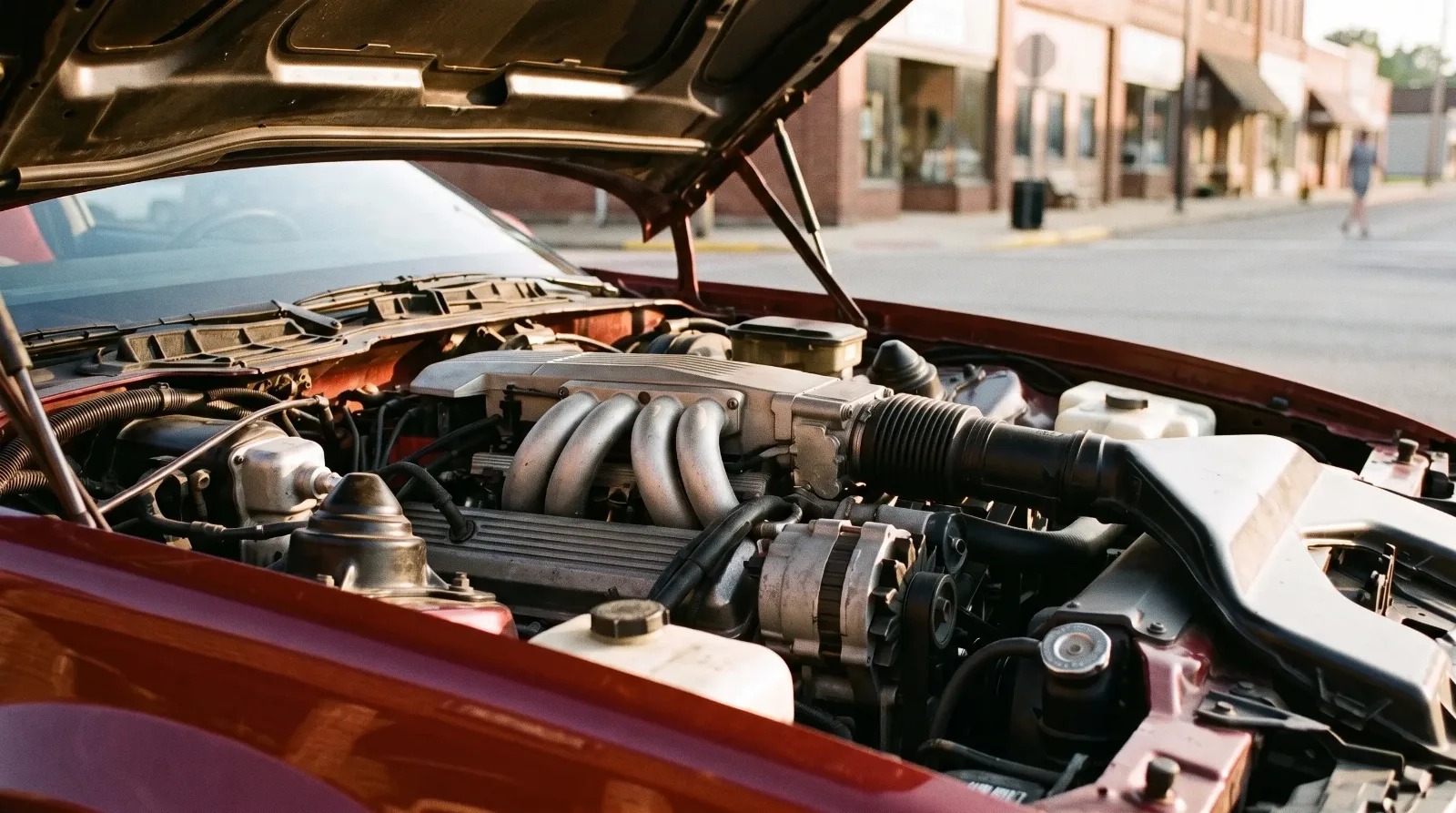
What the TPI Camaro hardware actually was
Strip the plastic covers off and the layout is simple. A cast-aluminum plenum sits across the front of the engine. Individual tubular aluminum runners, one per cylinder, curve back from that plenum to the intake ports. Each cylinder gets its own injector, fed by fuel rails that run above each bank. Chevrolet introduced it for 1985 on two engines at once: the L98 350 in the Corvette and the LB9 305 in the F-body. Through 1989 the F-body system measured incoming air with a mass airflow sensor; for 1990 it switched to speed-density, working from manifold pressure instead.
The name tells you the theory. Long runners of a fixed length set up pressure waves in the intake charge that help pack the cylinder at a particular engine speed. Tune the length for the middle of the rev range and you get a fat torque curve right where a street car spends its life. That is a real gain, not a brochure claim, and the factory ratings show it. The 1985 LB9 made 215 hp at 4,400 rpm and 275 lb-ft at 3,200 rpm. The carbureted L69 High Output 305 sold alongside it made 190 hp at 4,800 rpm and 240 lb-ft at 3,200. Same displacement, 25 more horsepower and 35 more lb-ft, with the peak coming 400 rpm sooner.
The 1985 Mustang GT was rated at 210 hp. On paper, the Camaro had the bigger number.
From Cross-Fire to tuned port
To see why TPI landed so hard, look at what it replaced. The 1982 and 1983 Camaro offered the LU5 Cross-Fire 305: two 48 mm Rochester throttle bodies, one per bank, sitting on a cross-ram aluminum intake. The throttle bodies added up to 750 cfm, but the plenum flowed about 475 cfm, and the runners were short to clear the hood. The result was low intake velocity, uneven fuel distribution and an engine that went flat above about 4,000 rpm. The injectors were batch fired, one bank and then the other. The LU5 was rated at 165 hp for 1982 and 175 hp for 1983, and it was gone from the Camaro after that.
Owners had their own name for it. Chevrolet had a better answer two years later.
On the Corvette side, Cross-Fire had gained only about 10 hp and 5 lb-ft over the carbureted engine it replaced, while TPI added roughly 25 hp over Cross-Fire. That is the jump that made the 1985 cars feel like a different breed. If you want to know why the car wearing this engine carried a race series name, the background is its own story.
The LB9 305 ratings, year by year
The 305 TPI never held one rating for long. Exhaust changes, transmission pairing and emissions tuning moved the number almost every model year. Here is how it went, as published.
| Model year | LB9 305 TPI rating | Transmission note |
|---|---|---|
| 1985 | 215 hp, 275 lb-ft | 4-speed automatic (700-R4) only |
| 1986 | 190 hp | Automatic |
| 1987 | 190 hp (auto) / 215 hp (manual) | 5-speed offered with TPI for the first time |
| 1988 | 195 hp (auto) / 220 hp (manual) | Both |
| 1989 | 220 hp single exhaust, 230 hp with N10 dual exhaust (manual) | Both |
| 1991 to 1992 (Z28) | 205 hp / 285 lb-ft (auto), 230 hp / 300 lb-ft (5-speed) | Both |
Two things jump out. First, the 1986 car lost 25 hp against the 1985 car, so a later IROC-Z is not automatically the quicker one. Second, the manual car always carried the higher rating once the five-speed arrived for 1987. That five-speed only ever came with the 305, which is the trade every IROC-Z buyer had to make.
The period road tests back up the 1985 rating. Motor Trend, in its October 1984 issue, ran a 215 hp IROC-Z to 60 mph in 6.8 seconds and through the quarter mile in 15.3 seconds at 89.1 mph. Car and Driver, the same month, recorded 7.0 seconds and 15.2 at 91.0 mph. A tenth or two either way is road and driver. Both cars ran mid-15s, which in 1984 was quick.
The 350 TPI: more torque, one transmission
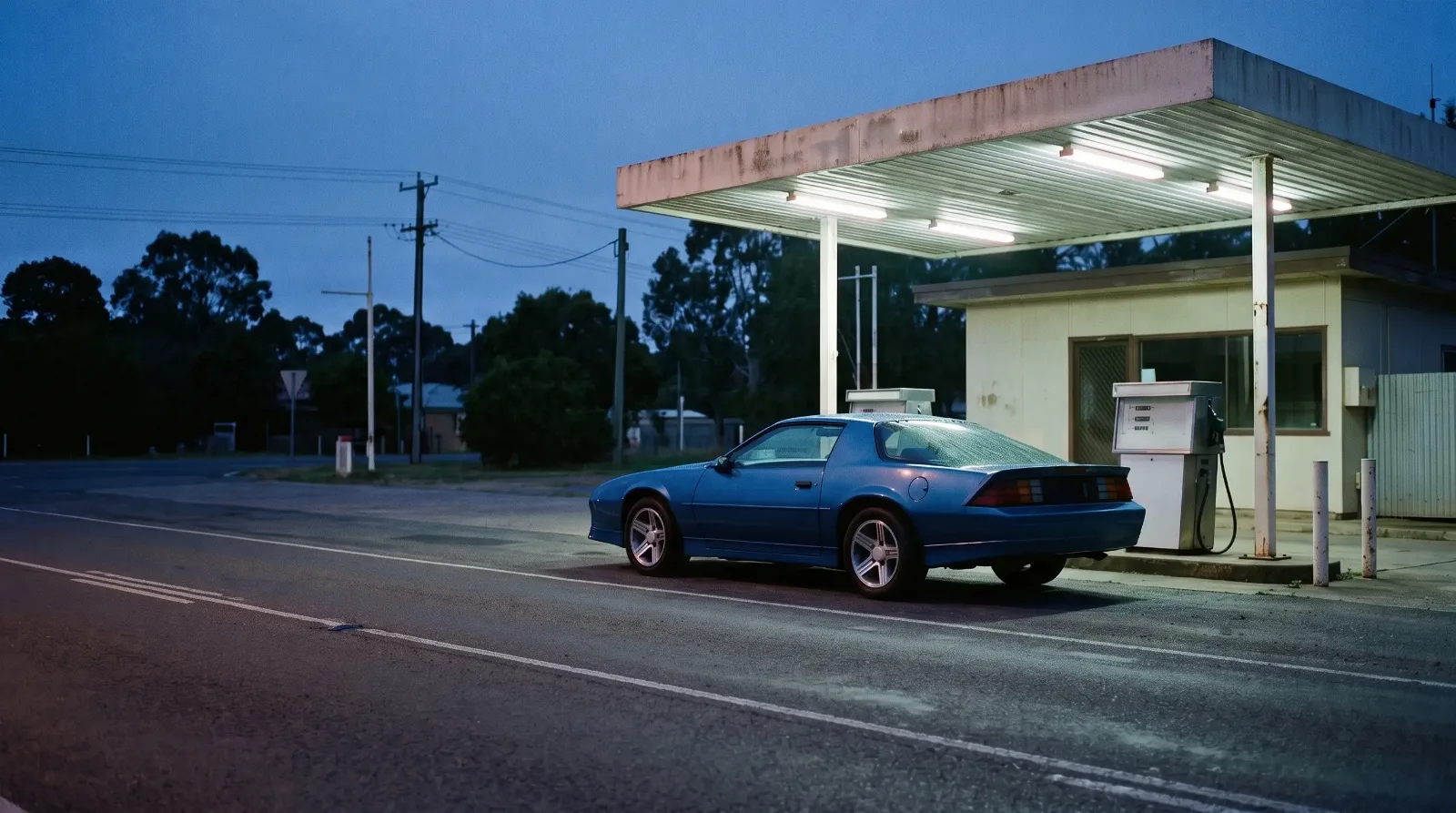
For 1987 the Corvette's bigger engine came over. Chevrolet's order code was B2L, the engine was the L98 family, and in 1987 it was offered only in the IROC-Z coupe, only with the automatic. It listed at $1,045 and was rated at 225 hp at 4,400 rpm and 330 lb-ft at 2,800 rpm. Look at the torque figure before the horsepower. Fifty-five lb-ft more than the 1985 LB9, arriving 400 rpm lower, is what you feel from a stop light. The full arrival story is covered under the L98 350, so here is just the progression.
The 350 went to 230 hp and 330 lb-ft for 1988. For 1989 it was 240 hp with dual exhaust, though at least one period source still printed 230. By 1990 it was 245 hp and 345 lb-ft at 3,200 rpm, and it held that rating through the 1992 Z28. That 245 hp figure is the ceiling for any factory third-generation V8. Through 1990 the 350 was paired with the TH700-R4 four-speed automatic and nothing else.
"Ignore the horsepower column on a TPI car and read the torque column. These engines were built to win the first 60 feet and the run to 60 mph. Past the power peak the long runners stop helping, and the number on the window sticker was never the point."
Dan Reeves
Buyers took the 350 when they could. About half of 1988 IROC-Zs had it, by most estimates. In 1990, of 4,213 IROC-Z coupes, 2,415 had the 5.7. If you paired it with the G92 performance axle you got 3.27 gears; the 305 manual got 3.45. The standard axle on the 350 was a lazy 2.77 from 1988 to 1990, which tells you how much of that torque Chevrolet expected owners to spend on cruising.
Where tuned port ran out of air, and why it still matters
The same runners that built the low-end torque choked the top end. Tuned length works around one speed band; above it, the long, narrow tubes become a restriction. That is why the TPI engines were rated at their peak at 4,400 rpm, well short of where a high-winding small block makes its best power. On a stock car, shifting at the redline buys you very little over shifting 1,000 rpm earlier.
It also explains what came next. The 1993 Z28 dropped TPI for the LT1 5.7, rated at 275 hp and 325 lb-ft. That was 30 hp more than the outgoing 245 hp L98, and the tuned port era was over.
The honest summary: tuned port did not make the IROC-Z fast by modern standards. It made it the quickest Camaro Chevrolet had sold in years, it beat the Mustang GT's rating in 1985, and it delivered torque in the band where people actually drive. A clean, documented 350 car today is the strongest of the line, and the market treats it that way. A 305 five-speed car is the one to buy if you want to row your own gears, and its 215 to 230 hp is close enough that you will not notice the gap on a back road.
What you are buying is a period engineering answer, done properly, on top of the engine bay. The runners are the heart of the car. Keep them original and keep the VIN digit matching, and the rest of the IROC-Z argument takes care of itself.
Sources and notes
- Chevrolet Camaro (third generation), Wikipedia
- 1985 Camaro IROC-Z engines and road tests, Muscle Car Facts
- 1987 Camaro IROC-Z specifications, Muscle Car Facts
- Corvette fuel injection history, In The Garage Media
- GM Cross-Fire Injection history, Jalopnik
- MAF and speed-density TPI ECMs, owner technical notes (University of Delaware page)
Related Reading
Have a
Chevrolet Camaro
for Sale?
Reach thousands of serious classic car collectors across the US.
Sell It Here →
Are You a Classic Car Dealer?
List your full inventory and connect with targeted classic car buyers.
Join as a Dealer →
#chevrolet camaro
#tuned port injection
#third generation Camaro
#IROC-Z
#1980s muscle cars
#LB9 305
#L98 350

About the author
Dan Reeves
Performance engine builder from North Carolina's motorsports corridor, focused on swaps, forced induction and making real, repeatable power.
Related Listings - Chevrolet Camaro


Comments
Be the first to comment on this article.