
For the 1988 model year, Chevrolet's Camaro price list got shorter. The Z28 was gone as a separate model, the LT was gone, and the IROC-Z was left as the only performance Camaro on the order form. That is what makes the 88 IROC-Z Camaro worth a closer look. It was the first year the IROC-Z carried the line by itself, and the records from that year are cleaner than most people assume. Here is what changed, what the codes say, and how many were built.
Car Features
7 min read
1988: The IROC-Z Stands Alone
For 1988 the Z28 model was dropped and the IROC-Z carried the Camaro line alone. Engines, axle codes, production and how to read a 1988 VIN.
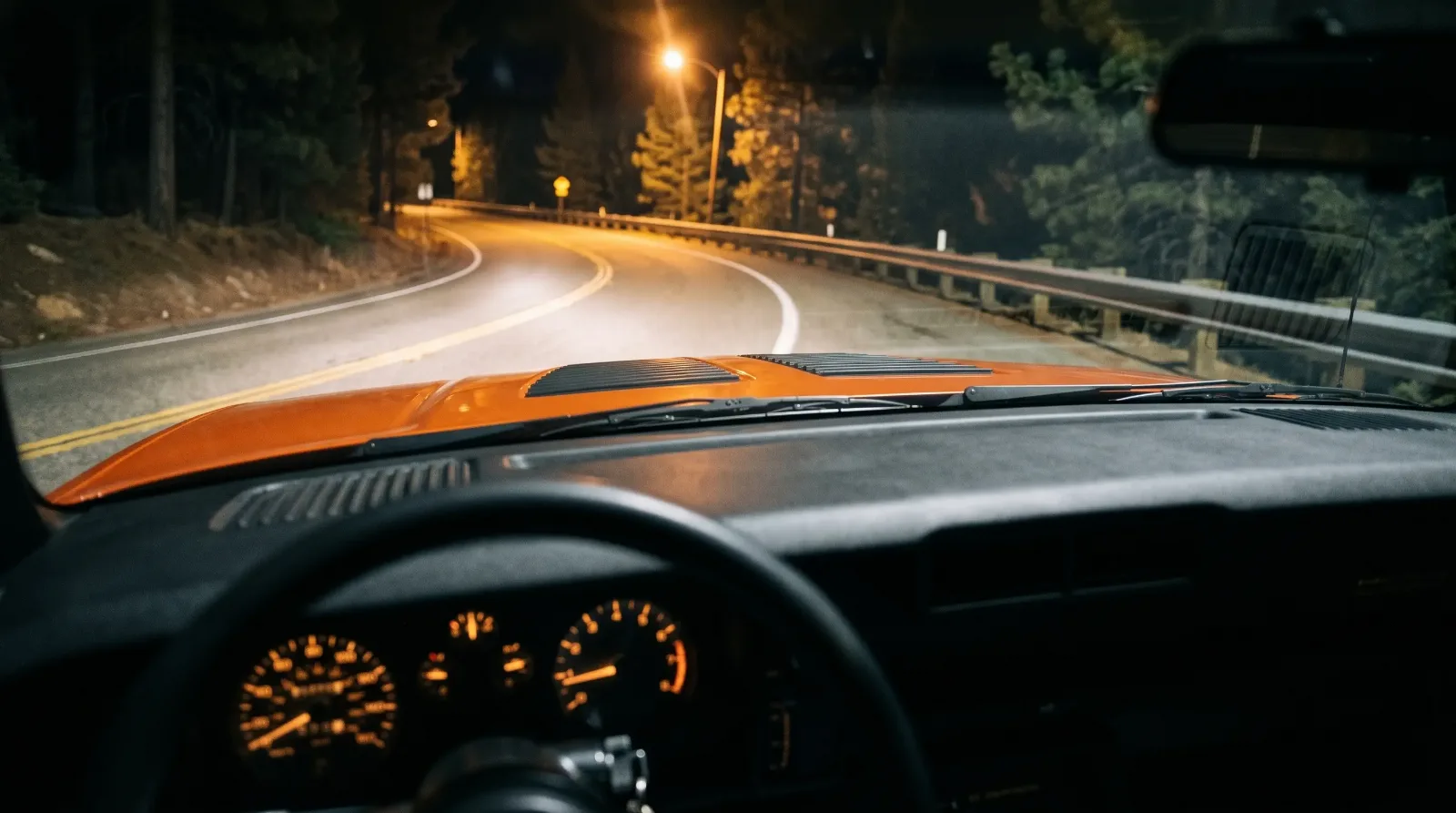
How the 88 IROC-Z Camaro came to stand alone
From 1985 through 1987 the IROC-Z was a package on the Z28, a step up from a car that was already the sporty Camaro. In 1987, Chevrolet built 52,863 Z28s, and 38,889 of them were IROC-Zs. The package had become the car most buyers wanted. For 1988, Chevrolet stopped pretending otherwise.
The Z28 was dropped as a model, and the IROC-Z content became what the Z28 had been. The lineup was reduced to four entries: the Sport Coupe, the IROC-Z coupe, the IROC-Z convertible and a base convertible. The LT, which had replaced the Berlinetta only a year earlier, was dropped too.
A small correction is worth making here, because it comes up often. Some sources write that the Z28 name disappeared entirely in 1988. The more accurate way to put it is that the IROC-Z replaced the Z28 as a model for 1988 through 1990. The Z28 returned as its own car for 1991, after Chevrolet's arrangement with the International Race of Champions ended. For the full arc of the package, our IROC-Z history covers each year.
There was a second change behind the scenes. The Norwood, Ohio plant had closed in August 1987, so every 1988 Camaro came from Van Nuys, California. One plant, one performance model, one simpler order guide.
The engine and axle codes for 1988
The 1988 IROC-Z offered two tuned port engines, and the ratings moved up from 1987.
The LB9 305 with tuned port injection was rated at 220 hp with the five-speed manual and 195 hp with the automatic. The B2L, the order code for the 5.7-liter L98 350, was rated at 230 hp at 4,400 rpm and 330 lb-ft at 3,200 rpm. As in 1987, the 350 came only with the automatic. About half of 1988 IROC-Zs were built with the 350, a figure that should be read as an approximation rather than a counted total.
Below the IROC-Z, the carbureted LG4 305 was retired. Its replacement was the LO3, a 305 with throttle body injection rated at 170 hp. That meant every V8 in the 1988 Camaro range was fuel injected.
The axle story is where 1988 differs most from 1987, and it matters to collectors. In 1987 the 350 came with a 3.27 rear axle as standard. From 1988 the standard ratio behind the 350 was 2.77. To get the 3.27, a buyer had to order G92, the performance axle option, which also gave a 3.45 ratio with the 305 and manual transmission. G92 was not offered with T-tops. So a 1988 IROC-Z with the 350, the steeper axle and a removable glass roof is not a combination the factory built. If a seller describes one, ask for the paperwork.
| 1988 Camaro model | Built |
|---|---|
| Sport Coupe | 66,605 |
| Base convertible | 1,859 |
| IROC-Z coupe | 24,050 |
| IROC-Z convertible | 3,761 |
| Total | 96,275 |
Counting the 1988 cars
Chevrolet built 96,275 Camaros for 1988, down from 137,760 in 1987. That is a drop of more than 41,000 cars in a year. Ford built 179,565 Mustangs that model year.
The IROC-Z totals deserve care. One published source says the 24,050 IROC-Z figure includes the 3,761 convertibles. The arithmetic does not support that. Add 66,605 Sport Coupes, 1,859 base convertibles, 24,050 IROC-Z coupes and 3,761 IROC-Z convertibles and you get exactly 96,275, the published model-year total. The coupes and convertibles are separate lines. The 1988 IROC-Z total is therefore 27,811 cars, a little under three in every ten Camaros built that year.
The convertible count also corrects a second myth. Some sellers advertise a 1988 IROC-Z convertible as the "first year" of the open Camaro. It was not. ASC began converting T-top coupes for the 1987 model year, when 1,007 convertibles were built. The 1988 total of 3,761 IROC-Z convertibles is a big step up, but it was the second year. Those cars ran through 1990, and the longer story follows them year by year.
The 1LE was meant for SCCA Showroom Stock racing, and buyers had to show they would race in SCCA or IMSA events. It added larger front rotors, an aluminum driveshaft and a baffled fuel tank. It is the rarest 1988 IROC-Z by a wide margin and a subject of its own.
What you can see on a 1988 car
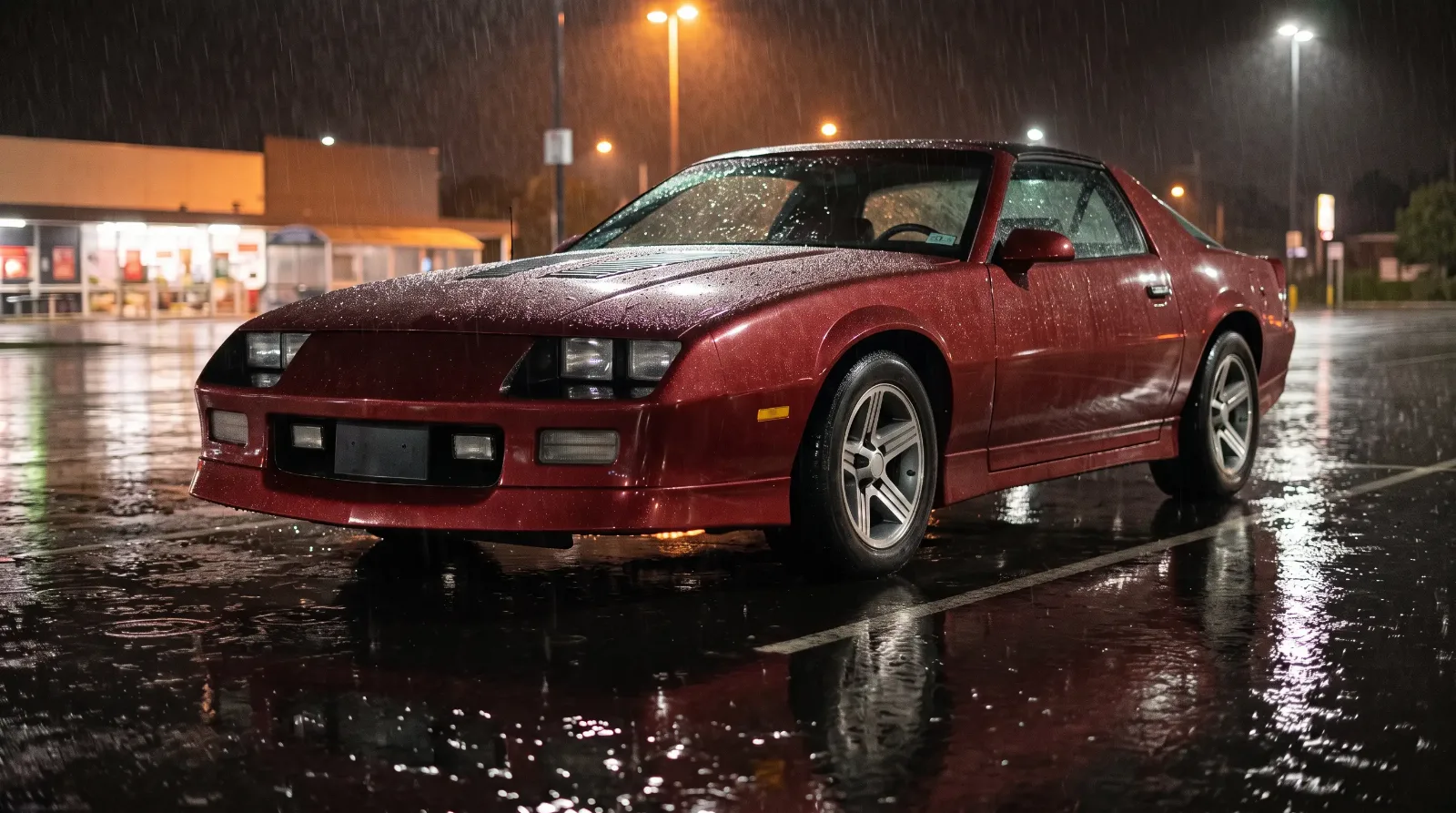
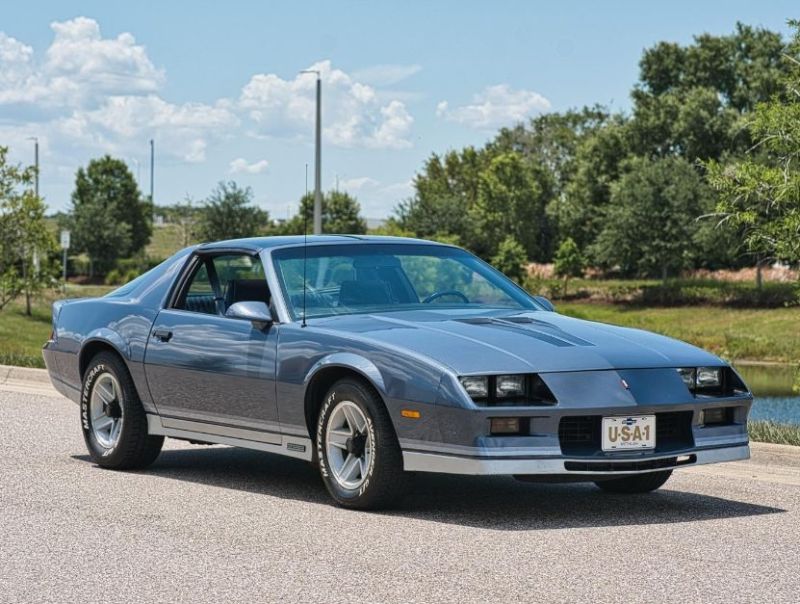
The visual changes for 1988 were modest, and they help with identification. The IROC-Z door decals moved toward the rear of the door, and the lower body stripe was revised. Every 1988 Camaro got a center high-mounted stop lamp built into the rear spoiler. Overall length grew slightly, from 192.0 inches to 192.5 inches.
Wheels changed too. For 1988, 15-inch wheels were standard on the IROC-Z, and the 16 by 8 inch aluminum wheels became an extra-cost option, RPO N96, at $468. A 1988 car on 16-inch wheels is not wrong, but it should be an optioned car, and the build documentation should say so.
The VIN carries the rest. The tenth character for a 1988 Camaro is J. The eighth character identifies the engine: 8 for the 350 with tuned port injection, F for the 305 with tuned port, and E for the 305 with throttle body injection. A car presented as a 1988 IROC-Z 350 should show both a J and an 8. If it does not, the conversation changes.
"The 1988 cars are easy to argue about and easy to check. The VIN, the axle code and the production lines add up. When a story about a particular car does not add up, it is usually the story that is wrong."
Tom Ramirez
How the 1988 IROC-Z reads today
The 1987 IROC-Z tends to get the collector's attention, because it was the only year to combine the 350, the 3.27 axle and T-tops. The 1988 car sits a step behind in that conversation, which is a fair assessment rather than a dismissal. It has the 350 at a higher rating, it has the cleaner lineup, and it has the first 1LE cars.
Values have moved for the whole run. In a Hagerty review from December 2022, a 1988 IROC-Z in number 2 condition had risen 225 percent in value over ten years. That is a dated figure, not a current price, and condition and documentation will move any individual car far from an average.
Performance was respectable for the period. Motor Trend tested an IROC-Z 350 in its September 1988 issue and recorded 0 to 60 mph in 7.2 seconds and a quarter mile of 15.7 seconds at 91.6 mph. In 1988, Al Unser Jr. won the International Race of Champions in the series cars, which kept the name current a little longer.
The next year brought dual exhaust and higher ratings, which belong to the 1989 IROC-Z. For where 1988 fits in the longer run, see the Camaro from 1967 to 2002. On its own terms, 1988 is the year the record becomes simple: one performance Camaro, one plant, and production lines that add up.
Sources and notes
Related Reading
Have a
Chevrolet Camaro
for Sale?
Reach thousands of serious classic car collectors across the US.
Sell It Here →
Selling a classic? Here's how: compare the places to sell classic cars
Are You a Classic Car Dealer?
List your full inventory and connect with targeted classic car buyers.
Join as a Dealer →

About the author
Tom Ramirez
Corvette researcher and historian based in Bowling Green, Kentucky. Two decades documenting Corvette production history from original factory records.
Related Listings - Chevrolet Camaro
Comments
Be the first to comment on this article.