
The Model A dashboard has three instruments that tell you anything: a speedometer, a fuel gauge and an ammeter. That is the whole list. No oil pressure gauge, no temperature gauge, no tachometer. If you came from a Model T, that was a lot. If you come from anything built since, it looks like Ford forgot half the panel. It didn't. It gave the driver what a 1928 driver needed and left the rest to his ears and his nose.
Car Features
7 min read
The Model A Dash: Speedometer, Fuel Gauge and Ammeter
Three needles, no oil gauge: what the Model A dashboard shows, how each instrument works, and how to tell a correct panel from a swapped one.
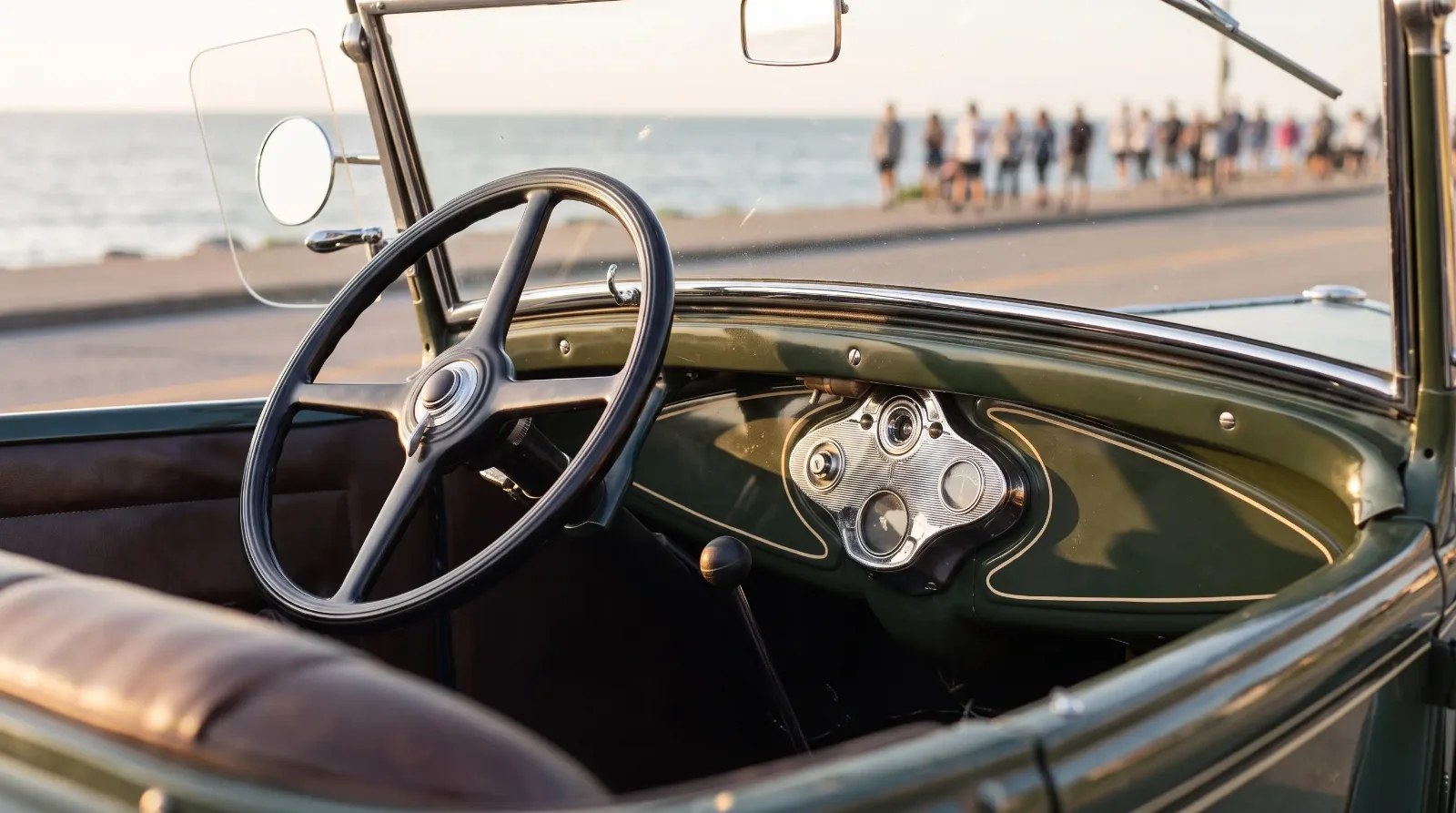
This piece goes through each instrument, the panel they sit in, the changes between 1928 and 1931, and what to check on a car you are about to buy. It skips the broad story of the changeover. For that, there is more on the T to A cars.
What sits on a Model A dashboard
The Model A Ford Club of America's judging standard is the reference here, and it is plain about it. The instrument panel is a central unit carrying the speedometer, the ammeter, the gas gauge, the ignition switch and a dash lamp. Its judged list has no factory oil pressure gauge and no temperature gauge.
Ford's own 1928 standard equipment list lines up with that. It names a speedometer, a gas gauge and a dash light along with the starter, the windshield wiper, the mirror and the five steel-spoke wheels. One club history also mentions an "oil gauge." The judging standard wins that argument. The likely explanation is the oil level indicator rod on the engine, which is a dipstick, not a gauge on the dash.
| Item | Where it is | What to know |
|---|---|---|
| Speedometer | Central instrument panel | Stewart-Warner for the whole run; Northeast and Waltham also supplied; 0 to 75 mph, Northeast oval 0 to 80 mph |
| Ammeter | Central instrument panel | 20-0-20 scale, no Ford script |
| Fuel gauge | In the cowl tank, read at the dash | Tank holds 10 gal (1928 to 1929), 11 gal (1930 to 1931) |
| Ignition switch | Central instrument panel | Part of the panel on every year |
| Dash lamp | Central instrument panel | Standard equipment from 1928 |
| Oil pressure, temperature | Not fitted | No factory gauge in the judged list |
The speedometer: three makers and two shapes
Stewart-Warner built Model A speedometers for the whole run. It was not alone. Northeast supplied them from December 1929 to December 1930, and Waltham came in from June 1930. Most read 0 to 75 mph. The Northeast oval went to 80.
Neither number means much. A healthy stock Model A runs out of breath at about 60 to 65 mph, and it is happiest cruising at 45 to 50. The last stretch of the dial is there for optimism and for the salesman.
Shape tells you the era. Early cars, from October 1927 to June 1930, have a smooth panel with an oval speedometer, and the club counts four variations of that panel. From June 1930 to the end, the panel is ribbed and the speedometer is round. Ford's 1931 change list also notes a new instrument panel in April 1931, so a late car can differ again from a mid 1930 car. If someone shows you a 1929 with a round speedometer in a ribbed panel, ask questions. Somebody swapped something.
"Nobody ever lost a judging point to a needle that bounced. They lose points for the wrong face in the wrong panel. Check the shape before you check the reading."
Mike Sullivan
The fuel gauge lives in the tank
This is the part that surprises people. The Model A has no fuel pump and no rear tank. The tank sits in the cowl, between the firewall and the dash, and the gas runs down to the updraft carburetor by gravity. Ford carried that idea over from the late Model T, which had already moved its tank up under the cowl on most cars in 1926.
Because the tank is right behind the panel, the gauge is part of the tank itself. You read it at the dash, but it is the tank's own gauge, not a sender wired to a dial somewhere else. Fewer parts, fewer things to fail. The tank held 10 gallons on 1928 and 1929 cars and 11 gallons on 1930 and 1931 cars.
The trade-off is obvious once you think about it. You are sitting with your knees a short reach from ten gallons of gasoline. It worked for millions of cars. It still makes some new owners nervous, and a weeping seam or a tired gauge gasket is a job to do now, not next season.
The ammeter: the gauge that actually matters
If you only watch one needle, watch this one. The Model A runs a 6-volt system with a battery, a generator, a coil and a breaker-point distributor, positive ground. That is a long way from the Model T's magneto and four trembler coils. It also means the car lives or dies on whether the generator is keeping up.
The ammeter reads 20-0-20. Center is zero, one side is charge, the other is discharge. Lights on at idle, it will lean toward discharge. Once the engine is turning at road speed, it should swing back to charge. If it sits on discharge at speed, the battery is losing, and you will find out the hard way at the next stop when the starter just clicks.
Judges look at the face too. The correct Model A ammeter has no Ford script on it. Reproduction faces with a script are around. They read fine. They are just wrong for the car.
The ignition system that this needle watches over is covered in this piece, along with the rest of the engine.
For context, a Model T driver had very little on the board. The coil box, four trembler coils potted in pitch inside a wooden box, sat on the dash. The carburetor's one adjustment was worked from the dash. On cars with the optional starter, the 1919 manual puts a priming rod on the instrument board and the starter button on the floor. The early dash had no gauges at all.
So the Model A dash, plain as it looks today, was a real step. A speedometer as standard, a fuel reading you could see without lifting the front seat cushion, and a needle telling you whether the electrics were winning. That is three pieces of information most Model T drivers never got from the factory as standard.
Other parts of the car moved forward at the same time. The steel-spoke wheels on the standard equipment list are one example, and the wheels get their own story.
Buying and restoring: what to check
Instruments are cheap to get working and expensive to get right. A Model A will drive fine with any speedometer face in the hole. It will not judge fine. Here is the short list.
The rest is common sense. A car with the right panel and three working needles tells you the last owner cared. A car with a modern aftermarket gauge cluster screwed into the dash tells you something too. Neither is a deal breaker. One is a weekend, the other is a parts hunt.
Bottom line: the Model A dash gives you speed, fuel and charge, and nothing else. Learn to read the ammeter, keep the tank tight, and ignore the top of the speedometer. That is all the car asks.
Sources and notes
Related Reading

Have a
Ford Model A
for Sale?
Reach thousands of serious classic car collectors across the US.
Sell It Here →
Selling a classic? Here's how: where to sell your classic car online
Are You a Classic Car Dealer?
List your full inventory and connect with targeted classic car buyers.
Join as a Dealer →
#ford model a
#Model A restoration
#Model A dashboard
#Model A instruments
#Ford speedometer
#Model A electrics

About the author
Mike Sullivan
Detroit-area muscle car enthusiast and restoration specialist with three decades of hands-on experience working on American iron.
Related Listings - Ford Model A

Comments
Be the first to comment on this article.