
Ask ten CJ enthusiasts about the jeep cj10 and you will get four blank stares, three vague guesses about a Wrangler prototype, and maybe two or three who actually know it was a real production Jeep, built for a job most Americans never saw it do. I love telling this one at meets because the reaction is always the same. Nobody expects a CJ-10.
Car Features
7 min read
The Jeep CJ-10: The Airport Tug and Export CJ Few Americans Saw
Most CJ enthusiasts have never heard of the Jeep CJ-10, an export and airport-tug variant that quietly worked tarmacs and overseas markets while the CJ-7 got all the attention.
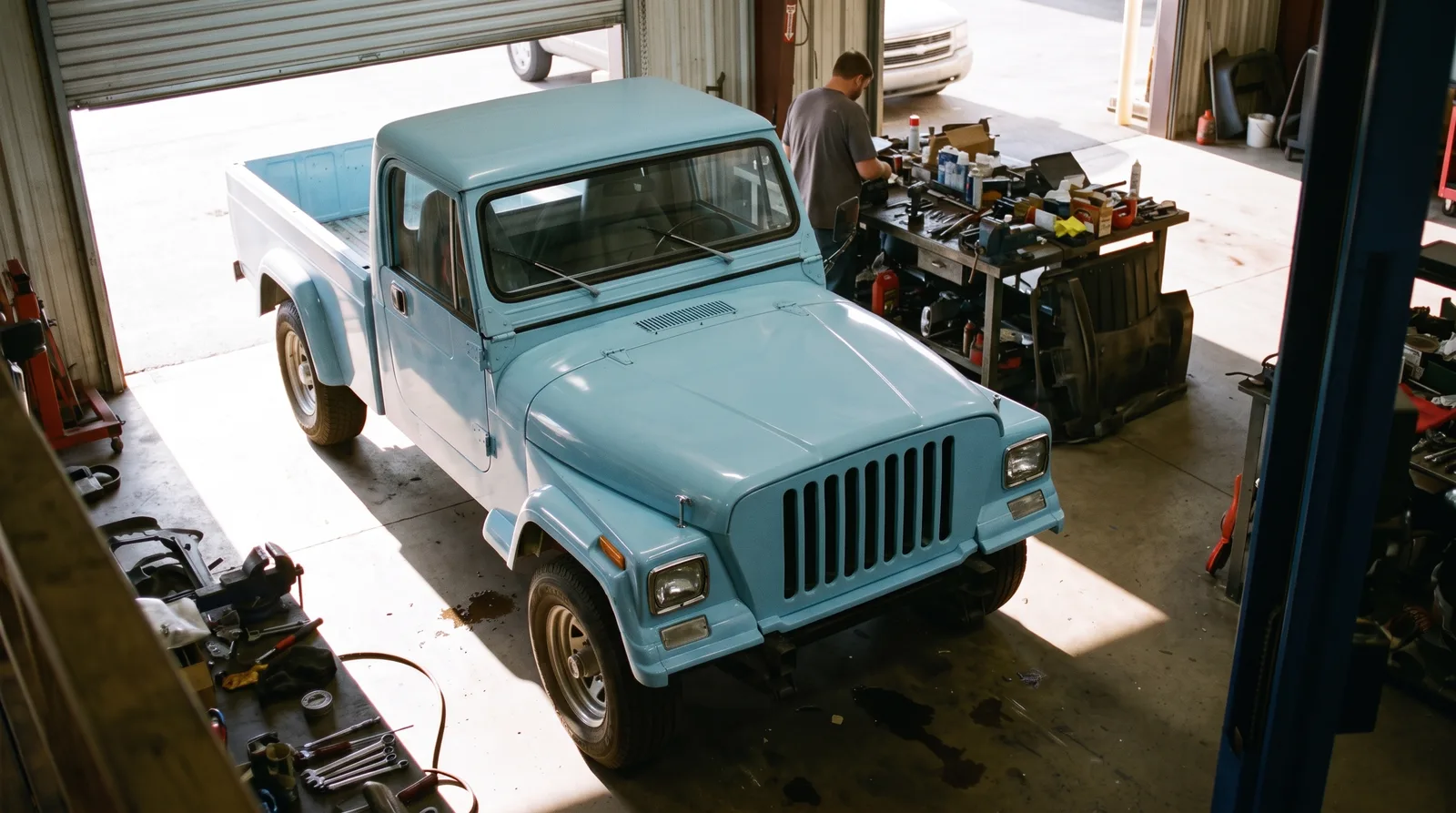
Not a trail rig, not for America
The CJ-10 was never sold new to American buyers, and that alone explains most of the confusion around it. Jeep built the CJ-10 primarily as an export model, and a version of it also found genuine domestic work as an airport tug, hauling baggage carts and aircraft support equipment around tarmacs. It shared its basic underpinnings with the CJ-8 and the full-size Jeep pickup line, but it looked and worked differently enough that most people who have only ever seen a CJ-5 or CJ-7 do not recognize it as part of the same family at all.
Export markets in Australia, parts of Asia, and elsewhere took the CJ-10 as a genuine working vehicle, sold through Jeep's international distribution rather than through the American dealer network most CJ buyers used. That international-first approach is exactly why the truck is such a mystery stateside. There was never a marketing push here, never a dealer brochure sitting on a rack next to the CJ-7 literature. It simply was not built for that audience.
The airport tug variant
The domestic version most Americans who do know the CJ-10 have actually encountered is the airport tug, a specialized configuration built for ground support work at airports and military installations. Stripped of the creature comforts a road-going Jeep would carry, these tugs were built around durability and towing capability, moving loaded baggage carts and support equipment across tarmac for shift after shift without the kind of attention a private owner would lavish on a personal vehicle.
That working history means most surviving CJ-10 tugs come with a genuinely rough life behind them. Airport ground equipment gets used hard and maintained just enough to keep it running, not restored to showroom condition. Finding one that has survived in reasonable shape, let alone with any of its original paperwork intact, is a real find.
Why it stayed obscure so long
Part of what kept the CJ-10 out of the enthusiast conversation for so long is simple visibility. Export vehicles do not show up at American swap meets. Airport tugs do not get driven to cars and coffee. The people who actually encountered CJ-10s during their working lives were airport ground crews and, in overseas markets, everyday buyers who had no reason to think their truck would ever be a topic of interest to American collectors decades later.
It took the broader boom in classic Jeep interest, the same wave that lifted values on the CJ-8 and other overlooked models, for people to start asking what else Jeep built during that era that they had never heard of. That curiosity eventually led collectors back to the CJ-10, and to the realization that it represented a genuinely distinct chapter in the CJ family's story, one that ran parallel to the more familiar domestic lineup rather than as part of it. For readers who want the fuller picture of how the CJ-8 fits into that same era and export conversation, our complete history covers the platform the CJ-10 was closely related to.
"I've had guys tell me flat out that I made the CJ-10 up. Then I show them a photo of one towing a luggage cart across a tarmac in the 1980s and watch their whole face change."
- Wayne Coburn
How the CJ-10 relates to the full-size Jeep pickup
Part of the confusion around the CJ-10 comes from its relationship to Jeep's full-size pickup line of the same general era. The two shared enough underlying components that casual observers sometimes lump them together, but the CJ-10 carried its own distinct identity, badge, and market role. It was smaller and more purpose-built than the full-size trucks, tuned specifically for the fleet and export duty it was designed around rather than trying to compete as a general-purpose consumer pickup.
That distinction matters to anyone trying to correctly identify a surviving example. A truck that shares components with both the CJ-8 and the full-size pickup line but does not match either one exactly is a strong candidate for being a genuine CJ-10, and recognizing that pattern is often the first clue a collector has that they are looking at something unusual.
What to know if you find one
Anyone who stumbles across a genuine CJ-10, whether an ex-airport tug at a government surplus sale or an export example that has made its way back to the United States, is dealing with a genuinely rare piece of Jeep history. Confirming authenticity matters even more here than with better-documented CJ models, since so few reference points exist for comparison. VIN patterns, any surviving fleet or export paperwork, and even period photographs can help establish what a specific truck actually is.
Because parts and documentation are scarce, restoring or even just maintaining a CJ-10 requires more creativity than working on a mainstream CJ-7. Owners often lean on the broader CJ parts network for shared components while sourcing model-specific pieces through patience and persistence rather than a simple parts catalog order.
Keep exploring the family tree
The CJ-10 is a genuinely fascinating side branch of the CJ story, and it connects directly to the launch of the Scrambler that shared so much of its underlying engineering. For readers who want to trace that connection further, it is worth taking time to keep exploring how these related models came to exist within the same era of Jeep's lineup.
Stories from the swap meet circuit
Over the years I have collected a handful of secondhand accounts about CJ-10s from people who actually worked around them, retired ground crew, former military mechanics, the occasional overseas visitor at a Jeep event who grew up around one in an export market. None of these accounts amount to formal documentation, but taken together they paint a consistent picture of a truck that did unglamorous work reliably and without much fuss, exactly the reputation you would expect from a vehicle built for fleet duty rather than personal ownership.
One story that stuck with me came from a retired airport mechanic who described spending an entire winter keeping a fleet of CJ-10 tugs running with almost no downtime, despite minimal spare parts on hand. He credited the truck's simplicity more than any particular skill on his part. That kind of firsthand account, even secondhand through club conversation, is often the closest thing collectors get to real documentation on a model this obscure.
A working truck finally getting its due
The CJ-10 was never designed to be admired. It was designed to move cargo, tow loads, and take abuse without complaint, first on tarmacs and then in export markets that needed exactly that kind of durability. That it has taken this long for American collectors to even learn the model existed says less about the truck's worth and more about how narrow the domestic CJ story has always been told. For anyone chasing a genuine piece of that broader story, it helps to browse classic CJ for sale and see what related models are actually available on today's market.
Sources and notes
Related Reading
Have a
Jeep CJ
for Sale?
Reach thousands of serious classic car collectors across the US.
Sell It Here →
Selling a classic? Here's how: compare the places to sell classic cars
Are You a Classic Car Dealer?
List your full inventory and connect with targeted classic car buyers.
Join as a Dealer →

About the author
Wayne Coburn
Longtime Corvette owner, judge and club figure who knows the cars, the records and the people behind them.
Related Listings - Jeep CJ



Comments
Be the first to comment on this article.