
The 1993 Cobra R is a short story with good numbers. Ford's new Special Vehicle Team built 107 of them, painted every one Vibrant Red, and priced them at $25,692. That was $7,187 more than the street Cobra. For the extra money you got no back seat, no radio and no air conditioning. You also got bigger brakes, adjustable dampers and a car pointed at a starting grid instead of a driveway.
Car Features
6 min read
The 1993 Cobra R: 107 Cars for Racers
Why SVT built 107 Vibrant Red 1993 Cobra R Mustangs for IMSA and SCCA racing, what it deleted, and what the extra $7,187 bought.
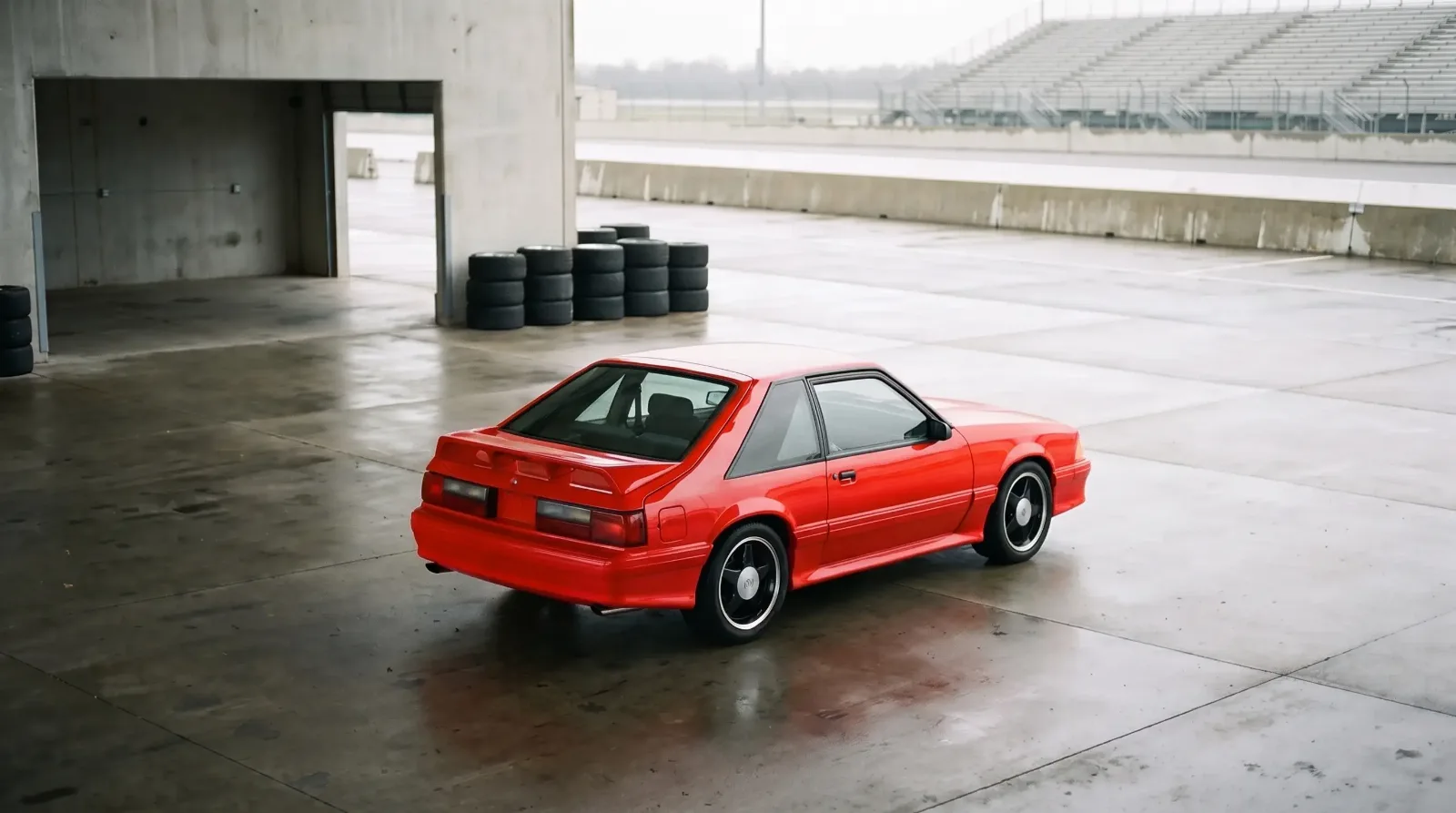
This is the race car's story, not the street car's. The wider run of tuner Mustangs, from the SVO through the Saleens, has its own overview with the details. Here it is what came off the car, what went on, and why there were only 107.
Why SVT built the 1993 Cobra R
SVT's first product was the 1993 Cobra, shown at the 1992 Chicago Auto Show. John Coletti ran the team from 1993 to 2004, and Neil Ressler, Ford's executive director of vehicle engineering, is counted among its founding fathers. A team like that does not build a stripped, red-only, low-volume car by accident. The R had a job.
The job was racing. The car was built for two series: IMSA's Firestone Grand Sport and SCCA World Challenge, in Class B. Both raced cars that started life on a dealer's lot, so a team's best starting point was whatever the factory would sell it. SVT's answer was to sell a car with the race prep already half done. Fewer parts to strip out. Fewer parts to buy.
Who could buy one is a fair question. Two years later, 1995 Cobra R buyers needed a valid NHRA or SCCA competition license. MustangSpecs says 1993 buyers needed an active racing license too. I have not seen the Ford document behind that, so treat it as likely rather than settled.
What came off the car
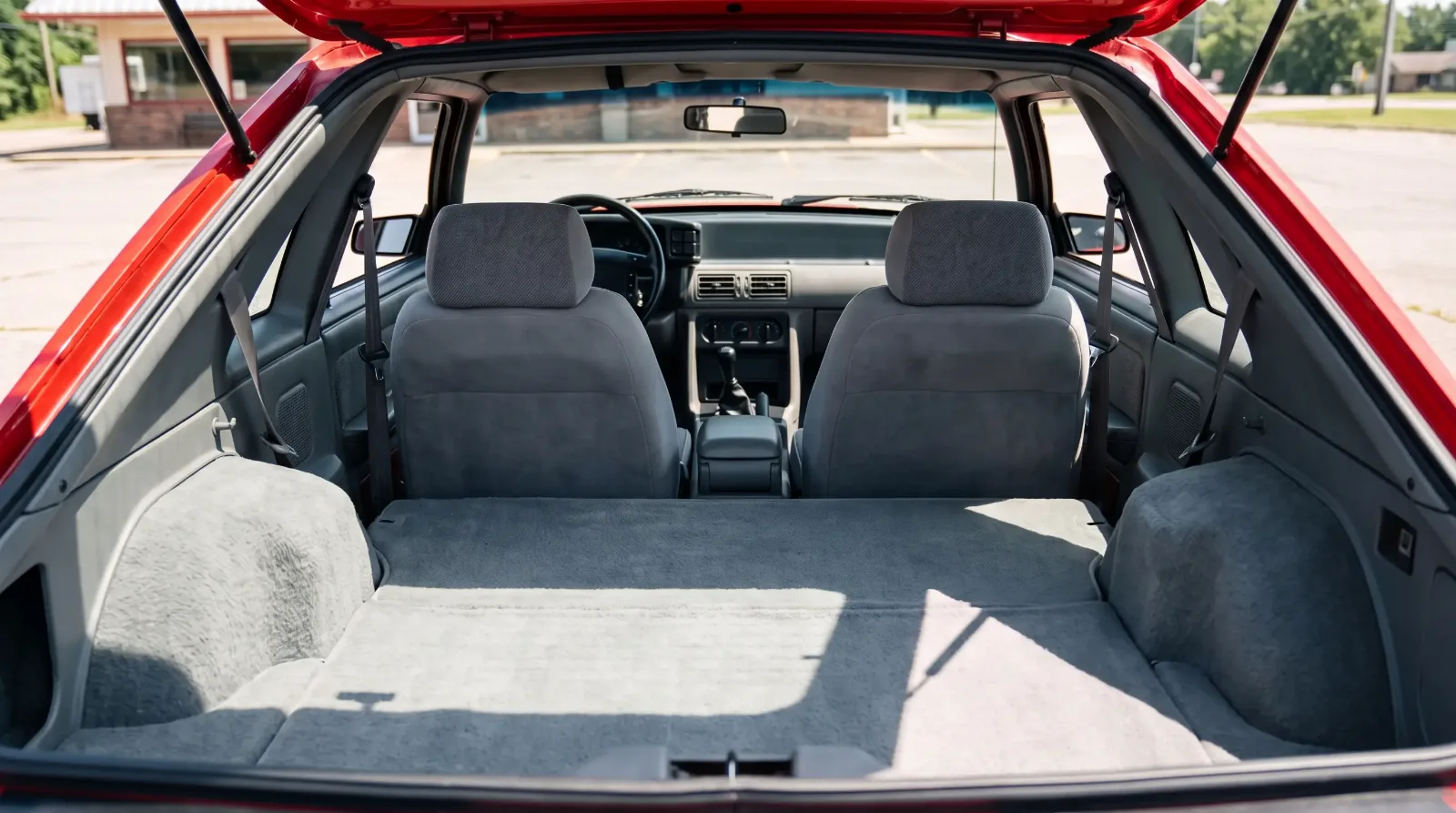
The list is short and every item on it is weight. The rear seat went. So did the radio, the air conditioning, the fog lamps, the sound deadening and the power windows, locks and mirrors. The published figure for what came out is roughly 450 pounds, and that figure ignores whatever a race team bolted back in afterward: cage, seat, harnesses, fire system.
For scale, the street Cobra weighed 3,255 pounds. I will not do the subtraction and hand you a curb weight. MustangSpecs lists 3,089 pounds for the R, which does not square with 450 pounds out of a 3,255-pound car, and a number built on a number is how bad spec sheets get started. What I will say is that 450 pounds is a lot. On a road course, weight costs you in every braking zone, every corner and every exit. Taking it out costs nothing at the dyno and pays off everywhere else.
Some would call a $7,187 premium for less equipment a bad deal. Those people were not the customer. The customer was going to throw the radio away anyway.
Brakes, springs and dampers
The street Cobra already had a decent base for a 1993 Fox body: rear disc brakes, Tokico dampers, 17-inch wheels (the first on a factory Mustang) and a five-speed manual as the only gearbox. Motor Trend's figures for the street car were 0.87 g on the skidpad and 64.8 mph through the slalom. Good numbers for the day. Not race numbers.
The R went further on every corner. It got Eibach springs, adjustable Koni dampers and a strut tower brace. The brakes grew to vented discs at both ends: 13-inch Kelsey-Hayes rotors with twin-piston calipers up front and 10.5-inch rotors at the rear. One spec page says 13.5 inches for the fronts, but Wikipedia, MustangSpecs' own Cobra R guide and Silodrome all say 13. The wheels were 17 by 8 inches and painted black.
| Item | 1993 SVT Cobra | 1993 Cobra R |
|---|---|---|
| Production | 4,993 | 107 |
| Price | $18,505 | $25,692 |
| Color | Black, Vibrant Red or Teal | Vibrant Red only |
| Rear seat, radio, A/C, fog lamps | Yes | Deleted |
| Dampers | Tokico | Adjustable Koni |
| Springs and bracing | SVT street setup | Eibach springs, strut tower brace |
| Brakes | Discs front and rear | Vented discs, 13-inch front, 10.5-inch rear |
| Wheels | 17-inch | 17 x 8-inch, black |
| 0 to 60 mph | 5.9 s (Road & Track test) | 5.7 s (SVT claim) |
The engine SVT left alone
The street Cobra's 5.0 HO got GT-40 heads, a Cobra upper intake, its own camshaft, larger injectors and a 65 mm throttle body. Ford rated it at 235 hp at 4,600 rpm. Torque depends on which source you read: 280 or 285 lb-ft. The R used the same engine, with the same Borg-Warner T-5 five-speed manual behind it. The changes under the hood were for cooling: a Lincoln radiator and an extra purge tank.
That tells you what SVT thought the car needed. Not more power. More brake, more damper, less mass. A car that stops later and turns in harder will beat a stronger car that does neither more often than the horsepower crowd likes to admit. Lap data does not care about the window sticker.
The performance numbers line up with that. SVT claimed 0 to 60 mph in 5.7 seconds and a 140 mph top speed for the R. Road & Track timed the street Cobra at 5.9 seconds to 60 and 14.5 seconds at 98 mph in the quarter mile. One is a factory claim and one is a magazine test, so do not read the gap as gospel. Two tenths from about 450 pounds is in the right neighborhood, though.
"Look at where the extra $7,187 went: brakes, dampers, springs, and about 450 pounds out of the car. That is a road-race parts list, not a drag-strip one. Somebody at SVT knew where lap time comes from."
Dan Reeves
107 cars, and what came after
Ford built 114,228 Mustangs for 1993. The Cobra R was 107 of them. That is about one car in every 1,070. It was also the only Cobra R built on the Fox platform, because the 1994 car moved to the SN95 body.
The R badge came back on the new body. SVT built its next base car on the SN95, the 1994 to 1995 Cobra, and the 1995 Cobra R swapped the 5.0 for a 5.8-liter 351 Windsor rated at 300 hp, with a Tremec TR-3550 five-speed and a racing fuel cell of 20-plus gallons. Ford built 250 at $37,599. The 2000 Cobra R went further again: a 5.4-liter DOHC V8 rated at 385 hp, a Tremec T-56 six-speed, 300 cars and a $54,995 sticker.
Put the three side by side and the 1993 car looks almost modest. Smallest engine, lowest price, fewest cars. It was also the first, and it set the template the later two followed: build a small batch, strip it, fix the brakes and suspension, and sell it to people who were going racing. The power came later. The idea came in 1993.
Sources and notes
Related Reading
Have a
Ford Mustang
for Sale?
Reach thousands of serious classic car collectors across the US.
Sell It Here →
Selling a classic? Here's how: sell my classic car
Are You a Classic Car Dealer?
List your full inventory and connect with targeted classic car buyers.
Join as a Dealer →

About the author
Dan Reeves
Performance engine builder from North Carolina's motorsports corridor, focused on swaps, forced induction and making real, repeatable power.
Related Listings - Ford Mustang




Comments
Be the first to comment on this article.