
The 1994 Mustang Cobra had a harder job than the car it replaced. The 1993 Cobra was SVT's first product, built on a Fox chassis that everybody already knew inside and out. One model year later the team had to do it again on a brand-new body, and the first big public job the new Cobra got was leading the field at Indianapolis. This piece covers the two pushrod SN95 Cobras, 1994 and 1995, and the Rio Red pace car that has followed them around ever since.
Car Features
8 min read
The 1994–95 SVT Cobra and Pace Car
The 1994 Mustang Cobra and its 1995 follow-up: 240 hp from GT-40 heads, big brakes, and 1,000 Rio Red Indy 500 pace car replicas.
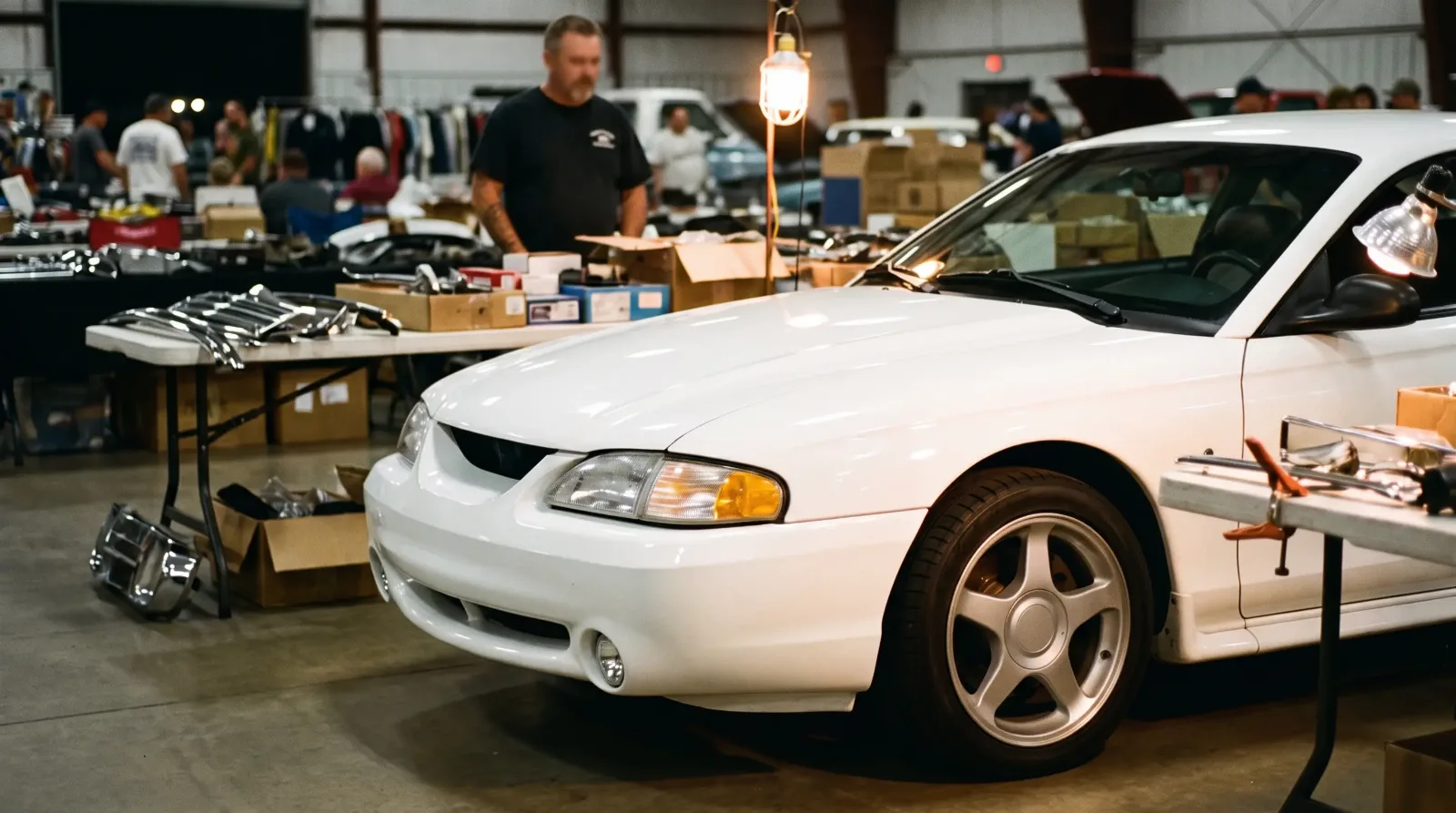
For the wider picture of SVO, SVT and Saleen cars, start with our tuner Mustang history. Here it is one car across two model years.
What SVT changed for the 1994 Mustang Cobra
The starting point was the new SN95, the car Ford put on sale on December 9, 1993, with one coupe, one convertible and no notchback or hatchback. The SN95 Mustang story covers how that body came to be. SVT, run through these years by John Coletti, the engineer who had led the skunkworks that kept the rear-drive Mustang alive, took the GT version of it and built something that listed for about $4,000 more.
The engine is where it started. The GT's 5.0 pushrod V8 was rated at 215 hp and 285 lb-ft at 3,400 rpm. SVT gave the Cobra's 5.0 GT-40 heads, a Cobra intake and its own camshaft and injectors, and the rating went to 240 hp, with 285 lb-ft at 4,000 rpm. Read those two lines together. Peak torque is the same number. The Cobra makes it 600 rpm higher, and its extra 25 hp lives at the top of the rev range. That is a top-end engine sitting in a body whose volume V8 was tuned for the bottom.
It was also only 5 hp more than the 1993 Cobra's 235, from the same broad recipe of GT-40 heads, Cobra intake and a unique cam. The bigger news was underneath. The Cobra stopped on 13.0-inch front and 11.7-inch rear disc brakes and rode on Goodyear GS-C tires, P255/45ZR17, on 17-inch wheels. SVT recalibrated the springs, shocks and anti-roll bars instead of reinventing the suspension. The only gearbox was a Borg-Warner T-5 five-speed manual. SVT did not offer an automatic. From the front, the fog lamps give it away: round on the Cobra, rectangular on the GT.
Cobra or GT: the numbers side by side
| 1994 model year | Mustang GT | SVT Cobra |
|---|---|---|
| Engine | 5.0 pushrod V8 | 5.0 V8, GT-40 heads, Cobra intake, own cams and injectors |
| Rating (SAE net) | 215 hp at 4,200 rpm; 285 lb-ft at 3,400 rpm | 240 hp; 285 lb-ft at 4,000 rpm |
| Wheels and tires | 16-inch wheels (17-inch optional) | 17-inch wheels, Goodyear GS-C P255/45ZR17 |
| Fog lamps | Rectangular | Round |
| Coupe base price | $17,280 | $21,300 |
| Convertible base price | $21,790 | $25,605 |
| Coupes built | 30,592 | 5,009 |
| Convertibles built | 25,381 | 1,000 (all pace car replicas) |
The price gap was $4,020 on the coupe and $3,815 on the convertible. For that money you got 25 hp, much bigger brakes, wider rubber and a badge most people at a stoplight would not notice. Ford sold roughly one Cobra coupe for every six GT coupes in 1994, which tells you the Cobra was never meant to be the volume performance car. The GT was. The Cobra was for the buyer who wanted the parts SVT would have put on the GT if the accountants had let them.
The weak spot is the same one every 5.0 SN95 has: the engine was near the end of its life in this car, and it shows when you compare the numbers with what came next. That is not a complaint about the 1994 Cobra so much as a note on timing. It was the last word on a pushrod V8 that Ford was already preparing to replace.
The pace car at the 78th Indianapolis 500
On May 29, 1994, a Mustang Cobra convertible paced the 78th Indianapolis 500. Parnelli Jones drove it at the start, and Don Bailey drove during the caution periods. It was the third time a Mustang had paced the race, after 1964 and 1979, which puts the three Mustang pace car years at the start of the original car, the Fox and the SN95. The 1964 end of that story begins with where the Mustang came from.
The track cars were not showroom Cobras. Wikipedia counts three of them, modified by Jack Roush in Allen Park, Michigan, with heavy-duty four-speed automatics, 15-gallon racing fuel cells, stiffer rear springs to carry TV camera gear, a Halon fire system and a roll bar with built-in strobe lights. MustangSpecs goes further and calls Roush the designer of the pace car. Prepared is the safer word, since the car itself was SVT's. Roush's company did work closely with Team Mustang from 1990 on, so his shop getting the job is no surprise. Remember the automatics, because no showroom 1994 Cobra had one.
The 1,000 Rio Red replicas
Ford built 1,000 pace car replicas, and that was every 1994 Cobra convertible. All of them were Rio Red with a saddle top and saddle leather. The front seats carried the Indy winged-tire logo, a chrome version of it sat on the decklid, and the recessed areas of the wheels were painted charcoal. Mechanically they were Cobras. RM Sotheby's catalogued number 376 of 1,000 with the 240 hp 5.0 and a five-speed manual, the same hardware as the coupes. The base price was $26,845 before options, the figure in both Wikipedia's price table and the MustangSpecs spec box. You will also see $27,320 quoted, which MustangSpecs gives in its text without explaining the difference.
The "Official Pace Car" door decals are the detail that causes the arguments. Ford shipped them loose, to be put on at the dealer or by the owner if wanted, so some replicas wear them and some never did. A replica without decals is not a fake, and a red Cobra convertible with decals is not proof of anything either, because reproduction stickers are easy to get. The winged logo on the seats, the chrome winged-tire badge on the decklid and the full color and trim combination are better evidence. You will also see a figure of 107 quoted for the replica run. That number belongs to the 1993 Cobra R, and three separate sources put the replicas at 1,000.
"People get hung up on the decals. I look at the seats and the brakes. A 13-inch rotor behind a 17-inch wheel was a lot of car for 1994, and the replicas got exactly the same hardware as every other Cobra. The paint is what made it a pace car. The parts are what made it a Cobra."
Mike Sullivan
1995: the last pushrod Cobra
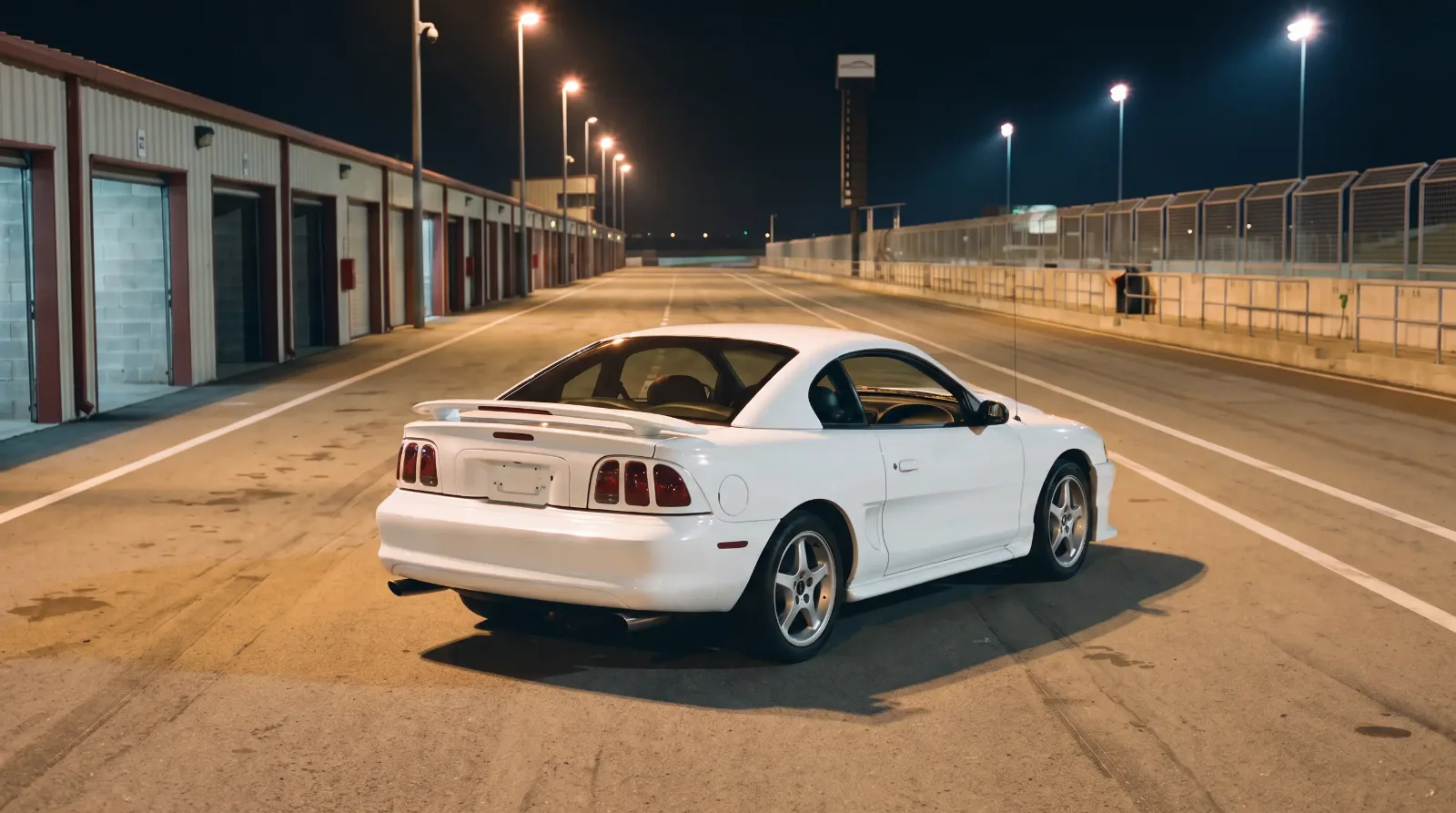
The 1995 Cobra carried on with the same 240 hp 5.0 and the same price list, $21,300 for the coupe and $25,605 for the convertible. Ford built 4,005 coupes and 1,003 convertibles. With the pace car duty over, the convertible was simply a Cobra convertible again, and once more it came one way only: every 1995 Cobra convertible was painted Black, with saddle leather and a black top. Coupes could be Black, Rio Red or Crystal White.
Two smaller things set the 1995 apart. It brought the chrome SVT badge on the decklid, new that year for every SVT vehicle. And the convertible got a one-year-only removable hardtop option, listed at $1,825 and fitted to 499 of the 1,003 Cobra convertibles. The GT convertible could not be ordered with it.
The other 1995 Cobra is a different animal. SVT built 250 Cobra R coupes with a 5.8-liter 351 Windsor rated at 300 hp, a racing fuel cell, no rear seat and no air conditioning, and buyers needed an NHRA or SCCA competition license to get one. The story of the 1995 Cobra R deserves its own article, and it is not a 5.0 car at all.
Then the 5.0 was gone. The 1995 model year was the last of the pushrod V8 in the Mustang, and the 1996 Cobra moved to a 4.6-liter four-valve DOHC V8 rated at 305 hp. Add it up and SVT built 11,267 Cobras across 1994 and 1995, the 250 R cars included: 6,009 in 1994 and 5,258 in 1995. Those are the only SN95 Cobras with a pushrod engine under the hood.
Pull up the SN95 Mustangs listed right now and expect the 1994 and 1995 Cobras to be heavily outnumbered by GTs, which is exactly how Ford built them. The Cobras are easy to pick out: round fog lamps, 17-inch wheels, the big brakes, and on a 1994 convertible, Rio Red paint and the winged logo on the seats.
Sources and notes
- Ford Mustang SVT Cobra, Wikipedia
- 1994 Ford Mustang Cobra Indy 500 pace car, MustangSpecs
- 1995 Ford Mustang SVT Cobra, MustangSpecs
- 1995 Ford Mustang Cobra hardtop SVT convertible, Martin Auto Museum
- 1994 Ford Mustang SVT Cobra Indy 500 pace car, RM Sotheby's lot
- List of Indianapolis 500 pace cars, Wikipedia
Related Reading
Have a
Ford Mustang
for Sale?
Reach thousands of serious classic car collectors across the US.
Sell It Here →
Selling a classic? Here's how: sell my classic car
Are You a Classic Car Dealer?
List your full inventory and connect with targeted classic car buyers.
Join as a Dealer →

About the author
Mike Sullivan
Detroit-area muscle car enthusiast and restoration specialist with three decades of hands-on experience working on American iron.
Related Listings - Ford Mustang




Comments
Be the first to comment on this article.