
The Mustang turned 30 in April 1994, and Ford marked the year by putting an all-new car in showrooms. That is the short version of 1994 Mustang history, and it is accurate as far as it goes. The longer version has a few corrections in it. There was no 30th-anniversary edition, the new car was on sale months before the birthday itself, and the car that carried the Mustang name to the Indianapolis 500 that May was not the one most buyers drove home. This piece follows the 1994 model year through the records: when the first SN95 Mustang came off the line, what it cost, what it paced, and how many Ford built.
Car Features
7 min read
The 1994 Mustang: A New Pony Car in the 30th Year, and the Pace Car
No anniversary edition, a December 1993 launch and a Cobra at Indy: the 1994 Mustang's first year, from Job One to 123,198 cars.
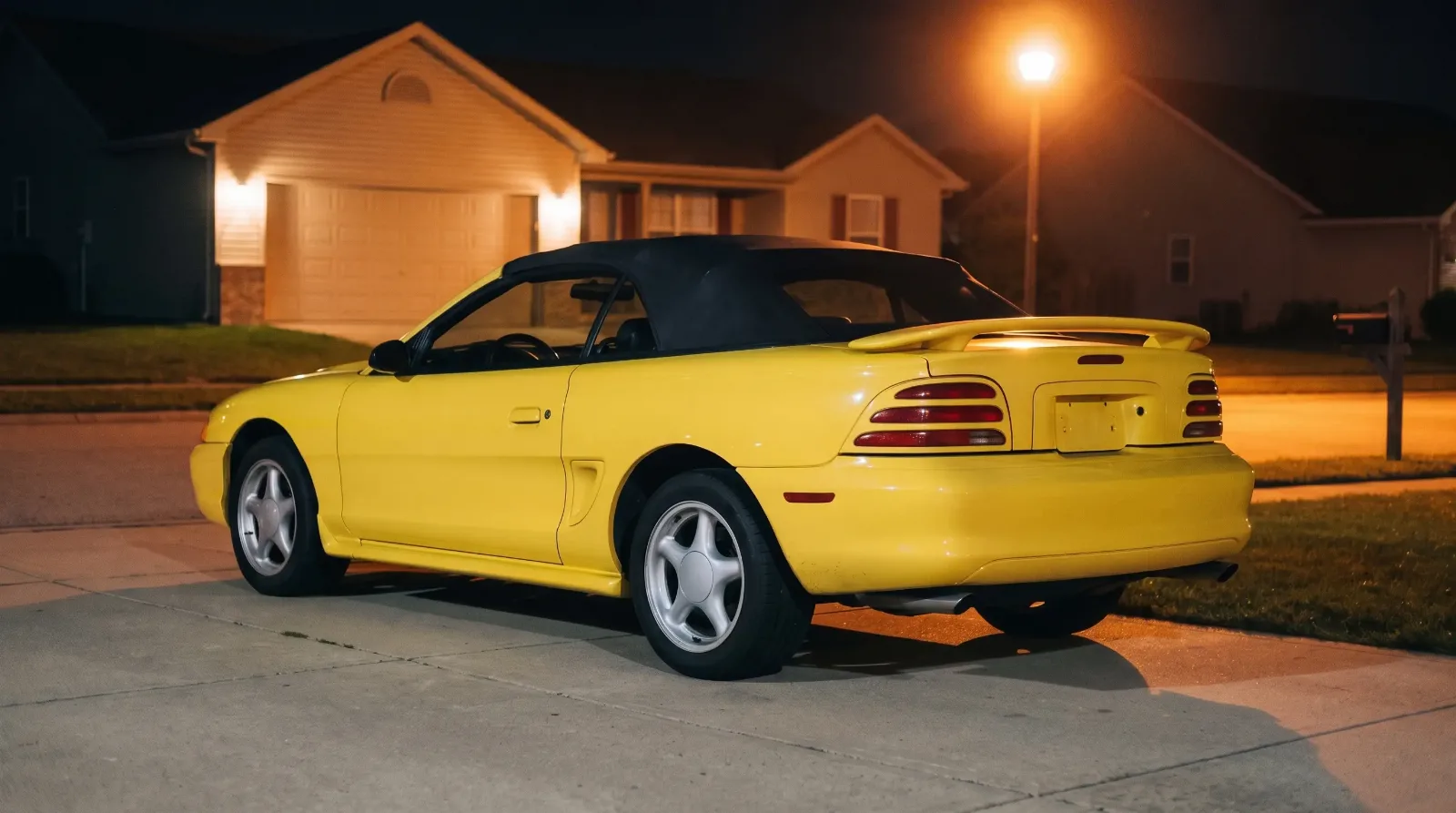
A new Mustang for the 30th year
The original Mustang went public on April 17, 1964, at the New York World's Fair, and it was in showrooms the same day. Thirty years on, Ford had a new body, a new interior and a new chassis tune to show for the occasion. People tend to assume that a car launched in an anniversary year must carry anniversary badges. The 1994 car did not. Ford built no 30th-anniversary edition. Ford marked the 20th in 1984 with a GT350 edition and would mark the 35th in 1999 with a Limited Edition GT and fender badges, but it skipped the 30th. The most likely reason is the obvious one: the new car was the celebration.
The anniversary itself belonged to the owners. Jim Osborn, who founded the Mustang Club of America, chaired the Mustang 30th Anniversary event in 1994. I have not found a record I trust for the venue, so I will leave it there. What matters for this story is that the club's celebration and the factory's launch fell in the same season, and the new car arrived in time to be part of it.
Job One and the December 1993 launch
Production started at Dearborn Assembly, inside the Ford River Rouge Complex, on October 15, 1993. That Job One date was two months ahead of schedule, which is not a sentence you write often about a new car program. The team behind it had worked from an off-site warehouse on about $700 million and a 36-month deadline. That story, with John Coletti's skunkworks and Will Boddie's Team Mustang, is told here, and I will not retell it.
Ford did not unveil the car at a single auto show. On Sunday, October 17, 1993, it showed the new Mustang at 100 locations across the United States at the same time; one of them was the Crossroads Mall in Roanoke, Virginia. Sales began nationwide on December 9, 1993. A Mustang introduced at a shopping mall, rather than under show-stand lights, was a fair match for a car that had always sold to ordinary buyers first.
A small point of record that confuses people: the "1994" Mustang was on sale in calendar 1993. Every early car is a 1994 model, and the anniversary everyone talks about came about four months after the launch. When you see a 1994 Mustang with an early build date, that is not a mistake on the paperwork.
What the 1994 Mustang history records show about the lineup
The new lineup was simpler than the Fox car it replaced. The notchback and the hatchback were gone. There was one coupe, with a fastback roofline, and a convertible. The 2.3-liter four was dropped, so the 3.8-liter V6 became the standard engine, rated at 145 hp and 215 lb-ft. The GT kept the 5.0-liter pushrod V8 at 215 hp and 285 lb-ft. The base car led the launch in December, and the 1994 GT followed in January 1994. Above both sat the SVT Cobra, with a 240 hp version of the 5.0.
| 1994 model | Engine | Base price | Production |
|---|---|---|---|
| V6 coupe | 3.8 V6, 145 hp | $13,365 | 42,883 |
| V6 convertible | 3.8 V6, 145 hp | $20,160 | 18,333 |
| GT coupe | 5.0 V8, 215 hp | $17,280 | 30,592 |
| GT convertible | 5.0 V8, 215 hp | $21,790 | 25,381 |
| SVT Cobra coupe | 5.0 V8, 240 hp | 5,009 | |
| SVT Cobra convertible | 5.0 V8, 240 hp | 1,000 | |
| Total | 123,198 |
The prices above are the launch figures printed in a 1993 newspaper report, and I use them over the slightly different numbers that circulate on later web pages. You will see $13,355 for the V6 coupe and $21,960 or $21,970 for the GT convertible in some places. The period figure is the one I trust. That same report put the base Mustang a few dollars under the base Camaro and Firebird, and a loaded GT convertible at about $24,000. Ford also added the Mustang's first CD player option that year, as part of the Mach 460 sound system.
The pace car at the 78th Indianapolis 500
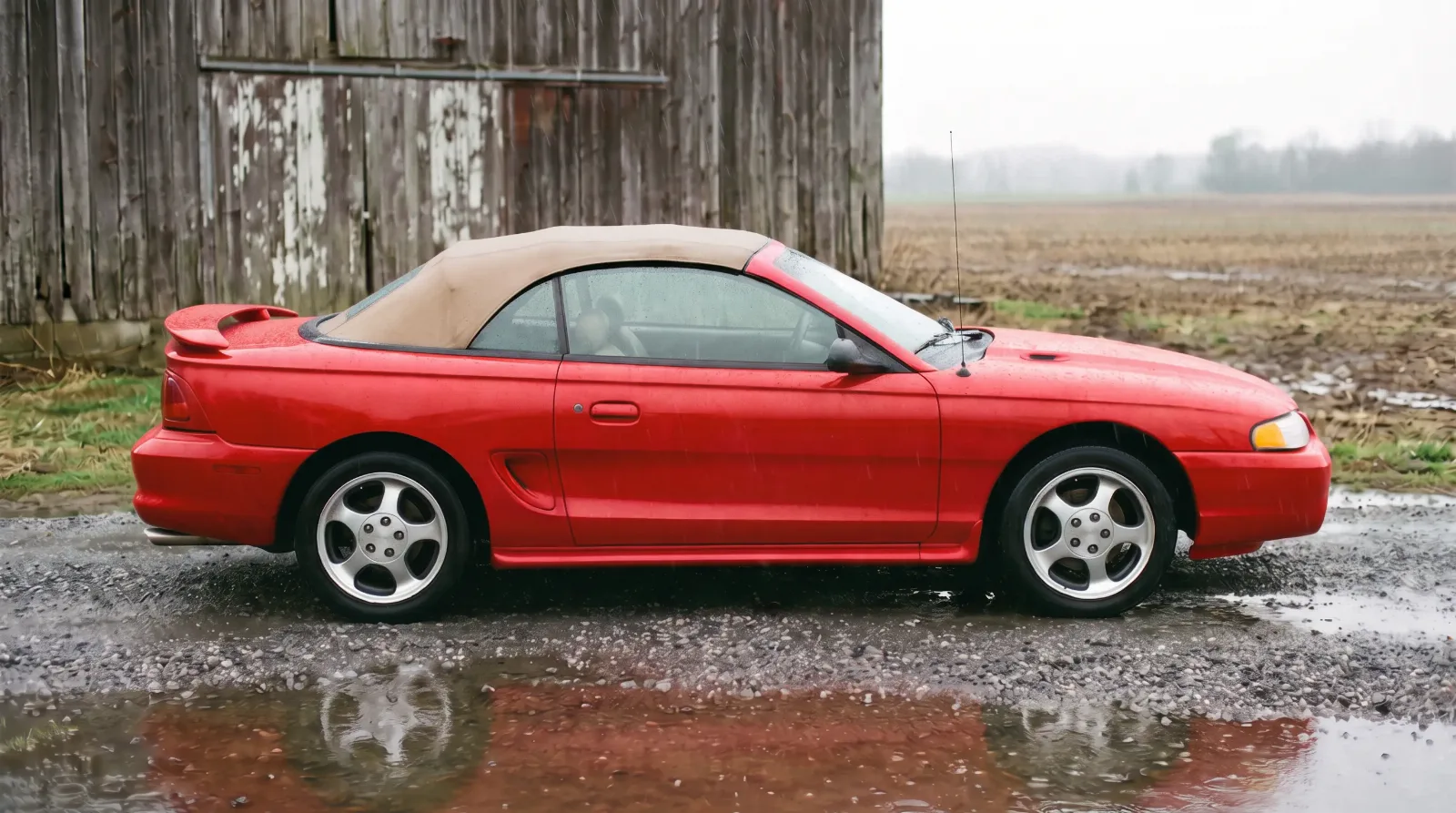
In May 1994 a Mustang Cobra convertible paced the 78th Indianapolis 500. Parnelli Jones drove it at the start, and Don Bailey drove it during the caution periods. It was the third time a Mustang had led the field at Indianapolis. The first was in 1964, with Benson Ford as pacemaker, and the second was in 1979, with Jackie Stewart behind the wheel. So the three pace-car years land at the original launch, the start of the Fox era and the start of the SN95 era. I doubt anyone planned that symmetry thirty years in advance, but it holds up on paper.
Ford built 1,000 pace car replicas, and those 1,000 cars were the entire 1994 Cobra convertible run. Every one was painted Rio Red, with a saddle top and saddle leather. The front headrests carried embossed Indy "wings," and the recessed areas of the wheels were painted charcoal. The "Official Pace Car" decals were supplied loose for the dealer to install, which means some replicas wear them and some never did. The cars shared the Cobra's mechanical package: the 240 hp 5.0, 13.0-inch front and 11.7-inch rear disc brakes, and Goodyear GS-C P255/45ZR17 tires on 17-inch wheels.
One number to watch: a photo caption in one widely read online reference gives 107 for the replica count. Three other sources say 1,000. The 107 figure matches the 1993 Cobra R production, and I read the caption as a mix-up. I would also be careful with claims about who prepared the actual track cars and how many there were. I have not seen a record for either that I would put my name to.
"Collectors sometimes ask me for the 1994 anniversary option code. There isn't one. The factory's way of marking the 30th year was a new car, a launch date two months early and a Cobra at Indianapolis. If someone shows you a 1994 Mustang with 30th-anniversary trim, ask where it came from, because it did not come from Dearborn."
Tom Ramirez
Car of the Year and the sales verdict
Motor Trend named the 1994 Mustang its Car of the Year. It was the Mustang's second win, twenty years after the 1974 Mustang II took the same title. I have not confirmed the issue date, so I will not give one. The award mattered because the car was entering a market where its own maker had once planned to replace it with a front-drive coupe, and a magazine verdict was useful evidence that the rear-drive Mustang still had a case.
The production figures made the same argument. Ford built 123,198 Mustangs for 1994, against 114,228 for the final Fox model year in 1993. That is a modest gain, and it came with a short first season, since the car launched in December and the GT followed a month later. The full effect showed in 1995, when production rose by 51 percent over 1994 to the highest Mustang total since 1989.
For the record, the 1994 cars are the first-year SN95s, built with the pushrod 5.0 that would last only through 1995, and the only year in which every Cobra convertible was a pace car replica. The V6 coupe was the volume car by a wide margin, as the production table shows. Anyone tracing one of these cars today, whether a plain V6 or a Rio Red Cobra, will find 1994 Mustangs for sale in every trim on that chart. The window sticker and the build date will tell you more about any one of them than an anniversary badge ever could.
Sources and notes
- MustangSpecs: 1994 Ford Mustang specifications, prices and production
- MustangSpecs: 1994 Mustang Cobra Indy 500 pace car
- The Roanoke Times, 15 October 1993: the new Mustang's launch and prices
- Wikipedia: Ford Mustang (fourth generation)
- Wikipedia: List of Indianapolis 500 pace cars
- RM Sotheby's: 1994 Ford Mustang SVT Cobra Indy 500 pace car, number 376 of 1,000
Related Reading
#mustang history
#Ford Mustang
#motor trend car of the year
#Indianapolis 500 pace car
#SVT Cobra
#SN95 Mustang
#1994 Mustang

About the author
Tom Ramirez
Corvette researcher and historian based in Bowling Green, Kentucky. Two decades documenting Corvette production history from original factory records.
Related Listings - Ford Mustang




Comments
Be the first to comment on this article.