
Ford gave the three design proposals for the 1994 Mustang nicknames that sound like they came from a gym, not a design studio: "Bruce Jenner," "Rambo" and "Arnold Schwarzenegger." Ask a room of owners "what is a SN95 Mustang, really?" and you will get answers about engines and model years. The better answer is about the body. SN95 is the code name Ford assigned in May 1990 to the 1994 Mustang, a car built on an updated Fox platform known as Fox-4, and the shape on top of it came out of a three-way fight over how much muscle a Mustang should show.
Car Features
7 min read
Rambo, Bruce Jenner and Arnold: The SN95 Design Themes
The three clay themes Ford nicknamed Bruce Jenner, Rambo and Arnold Schwarzenegger, why Arnold won, and the heritage cues that made the 1994 shape.
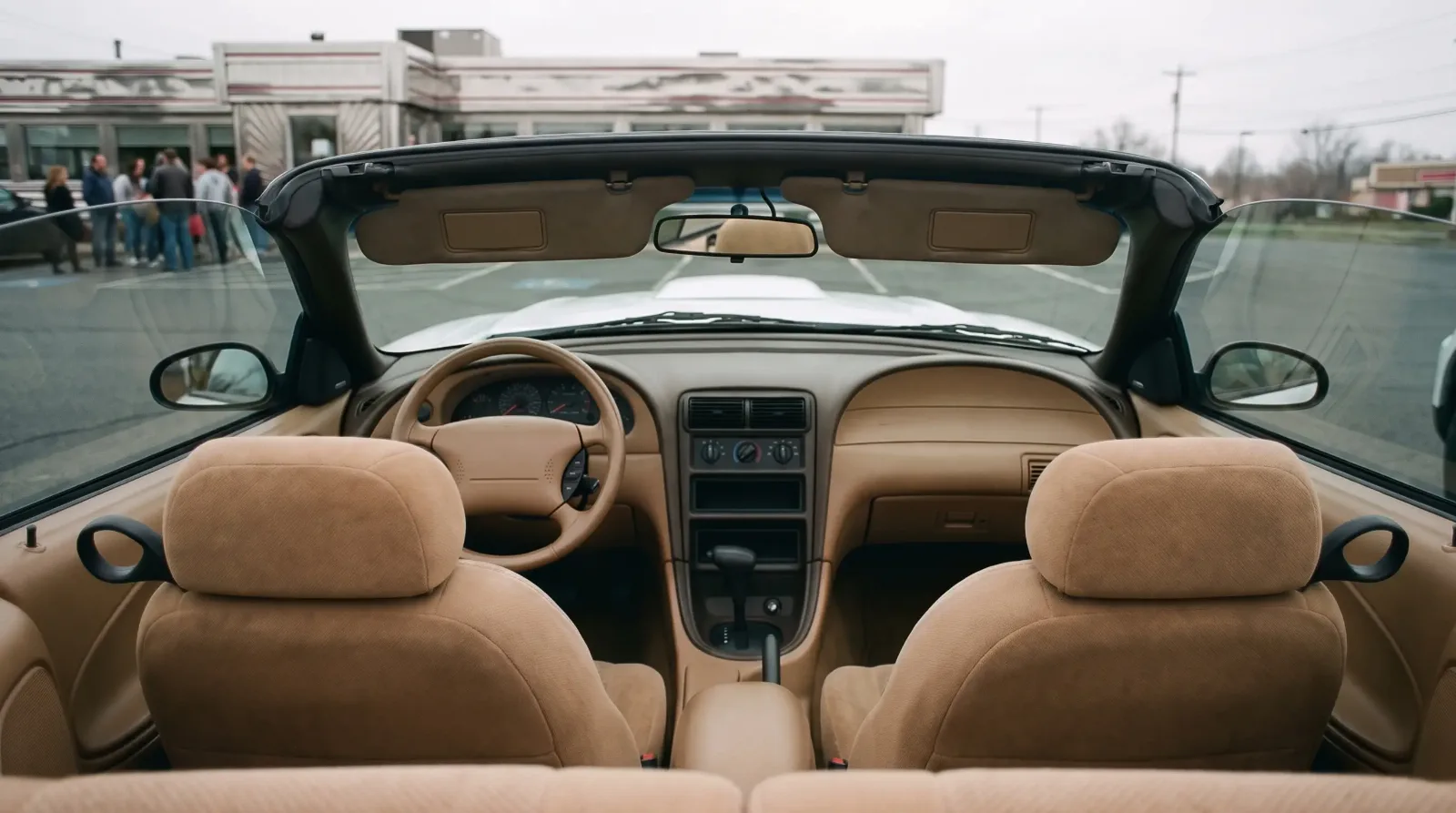
This one stays on sheet metal and clay. The people, the budget and the warehouse are covered in the SN95 story, so here we look at the bodies Ford put on the table and the one it built.
What is a SN95 Mustang, in design terms
Start with what the designers inherited. The Fox Mustang had been around since the 1979 model year. It got a grille-less nose in 1985 and a smoother aero front end for 1987, but under the updates it was still a crisp, boxy car from the late 1970s. By the end of the decade it looked like what it was: an old shape that had been sanded down a few times.
Styling work on the replacement began in November 1989. The brief, as program leader Will Boddie put it, was blunt: "Our goal was to create a vehicle that would be recognizable as a Mustang, even without the badging." That sounds like a slogan until you try to do it. Take the horse off the grille and the name off the fender, and the panels themselves have to say Mustang. Customer clinics backed that approach, favoring a car that read as a Mustang even without the horses.
The team also made a call that any body man will respect. The notchback and the hatchback were dropped. The SN95 came as one fastback-style coupe and a convertible, and it was the first Mustang since 1964 without a notchback. One roofline, done right, instead of several done halfway. In February 1990 Alex Trotman approved the clay model and green-lit the program. Then came the real argument: which body.
Three bodies, three nicknames
The nicknames tell you the whole debate before you see a single photo. Ford's own look-back confirms the names, and it says plainly that "Rambo was the most far out design." Later write-ups describe the "Bruce Jenner" theme as too tame and "Rambo" as too aggressive. One history adds that Jenner, a trim and athletic shape, still looked a little too much like the Probe, while Rambo proved too dramatic for the people in Ford's customer clinics. That leaves "Arnold Schwarzenegger" in the middle.
My read on the names is simple, and it is only a read. Jenner is the lean athlete: clean, fit, nothing extra. Rambo is the action hero with everything turned up. Schwarzenegger is the bodybuilder, which sounds like the loud option but is really about muscle in proportion. Big shoulders, tight waist, nothing that looks bolted on. That is exactly the line you want a pony car to walk. Go too soft and it looks like a commuter coupe. Go too hard and it looks like an aftermarket body kit before it ever leaves the factory.
| Theme nickname | How it has been described | Outcome |
|---|---|---|
| "Bruce Jenner" | Trim and athletic; later accounts call it too tame and too close to the Probe | Rejected |
| "Rambo" | Ford: "the most far out design"; too dramatic for the clinic audiences | Rejected |
| "Arnold Schwarzenegger" | The middle ground: the Jenner idea with more muscle and bulk | Approved for production, November 1990 |
Ford put images of the proposals back into circulation in 2013, which is a big part of why enthusiasts still argue about them today.
Why Arnold won the clay war
The "Schwarzenegger" theme was approved for production in November 1990, and the part I find most impressive is what happened next: almost nothing. The production SN95 closely matches the approved theme, with only a slight change to the lower front fascia. Anyone who has watched a design go from clay to steel knows how rare that is. Cost, tooling, crash rules and engineering usually chip away at a theme until the showroom car looks like a tired cousin of the model. This one came through with its proportions intact.
Credit for the final exterior generally goes to Bud Magaldi, whose work dates to 1990, with Emeline King credited for the interior. You will also see Patrick Schiavone named. He was one of the designers, with John Aiken and Dennis Reardon, who sculpted the first exterior proposal in November 1989, so both names belong in the story. Magaldi also worked with Darrell Behmer on the Mach III, the two-seat show car Ford rolled out at the Detroit show in January 1993. That car was a preview of the attitude, if not the exact body, that buyers got later that year.
"Rambo would have drawn the biggest crowd at a show and aged the worst. Jenner would have been forgotten in five years. Arnold is the one I would still lay a straightedge across: the surfaces hold, the scoop sits where your eye expects it, and the nose does not apologize for itself."
Jim Vasquez
The heritage cues that made it read as a Mustang
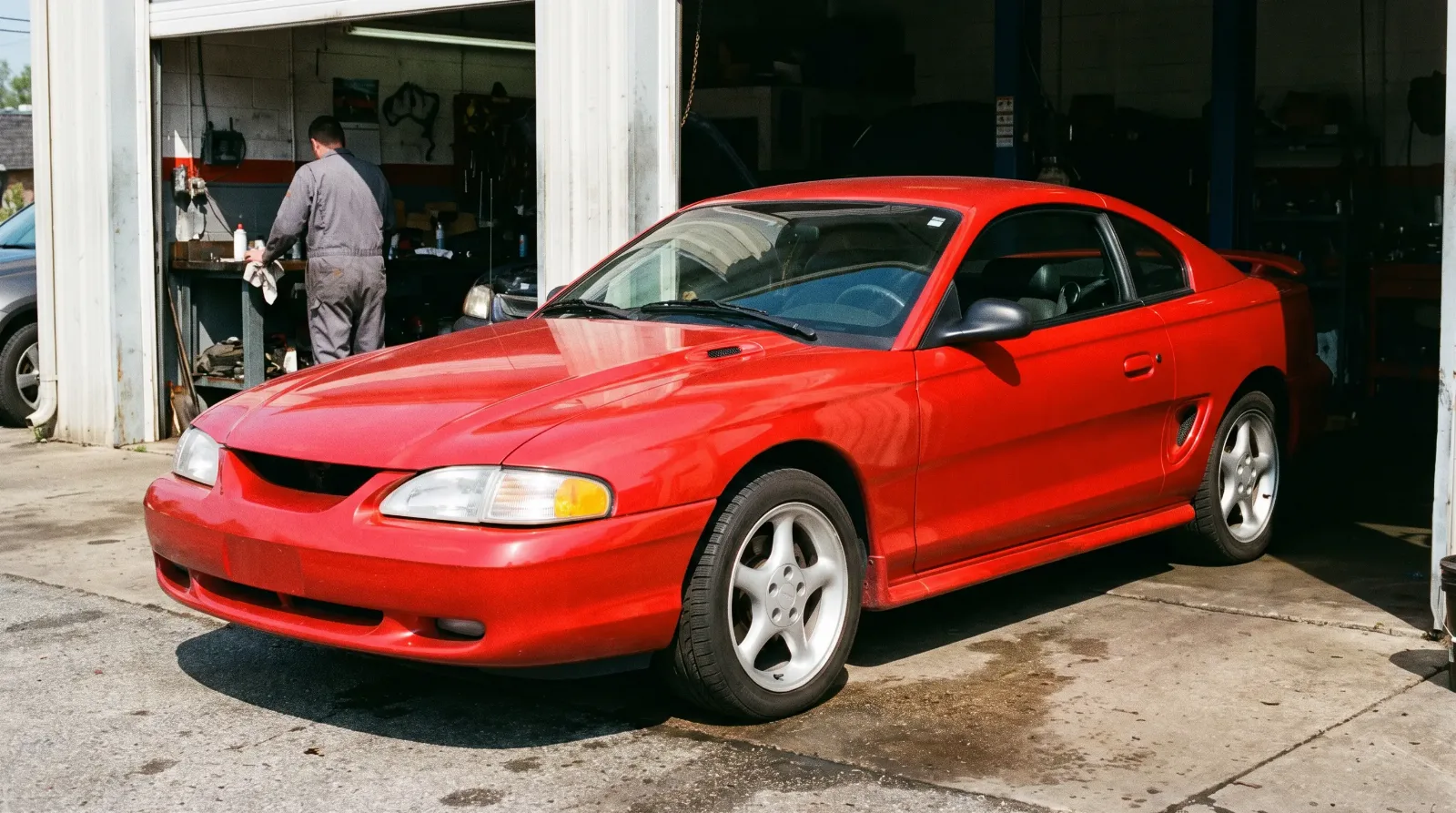
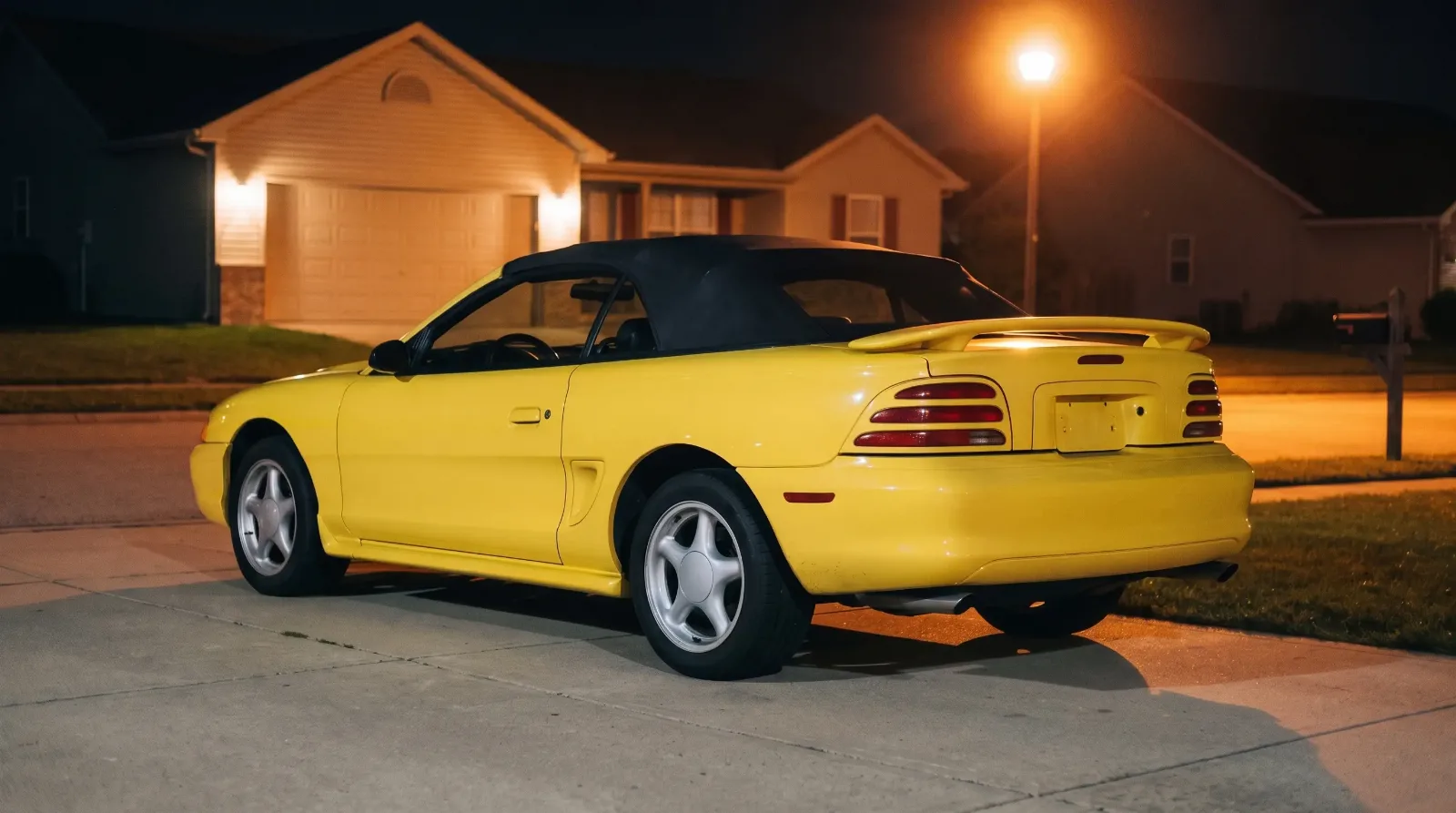
Boddie's "even without the badging" test is answered in the details. The running horse went back into the grille. The sides got C-shaped scoops, a direct nod to the cars of the 1960s. Out back sat three-element taillights. None of those is a new idea, and that is the point. They are the visual vocabulary Mustang owners already knew, rewritten in the rounded surfaces of the early 1990s. For how those cues developed over the decades, the Mustang design chapter walks through the full history.
Inside, the heritage play was the dual-cockpit dash, which split the cabin into a driver's side and a passenger's side. To my eye it echoes the twin-cowl dashboards of the 1960s cars without copying them. The interior stayed with that layout from 1994 through 2004. It is one of the few 1990s Ford interiors that still makes sense to an owner who grew up around the originals.
How the shape holds up
The finished car sat on a 101.3-inch wheelbase, measured 181.5 inches long and 71.8 inches wide for 1994 to 1998. It was bigger than the Fox it replaced, and heavier, but the Schwarzenegger surfacing hid the bulk better than a squarer body would have. Ford says 1,330 of the car's 1,850 parts changed, and most of what you see from ten feet away is in that number. The car went on sale as the 1994 relaunch in the Mustang's 30th year.
The 1999 restyle sharpened the edges and gave the body creases, and plenty of people prefer that look. I like the 1994 to 1998 car better as a piece of body design. It is the version that shows the original argument most clearly: a theme picked because it was strong without shouting, and built almost exactly as it was approved. As an epilogue, the SN95 line stayed in production until 2004.
Sources and notes
- Ford Motor Company: Ford concludes look back at Mustang history (press release, 2009)
- MustangSpecs: The 4th generation Ford Mustang overview
- Jalopnik: How the fourth-generation Mustang could have looked
- Motorious: The Schwarzenegger Mustang, Rambo and Bruce Jenner
- Wikipedia: Ford Mustang (fourth generation)
Related Reading

About the author
Jim Vasquez
Southern California hot rod and custom car builder with roots in the traditional kustom kulture scene.
Related Listings - Ford Mustang




Comments
Be the first to comment on this article.