
In June 1987 Donald Farr, the editor of Mustang Monthly, used his editorial page to ask readers to write to Ford chairman Donald Petersen. His message fit on a bumper sticker: "No Japanese Mustang, please." Ford had scheduled a front-wheel-drive car on Mazda 626 underpinnings to carry the Mustang name for 1989. That editorial is where the Team Mustang SN95 story really begins, a few years before anyone at Ford used either name.
Car Features
7 min read
Team Mustang: How a Skunkworks Saved the Mustang
How a nine-person skunkworks and Will Boddie's Team Mustang kept the rear-drive Mustang alive and built the 1994 SN95 for about $700 million.
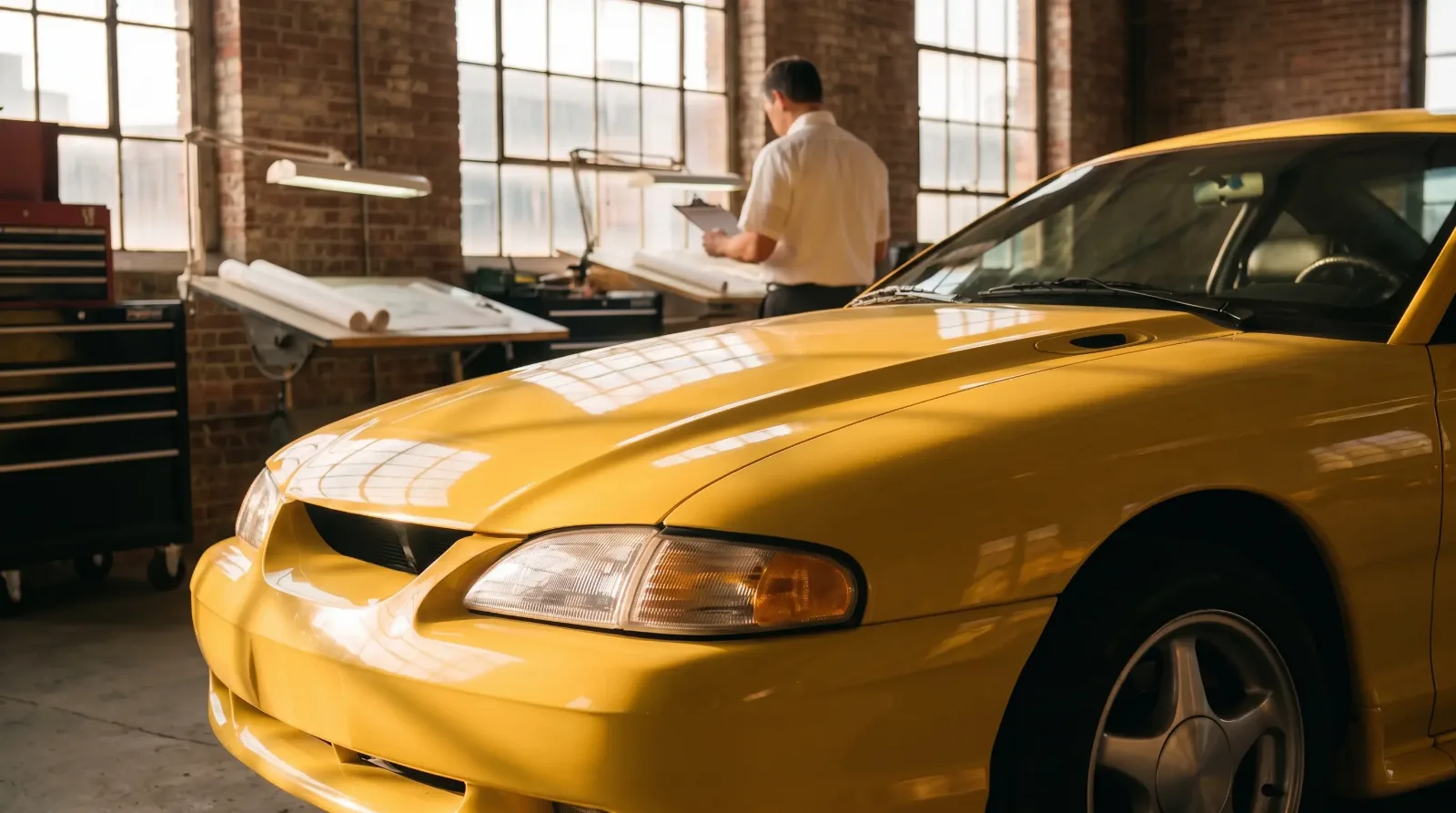
The front-drive car became the Ford Probe, and the rear-drive Mustang lived on. Only just, though. What carried it into the 1990s was a small group of engineers who started meeting informally, and a program that ran out of a warehouse instead of a corporate tower. For the full generation, engines and trims included, read more here. This piece stays with the people.
The Probe scare and the billion-dollar estimate
It is easy to forget how close the Mustang came to being something else entirely. In the late 1980s Ford seriously considered letting the front-drive Probe replace the rear-drive car. Inside the company the plan had opponents. Bob Rewey, general manager of Ford Division, pushed to reverse the idea of calling the Probe a Mustang, and he went on to become a key internal backer of the car that followed. John Coletti, an engineer who would end up at the center of this story, is on record saying he would rather see the Mustang name die than see it on the Probe.
Enthusiasts won that round. The Probe arrived under its own name. But winning the argument over a badge did not pay for a new car, and the Fox platform under the Mustang had been in production since the 1979 model year. Then a 1989 study priced a full redesign at $1 billion. For a car Ford had nearly walked away from once already, that figure was close to a death sentence. Nobody upstairs was going to write that check on sentiment.
Nine freethinkers in August 1989
The turn came from the middle of the organization. Ken Nabroski, one of two North American Automotive Operations directors (Steve Lyons was the other) that Alex Trotman had enlisted, told John Coletti, then the Mustang's engineering design manager, to pull together a team of freethinkers. Nine people began meeting informally, on Thursday afternoons, in August 1989. That was the skunkworks. No big budget and no announcement, just a small group asking whether the Mustang could be saved for a lot less than a billion dollars.
Their answer was to keep the bones and change nearly everything you could see and touch. Styling work started in November 1989. The group also had a friend in a high place. Trotman had become executive vice president of North American Automotive Operations in 1989, and the Mustang Club of America later called him "the key sponsor" who got Coletti's team its approval. In February 1990 Trotman signed off on a clay model and gave the project a green light. By May 1990 it had a code name: SN95.
How Team Mustang SN95 worked under one roof
A skunkworks can save a program. Building the car takes a bigger crew. Once the project was approved, leadership passed to Will Boddie, Ford's director for small and mid-size cars, and the effort became Team Mustang. The two stages get blurred in a lot of retellings, so it is worth being plain about it. Coletti led the 1989 skunkworks that kept the idea alive. Boddie led the team that carried it through development and onto the street.
In June 1990 that team moved into a warehouse in Allen Park, Michigan. Boddie gathered about 200 people from across the company at the core, and accounts of the head-count at its peak run to roughly 400 to 450. By Boddie's account, putting everyone under one roof swapped the usual chain-of-command delays for quick, informal decisions made by people who could walk over and talk to each other. He did not dress up the stakes. "It was a do-or-die situation for Mustang at the time," he said later in a Ford look-back at the car's history.
The design work ran in parallel. Three design themes went up for review, each nicknamed after a very different physique, and the story of Rambo, Bruce Jenner and Arnold deserves its own telling. The short version is that the "Arnold Schwarzenegger" theme was approved for production in November 1990. Outside help came in too. Roush's company worked closely with Team Mustang on development, a relationship that ran from 1990 through 2004.
| Date | Milestone |
|---|---|
| June 1987 | Donald Farr's "No Japanese Mustang" editorial in Mustang Monthly |
| 1989 | A study puts a full Mustang redesign at $1 billion |
| August 1989 | Coletti's nine-member skunkworks begins meeting informally |
| November 1989 | Styling work begins |
| February 1990 | Trotman approves the clay model and green-lights the program |
| May 1990 | Code name SN95 assigned |
| June 1990 | Team Mustang moves into the Allen Park warehouse |
| November 1990 | "Arnold Schwarzenegger" design theme approved for production |
| January 1993 | Mach III concept shown at the Detroit auto show |
| October 15, 1993 | SN95 production begins at Dearborn Assembly, two months ahead of schedule |
Cheaper and faster than Ford expected
The money is what made people inside Ford pay attention. The program came in at about $700 million, against the roughly $1 billion that most all-new cars cost at the time. A 1993 newspaper report credited the team with working 25 percent faster and spending 30 percent less than any comparable Ford program. Boddie's group was given a 36-month deadline, and Job One arrived in October 1993, two months early.
Cheap did not mean carried over. Ford says 1,330 of the car's 1,850 parts were changed, even though the SN95 rode on an updated Fox platform known as Fox-4. Boddie's design target was easy to state and hard to hit: "Our goal was to create a vehicle that would be recognizable as a Mustang, even without the badging." In customer clinics, people favored the car that still read as a Mustang with the horses taken off, which tells you the team understood its audience.
Before any of that reached a showroom, Coletti's people gave the public a preview. The Mach III, a two-seat show car with a supercharged 4.6-liter DOHC V8 rated at 450 hp, appeared at the Detroit show in January 1993. Production followed at Dearborn Assembly on the River Rouge complex from October 15, 1993, and Ford built 123,198 Mustangs for the 1994 model year, up from 114,228 in the final Fox year. A car that had been a budget line on the chopping block in 1989 was built in bigger numbers than the car it replaced.
What the skunkworks left behind
The people who saved the Mustang did not go quiet afterward. Coletti went on to run Ford's Special Vehicle Team, retiring from SVT in 2004, and his group turned out a run of concept cars: the Mach III, a 10.0-liter Boss Mustang, the GT90, the Mustang Super Stallion, a 6.1-liter Mustang CJR and the Ford GT. Trotman rose to chairman and chief executive of Ford, a post he held from 1993 to 1998.
"Park a 1994 GT beside a 1993 LX at any Mustang show and the gap looks like a generation of money. It wasn't. It was a few hundred people in a warehouse who were told the car might not survive and decided to prove otherwise."
Patrick Walsh
The bigger legacy is simpler. The SN95 showed that a small, co-located team could build a new Mustang for well under the price the 1989 study had put on it, and that buyers in the 1990s still wanted a rear-drive pony car. It also showed that enthusiasts were part of the argument, starting with one editor's plea in 1987. Every SN95 that rolls onto a show field today carries a little of that story with it. If you want the long view of how this chapter connects back to the 1960s cars, start with the classic Mustang story. As an epilogue, the SN95 platform stayed in production until 2004.
Sources and notes
- Mustang Club of America: Hall of Fame inductees
- Ford Motor Company: Ford concludes look back at Mustang history (press release, 2009)
- MustangSpecs: The 4th generation Ford Mustang overview
- The Roanoke Times, October 15, 1993: the new Mustang program
- Wikipedia: Ford Mustang (fourth generation)
- Wikipedia: Donald Petersen
Related Reading
#mustang history
#Ford Mustang
#Ford history
#SN95 Mustang
#Team Mustang
#1994 Mustang
#John Coletti

About the author
Patrick Walsh
Automotive journalist covering classic car shows, events, and the enthusiast community across North America.
Related Listings - Ford Mustang




Comments
Be the first to comment on this article.