
Start with the result: 305 hp. That was the rating on the 1996 Mustang Cobra, 65 hp more than the 1995 car it replaced, and it came from a smaller engine. Ford's Special Vehicle Team got there by retiring the pushrod 5.0 that had been the Mustang's performance V8 since 1982 and fitting a 4.6-liter V8 with two overhead cams per bank and four valves per cylinder. The 1996 Cobra was the first Mustang to make its power that way, and the numbers show exactly what the change bought and what it didn't.
Car Features
7 min read
The 1996 Cobra and the Four-Valve 4.6
The 1996 Mustang Cobra by the numbers: a hand-built 4.6 DOHC with 305 hp, how it compared with the 5.0 Cobra and GT, and the Mystic Cobra.
This piece looks only at that engine and the 1996 to 1998 cars built around it. The wider story of SVT, from the first Cobra to the R models, sits under the SVT Cobra Mustang overview.
What the 1996 Mustang Cobra engine was
The base hardware came from Ford's Modular engine family, which first went into production as a 4.6 SOHC in the 1991 Lincoln Town Car. For 1996 the Mustang GT got the two-valve SOHC version. The Cobra got something else: a 4.6 DOHC with 32 valves, rated at 305 hp at 5,800 rpm and 300 lb-ft at 4,800 rpm, on a 9.85:1 compression ratio.
Displacement was 281 cubic inches, from a 3.55-inch bore and a 3.54-inch stroke. That is almost perfectly square, and it is a long way from the 302's 4.00 by 3.00 layout. The short-stroke 302 was a torque engine. The 4.6 DOHC was built to breathe at high rpm, and it showed in the tach: redline was 6,800 rpm, with the fuel cut-off at 7,000.
Three details separated the Cobra engine from a parts-bin job:
- The block was aluminum, cast in Italy by Teksid, a Fiat subsidiary. The GT's two-valve 4.6 used a cast-iron block.
- Induction ran through a twin 57 mm throttle body and an 80 mm mass air meter, with an integral oil cooler.
- Each engine was assembled by a two-person team of SVT technicians at Ford's Romeo, Michigan engine plant.
The numbers against the 5.0 Cobra and the GT
The cleanest way to see what four valves bought is to line the Cobra up against the cars around it. The 1994 to 1995 Cobra used a 5.0 with GT-40 heads, a Cobra intake and its own cams, and it was rated at 240 hp and 285 lb-ft at 4,000 rpm. The 1996 GT's two-valve 4.6 made 215 hp at 4,400 rpm and 285 lb-ft at 3,500.
| Car | Engine | Horsepower | Torque | Base price (coupe) |
|---|---|---|---|---|
| 1993 SVT Cobra | 5.0 OHV, GT-40 heads | 235 hp | 280 to 285 lb-ft | n/a |
| 1994 to 1995 SVT Cobra | 5.0 OHV, GT-40 heads | 240 hp | 285 lb-ft @ 4,000 | n/a |
| 1996 Mustang GT | 4.6 SOHC 2-valve | 215 hp @ 4,400 | 285 lb-ft @ 3,500 | $17,610 |
| 1996 SVT Cobra | 4.6 DOHC 4-valve | 305 hp @ 5,800 | 300 lb-ft @ 4,800 | $24,810 |
| 1999 SVT Cobra (advertised) | 4.6 DOHC 4-valve, revised | 320 hp @ 6,000 | 317 lb-ft @ 4,750 | n/a |
Read the table carefully and the story is in the right-hand columns. Horsepower jumped 27 percent over the 1995 Cobra. Torque went up only 15 lb-ft, and its peak moved 800 rpm higher. Per liter the gap is bigger still: about 66 hp per liter for the 4.6 DOHC against roughly 48 for the 5.0 Cobra. The four-valve engine did its best work above 4,500 rpm. Below that, the torque figures say a 5.0 Cobra would have felt closer than the horsepower gap suggests.
The price story is just as tidy. At $24,810 the Cobra coupe cost $7,200 more than a GT coupe. Divide the sticker by the rating and both cars land at about $81 per horsepower. Ford was not discounting the extra power. It was charging the going rate for it.
How fast it actually was
Catalog horsepower is one thing. Elapsed time is what settles arguments. Ford's own figures for the 1996 Cobra, as given in Jim Campisano's book Powered by SVT, were 5.9 seconds from 0 to 60 mph and a quarter mile of 13.99 seconds at 101.6 mph. Car and Driver did better in a comparison test in its December 1995 issue: 5.4 seconds to 60 mph and 14.0 seconds at 102 mph. Treat the two as a range rather than a record.
A half-second spread in 0 to 60 times is normal for a car with this power curve. It needs revs at launch, and how hard the driver is willing to slip the clutch decides a lot. The trap speed is the more honest figure. Just over 100 mph in the quarter is a real 300 hp result for a car of this size.
"People still argue about whether the 1999 Cobra made its 320 hp. I haven't seen that case made against the 1996. The trap speed says the 305 was there."
Dan Reeves
That contrast matters. The 1999 Cobra was advertised at 320 hp and 317 lb-ft, but owners found it slower than a 1998, and dyno results pointed to about 285 hp. The 1996 to 1998 engine has no comparable shortfall on record, which makes the earlier four-valve cars the ones whose rating holds up.
Production, prices and the Mystic Cobra
SVT built the four-valve SN95 Cobra in three model years before the 1999 redesign. Coupe production fell each year while convertible output rose:
- 1996: about 7,500 coupes (7,496 in the production tables) and 2,510 convertibles
- 1997: 6,961 coupes and 3,088 convertibles, for 10,049
- 1998: 5,174 coupes and 3,480 convertibles, for 8,654
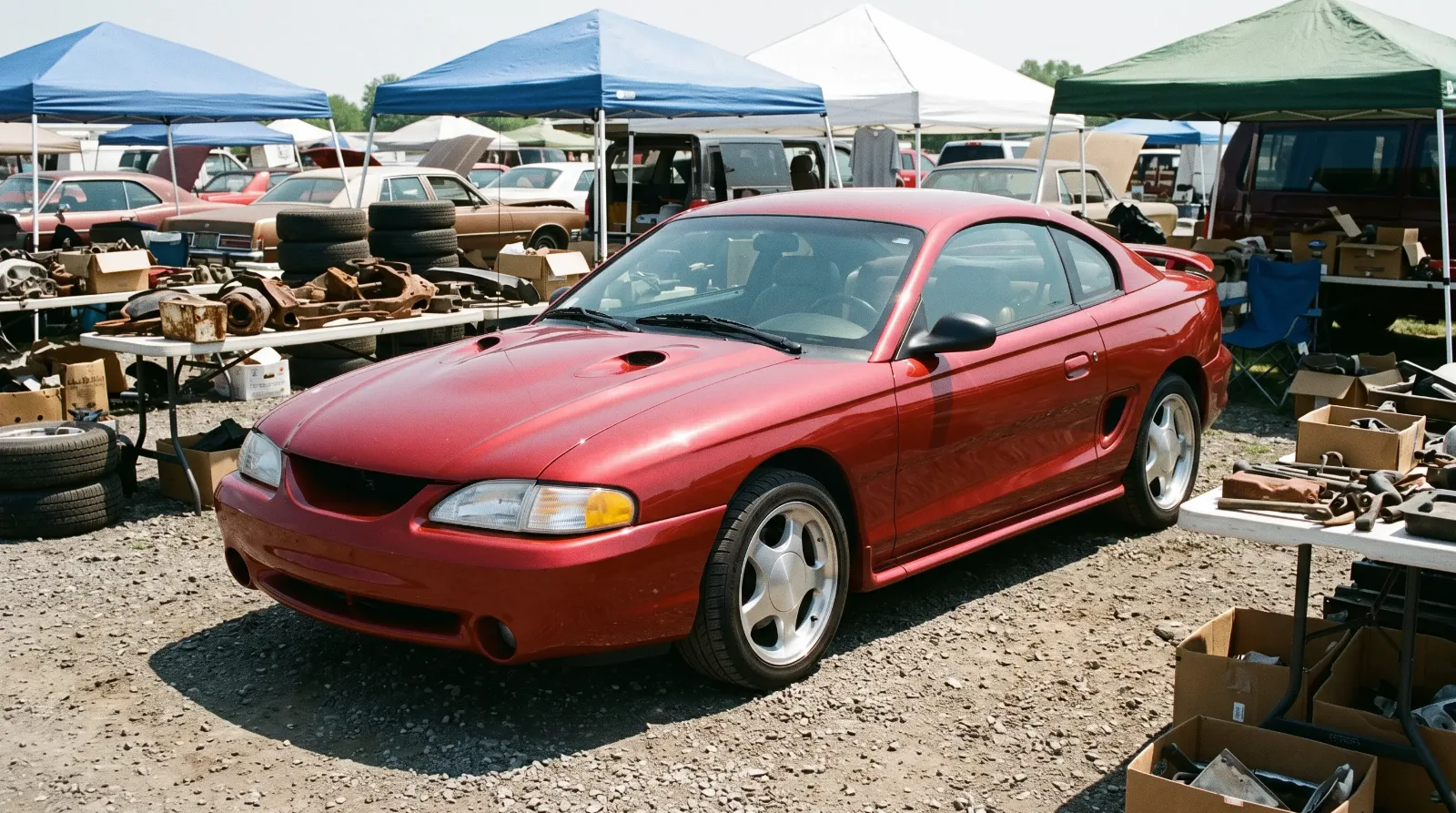
That adds up to about 28,700 cars across the three years. Prices rose a few hundred dollars a year, from $24,810 for a 1996 coupe and $27,580 for the convertible to $25,710 and $28,510 for 1998. The 1997 cars lost the honeycomb grille insert to feed more air to a larger radiator, and Pacific Green joined the Cobra color list. For the broader run of the platform there is more on the SN95 cars in this series.
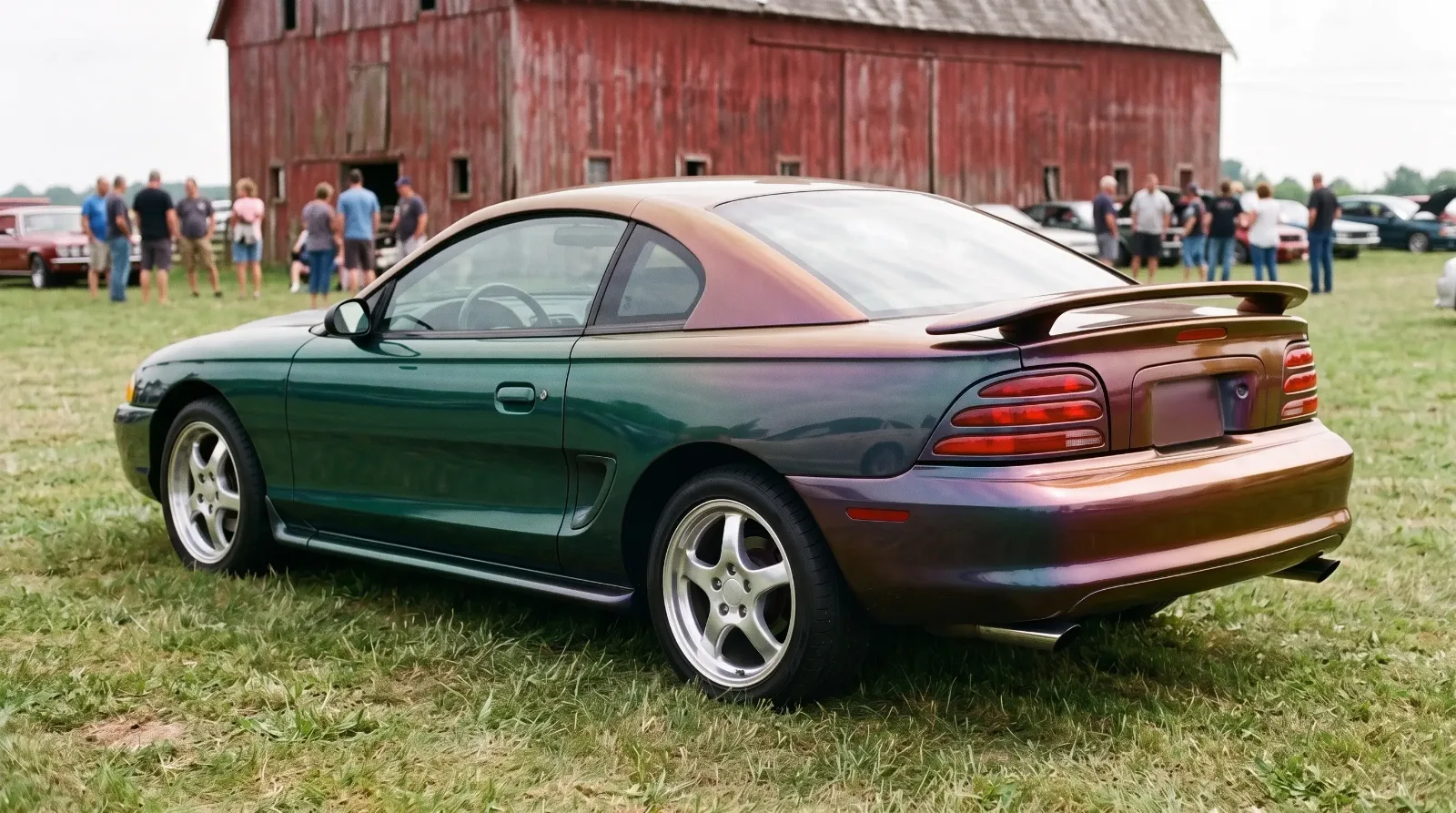
The car collectors chase is the 1996 Mystic Cobra. It wore BASF's color-shifting Mystic paint, code LF, which moves from green through amber and gold to purple with the light and the viewing angle. It was an $815 option on the coupe, and about 2,000 were built (1,999 in the color tables, with 2,000 being the planned or marketed figure). That makes the Mystic one of the lowest-production SN95 variants, alongside the Cobra R models and the 1994 pace car replicas.
Where the four-valve Cobra sits now
The 1996 Cobra was the point where the Mustang's performance engine changed character. The 302 had made its name on low-end torque. The 4.6 DOHC made its name on revs, and every SVT Mustang that followed built on that idea. Under John Coletti, who ran SVT through the 1990s, the team went on to the independent rear suspension of the 1999 Cobra and the 5.4-liter 2000 Cobra R.
The tuners were moving in the same years. Steve Saleen took a different route with Saleen's SN95 cars, which kept developing Saleen's own EPA-certified 351 Windsor after Ford moved the GT to the 4.6. Cubic inches instead of valves. Comparing the two approaches is a good way to see why Ford's own answer looked so different from the aftermarket's.
For buyers, the math is simple. A 1996 to 1998 Cobra gives you the first four-valve Mustang engine, a 305 hp rating that matches its trap speeds, and production small enough to keep clean examples scarce. Condition and paperwork set the price. If you are shopping, start with the 1996 Mustangs for sale and look for the cars with their original engine and window sticker.
Sources and notes
- Ford Mustang SVT Cobra (Wikipedia): 1996 to 1998 engine, performance, production and Mystic paint
- Ford Modular engine (Wikipedia): 4.6 DOHC blocks and Romeo hand assembly
- MustangSpecs: 1996 Ford Mustang SVT Cobra, Teksid block, colors and Mystic option
- MustangSpecs: 1996 Ford Mustang production, prices and engines
- MustangSpecs: 1998 Ford Mustang production and prices
- NHTSA vPIC: VIN decode of a 1996 Cobra pattern (engine code V, 4.6 DOHC)
Related Reading
Have a
Ford Mustang
for Sale?
Reach thousands of serious classic car collectors across the US.
Sell It Here →
Selling a classic? Here's how: compare the places to sell classic cars
Are You a Classic Car Dealer?
List your full inventory and connect with targeted classic car buyers.
Join as a Dealer →

About the author
Dan Reeves
Performance engine builder from North Carolina's motorsports corridor, focused on swaps, forced induction and making real, repeatable power.
Related Listings - Ford Mustang




Comments
Be the first to comment on this article.