
The 1995 Cobra R is what happens when a race program runs out of patience with a 5.0. SVT took the small-block out of its street Cobra, put in a 5.8-liter 351 Windsor rated at 300 hp, and built 250 cars around it. Every one was Crystal White. Every one carried a racing fuel cell. And every buyer was supposed to hold a competition license before the car left the dealer.
Car Features
7 min read
The 1995 Cobra R: A 351 and a Fuel Cell
Why SVT put a 300 hp 351 Windsor and a racing fuel cell in 250 white 1995 Cobra R Mustangs, and what the numbers showed.
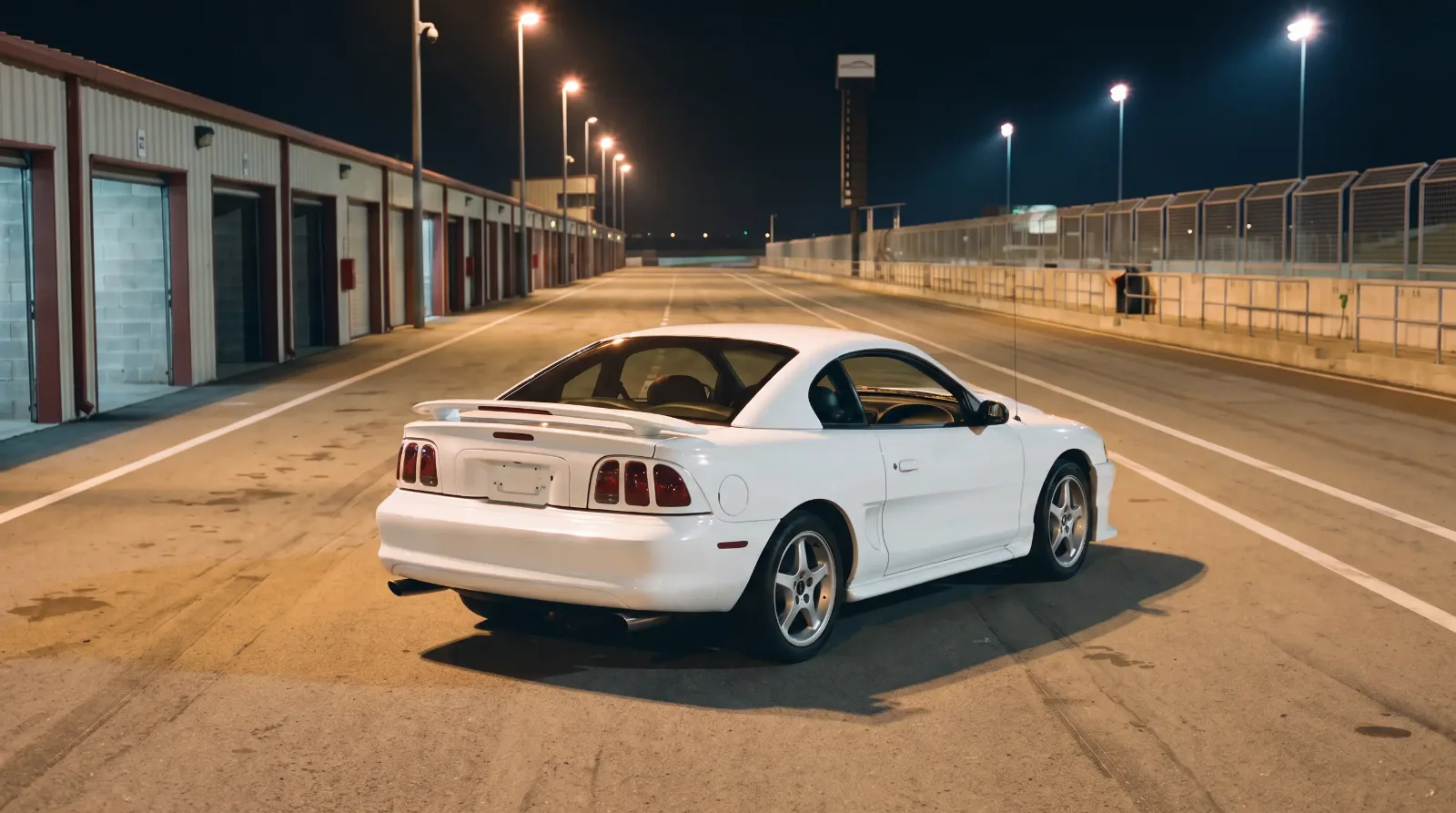
This is the narrow story: the engine swap, the parts list and the numbers that came out of it. The street Cobras, the SVO and the Saleens belong to the wider tuner-Mustang overview, with more on the SVT Cobra and Saleen cars. Here the subject is one white car with a big engine and no back seat.
Why the 1995 Cobra R got a 351
Start with the street car. The 1994 and 1995 SVT Cobra used a 5.0 V8 with GT-40 heads, a Cobra intake and its own cams and injectors. Ford rated it at 240 hp, with 285 lb-ft at 4,000 rpm. That is a good street engine. For a car sold to people holding racing licenses, SVT wanted more, and the cheapest way to more torque is more cubic inches.
The 351 Windsor is the bigger, taller-deck relative of the 302, and SVT already knew the 5.8 well. Its other launch product, the 1993 F-150 Lightning pickup, ran a 5.8 V8 rated at 240 hp. In the Cobra R, SVT's version of the 351 made 300 hp at 4,800 rpm and 365 lb-ft at 3,750 rpm, on a 9.0:1 compression ratio.
Read those numbers the way you read a dyno sheet. Sixty more horsepower is the headline. The torque is the story: 80 lb-ft more than the 5.0, and it peaks 250 rpm sooner. That is what pulls a car off a slow corner without a downshift. The 9.0:1 compression is conservative. It says SVT wanted an engine that would live on pump gas and take a season of abuse, not one built to chase a brochure figure.
Fitting the engine took more than a pair of motor mounts. A 351 sits taller than a 302, and the R wore its own fiberglass hood with a tiered center section, raised to clear the engine and its induction system. Even the program list attached to John Coletti, who ran SVT, files the car under its engine: the 1995 "351W" Cobra R.
The fuel cell and the rest of the diet
The title promises a fuel cell, and the R had one. In place of the street car's tank it carried a racing fuel cell, most often listed at 20 gallons (one reference gives 22). The reason matters more than the capacity. A racing cell is built to hold together in a hit that would split a stamped steel tank, and cells are usually foam-filled so fuel does not slosh away from the pickup in a long, hard corner. Neither of those things matters on a commute. Both matter in a long race.
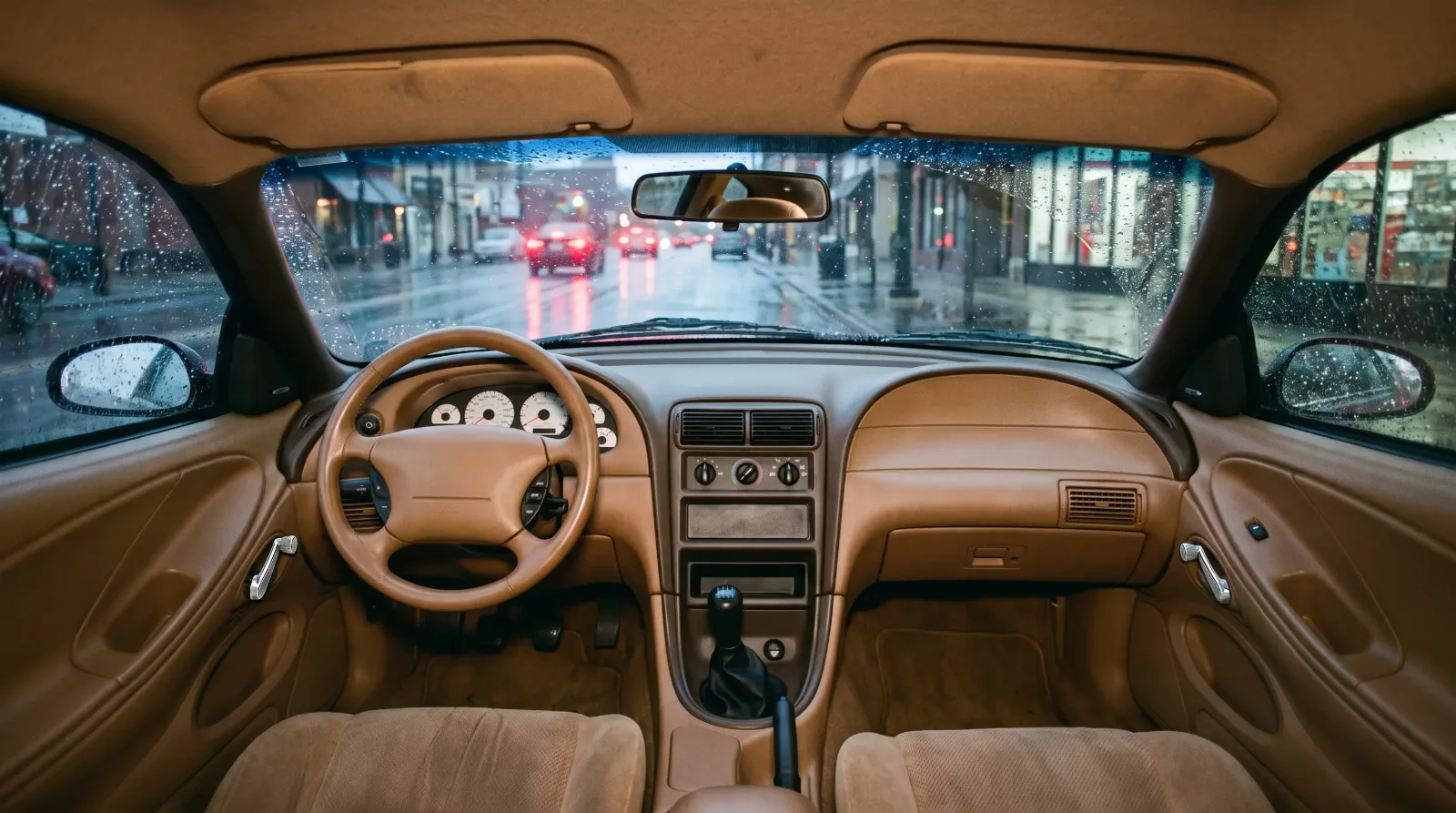
Then came the deletions. No rear seat. No radio and no air conditioning. No power windows, locks or mirrors, no sound insulation and no fog lamps. The front seats were base cloth. All of that was weight, and none of it made a lap faster. A race team would have pulled most of it on the first night anyway. SVT saved them the evening and the parts bin.
The color choice was simple, because there was none. All 250 cars were Crystal White with a saddle interior. The 1993 R had played the same one-color game with 107 cars in Vibrant Red, and the Fox-body car's story is told in this piece. The big difference is under the hood. The 1993 R kept the street Cobra's 235 hp 5.0. The 1995 car threw it out.
Gearbox, axle, brakes and springs
An engine with 365 lb-ft needs a gearbox that can take it. The 5.0 Mustangs of 1994 and 1995 used the Borg-Warner T-5 five-speed manual. The R got a Tremec TR-3550 five-speed instead, with a 3.27:1 limited-slip axle behind it. That ratio deserves a second look. A 3.27 is a tall gear. Drag racers chase a numerically higher ratio to get off the line hard. A 3.27 is a road-course and top-speed gear, and it lets the 351's torque do the pulling instead of the tachometer.
The brakes were 13-inch vented discs up front with twin-piston calipers, and 11.65-inch discs at the rear. The street car was closer than you might expect: SVT's 1994 Cobra already ran 13-inch front and 11.7-inch rear rotors. So the R's braking gain came from the calipers and from the weight that was no longer in the car, not from bigger rotors.
The springs are where the R stops pretending to be a road car. The progressive-rate fronts ran from 700 to 850 lb/in, with 200 to 260 lb/in at the rear. Anti-roll bars were 30 mm front and 27 mm rear, and the wheels were 17 by 9 inches. Those front rates are race numbers. On a broken city street the car tells you about every expansion joint. On a smooth track it holds its line through a fast sweeper without leaning on the bump stops.
| Item | 1995 SVT Cobra coupe | 1995 Cobra R |
|---|---|---|
| Engine | 5.0 V8, GT-40 heads | 5.8 (351) Windsor V8, SVT-modified |
| Power | 240 hp | 300 hp @ 4,800 rpm |
| Torque | 285 lb-ft @ 4,000 rpm | 365 lb-ft @ 3,750 rpm |
| Transmission | Five-speed manual | Tremec TR-3550 five-speed, 3.27:1 limited-slip axle |
| Fuel tank | Production tank | Racing fuel cell, about 20 gallons |
| Rear seat, radio, A/C | Yes | Deleted |
| Color | Choice of colors | Crystal White only, saddle interior |
| 1995 production | 4,005 | 250 |
| Price | About $21,300 | $37,599 |
"Sixty horsepower is nice. What I care about is the extra 80 lb-ft and where it shows up. SVT put the torque low, geared the car tall and took the radio out. That is a car built by people who had read a lap chart."
Dan Reeves
250 cars, a license and what came next
SVT built 5,258 Cobras for 1995: 4,005 coupes, 1,003 convertibles and the 250 R models. One account says Ford kept 18 of the R cars for its press and engineering fleets, which would leave 232 for customers. I have not seen that 18 repeated elsewhere, so file it as likely rather than settled.
The customers were supposed to be racers. Buyers needed a valid competition license, usually cited as NHRA or SCCA, which covers both ends of the sport, drag strip and road course. The 3.27 gear suggests SVT had the road course more in mind. The sticker was $37,599. A 1995 Cobra coupe listed at about $21,300, so the R cost roughly $16,300 more for 60 extra horsepower, a fuel cell and a long list of things that were not there.
The 1995 car was also the end of a line. It was the last model year of the pushrod 5.0 in the Mustang, and for 1996 the street Cobra moved to an aluminum-block 4.6-liter DOHC V8 rated at 305 hp, assembled by two-person teams of SVT technicians at Ford's Romeo engine plant. The full story of the four-valve Cobra has its own article. The pushrod Cobra was finished, and the 351 Cobra R was its loudest last word.
The R badge came back once more before the classic era closed. The 2000 Cobra R used a 5.4-liter DOHC V8 rated at 385 hp and a Tremec T-56 six-speed, and SVT built 300 of them. Line the three up and the 1995 car sits in the middle: 107 cars, then 250, then 300, and 235 hp, then 300, then 385. It is also the only one of the three that found its extra power the old way, with a bigger pushrod engine. That makes it the simplest answer SVT ever gave to the question of more power. Add cubic inches, take out the radio, and hand the keys to someone with a license.
Sources and notes
- MustangSpecs: 1995 Ford Mustang SVT Cobra R (engine, fuel cell, chassis, deletions, license rule)
- Wikipedia: Ford Mustang SVT Cobra (tiered fiberglass hood, production, price)
- MustangSpecs: 1995 Ford Mustang (production by body style)
- Ford Muscle: 20-mile 1995 SVT Cobra R time capsule heads for Mecum auction
- RM Sotheby's: 1995 Ford Mustang Cobra R, lot description
- Wikipedia: John Coletti (SVT program list)
Related Reading
Have a
Ford Mustang
for Sale?
Reach thousands of serious classic car collectors across the US.
Sell It Here →
Selling a classic? Here's how: sell my classic car
Are You a Classic Car Dealer?
List your full inventory and connect with targeted classic car buyers.
Join as a Dealer →

About the author
Dan Reeves
Performance engine builder from North Carolina's motorsports corridor, focused on swaps, forced induction and making real, repeatable power.
Related Listings - Ford Mustang




Comments
Be the first to comment on this article.