
The 1998 Camaro gained 20 rated horsepower, lost about 95 pounds of engine and got the most argued-about face the fourth generation ever wore. That is the year in one sentence. The 1998 Camaro SS made 320 hp from an all-aluminum LS1, the Z28 made 305 hp from the same engine, and every Camaro on the lot finally had four-wheel disc brakes. It also came at a bad moment: sales for 1997 had dropped nearly 23 percent against 1996, so Chevrolet needed the new car to move. This piece sticks to what changed between the 1997 and 1998 model years. For the full generation arc, start with our fourth-gen story.
Car Features
7 min read
1998: The LS1 Arrives and the Camaro Gets a New Face
The 1998 Camaro got the all-aluminum LS1, a new catfish nose and four-wheel discs. The SS became RPO WU8 with 320 hp, and only 3,025 were built.
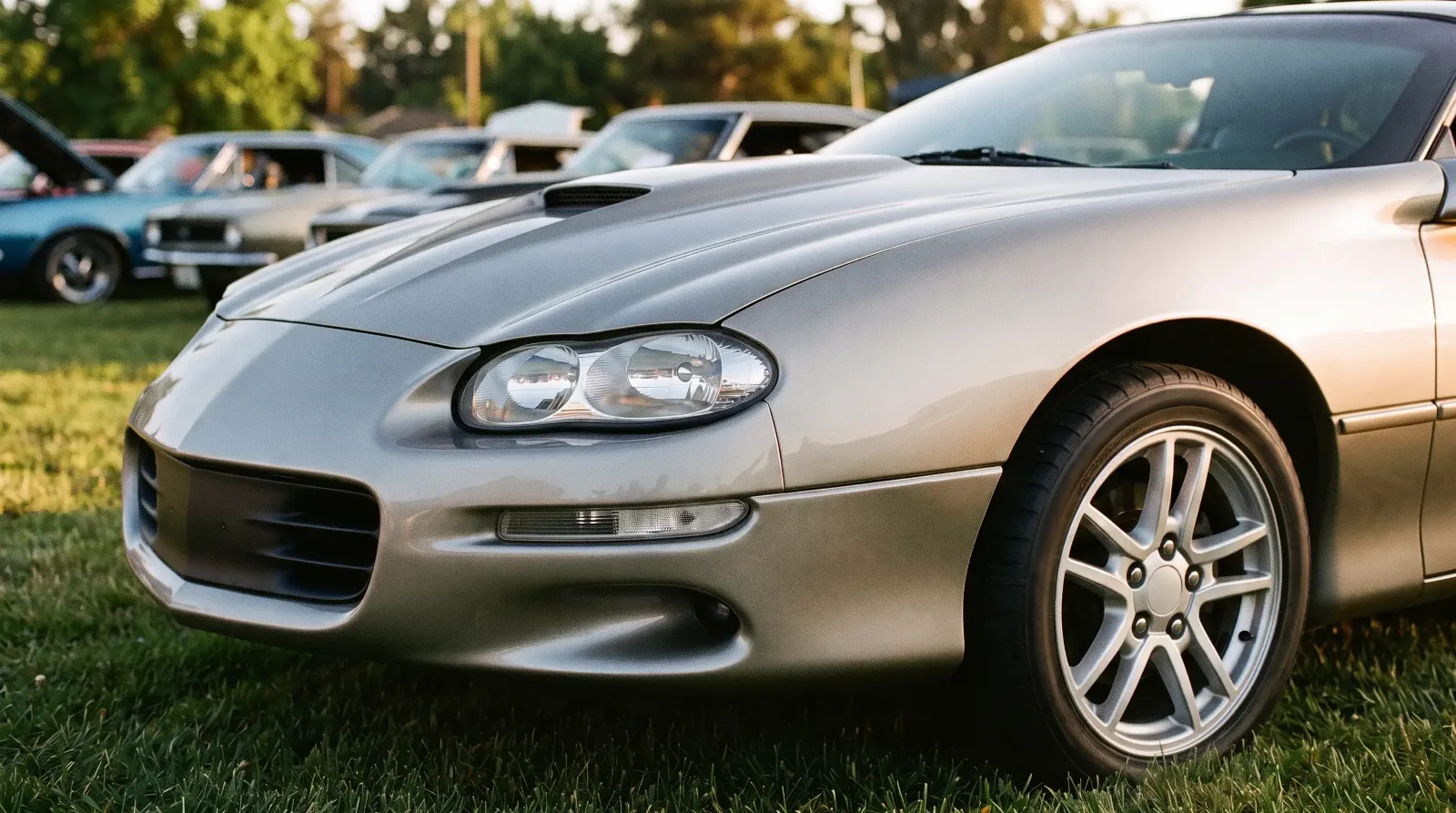
1997 vs 1998, by the numbers
Most model-year changes on an F-body were trim and paint. This one went through the nose, the engine bay and the brakes at the same time. Here is the V8 car before and after.
| Item | 1997 Z28 | 1998 Z28 |
|---|---|---|
| Engine | LT1 5.7 L, iron block | LS1 5.7 L (346 ci), all aluminum |
| Rated output | 285 hp | 305 hp, 335 lb-ft |
| SS rated output | 305 hp (SLP car) | 320 hp (RPO WU8) |
| Ignition | Opti-Spark distributor | No Opti-Spark |
| Front brakes | Single-piston calipers | Two-piston calipers, larger rotors |
| Headlamps | Four recessed "letterbox" lamps | Streamlined composite lamps |
| Overall length | 193.2 in | 193.5 in |
Two of those rows matter more than the rest. The engine row is why people still buy these cars. The ignition row is why people stopped cursing them.
The LS1: lighter, stronger, and still a 5.7
The LS1 had debuted in the 1997 C5 Corvette. Chevrolet put it in the Camaro one year later, and the displacement stayed at 5.7 liters (346 cubic inches). Almost everything else was new. The block and heads were aluminum, and the engine came in about 95 pounds lighter than the iron-block LT1 it replaced. On a car that carries its weight up front, that is not a rounding error.
The rating went from 285 hp on the 1997 Z28 to 305 hp on the 1998 Z28, with 335 lb-ft of torque. Twenty horsepower is a real gain, but the number people argue about is not the rated one. You will read that the LS1 made 350 hp at the flywheel and Chevrolet only advertised 310. No primary source backs that. What can be said is that the F-body ratings were widely considered conservative, and that John Heinricy, later GM's Director of High-Performance Vehicles, has denied deliberate underrating while conceding that little more than tuning software separates a Camaro LS1 from a Corvette LS1. Treat the 350 figure as lore. Treat 305 as the number on the window sticker.
The engine was not a straight drop-in from the Corvette. The F-body got its own oil pan, a relocated accessory drive to fit the narrower engine bay, and a cable throttle where the Corvette used drive-by-wire. Gearbox choices stayed familiar: a Borg-Warner T56 six-speed manual or the 4L60E four-speed automatic, the same pair the LT1 cars had offered.
The quiet win was the ignition. Every LT1 Camaro used the Opti-Spark distributor mounted beneath the water pump, and its habit of failing once moisture or a leaking pump's coolant got inside gave the 1993 to 1997 cars their reputation. The LS1 dropped it. That single change does more for a 1998 car's long-term ownership cost than the extra 20 horsepower does for its quarter-mile time.
"Rated horsepower sells the car. Losing the Opti-Spark is what keeps it on the road. If you are comparing a 1997 and a 1998 at the same price, the 1998 wins before you open the hood."
Dan Reeves
The new face, and the nickname that stuck
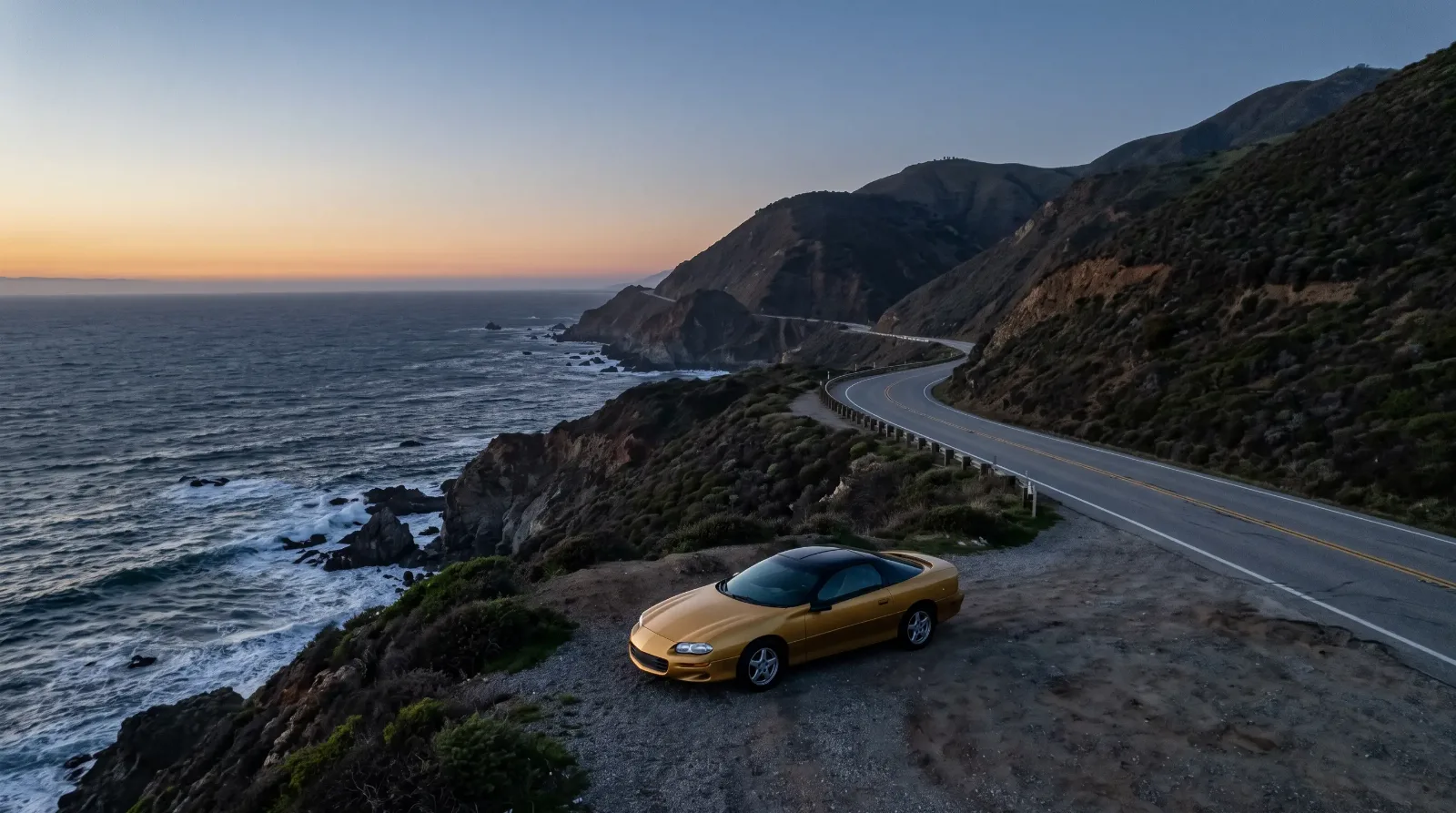
The 1998 facelift replaced the four recessed letterbox headlamps with streamlined composite units and redesigned the hood, front fenders and front fascia to suit them. The result is longer by 0.3 inches and visually much heavier at the mouth. Enthusiasts call it the "Catfish Camaro," and the name has not gone away.
Love it or not, the new clip is not cosmetic trivia for anyone working on these cars. LT1 and LS1 cars need different front clips, and an LT1 hood will not close over the LS1 airbox. If you are shopping for an LT1 car with a later engine swapped in, check what nose it wears and whether the hood actually latches.
Chevrolet sold the new look hard. Campbell-Ewald, its agency, built a "brute power" campaign around two 30-second TV spots that compared the car to rough motorcycle riders. Subtle it was not, and that matched the engine better than it matched the headlamps.
The 1998 Camaro SS becomes a regular order code
For 1996 and 1997, the SS was an SLP Engineering conversion. For 1998 it became RPO WU8, a line on the Chevrolet order form. The package cost $3,500 on top of the Z28 and brought the 320 hp LS1 with a forced-air Ram Air hood, a special rear spoiler, 17-inch wheels and tires, and a special suspension. Chevrolet built 3,025 of them for 1998. Some period sources quote 327 hp for a car with the optional SLP exhaust; 320 hp is the standard rating.
The paperwork changed more than the workflow. The cars were still built at Ste-Thérèse, then shipped to SLP in nearby LaSalle, Quebec, for the hood, spoiler, wheels and suspension. The 15 hp gap over the Z28 came from the cold-air intake and a freer exhaust, which is the same recipe SLP used on the LT1 cars. For the full five-year run of the LS1 SS, including the later 325 hp cars, see the dedicated piece. The SLP side of the story, from the first conversions to the last, is worth reading next.
That 3,025 is the smallest production figure of the LS1 SS years; the 2002 total was 11,191. If you want the rarest LS1 SS by count, 1998 is it.
Brakes, prices and the production fog
Four-wheel disc brakes became standard on every 1998 Camaro, and the front calipers went from single-piston to two-piston, with larger rotors front and rear. The Z28 already had rear discs. The base V6 coupe had run front discs with rear drums through 1997, so the change mattered most at the bottom of the range. From 1998 on, every Camaro stopped on four discs.
Prices for 1998, US MSRP: base coupe $17,150, base convertible $22,650, Z28 coupe $20,995, Z28 convertible $27,975. Add $3,500 to a Z28 for the SS. The V6 RS model was dropped; in its place, the Y3F Sport Appearance Package ($1,755 on a base car, $1,480 on a Z28) went on 7,411 cars.
Total 1998 production is where the numbers get soft. Wikipedia gives 48,495. Hagerty gives 54,026, split 33,973 base and 20,053 Z28. Other references land between 47,218 and 49,218. No primary GM figure has settled it, so the honest answer is somewhere around 48,000 to 54,000, and any single number quoted as fact deserves suspicion.
The verdict on 1998 is simple. It is the first year of the better engine, the first year of four-wheel discs across the line, and the lowest-production LS1 SS. The face is the price of admission. For how the year fits the rest of the run, go back to our Camaro hub, or browse 1998 Camaros for sale and judge the catfish in person.
Sources and notes
- Hagerty: 1998 Chevrolet Camaro (prices, SS package, production)
- WS6.com F-body FAQ: 1998 changes and SS ratings
- Hagerty: Fourth-gen Camaro, the one that died first
- Wikipedia: Chevrolet Camaro (fourth generation)
- Auto123: 1997 Camaro base coupe specifications (rear drum brakes)
- Motorsport.com: Gateway Chevy notes, June 1998
Related Reading
Have a
Chevrolet Camaro
for Sale?
Reach thousands of serious classic car collectors across the US.
Sell It Here →
Selling a classic? Here's how: the best sites to sell a classic car
Are You a Classic Car Dealer?
List your full inventory and connect with targeted classic car buyers.
Join as a Dealer →
#camaro z28
#chevrolet camaro
#LS1 Camaro
#fourth-gen Camaro
#1998 Camaro
#1998 Camaro SS
#Catfish Camaro

About the author
Dan Reeves
Performance engine builder from North Carolina's motorsports corridor, focused on swaps, forced induction and making real, repeatable power.
Related Listings - Chevrolet Camaro
Comments
Be the first to comment on this article.