
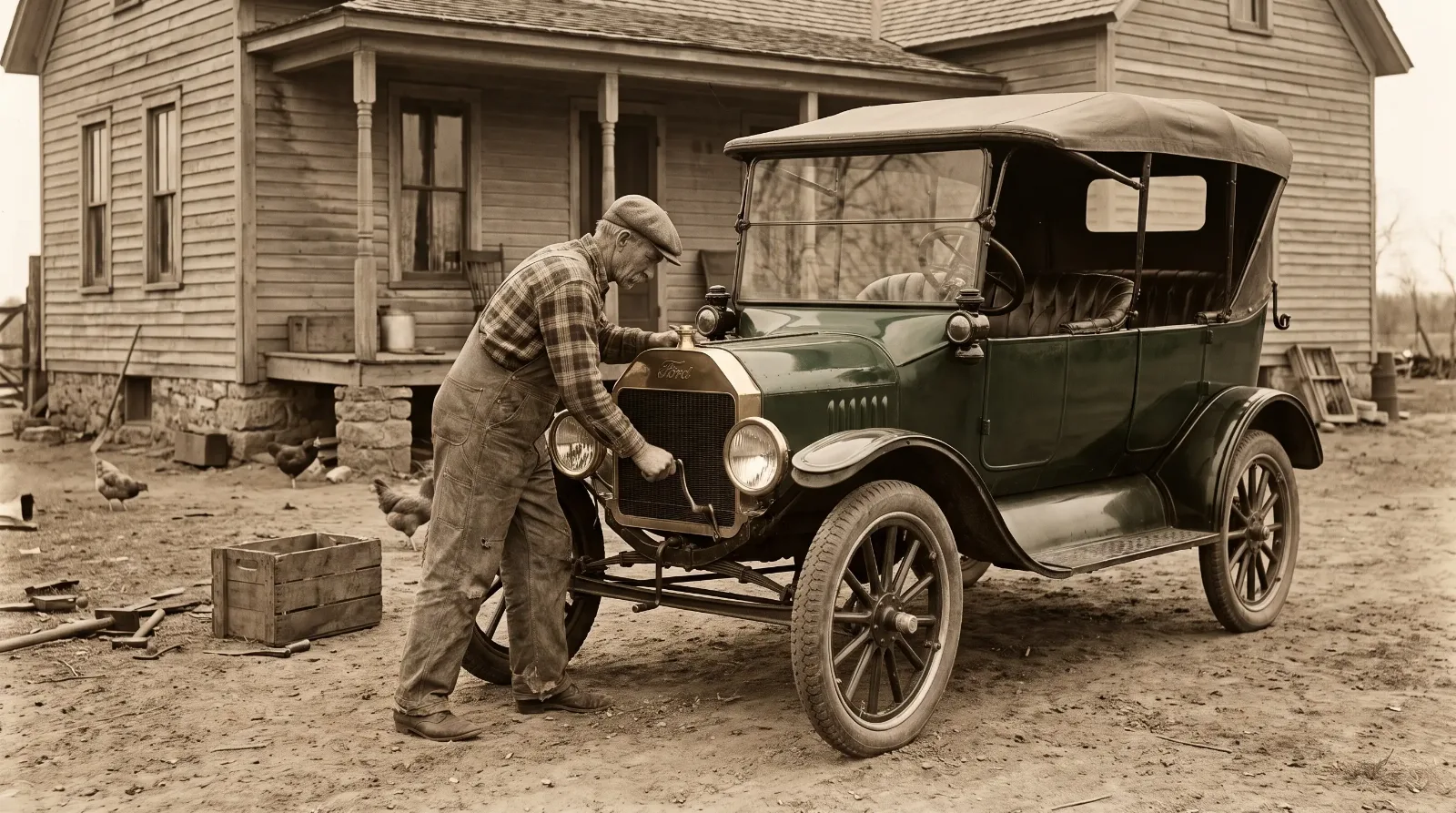
The Model T electric start arrived with the 1919 model year, eleven years into the car's life, and it went first to the sedans. Before that, every Model T was started the same way: a person stood in front of the radiator and turned a crank. The interesting question is not when Ford added a starter. It is why a company that already sold more cars than anyone else waited that long, and what it had to change in the car to make room for one.
Car Features
7 min read
When the Model T Got an Electric Starter
The Model T electric start arrived for 1919, first on sedans. Why the magneto car needed a new block and flywheel, and how it kept both systems.
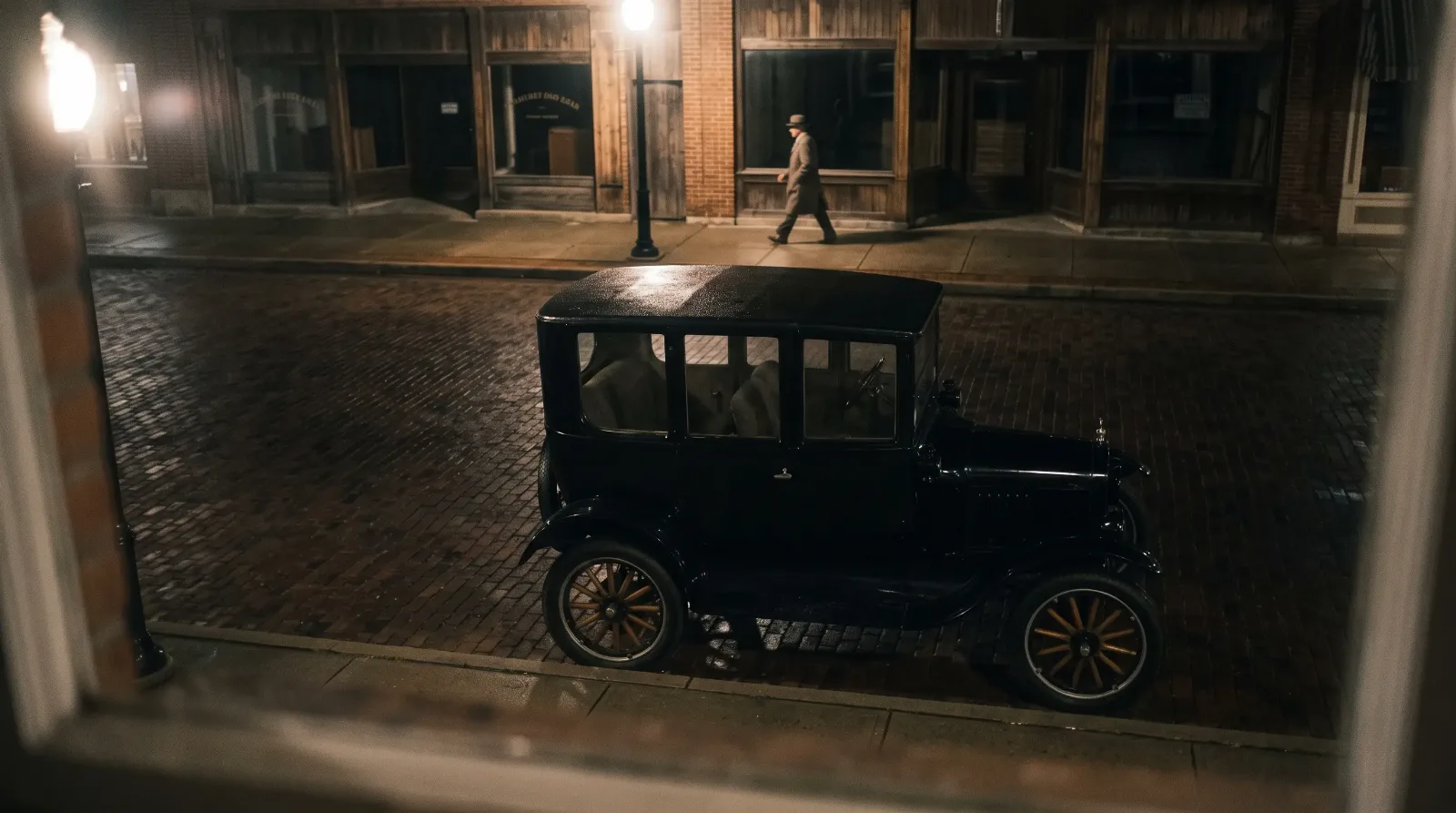
The short version is that the Model T was designed around a system that did not need a battery, and a starter needs one. For the wider picture of how the Model T began, the history piece covers the car's origins. This one stays on the starter.
Why the Model T had no battery to start with
The Model T made its own ignition current. Sixteen V-shaped permanent magnets were bolted to the flywheel, and they spun past a ring of sixteen coils fixed to the engine. That flywheel magneto produced low-voltage alternating current, roughly 4 volts at low speed and over 30 volts at higher engine speeds, which the four trembler coils on the dash turned into sparks.
For a 1908 car, this was a sensible design. No battery to go flat, no generator to fail, and no charging circuit to wire. The cost was hidden until you wanted electricity for something else. The magneto's alternating current could run the ignition and, from 1915, the headlights, but it could not charge a battery. A battery charges on direct current. A starter motor draws a large current from a battery. So the Model T, as built, had nowhere to get starting power and nowhere to store it.
The headlights show the limitation well. By 1915 the two bulbs, wired in series, ran off the magneto. Their brightness followed engine speed: adequate at 30 mph, only a glow at 10 mph. Lighting that dims as you slow down for a corner is a strong argument for a battery.
There is more on the magneto, the timer and the trembler coils in the explainer on how the Model T engine worked.
The 1919 Model T electric start and what it cost
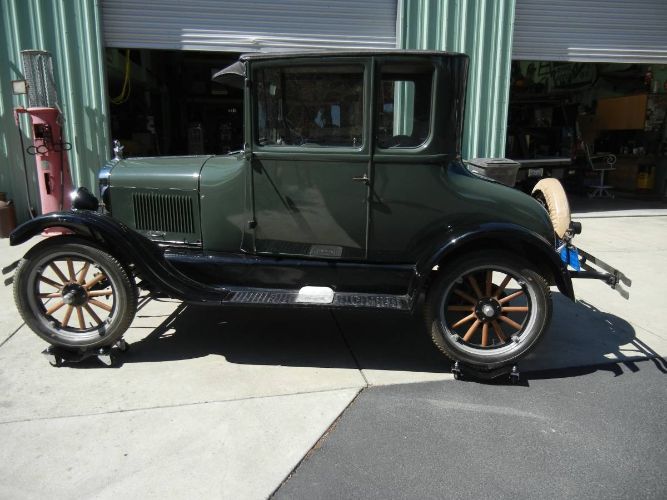
The starter came for the 1919 model year, first on the sedans, together with demountable rims. On open cars it was a $75 option. Whether it was included in the closed-car price from the start is unclear: The Henry Ford's description of a 1919 sedan says the starter and demountable rims cost extra, while other sources describe them as standard on closed cars. The careful statement is that the starter was introduced for 1919, appeared first on the sedans, and cost $75 on an open car.
Fitting it was not a bolt-on job. Ford's first electric starter needed a new engine block, a new transmission cover and a new flywheel. That list explains some of the delay. The flywheel was not just a flywheel: it carried the magneto magnets that fired every Model T. Adding a starter meant redesigning parts at the center of the most standardized car in the world, then retooling a production line that was built never to change.
Cadillac had introduced Charles Kettering's electric self-starter on its 1912 models, seven years earlier. Ford's lag was not a technical gap. It was a choice about cost and complexity on a car whose whole argument was price.
| Date | Starter status | Price on open cars |
|---|---|---|
| 1908 to 1918 | Hand crank only | Not offered |
| 1919 model year | Introduced, first on sedans, with demountable rims | $75 option |
| 1923 | Included on closed cars | $65 extra |
| 1926 to 1927 | Standard on closed cars; the cheapest open cars could still be had without it | Extra on the basic open cars (sources differ on the amount) |
| 1928 Model A | Standard on every model | Included |
Two electrical systems in one car
The engineering detail I find most telling is what Ford kept. The starter cars did not abandon the magneto. Trembler coil and magneto ignition stayed on cars with the starter, and the coil box switch gained two positions, BAT and MAG. The driver could start on the battery and then switch over, or start on the magneto by hand if the battery was low. In effect the car carried a battery system for starting and lighting alongside the original magneto system for ignition.
That is redundancy by accident rather than by design, but it worked in the owner's favor. A flat battery did not strand a Model T the way it would strand a later car. You went back to the crank.
The controls changed only slightly. The 1919 manual describes a push button on the floor for the starter and a priming rod on the instrument board for the carburetor. The hand crank stayed in its place at the front. Ford did not trust the new system enough to remove the old one, and owners did not either.
"Ford never replaced the magneto. It added a battery beside it and let the driver choose with a switch. Two ignition sources, one key decision: very Model T."
Emily Chen
Why the crank was worth getting rid of
The case for a starter was partly comfort and mostly safety. Cranking a Model T is a procedure, not a gesture. The parking brake lever, which also holds the transmission in neutral, has to be set first, or the car can run over the person starting it. The spark lever must be retarded. The 1919 manual tells the driver to crank by pulling up, not by pushing down against compression, and warns that otherwise "a sudden backfire may injure the arm of the operator."
The starter removed that risk from the routine. It also changed who could comfortably drive the car, because starting no longer depended on technique and arm strength. Many Model Ts spent their lives on farms, running belt equipment and pulling implements, where a quick restart mattered as much as the road; the background on those working cars is its own story.
From option to standard, and the Model A
Over the early 1920s the starter moved from option toward standard equipment. A 1923 price list shows it included on closed cars and $65 extra on open ones. Some references say it was standard on all Model Ts by 1926, the year of the restyled cars sold as the Improved Ford, but period pricing quoted by auction and parts sources still shows a basic 1926 open car without the starter, generator and battery, and a fully equipped version at a higher price. The year it became standard on every open car is not settled by a primary source, so the safe statement is that most late Model Ts left the factory with a starter, not that all did.
The Model A closed the question. From its 1928 launch the starter was listed as standard on every model, and the magneto was gone, replaced by a 6-volt battery, a generator, a coil and a breaker-point distributor. The Model A driver pressed a floor button to the left of the gas pedal and never had to stand in front of the car.
Seen as an engineering sequence, the Model T starter is a retrofit to a system designed without it: new block, new flywheel, a second power source and a switch to choose between the two. It took Ford eleven years to add and another model to make it simple. The result is a car that can still be started two ways, which, for a machine now more than a century old, is a feature worth having.
Sources and notes
- The Henry Ford: 1919 Ford Model T sedan
- RM Sotheby's: 1919 Ford Model T, starter fitment and price
- Ford Manual, 1919 edition (Internet Archive)
- Hagerty Marketplace: 1926 Ford Model T Sport Touring, basic and fully equipped prices
- Mac's Motor City Garage: 1923, the Model T Ford's biggest year
- ETHW: Charles F. Kettering and the self-starter
Related Reading

Have a
Ford Model T
for Sale?
Reach thousands of serious classic car collectors across the US.
Sell It Here →
Selling a classic? Here's how: compare the places to sell classic cars
Are You a Classic Car Dealer?
List your full inventory and connect with targeted classic car buyers.
Join as a Dealer →
#ford model t
#Model T history
#Model T electric start
#Model T starter
#Model T magneto
#Ford electrics

About the author
Emily Chen
Bay Area engineer with a deep focus on vintage Japanese and European performance cars. Approaches classic car research and restoration with an analytical eye.
Related Listings - Ford Model T
Comments
Be the first to comment on this article.