
The 429 Super Cobra Jet Mustang lasted one model year. Ford rated it at 375 hp, five more than the regular 429 Cobra Jet, and gave both engines the same 450 lb-ft. On paper that is a rounding error. In the parts list it is a different engine, with a solid-lifter cam, forged pistons and a big Holley on top. And you could not order it as an engine at all. You ordered a rear axle ratio, and the engine came with it.
Car Features
8 min read
The 429 Super Cobra Jet and the 1971 Mach 1
Five horsepower on paper, a different engine inside: how the Drag Pack turned the 1971 429 Cobra Jet into a Super Cobra Jet, and why it lasted one year.
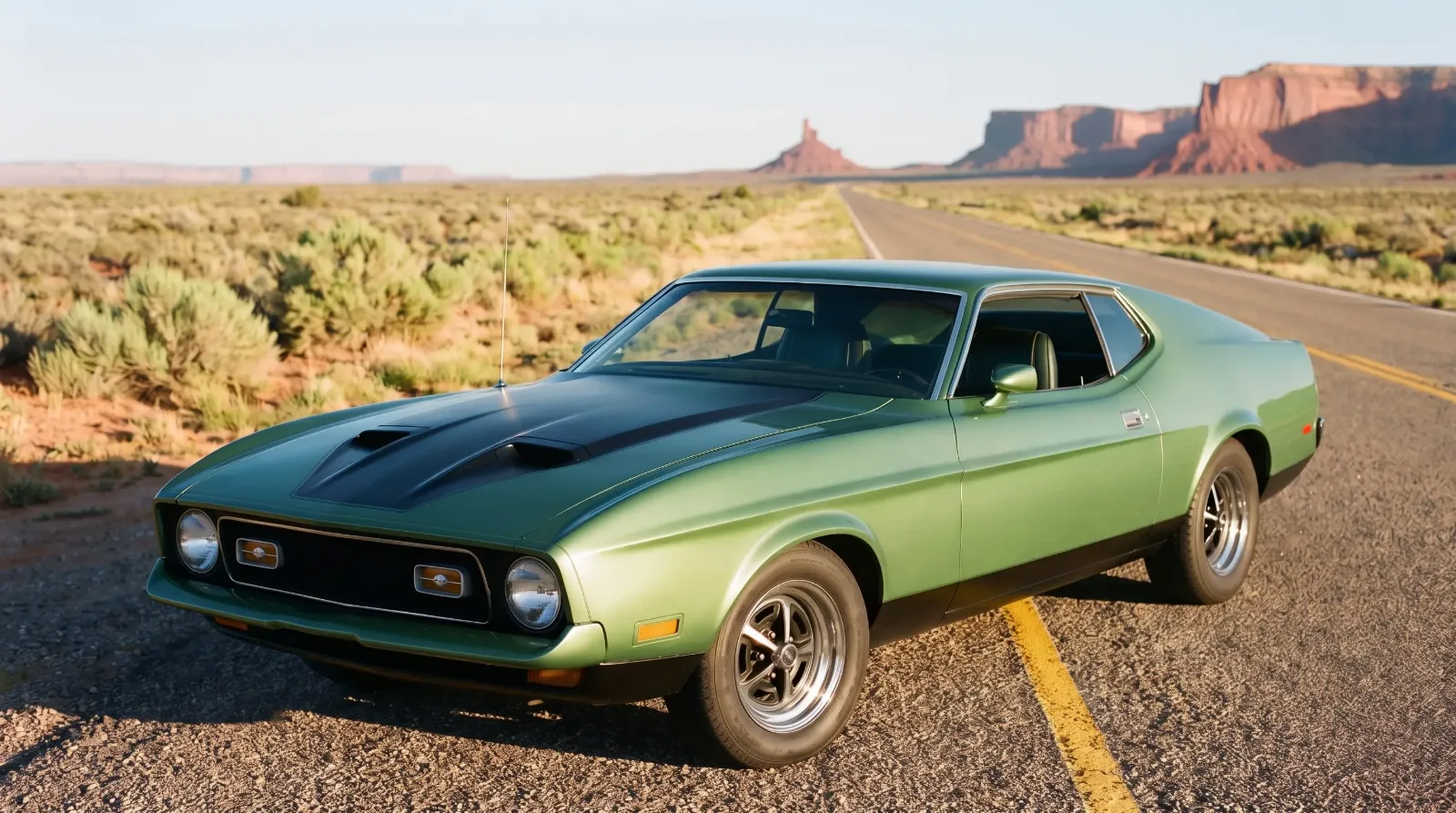
That one detail tells you most of what you need to know about 1971. The car around the engine had just grown, the Mach 1 was the volume performance model, and the big-block era was down to its last season. This is the story of the engine and the one year of the Mach 1 Mustang that carried it.
Why the 1971 Mustang got wider for the 429
The Boss 429 had already shown Ford the cost of forcing a 429 into the old body. Kar Kraft in Brighton, Michigan cut out and relocated the shock towers on those cars so the engine would fit. That works for a homologation special built in the hundreds. It is no way to sell a big-block option off a dealer order sheet.
The 1971 body solved the problem with sheet metal. Ford made the car wider so the 429 dropped in without extensive suspension redesign. Sources put the gain over the 1970 car at somewhere between two and a half and three inches, depending on whose tape measure you trust. Everything else grew with it: a 109 in wheelbase, 189.5 in overall, 74.1 in wide. A base SportsRoof weighed 3,560 lb, more than 400 lb up on the 1970 car by one count.
Bunkie Knudsen approved the design and took most of the credit and the blame for it, though Henry Ford II had fired him in September 1969, a year before the car reached the public. The new Mustang debuted on August 20, 1970 and went on sale that September. The 429 was the reason for the width. The width is what the critics remember.
Cobra Jet vs Super Cobra Jet: what the Drag Pack changed
Start with the C-code 429 Cobra Jet, the base big block for 1971. It ran 11.3:1 compression, hydraulic lifters and a Rochester Quadrajet, a 715 cfm spread-bore four-barrel. For 1971 the block had four-bolt mains. Ford rated it at 370 hp at 5,200 rpm and 450 lb-ft at 3,400. Ram Air was optional, and with it the twin NACA scoops on the hood actually fed the engine.
Tick the Drag Pack box and the CJ became a Super Cobra Jet. The Drag Pack was an axle option: a 3.91 Traction-Lok, code V, or a 4.11 with a Detroit Locker, code Y. It worked on either 429, with or without Ram Air. The order brought the engine changes with it. A mechanical camshaft with solid lifters. Forged pistons and rods. A 780 cfm Holley 4150 in place of the Quadrajet. The rating went to 375 hp at the same 5,200 rpm, and torque stayed put at 450 lb-ft.
The logic was not new. Ford had done the same with the 428 in 1969, when a Drag Pack order turned a Cobra Jet into an SCJ with heavier "Le Mans" rods and an oil cooler, and could not be combined with factory air conditioning. That was the 428 rule for 1969, not a documented 1971 one. The idea carried over intact, though: if you were buying 3.91 or 4.11 gears, you were going to the strip, so the bottom end and valvetrain got built for it.
| Engine | Years | VIN code | Carburetor | Lifters | Rated power (SAE gross) | Rated torque |
|---|---|---|---|---|---|---|
| 429 Cobra Jet | 1971 | C (J with Ram Air) | Rochester Quadrajet, 715 cfm | Hydraulic | 370 hp @ 5,200 rpm | 450 lb-ft @ 3,400 rpm |
| 429 Super Cobra Jet | 1971 | C or J (J with Ram Air) | Holley 4150, 780 cfm | Mechanical | 375 hp @ 5,200 rpm | 450 lb-ft @ 3,400 rpm |
| Boss 351 | 1971 | R | Autolite 4300-D, 715 cfm | Mechanical | 330 hp @ 5,400 rpm | 370 lb-ft @ 4,000 rpm |
| Boss 429 (for comparison) | 1969 to 1970 | Z | Holley, 735 cfm | Hydraulic 1969, mechanical 1970 | 375 hp @ 5,200 rpm | 450 lb-ft @ 3,400 rpm |
The 429 Super Cobra Jet Mustang on paper and on the street
Five horsepower. That is the official gap between the CJ and the SCJ, and it is the least useful number in this story. Both ratings are SAE gross and both peak at 5,200 rpm with the same torque figure. Look at the last row of the table: Ford gave the semi-hemi Boss 429 exactly the same 375 hp and 450 lb-ft. Three very different engines, one number. That tells you how much weight to put on the number.
What the SCJ hardware buys is margin. A solid-lifter cam holds its valve timing at high rpm where a hydraulic setup can start to pump up. Forged pistons and rods take punishment that cast parts eventually do not. The bigger Holley helps the top end breathe. Put 4.11 gears behind all that and the engine spends its working life near the top of the tach, which is exactly where the Cobra Jet's parts would start to complain.
Gross ratings also flatter everything from this era. For 1972 Ford switched to SAE net, and the figures dropped hard across the range. The two systems are not comparable, and lining up a 1971 gross rating against a modern net figure is comparing a brochure with a dyno sheet. For scale, road-test data put the 428 Cobra Jet, rated 335 hp gross, at about 275 hp net. I have not seen a net estimate for the 429 SCJ that I would stand behind, so I won't invent one.
"Five horsepower on the sticker, a different engine underneath. The SCJ was never about the rating. It was about what the parts could survive with 4.11 gears behind them, run after run."
Dan Reeves
Where the 429 sat in the 1971 Mach 1 lineup
The 1971 Mach 1 was a SportsRoof with door-tag body code 63R and a 05 in the VIN body position. Its base engine was not a big block at all. It was the F-code 302 two-barrel, rated at 210 hp, with a three-speed manual. The NACA-duct hood was a no-cost option on that car, and without Ram Air the scoops were decoration.
Between the 302 and the 429 sat the 351 Cleveland family: the two-barrel at 240 hp, the four-barrel at 285 hp, and from May 1971 the 351 Cobra Jet at 280 hp. Off to the side was the Boss 351 at 330 hp. It replaced both the Boss 302 and the Boss 429, only 1,806 were built, and it turned out to be the last Boss of the original run. The 429 CJ and SCJ sat at the top of the order sheet, the only big blocks Ford offered in the new body.
Ford built 36,499 Mach 1s for 1971, roughly half the 72,458 of the 1969 launch year, out of 149,678 Mustangs of all kinds. The 429 was a small slice of that. A breakdown that enthusiasts match to Marti's production data counts 1,865 Mustangs with a 429 for 1971, 1,651 of them Mach 1s. Only 613 had the Drag Pack, 554 of those with Ram Air and 59 without, and 531 of the 613 were Mach 1s, the same figure Marti Report holders quote for Mach 1 SCJ cars. Put another way, roughly one 1971 Mustang in 240 was a Super Cobra Jet.
One year and done, and how to read the paperwork
The 429 CJ and SCJ were dropped after 1971, along with the Boss 351, as emissions rules closed in. For 1972 the hottest Mustang engine was the R-code 351 HO, rated at 275 hp net, and only 398 were built. The big body carried on through 1973, wider than it needed to be for an engine it no longer offered.
That short run makes the paperwork matter more than the parts. The VIN has 11 characters, and the fifth is the engine code. A C means a 429 Cobra Jet. A J means a 429 Cobra Jet with Ram Air. Neither letter tells you whether the car had the Drag Pack, because the SCJ came both ways: 554 J-code cars and 59 C-code cars. The axle code does that: V for 3.91, Y for 4.11. Hoods, stripes and scoops can be bolted on in a weekend. A C or J engine code together with a V or Y axle code is the combination that says the factory built the car as an SCJ.
So when you look at 1971 Mustangs, start with the fifth character of the VIN and the axle code, then the engine, and leave the decals for last. On a spec sheet the 429 Super Cobra Jet is a five-horsepower footnote that lasted one year. What it actually was lives in the hardware and the codes.
Sources and notes
- Ford Mustang Mach 1 (Wikipedia): 1971 engines, Drag Pak axle codes V and Y, NACA hood
- Ford Mustang (first generation) (Wikipedia): 1971 dimensions, ratings and the 1972 switch to net
- Mac's Motor City Garage: Bunkie Knudsen's big horse, the 1971-73 Mustang
- 7173Mustangs.com: 1971 Mustang 429 production numbers by engine, body and transmission
- autoevolution: 1,865 429 Mustangs for 1971, 613 Super Cobra Jets
- Street Muscle: the Mustang Mach 1 cars from Diamonds Are Forever
Related Reading
Have a
Ford Mustang
for Sale?
Reach thousands of serious classic car collectors across the US.
Sell It Here →
Selling a classic? Here's how: sell my classic car
Are You a Classic Car Dealer?
List your full inventory and connect with targeted classic car buyers.
Join as a Dealer →

About the author
Dan Reeves
Performance engine builder from North Carolina's motorsports corridor, focused on swaps, forced induction and making real, repeatable power.
Related Listings - Ford Mustang




Comments
Be the first to comment on this article.