
In the 1960s the Mustang GT was not a model. It was an option package, the GT Equipment Group, a single line on the order form that bundled brakes, steering, exhaust and trim onto a V8 car. That sounds like a fine distinction until you try to document one. The classic Mustang GT history covers five model years, from a spring 1965 introduction to a quiet exit after 1969, and the paper trail behind it is thinner than most owners expect. What follows is what the period sources support, year by year, and where they stop. How the GT fits among the Boss and Mach 1 cars that came after it is the full story in its own right.
Car Features
8 min read
The Mustang GT Equipment Group, 1965–1969
The 1960s Mustang GT was an option group, not a model: what it added from April 1965, how many were built each year, and why early GTs are hard to prove.
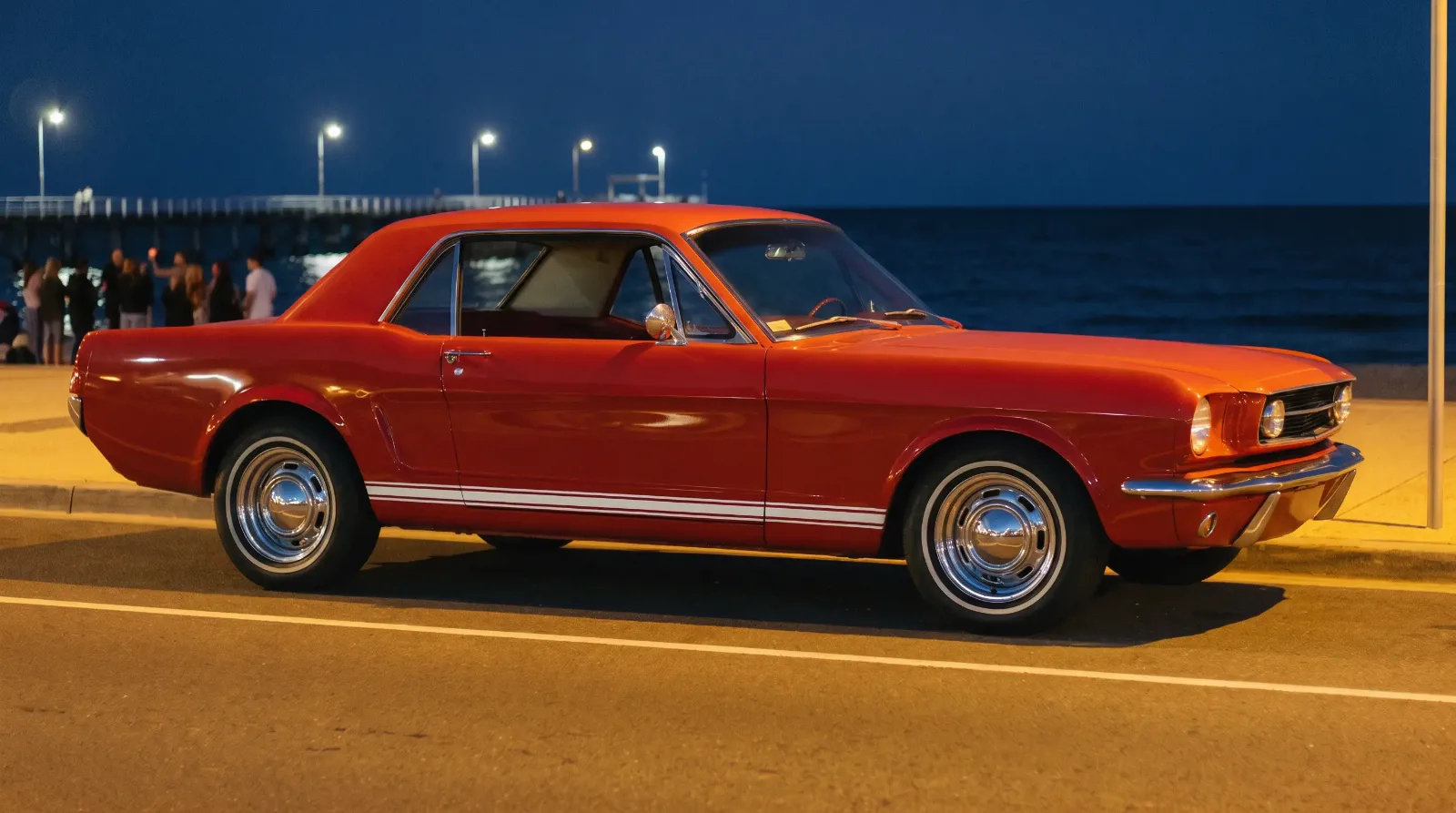
April 1965: what the GT Equipment Group added
Ford introduced the GT Equipment Group on April 17, 1965, the Mustang's first anniversary. Old Cars Weekly puts the price at about $150. You will also see April 15 and $165 quoted, and cars carrying the GT parts were already being built from mid-February 1965, so the April date is best read as the sales introduction rather than the first build.
The contents were practical before they were cosmetic. Front disc brakes replaced the drums. A special handling package firmed up the chassis, and quick-ratio steering at 22:1 cut the turns lock to lock. The dual exhaust exited through cutouts in the rear valance with trumpet tips. Up front, a grille bar carried a pair of fog lamps. Inside, a five-dial instrument panel replaced the Falcon-type swept cluster that standard 1965 cars used. Stripes above the rocker panels with GT badging finished the outside.
The package had one hard rule: it required a four-barrel 289. That meant the A-code at 225 hp or the K-code Hi-Po at 271 hp. A car with a C-code two-barrel 289, or either of the six-cylinder codes, T or U, could not leave the factory as a GT. Ford built 15,079 GT cars in what remained of the 1965 model year.
1966: the peak year, and a dashboard everyone got
The GT's best year was its second. Ford built 25,517 of them for 1966, the highest count of the whole run. The package also lost one of its distinctions. For 1966 the five-dial cluster became standard on every Mustang, so the gauges no longer marked a GT from the driver's seat.
The exterior did more of the work instead. Regular 1966 Mustangs wore a chrome side ornament with three horizontal bars. GT cars skipped it and kept the rocker stripe. The 1966 GT gas cap was marked "GT," a small part that gets swapped often and proves little on its own.
The order form tells you something about how Ford priced the package. In 1966 the base V8 upgrade cost $105.63. On a regular Mustang the 271 hp Hi-Po added $327.92 on top of that, for $433.55 in all. On a GT the same engine added $276.34, for a total of $381.97. Ford charged less for the Hi-Po when the buyer had already paid for the GT hardware. My reading, and it is only a reading, is that part of what a Hi-Po car needed was already in the package. The same year a special Cruise-O-Matic became available with the Hi-Po for $216.27. The 1965 K-codes had been four-speed only.
1967 and 1968: the GT in the bigger body
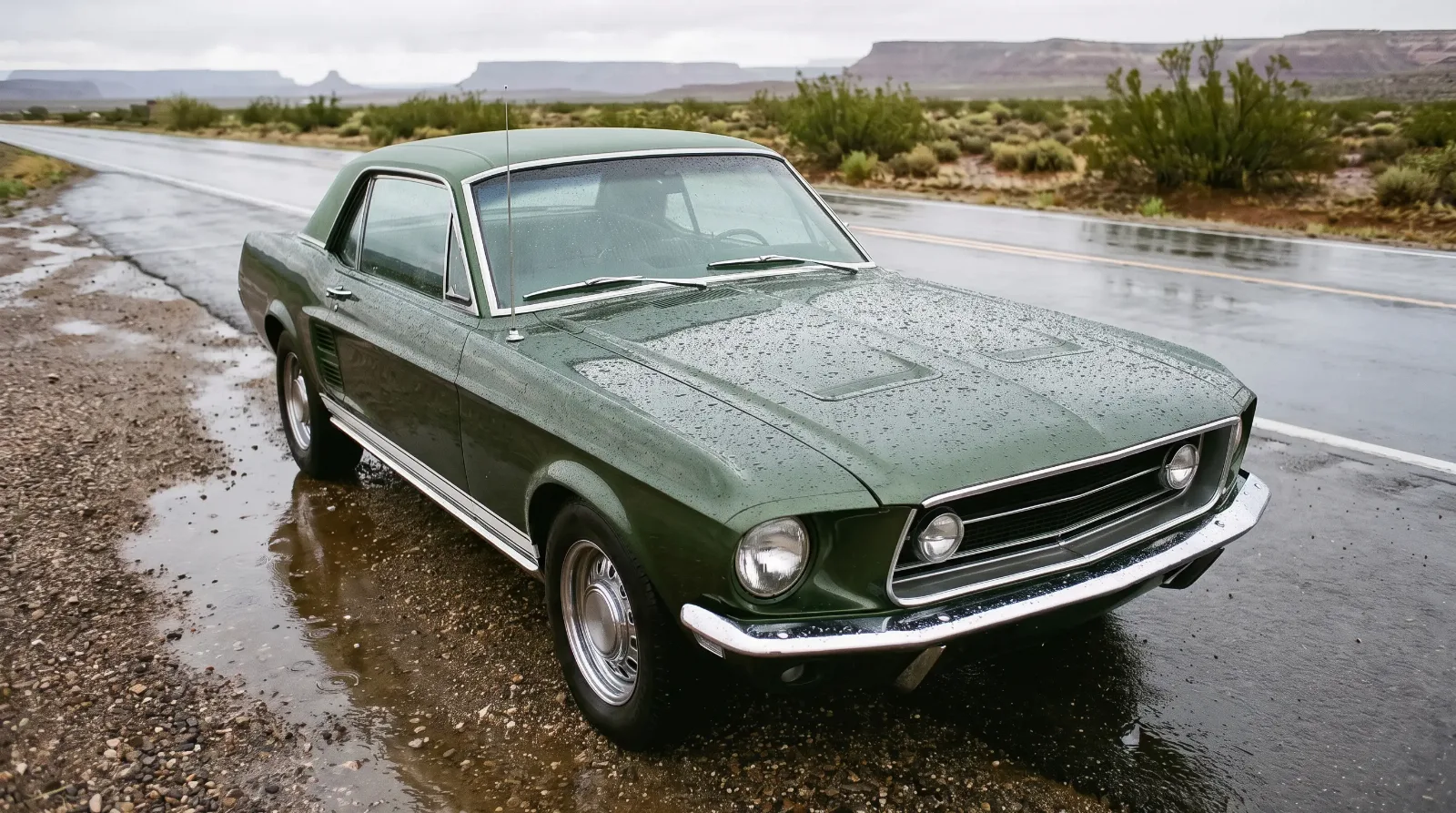
The 1967 Mustang was enlarged to take big-block V8s, and the GT changed with it. The 1967 package brought fog lamps, power front disc brakes, a quad-outlet dual exhaust, F70x14 tires, the handling package and rocker-panel stripes. Ford built 24,079 GTs that year, close to the 1966 figure even though total Mustang production fell.
The new engine on the sheet was the S-code 390, rated at 320 hp. About 28,800 buyers chose it for 1967, more than the number of GTs built, which tells you the engine and the package were separate decisions. A 390 car without GT trim is not automatically suspect. The K-code, meanwhile, was in its final year, with 489 built. A GT ordered with the automatic wore a "GTA" emblem on the lower front fender, inside the opening of the stripe, a marking used only for 1967.
For 1968 the count fell to 17,458. That figure comes from Mustang Monthly in 1995 and is repeated by the Mustang Club of America's 1968 pages; Ford never published GT totals, so I treat it as the best available number rather than a factory record. More certain is the company the GT kept that year. The two cars built for Bullitt were Highland Green 1968 Mustang GT fastbacks with the S-code 390, rated at 325 hp for 1968, and a four-speed. In April 1968 Ford put the 428 Cobra Jet on the regular production line at 335 hp. The C-stripe side graphic arrived the same year, and the GT wore it, along with styled steel wheels, a pop-open GT gas cap and quad exhaust outlets. The Sprint A and the California Special used the C-stripe too. That California car, the GT/CS, borrowed the letters but was a separate regional package, with 4,118 built including 251 High Country Specials.
Classic Mustang GT history by model year
| Model year | GT production | Engine news that year | What set the GT apart |
|---|---|---|---|
| 1965 | 15,079 | 289 four-barrel only: A-code 225 hp or K-code 271 hp | Grille fog lamps, front discs, 22:1 steering, valance exhaust, five dials, rocker stripes |
| 1966 | 25,517 | Same two engines; automatic now offered with the K-code | Rocker stripe instead of the three-bar side ornament; GT gas cap |
| 1967 | 24,079 | 390 S-code (320 hp) added; final K-code year | Power front discs, quad-outlet exhaust, F70x14 tires, rocker stripes; GTA badge on automatics |
| 1968 | 17,458 (Mustang Monthly figure) | 390 S-code 325 hp; 428 Cobra Jet 335 hp from April 1968 | C-stripe, styled steel wheels, pop-open GT gas cap, quad outlets |
| 1969 | 5,396 | Mustang V8s included the 351 Windsor (up to 290 hp), the 390 (320 hp) and the 428 Cobra Jet (335 hp) | Final year; restyled body 3.8 in longer; outsold by the Mach 1 |
The last row is the end of the first chapter. The 1969 Mustang was restyled and grew 3.8 inches in length, and the new Mach 1 arrived on the SportsRoof body. Buyers made their preference clear. Ford built 72,458 Mach 1s for 1969 against 5,396 GTs, and the GT Equipment Group did not return for 1970. The Mach 1 took over the performance role from there and carried the big engines into the next decade, through the 1971 car and the Super Cobra Jet. Enthusiast references list the final 1969 package as rocker-panel stripes, hood pins, a hood scoop that was simulated unless the engine called for a working one, GT hubcaps on styled steel wheels, a GT gas cap, heavier suspension and quad outlets on dual-exhaust cars. It could not be ordered together with the Mach 1.
Why an early GT is hard to prove
This is where the records run out. The 1965 data plate carries the body, color, trim, build date, district sales office, axle and transmission codes. There is no GT code on it. Marti Reports, built from Ford's production database, begin with the 1967 model year, so there is no Ford build data to pull for a 1965 or 1966 car. Old Cars Weekly also notes that exact GT counts are not available and that Ford sold GT parts through dealers for installation after the sale. A 1966 car with every GT part on it could be a factory GT, a dealer-built one, or a later conversion, and the car itself will not always tell you which.
What you can do is work by elimination. The engine code in the VIN is the floor. On a 1965 or 1966 car, an A or a K is consistent with a GT, and a C, T or U rules out a factory one. From there it is a matter of how the parts were fitted, what the paperwork says, and how far back the ownership history runs. If you are trying to settle a specific car, read more here before you trust any badge.
"A 1965 or 1966 GT is proven by subtraction. You rule out the engine codes that could never have carried the package, you look hard at what is left, and then you accept that some questions have no paper answer. That is not a reason to doubt every GT. It is a reason to be honest about which ones are documented and which ones are simply likely."
Tom Ramirez
The GT Equipment Group ran less than five model years and was overtaken by a package with a louder name. But it set the pattern for the Mustang as something more than a styled compact: disc brakes, quick steering, a full set of gauges, a four-barrel V8 and a set of stripes that told you the car had them. The rest of the road from there to today's car is in our Mustang history.
Sources and notes
- Old Cars Weekly: Car of the Week, 1965 Mustang GT
- Wikipedia: Ford Mustang (first generation)
- Over-Drive: 1966 Ford Mustang fact sheet (option prices)
- RM Sotheby's: 1967 Ford Mustang GT S-Code fastback (1967 GT contents and production)
- MustangSpecs: 1968 Ford Mustang guide (1968 GT package and count)
- Mustang Club of America 1968 pages: GT facts, after Mustang Monthly, April 1995
Related Reading

Have a
Ford Mustang
for Sale?
Reach thousands of serious classic car collectors across the US.
Sell It Here →
Selling a classic? Here's how: compare the places to sell classic cars
Are You a Classic Car Dealer?
List your full inventory and connect with targeted classic car buyers.
Join as a Dealer →
#1965 mustang
#mustang history
#Ford Mustang
#1967 Mustang
#mustang gt
#GT Equipment Group
#1966 Mustang
#classic Mustang documentation

About the author
Tom Ramirez
Corvette researcher and historian based in Bowling Green, Kentucky. Two decades documenting Corvette production history from original factory records.
Related Listings - Ford Mustang




Comments
Be the first to comment on this article.