
The Boss name outlived the boss. Larry Shinoda called his 1969 project "the boss's car" after Bunkie Knudsen, the Ford president who had brought him over from GM. Henry Ford II fired Knudsen on September 11, 1969, and Shinoda was gone a few days later. So by the time the Boss 351 Mustang reached showrooms for 1971, neither the man who named it nor the man it was named after still worked at Ford. The car went on sale anyway, ran for one model year, and closed out the original Boss line with 1,806 cars built.
Car Features
7 min read
The Boss 351: The Last Boss of the First Era
The 1971 Boss 351 replaced two Bosses with one: an R-code 351 Cleveland HO at 330 hp, SportsRoof and four-speed only, 1,806 built.
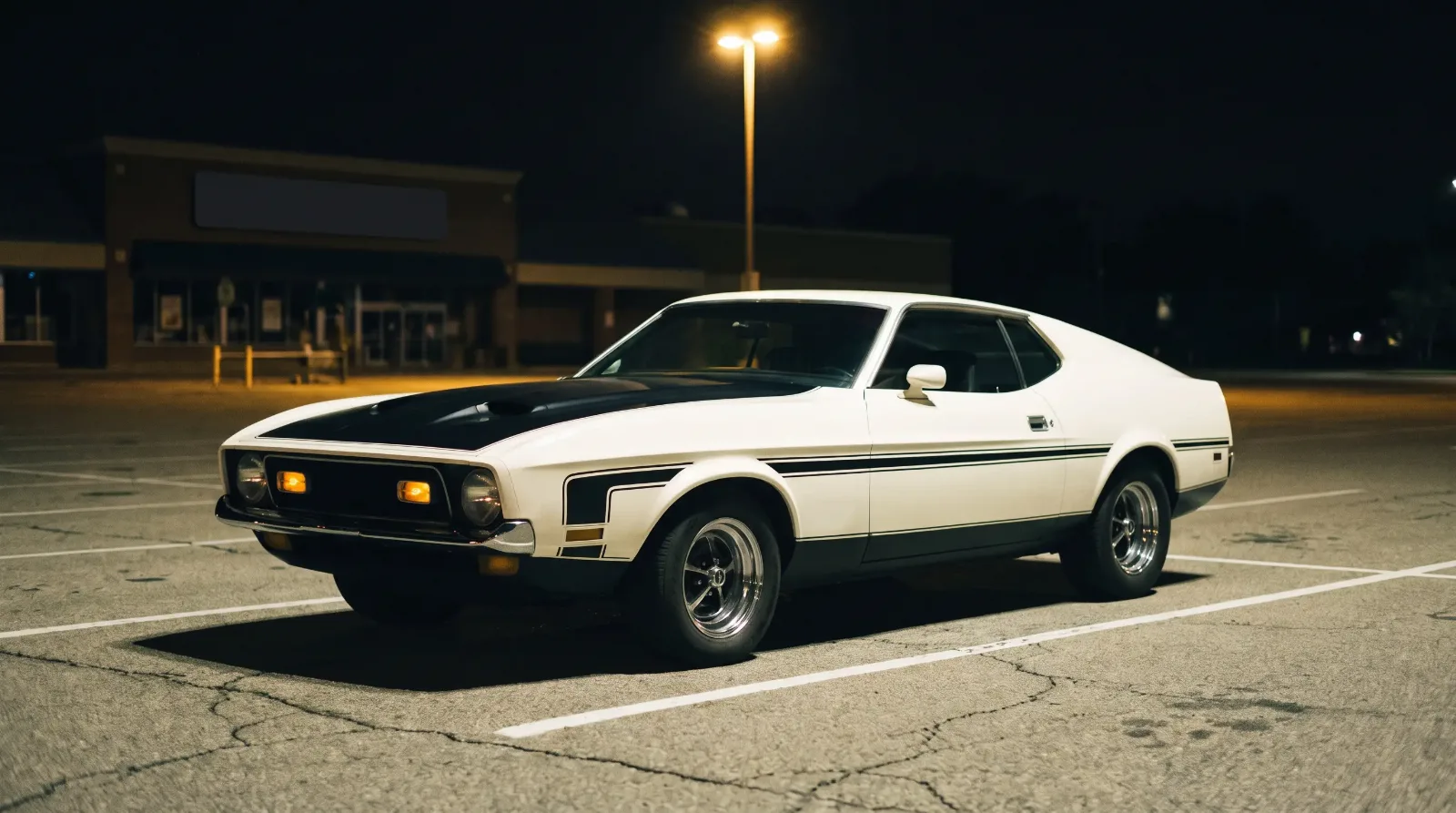
If you want the whole family first, the Boss 302, the Boss 429 and the Mach 1 that sold alongside them, start with the Boss and Mach 1 cars. This piece stays with the last one, the car that most people walk past at a show because they are looking for a 302 or a 429.
One Boss where there had been two
For 1971 the Boss 351 replaced both earlier Bosses. That was a bigger change than it sounds. The Boss 302 had just had its best year, with 7,013 sold in 1970, and Parnelli Jones had won the 1970 Trans-Am title in a Bud Moore team car. The Boss 429 had been the opposite kind of car, a big block crammed into a body that needed its shock towers reworked to take it, with 859 built in 1969.
The 1971 Mustang changed the math. The new body was about 3 inches wider precisely so a 429 would fit without that Boss 429 surgery. It rode on a 109-inch wheelbase, stretched to 189.5 inches long and 74.1 inches wide, and a base 1971 SportsRoof weighed around 3,560 lb. Ford now had a body that could swallow a big block with no special work, and the car that wore the Boss badge used a 351 instead. I have always found that a little funny. The whole point of the bigger car was room for the big engine, and the Boss went the other way.
The R-code 351 Cleveland HO
The reason it worked is the engine. The Boss 351 got the R-code 351 Cleveland HO, rated at 330 hp at 5,400 rpm and 370 lb-ft at 4,000 rpm, gross. That put it 45 hp above the regular 351 four-barrel in the same catalog, which was rated at 285 hp.
Look at the parts list and you can see where the extra came from. Forged domed pistons gave 11.1:1 compression, which meant premium fuel and nothing else. The bottom end had four-bolt main caps and forged, shot-peened rods. A solid-lifter cam worked the valves through Boss 302-type heads, and an Autolite 4300-D spread-bore carburetor rated at 715 cfm sat on an aluminum intake. A dual-point distributor handled the spark. That is a race-shop parts list bolted into a showroom car, and it shows in how the engine behaves.
The magazines saw it too. Motor Trend tested a Boss 351 in 1971 alongside a 429 Cobra Jet Mach 1 and a 302 car, and the Boss ran the quarter mile in 13.8 seconds at 104 mph, while the heavier 429 car, an automatic with air conditioning and taller gearing, managed 14.61 seconds at 96.8 mph. Car and Driver recorded 14.1 seconds at 100.6 mph, and 13.9 seconds at 102 mph with power shifting. It liked the engine and the steering a lot more than the ride, which it called punishing. Hagerty puts the best magazine 0 to 60 mph run at 5.8 seconds.
The flip side is upkeep. Solid lifters need their lash checked, and a dual-point distributor needs both sets of points set right or the engine never quite runs clean at the top. I have seen more than one Boss 351 that was called "tired" when the only thing wrong was a lash adjustment nobody had done in years.
| 1971 Boss 351 | Factory figure |
|---|---|
| VIN engine code | R |
| Engine | 351 Cleveland HO V8, solid lifters, four-bolt mains |
| Compression | 11.1:1, forged domed pistons |
| Carburetor | Autolite 4300-D, 715 cfm spread-bore, aluminum intake |
| Rated power (gross) | 330 hp at 5,400 rpm |
| Rated torque (gross) | 370 lb-ft at 4,000 rpm |
| Body and gearbox | SportsRoof only, four-speed manual only |
| Production | 1,806 (1971 model year only) |
What came with a Boss 351 Mustang
Ford kept the package simple. Every Boss 351 Mustang was a SportsRoof, every one had a four-speed manual, and Ram Air came standard. There was no automatic and no convertible, so a Boss 351 with either one is a story you should ask a lot of questions about.
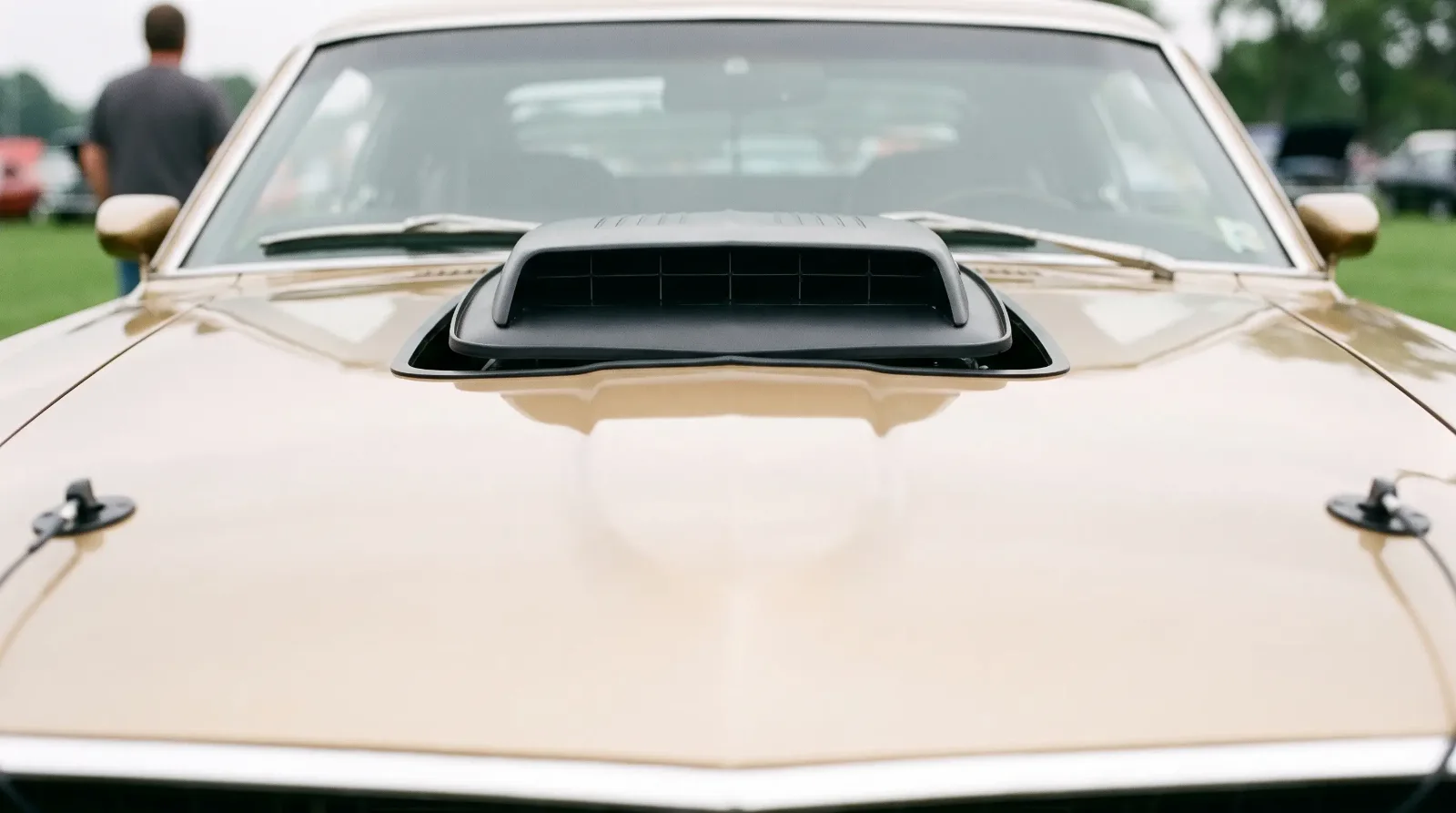
The Ram Air hardware is different from the 1969 and 1970 cars. Those years could carry the Shaker scoop, bolted to the engine and poking up through the hood. For 1971 Ford switched to a hood with two NACA-style ducts. On other 1971 Mustangs those ducts were only functional when Ram Air was ordered. On the Boss 351 it came with the car, so the scoops actually fed the engine.
The rest of the hardware followed the Boss pattern: a competition suspension with front and rear sway bars and staggered rear shocks, a 3.91 Traction-Lok rear axle, and a Toploader four-speed worked by a Hurst shifter. What you did not do was build one up from an options list. That was how the earlier performance Mustangs worked, with buyers ticking boxes on the order form for the GT Equipment Group, a story told here. The Boss 351 came as one car, specified by Ford. A reliable base price is hard to pin down, but one survivor that still carries its original window sticker shows $4,651 with its options.
The 1972 351 HO: a Boss without the badge
The Boss 351 did not quite die after 1971. Its engine carried on for 1972 as the R-code 351 HO, minus the Boss name and the Boss package. Ford cut the compression to 8.8:1, and the rating dropped to 275 hp at 6,000 rpm and 286 lb-ft. Only 398 were built, all at Dearborn.
Be careful comparing those numbers with 1971. Ford switched to SAE net ratings for 1972, measured with accessories and exhaust in place, so 330 gross and 275 net are not two points on the same ruler. The compression cut was real and it cost power, but the gap on paper makes it look worse than it was. If somebody tells you the 1972 HO lost 55 hp, ask them which way of measuring they are using.
Why it was the last Boss
Timing did the Boss 351 no favors. Lee Iacocca became Ford president on December 10, 1970, right in the middle of the car's only model year. More to the point, emissions rules were closing in, and Ford dropped the Boss 351 after 1971 along with the 429 Cobra Jet and Super Cobra Jet. The market was turning too. Pony car production fell 65 percent between 1967 and 1972, from almost one million cars to under 350,000, as a recession and soaring insurance rates pushed buyers toward compacts and imported sporty coupes. A solid-lifter, 11.1:1, premium-fuel Mustang was the wrong car for that world.
Put the 1,806 Boss 351s against 149,678 Mustangs built for 1971 and you get roughly one Mustang in 83. Survivors are thinner still. Wikipedia, citing the Boss 351 Registry, gives 591 registered cars, and a 2014 Mecum auction description put the registry at fewer than 600. The registry's own website is no longer online, so treat that as a snapshot, not a current count.
"Everybody wants the 302 for the racing or the 429 for the engine bay. Fine. But if you want to know what a Boss actually felt like to drive on the street, the 351 is the honest answer. It had the most usable motor of the three, and it got the least credit."
Mike Sullivan
The name stayed retired a long time. Ford leaned on it once in 1982, when "The Boss is Back" ran as the slogan for the returning Mustang GT, but that was an ad line, not a Boss model. The real Boss name did not return to a Mustang until the 2012 Boss 302, which Ford unveiled in Monterey, California, in August 2010. For everything that happened in the decades between, from the Mustang II to the Fox body and the SN95, the wider Ford Mustang history picks up where the last Boss of the first era left off.
Sources and notes
- Ford 335 engine, Boss 351 and 351 HO sections (Wikipedia)
- Ford Mustang (first generation) (Wikipedia)
- 1971 Ford Mustang Boss 351 (MustangSpecs)
- 1971 Mustang Boss 351: Car and Driver and Motor Trend road tests (Curbside Classic)
- 1971 Ford Mustang Boss 351, auction histories (Supercars.net)
- 2012 Mustang Boss 302 unveiled (AutoGuide)
Related Reading
Have a
Ford Mustang
for Sale?
Reach thousands of serious classic car collectors across the US.
Sell It Here →
Selling a classic? Here's how: compare the places to sell classic cars
Are You a Classic Car Dealer?
List your full inventory and connect with targeted classic car buyers.
Join as a Dealer →

About the author
Mike Sullivan
Detroit-area muscle car enthusiast and restoration specialist with three decades of hands-on experience working on American iron.
Related Listings - Ford Mustang




Comments
Be the first to comment on this article.