
At 12:55 in the afternoon on June 23, 1909, a mud-caked Ford pulled into downtown Seattle with a man named Bert Scott at the wheel. It had left New York City on June 1. Nobody else was close: the next car in, a Shawmut, would not arrive for about another 17 hours. That is the moment most people remember from the 1909 ocean to ocean race, and it is a good moment. The trouble is the paperwork that arrived five months later, because the paperwork took the win away.
Car Features
7 min read
The 1909 Ocean to Ocean Race: A Model T Across America
A Model T crossed 4,106 miles from New York to Seattle in June 1909 and finished first. Five months later it lost the trophy.
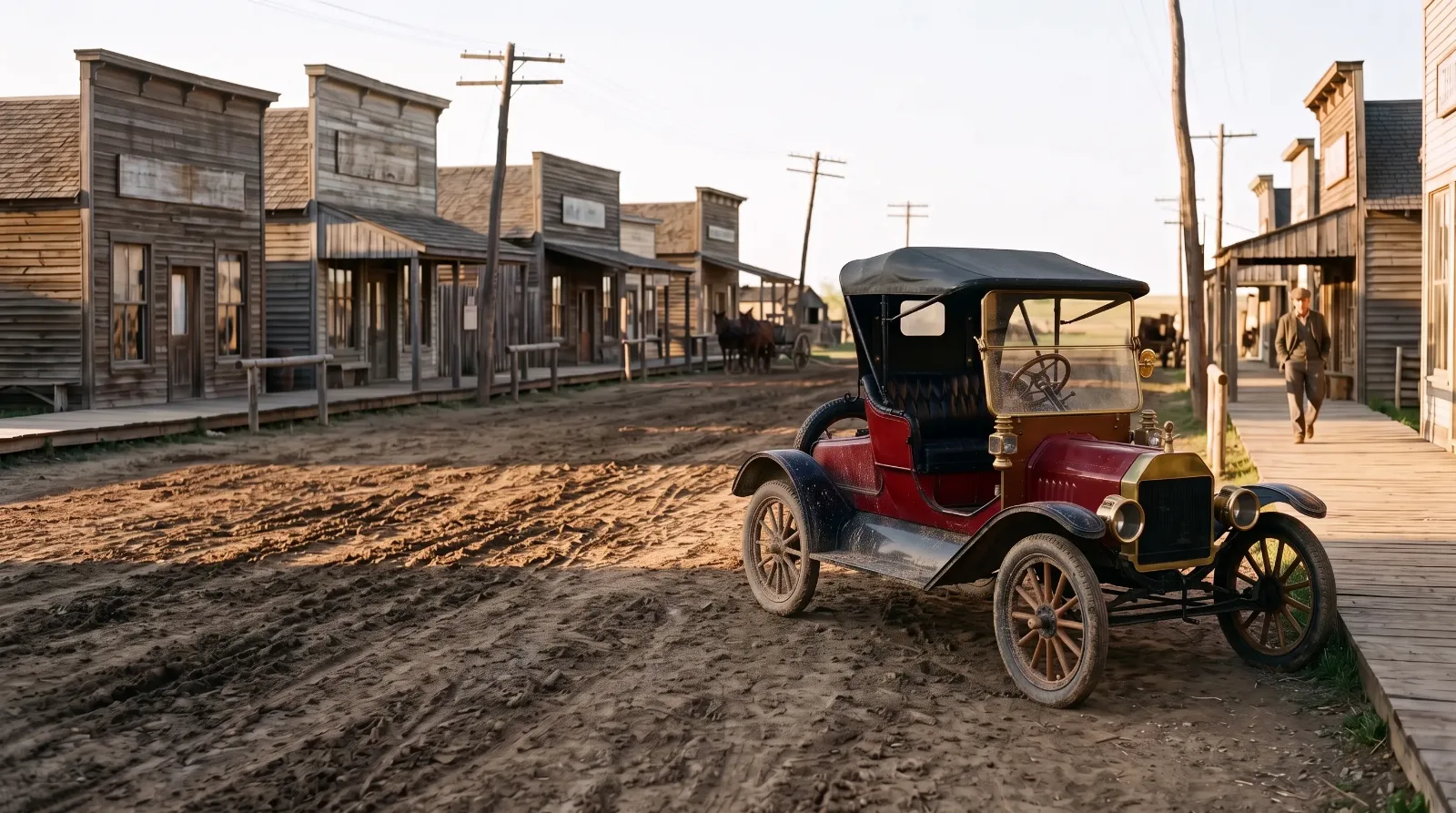
I have heard this story told at club meets a dozen ways, usually with the Ford winning and the story ending in Seattle. The real version is better. It has a millionaire's trophy, a world's fair, a car less than a year out of the factory, and a rulebook that caught up with the winner in November.
Why a race from New York to Seattle in 1909
The race was tied to the Alaska-Yukon-Pacific Exposition, the world's fair Seattle staged that summer. The Exposition, the Automobile Club of America, the Seattle Automobile Club and Henry Ford all put their names on it as co-sponsors. M. Robert Guggenheim, of the mining family, put up the trophy and the prize money: $2,000 for first place, $1,500 for second, and the Guggenheim trophy on top.
Ford had a reason to care. The Model T was brand new. The first production car had been completed on September 27, 1908, and the public launch came on October 1, 1908, so by the start of June 1909 the car had been on sale for eight months. Ford built 17,771 cars in fiscal 1909, a big number then but small next to what came later. A cross-country win against bigger, costlier machines would tell farmers and doctors and small-town merchants that the light, cheap Ford could take the worst roads in the country. If you want the wider arc of the car itself, our Model T history covers it from Piquette Avenue onward.
| Item | Detail |
|---|---|
| Start | New York City, June 1, 1909 |
| Finish | Seattle, Alaska-Yukon-Pacific Exposition |
| Distance | 4,106 miles |
| Route | New York, Chicago, St. Louis, Denver, Wyoming, Idaho, Washington |
| Format | Endurance run to St. Louis, speed race beyond |
| Prize | $2,000 first, $1,500 second, plus the Guggenheim trophy |
| First across the line | Ford No. 2, Bert Scott, 12:55 p.m., June 23, 1909 |
| Official winner | Shawmut, after Ford No. 2 was disqualified in November 1909 |
The field and the 4,106-mile route
Some 35 cars had been entered, but only six turned up at the start in New York. Ford sent two Model Ts. Against them stood a Stearns, an Acme, a Shawmut and an Italian Itala. A Thomas Flyer, the same make that had won the 1908 New York to Paris race, ran ahead as the pathfinder car, scouting the way rather than competing. The field thinned fast: HistoryLink's account has the Stearns dropping out in New York State and the Itala finishing its trip on a freight car. Exactly how many cars reached Seattle under their own power is told differently from source to source, and I would rather leave a blank than fill it with a club rumor.
The route ran 4,106 miles: New York to Chicago, then St. Louis, Denver, across Wyoming and Idaho, and into Washington. The first leg to St. Louis was an endurance run. From St. Louis on it was a speed race, and that is where the roads got honest. West of the Missouri a "road" in 1909 was often two ruts and a guess.
The Model T had a 177 cubic inch four rated at 20 hp, a 100 inch wheelbase, and a curb weight somewhere between 1,200 and 1,650 pounds depending on the body. The cars it faced were bigger and heavier. On a graded road that is a handicap. In mud, sand and creek crossings, light weight and high ground clearance count for a lot, and the Ford had both.
Ford No. 2 and the finish in Seattle
The Ford that mattered was car No. 2, driven by Bert Scott with a mechanic named James Smith riding along. Another Ford man, H.B. Harper, is named in the accounts too; he later remembered wearing rubber coats and hip boots day after day to push through the mud.
Scott reached downtown Seattle at 12:55 p.m. on June 23, 1909, first across the line. Some writers call it a 22-day run and others call it 23 days. Both are counting the same June 1 to June 23 trip; they just count it differently. Either way, a car that cost $850 as a touring model had crossed the continent ahead of everything else in the field.
Ford did not wait to celebrate. The company advertised the result heavily, including in the Saturday Evening Post, and the win went into the sales story that helped turn a new car into a household word. The nickname came later and from other places (the Tin Lizzie story sorts out where it really came from), but the idea that this little Ford could go anywhere got a big push in the summer of 1909.
The engine change and the November disqualification
Here is the paperwork. About five months after the finish, in November 1909, the Automobile Club of America disqualified Ford No. 2. The finding was an illegal engine change during the event: the rules did not allow the engine to be swapped, and the club ruled that it had been. The Shawmut, the car 17 hours behind, was declared the winner.
By November the advertising had already run. Summer readers had seen the Ford finish first, and most of them never read the correction. That is one reason the race still gets retold as a Ford victory. A club official's ruling in late autumn does not travel as far as a photograph of a muddy car in Seattle.
"The Ford got to Seattle first, and nobody argues that. What it did not have, five months later, was a clean record, and in a sanctioned event the record is what wins."
Wayne Coburn
I do not think the disqualification makes the drive less remarkable. Four thousand miles of 1909 roads in a car with a 20 hp engine was hard in any form. But if someone at a show tells you the Model T won the 1909 ocean to ocean race, the honest answer is: it finished first, and it lost the trophy.
The 2009 re-enactment and what the race left behind
A hundred years later, in 2009, Model T owners ran the route again. The centennial re-enactment drew 55 Model Ts representing all 50 states and five foreign countries. Nobody was chasing a Guggenheim trophy this time. They were chasing the experience of crossing the country in the car that did it first in 1909, at least on the clock.
The 1909 run belongs to a wider habit of long trips in the Model T. A little more than a decade later a teenager calling herself Aloha Wanderwell started around the world in one, and plenty of ordinary families pushed their Fords across states with no prize at all. The race showed that the car could be pushed that hard. The owners did the rest.
The story also says something about Ford the businessman. He co-sponsored the race, entered two cars, and turned a finish into a national ad campaign before the officials had finished their work. You can read more about Henry Ford and the Model T elsewhere, but this race is a neat sample of how he worked: build the car light and cheap, put it in front of the public, and let the result do the selling. The disqualification is the footnote. In a club meet, the footnote is usually where the real story starts.
Sources and notes
- Ocean to Ocean Automobile Endurance Contest (Wikipedia)
- University of Washington Libraries: the 1909 New York to Seattle race at the AYP Exposition
- HistoryLink.org essay on the 1909 transcontinental auto race to Seattle
- MotorCities National Heritage Area: Ford's 1909 cross-country race
- Salisbury Post on the 1909 ocean to ocean race
Related Reading
Have a
Ford Model T
for Sale?
Reach thousands of serious classic car collectors across the US.
Sell It Here →
Selling a classic? Here's how: the best sites to sell a classic car
Are You a Classic Car Dealer?
List your full inventory and connect with targeted classic car buyers.
Join as a Dealer →
#ford model t
#1909 ocean to ocean race
#Bert Scott
#Alaska-Yukon-Pacific Exposition
#Guggenheim trophy
#early motoring

About the author
Wayne Coburn
Longtime Corvette owner, judge and club figure who knows the cars, the records and the people behind them.
Related Listings - Ford Model T
Comments
Be the first to comment on this article.