
In January 1945, with the war still on, readers opened a new John Steinbeck novel about a row of canneries, a grocery and a lab in Monterey. Somewhere in its pages the narrator stops to suggest that someone ought to write an erudite essay on what the Model T did to the American soul. Then he makes a joke about the back seat. It is a small moment in a short book. It also shows how the Model T in literature worked: by 1945 the car was gone from the showrooms, but it had settled so deeply into American life that a novelist could lean on it for a laugh and a sigh in the same breath.
Car Features
6 min read
The Model T in American Literature
From tin lizzie slang to E.B. White's farewell essay, Steinbeck's Cannery Row joke and later novels: how writers used the Model T.
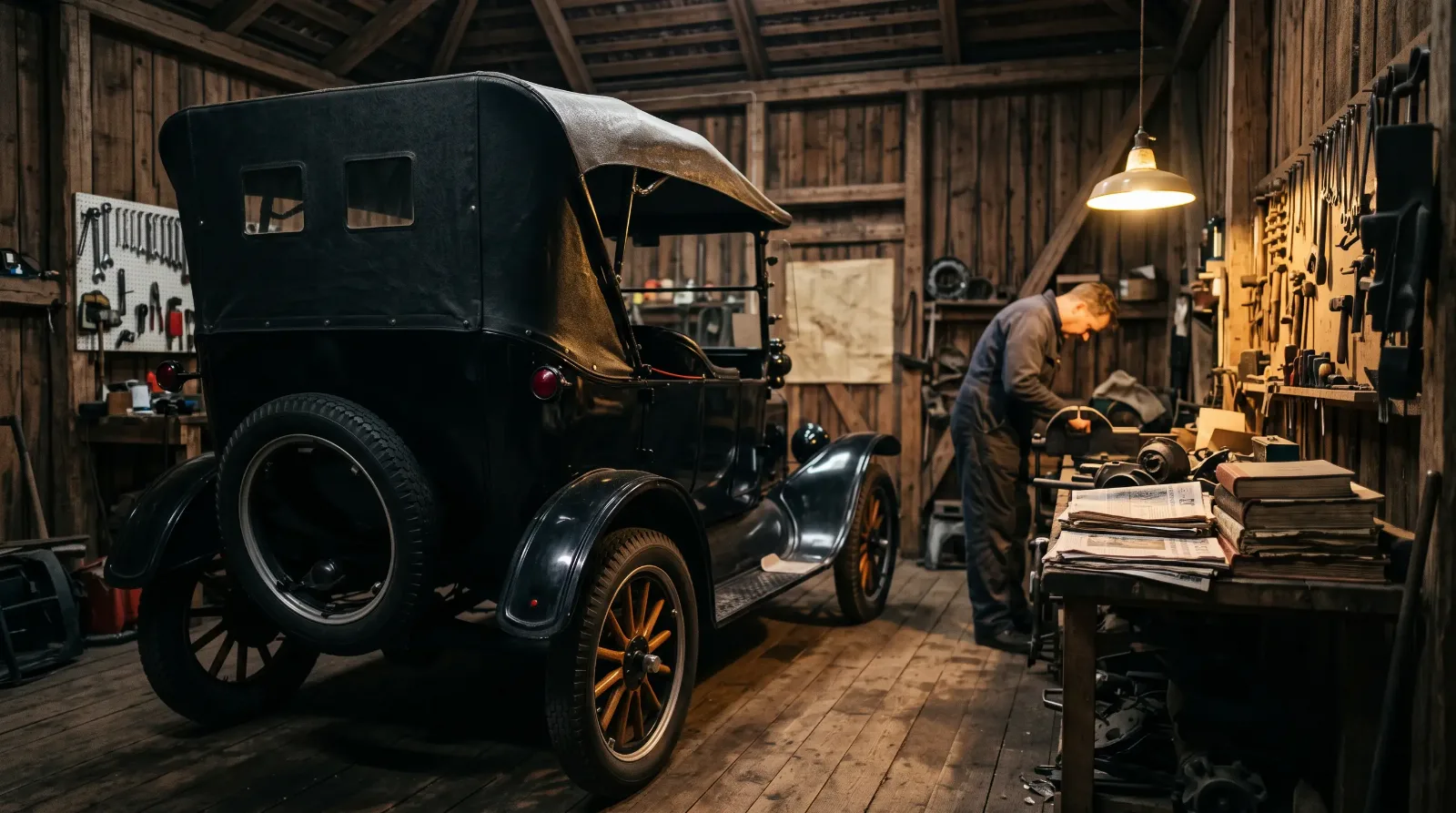
This is a look at how writers used the car, from slang that drifted onto the page to essays that mourned it and novels that brought it back.
From slang to the printed page
Before the Model T became a subject, it became a word. "Tin lizzie," slang for a small, cheap, worn-out car and usually a Ford, turns up in print by 1915, according to Merriam-Webster. Nobody has settled where the name came from, and Ford itself says it is not sure. You can read the full story of the competing theories elsewhere.
For writers, the nickname did a lot of work. It carried affection and mockery together. A character who drove a tin lizzie was ordinary, probably not rich, and probably a little proud of it anyway. Few objects arrive in a sentence already wearing that much meaning.
The car's own adventures also read like fiction before any novelist touched them. Newspaper readers followed the 1909 race from New York City, which left on June 1 and put the first car into Seattle on June 23. The Model T was a story in the papers long before it was a story in books.
The goodbye essay of 1936
The best-known piece of writing about the Model T is not a novel. On May 16, 1936, The New Yorker printed "Farewell, My Lovely!" under the byline "Lee Strout White." The name blended two writers: E.B. White and Richard L. Strout, a Christian Science Monitor correspondent from 1923 to 1984.
The essay is a catalog of affection. It lists the accessories owners bought for the car, the replacement parts ordered from the Sears catalog, the camphor ball dropped into the gas tank as a home remedy, and the bare early dashboard with nothing on it. It reads like a eulogy written by someone who could still smell the oil.
It came out as a small book the same year, with a second impression in November 1936 from G.P. Putnam's Sons. In 2003 The Little Bookroom reissued it, credited to E.B. White alone, paired with a later White essay. The piece has never really gone out of print in spirit. People who never drove a T still quote its tone.
Steinbeck and the back seat
Steinbeck's Cannery Row, published by Viking Press in January 1945, belongs to a different mood. The essay White and Strout wrote is a farewell. Steinbeck's passage is closer to a shrug and a wink.
He proposes, in a mock-serious voice, that the moral, physical and esthetic effect of the Model T on the nation deserves scholarly study. Then he says that most babies of the period were conceived in Model T Fords. It is a joke, and a good one, but it rests on something true. For a whole generation the car was the first private room many young people ever had.
"Steinbeck makes it a punch line, but look at what the joke assumes. Everyone reading in 1945 knew that car from the inside. Nobody had to be told what the seats felt like."
Nora Beckett
That is the quiet power of the Model T on the page. Writers did not describe it. They did not have to. A single mention summoned a whole decade.
Henry Ford's car as a symbol of the machine age
Not every writer was fond. In the 1930s the Model T also stood for mass production, standard parts and a life measured by the clock on the factory wall. John Dos Passos included a biographical sketch of Henry Ford titled "Tin Lizzie" in The Big Money, the closing volume of his U.S.A. trilogy, published in 1936. The title alone tells you where he aimed: at the man, through the car.
Across the Atlantic, Aldous Huxley pushed the idea to its limit in Brave New World in 1932. His future society reveres "Our Ford," counts its years from 1908, the year of the first Model T, and has cut the tops off its crosses to turn them into T's. It is British satire, not American fiction, but it shows how far the car had traveled as an idea. A cheap Ford from Michigan had become shorthand for a whole way of organizing human life.
Both writers took the car seriously in a way the joke books never did. They saw it as the product of a system, and the system was what interested them.
The Model T in literature, looking back
Later novelists used the car to set a clock. E.L. Doctorow's Ragtime, published in 1975, puts a Model T at the center of its most famous plot thread: a Black ragtime pianist's prized Ford is wrecked by the men of a volunteer fire company in New Rochelle, and his demand for justice drives the story toward violence. The choice of car is exact. The Model T was the ordinary man's machine, and that is what makes its ruin an insult.
By the time Ragtime appeared, few readers had ridden in a T. The car had become a period marker, like a straw boater or a gas lamp. Writers reached for it to say: this is the early century, before the Depression, when the roads were still dirt and the future still looked like a factory.
Read across these books and essays and you find the car doing three different jobs. In White and Strout it is a beloved old friend. In Steinbeck it is a shared private joke. In Dos Passos and Huxley it is the machine age itself. The same black Ford holds all of it.
Maybe that is why the car lasted so long in print. It was cheap enough to belong to everyone, which meant every writer could assume the reader knew it. That is rare for any object. For a car it may be unique.
Sources and notes
- Farewell, My Lovely! and the Lee Strout White byline (New Yorker State of Mind)
- Farewell to Model T, Little Bookroom edition (Sonderbooks)
- Cannery Row (Wikipedia)
- The Big Money and its Tin Lizzie section (Encyclopedia.com)
- Brave New World (Wikipedia)
- Ragtime: Willie Conklin and the Emerald Isle fire company (LitCharts)
Related Reading
Have a
Ford Model T
for Sale?
Reach thousands of serious classic car collectors across the US.
Sell It Here →
Selling a classic? Here's how: the best sites to sell a classic car
Are You a Classic Car Dealer?
List your full inventory and connect with targeted classic car buyers.
Join as a Dealer →

About the author
Nora Beckett
Automotive features writer and photographer who tells the human stories behind the cars, from show fields to cross-country road trips.
Related Listings - Ford Model T
Comments
Be the first to comment on this article.