
American Motors never had the budget of the Big Three, and it never pretended to. What it had instead was a compact V8 family that punched well above the company's size, and the 390 sat at the top of it. When people talk about muscle car engines, the AMC 390 rarely comes up first, which says more about AMC's marketing reach than about the engine itself. This is the motor that put a small independent into the horsepower conversation at the end of the 1960s.
Car Features
5 min read
AMC's Muscle: The 390 and the Rebel Machine
The AMC 390 V8 made around 315 to 340 hp and powered the AMX and Rebel Machine. Specs, history, and what to check before you buy one.
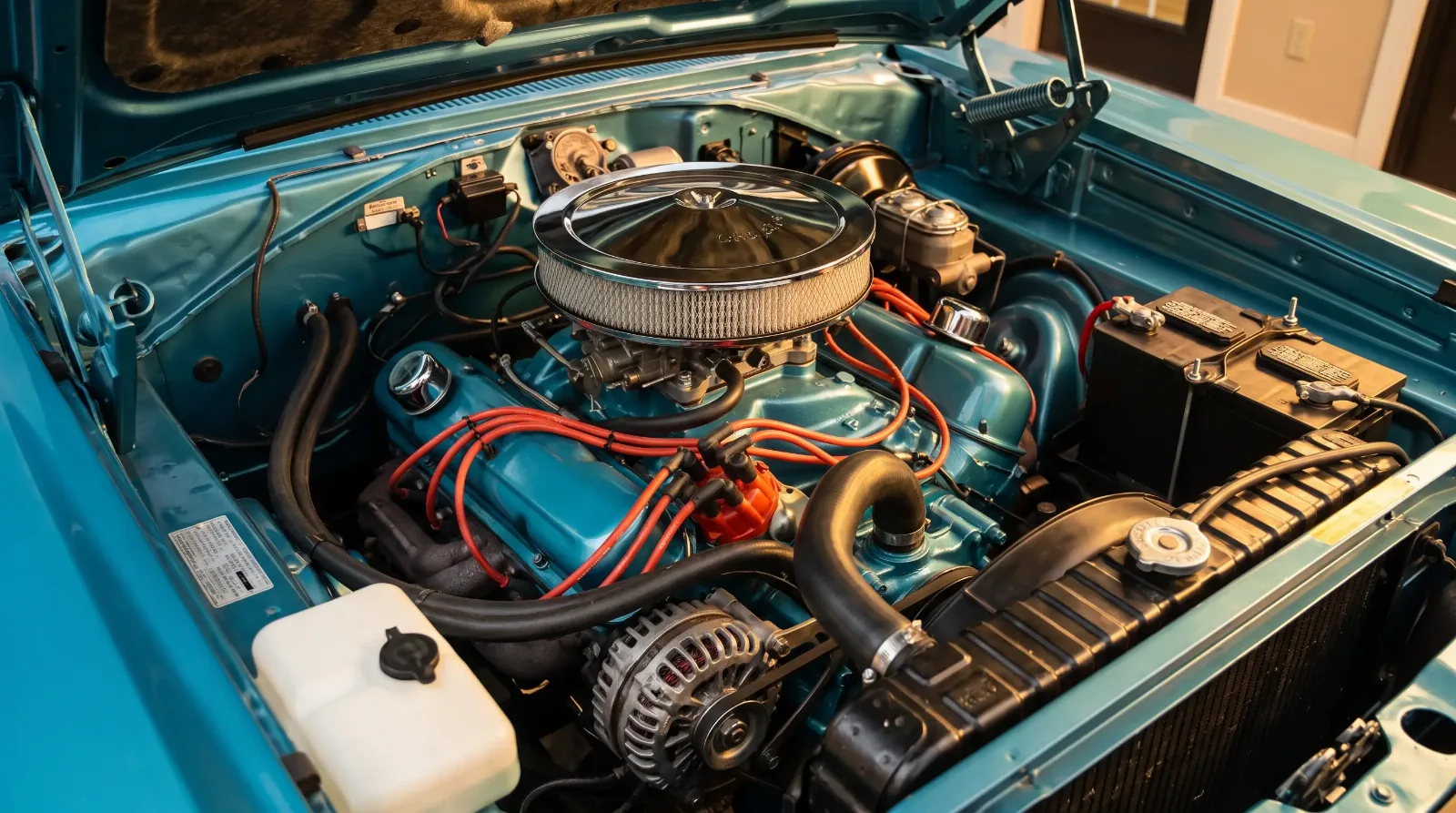
The 390 belongs to AMC's second-generation V8, the family that arrived in 1966 with thin-wall casting and a short-deck design that kept the block compact and stiff. That same architecture spawned the 290, 343, 360, and later the 401. The 390 was the performance flagship until the 401 took over. If you want the wider context on how these engines fit the era, we cover the ground in the muscle car engines breakdown, but the AMC story is worth telling on its own terms.
Where the 390 came from
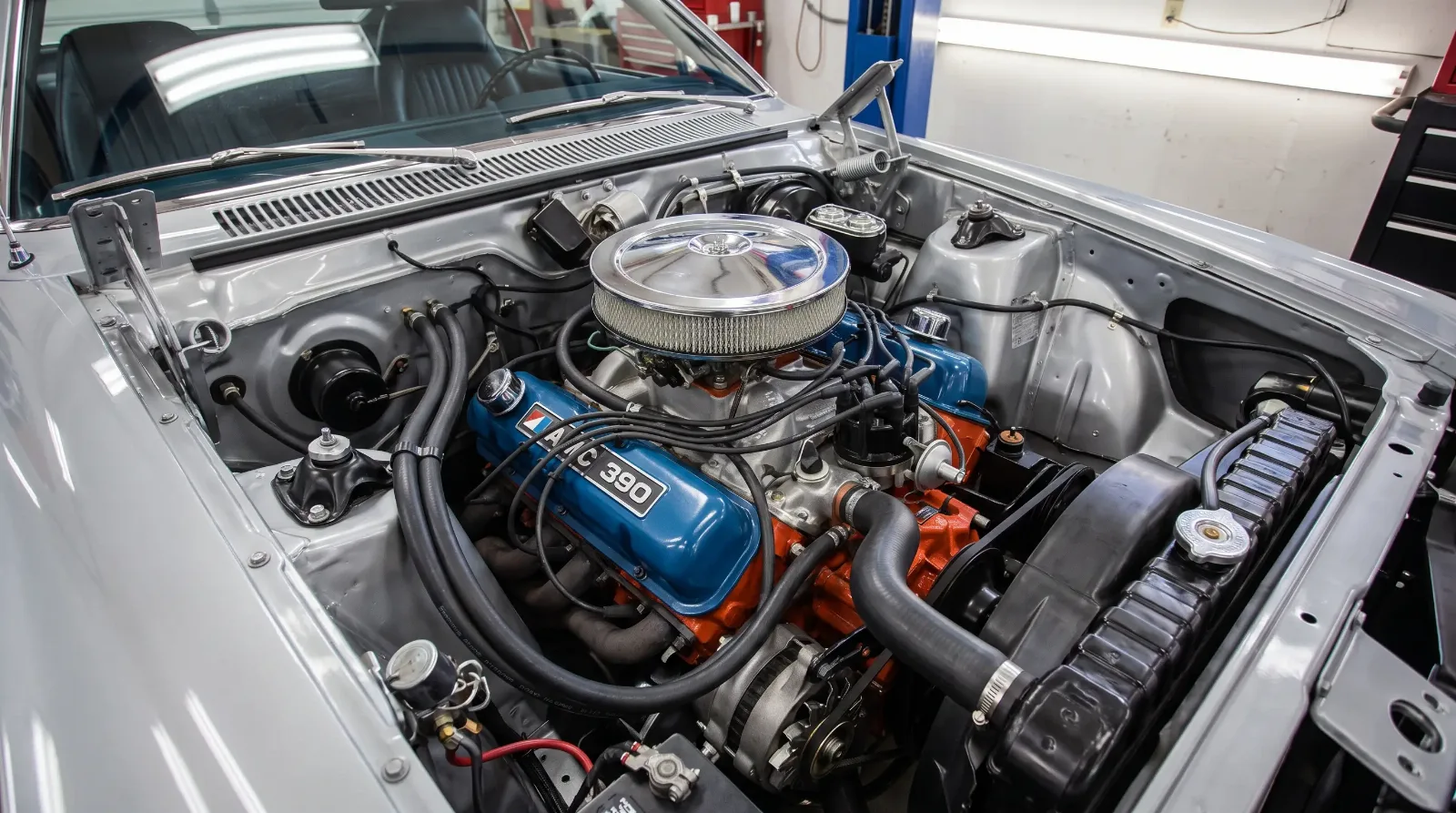
AMC introduced the 390 for 1968, the same year the AMX and the redesigned Javelin arrived. The company needed a big-inch option to make those cars credible against the Mustang and the Camaro, and the 390 answered. It shared its bore spacing and basic block with the rest of the second-generation family, so the same forged crank and connecting rods that made the smaller engines durable carried straight over.
The design priority was strength, not headline displacement. AMC used forged internals in the 390 when plenty of competitors were still running cast cranks in their mid-range big blocks. The result was an engine that survived hard use better than its reputation suggested. Owners who actually raced these cars learned that quickly. The block took abuse, the bottom end held together, and the heads flowed well enough to make real power without exotic parts.
What the numbers actually say
Factory ratings for the 390 sat in the range of roughly 315 to 340 horsepower depending on the year and the car it went into. The 1968 to 1969 AMX and Javelin 390 carried an advertised figure around 315 horsepower. The 1970 version, particularly in the Rebel Machine, was rated closer to 340 horsepower and about 430 lb-ft of torque. Treat those gross ratings the way you treat every gross number from the period. They were advertising figures, measured without the accessories and exhaust the car actually used, so the real crankshaft output was lower.
Displacement came from a bore near 4.17 inches and a stroke close to 3.57 inches, which is why the 390 felt willing to rev for a big block of its size. It was not a long-stroke torque monster in the mold of a 455. It was a squarer engine that liked to breathe, and that character showed up on the street.
| Spec | AMC 390 (typical 1968 to 1970) |
|---|---|
| Displacement | 390 cid (6.4 L) |
| Bore x stroke | approx. 4.17 in x 3.57 in |
| Advertised power | around 315 to 340 hp (gross) |
| Torque | roughly 420 to 430 lb-ft (gross) |
| Bottom end | forged crank and rods |
| Family | AMC second-generation V8 |
The Rebel Machine and the AMX
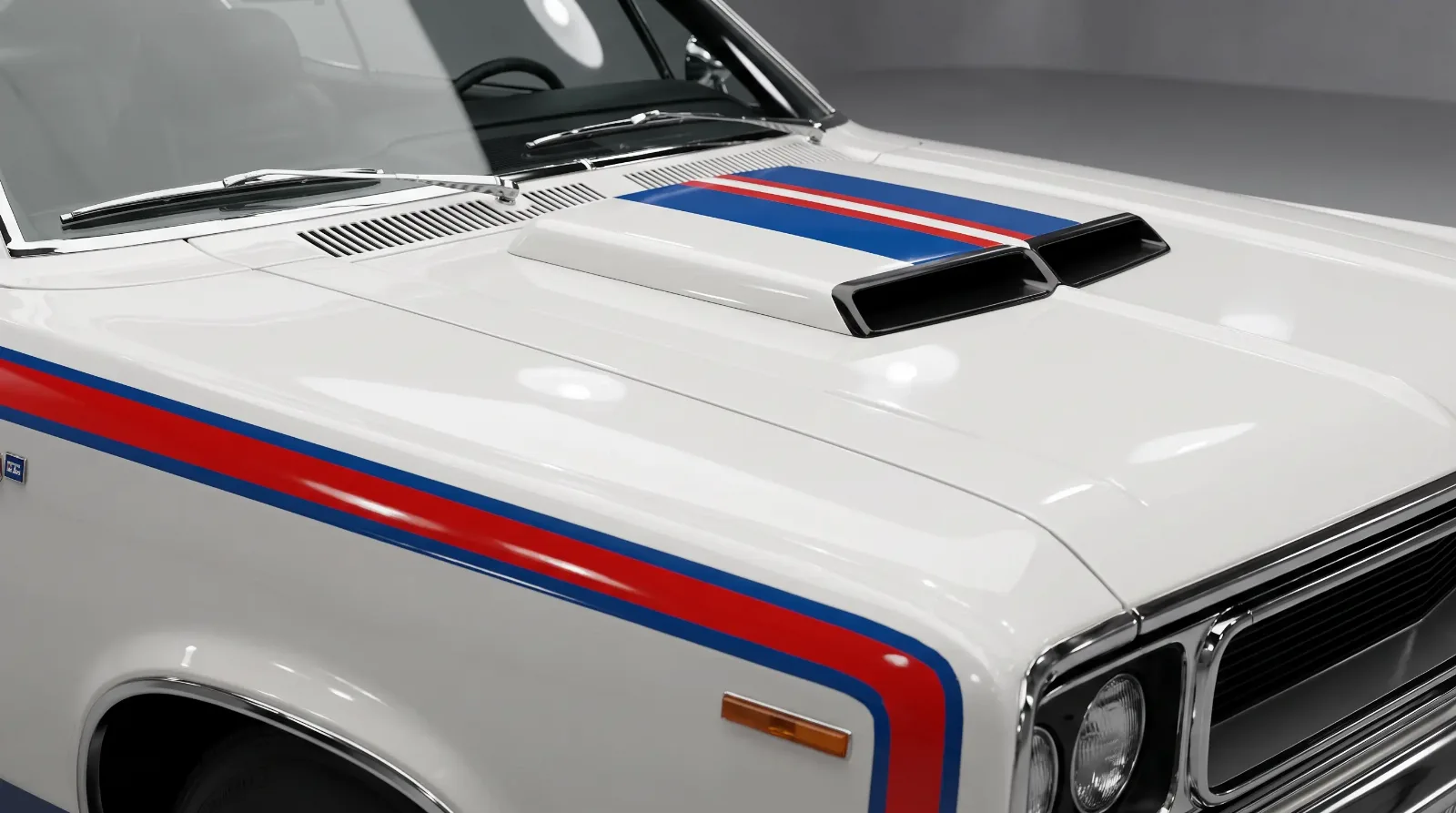
The 390 found two very different homes. In the AMX it powered a short-wheelbase two-seater that had no real equivalent from Detroit, a car built for handling and quarter-mile respectability at the same time. In the Rebel Machine of 1970 the same engine went into a full-size intermediate wearing a red, white, and blue paint scheme that made it impossible to miss. The Machine was AMC's answer to the question of whether a mainstream family body could be a genuine muscle car, and the 390 gave it the credibility to make that argument.
Production of these cars was small by Big Three standards. The Rebel Machine run for 1970 was limited, which is part of why clean examples command attention now. The AMX had its own following built around the two-seat layout and the factory drag heritage that came with it. In both cases the 390 is central to the car's identity, and a numbers-correct example is worth confirming before you commit.
What to know before you buy one
Verifying an AMC big block starts with casting numbers and the build documentation, the same as any period muscle engine. AMC casting numbers are stamped and cast in specific locations, and the second-generation blocks are close enough in external appearance that a 360 can wear 390 badges without much effort. The forged crank is a good sign, but confirm the actual displacement rather than trusting a fender emblem.
"The AMC guys kept better records than people give them credit for. When somebody tells me a 390 is original, I want to see the numbers, because on these cars a 360 and a 390 look the same from six feet away."
Tom Ramirez
Parts support has improved as the AMC hobby matured, but it is still narrower than what a Chevrolet or Ford owner enjoys. Gaskets, bearings, and rebuild components are available. Correct date-coded pieces for a concours restoration take patience. Budget for that reality before you start a project rather than after.
Why the 390 still matters
The 390 is the engine that proved a small company could build a serious performance V8 without copying anyone. It was strong where it needed to be, it revved better than its displacement suggested, and it powered two of the most distinctive muscle cars of the era. Mopar built its reputation on the B and RB engines, and if you want to see how a much larger corporation approached the same problem you can read the full story on the Chrysler big blocks, but the AMC 390 earned its place through engineering rather than volume. That is exactly why collectors keep circling back to it.
Related Reading
Have a
Classic Car
for Sale?
Reach thousands of serious classic car collectors across the US.
Sell It Here →
Are You a Classic Car Dealer?
List your full inventory and connect with targeted classic car buyers.
Join as a Dealer →

About the author
Tom Ramirez
Corvette researcher and historian based in Bowling Green, Kentucky. Two decades documenting Corvette production history from original factory records.




Comments
Be the first to comment on this article.