
Production paperwork rarely makes for exciting reading, but the first generation barracuda production numbers tell a story that the styling alone does not. Between the car's April 1964 launch and the end of the 1966 model year, Plymouth built a specific, documented run of fastbacks, and the year-by-year breakdown explains a lot about how the car was positioned, how it sold, and why certain years are scarcer than others today.
Car Features
7 min read
First-Generation Barracuda Production Numbers
A year-by-year breakdown of first generation Barracuda production, from the compressed 1964 launch to the 1966 Formula S cars that command real collector value today.
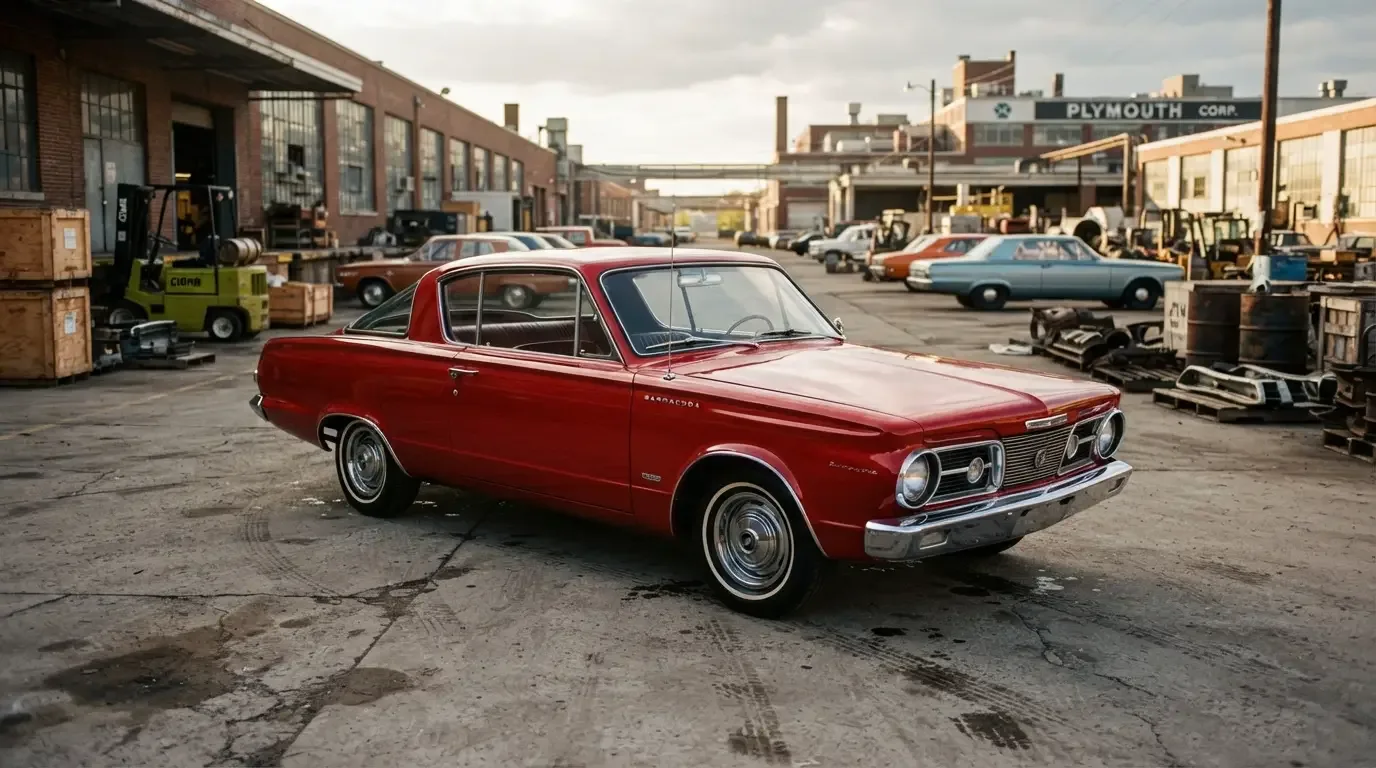
The 1964 short model year
Because the Barracuda launched partway through what would normally have been a full model year, its first sales period ran only from April through the end of the 1964 model year cycle. Chrysler's own production records list total 1964 Barracuda output at 23,443 units, a figure that reflects a genuinely compressed selling season rather than any lack of buyer interest. Plymouth dealers had only a few months to move the car before the 1965 model year lineup arrived, and the truncated calendar makes 1964 cars a distinct, identifiable subset within the first generation rather than a full year's worth of typical production.
Within that 1964 run, the vast majority of cars left the factory as base models with the standard slant-six engine, since the Barracuda at this stage was still primarily positioned as a sporty variant of the Valiant rather than a dedicated performance car. Buyers who wanted more had to specifically order the Commando V8 option, and documentation on how many did so in that first partial year is thinner than for later, fuller model years.
1965: the first full year
The 1965 model year gave Plymouth its first complete twelve months to sell the Barracuda, and production climbed accordingly. Chrysler's build records put 1965 output at 64,596 units, a substantial jump from the partial 1964 run and a number that reflects both a full sales calendar and growing dealer familiarity with how to market the car. This was also the year Plymouth introduced the Formula S handling package, which paired the 273 cubic inch V8 with upgraded suspension, faster steering, and wider wheels aimed at buyers who wanted the Barracuda to handle as well as it looked.
Formula S cars represent a small fraction of total 1965 production and are correspondingly harder to find today in documented, numbers-matching condition. Most surviving build sheets and fender tags from this era require careful cross-referencing against Chrysler's original broadcast sheets to confirm exactly which options a given car left the factory wearing, since dealer-installed accessories and later modifications have muddied plenty of cars' histories over six decades.
"Production numbers do not lie the way memory does. If you want to know how rare a Barracuda variant really is, the build records settle the argument every time."
- Tom Ramirez
1966: refinement and a production plateau
By 1966, the Barracuda had settled into a more mature identity within Plymouth's lineup, with modest styling revisions to the grille and trim distinguishing it from the 1965 model at a glance. Production for 1966 came in at 38,029 units, a decline from the 1965 peak that reflects both the natural sales curve of a car nearing the end of its generation and increasing competition in the pony car segment as other manufacturers rolled out their own entries.
This final year of the first generation also saw Plymouth continue to offer the Formula S package, and 1966 cars built with that option, particularly with the four-speed manual transmission, are now among the most sought after examples from the entire first generation. The relatively low production numbers combined with a documented performance package make these cars a genuine rarity rather than a common trim variant.
Reading the numbers correctly
Total production across all three years of the first generation lands at roughly 126,000 units (23,443 plus 64,596 plus 38,029), a number that sounds substantial until you consider how it splits across body styles, engine options, and transmission choices. A plain slant-six coupe from any of these years is common enough that survivors show up regularly at swap meets and online listings. A documented Formula S car with the V8 and manual transmission is a different animal entirely, and the production gap between those two categories is where most of the real collector value sits.
Understanding this breakdown matters for anyone trying to place a specific car within the full story of the first generation, since the broader historical narrative only makes sense once you know how many cars were actually built each year and in which configurations.
| Model Year | Approx. Production | Notes |
|---|---|---|
| 1964 | 23,443 | Partial model year, launched April 1964 |
| 1965 | 64,596 | First full year, Formula S introduced |
| 1966 | 38,029 | Final first-generation year, refined trim |
Body style and engine breakdown within the totals
The first generation was sold exclusively as a fastback across all three model years, which simplifies the production picture compared to later generations that added notchback and convertible body styles. Within that single body style, the engine split matters far more to collectors than the year-to-year totals alone. The base slant-six engine accounted for the majority of units built in every year of the run, since it was the standard, no-cost engine and the one most buyers accepted without upgrading. The 273 cubic inch V8 was the volume performance option, available across the generation and required for the Formula S handling package starting in 1965.
Transmission choices further split the production totals. A three-speed manual was standard, with a TorqueFlite automatic and, on V8 cars, a four-speed manual available as options. Four-speed cars, particularly when paired with the Formula S package, represent a small slice of an already modest total production run, and locating one with its original drivetrain still intact requires patience and a willingness to cross-reference paperwork carefully.
Why documentation is harder to find than the cars themselves
Chrysler's record-keeping from this period exists, but it was never designed with sixty years of future collector scrutiny in mind. Broadcast sheets, the factory paperwork that traveled with each car through the assembly process, were often discarded once a car left the factory, and only a fraction of surviving cars still have their original sheet tucked away in a glove box or trunk. Fender tags stamped with production codes remain on most surviving cars, but decoding those tags correctly requires reference material that has been compiled and cross-checked by enthusiast researchers over the decades, since Chrysler's original internal codebooks are not widely circulated in complete form.
This gap between what exists and what is easily verifiable is part of why documented cars command such a premium over undocumented ones with similar cosmetic condition. A seller who can produce a fender tag decode alongside period photographs or a partial ownership history is offering something meaningfully more valuable than a seller who can only point to the car's current appearance.
What this means for today's buyers
For anyone shopping the current market, these production figures are a useful reality check against asking prices. A seller claiming rarity for a plain 1965 slant-six car is working against the actual volume data, while a genuinely documented Formula S example has real scarcity behind the claim. Buyers who take the time to request a fender tag decode before committing to a purchase consistently make better-informed decisions than those who rely on a seller's verbal description alone.
If you want to compare what is currently available against this production history, you can browse classic Barracuda for sale and see how pricing tends to track these documented rarity tiers fairly closely once buyers do their homework.
Sources and notes
Related Reading

About the author
Tom Ramirez
Corvette researcher and historian based in Bowling Green, Kentucky. Two decades documenting Corvette production history from original factory records.
Related Listings - Plymouth Barracuda
Comments
Be the first to comment on this article.