
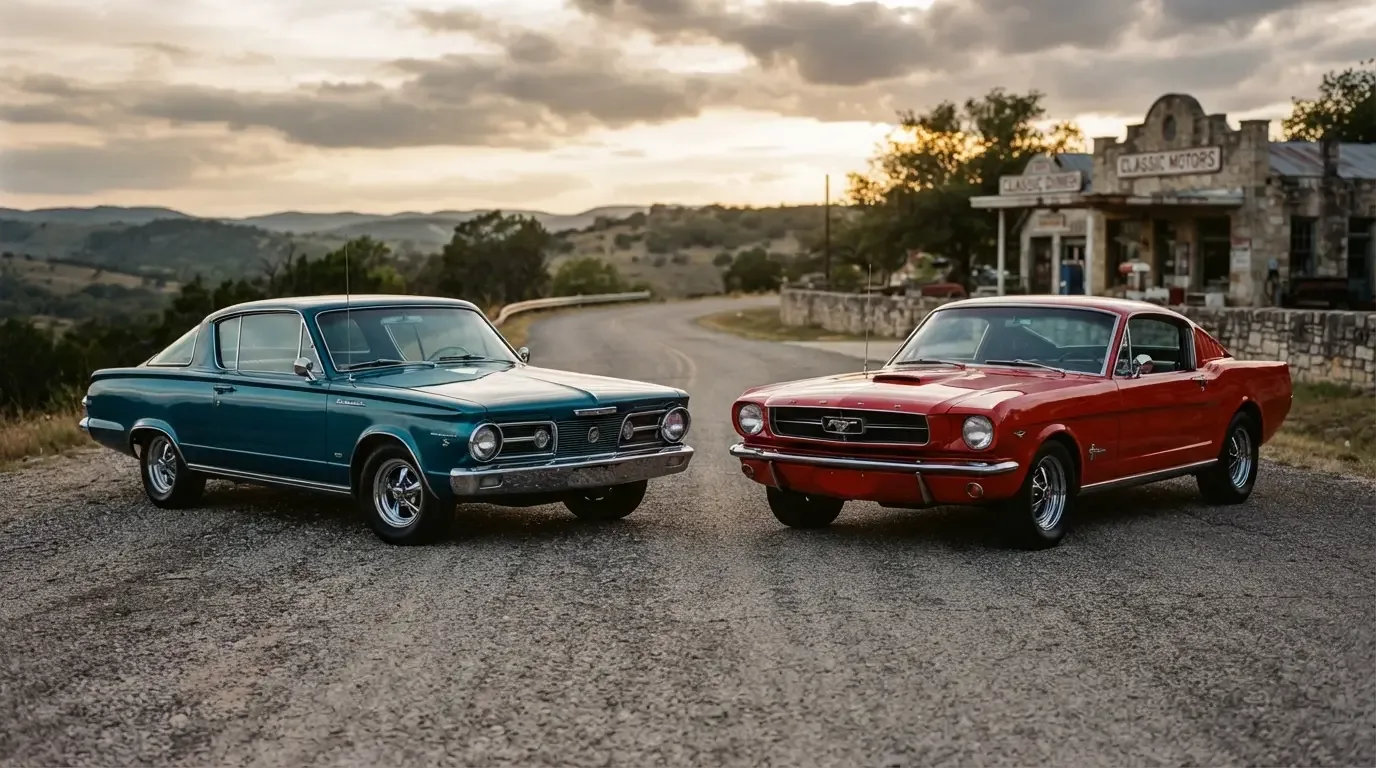
By the time both companies had a full model year of sales data to compare, the barracuda vs mustang 1965 matchup had already been decided in the court of public opinion, even though the cars themselves were closer in substance than most people assumed at the time. Plymouth and Ford were selling into the same new segment with genuinely different philosophies, and 1965 is the year those philosophies show up most clearly side by side.
Car Features
7 min read
1965 Barracuda vs Mustang: The First Pony Duel
The 1965 Barracuda and Mustang were closer in engineering and value than sales figures suggest, with the gap between them explained more by marketing budgets than by the cars themselves.
Two different starting points
The Barracuda's roots in the Valiant platform meant Plymouth's engineers were working with proven, cost-effective mechanical bones and pouring their development effort into disguising that heritage well enough to compete visually. The Mustang, while it also drew heavily on Ford Falcon components underneath, was packaged and marketed from day one as a standalone model with no visible connection to its economy-car parent. Ford's approach hid the shared parts bin more completely, and that difference in presentation mattered enormously to buyers who were choosing an image as much as a car.
Neither company was building something exotic under the skin. Both were doing smart, cost-conscious engineering, repurposing existing platforms into something that looked and felt sportier than the economy cars underneath. The real difference in 1965 was how convincingly each company sold that transformation to the public.
Comparing what buyers actually got for their money
Both cars offered a similar spread of engine options for 1965, ranging from an economical six-cylinder up through small-block V8 power, and both offered handling packages aimed at buyers who wanted more than a straight line. Plymouth's Formula S package for the Barracuda paired the 273 cubic inch V8 with upgraded suspension and wider wheels, a direct answer to what Ford was offering with its own GT package on the Mustang. On paper, the two performance packages were closely matched in what they delivered for the money.
Where the cars diverged sharply was options breadth. The Mustang's order sheet in 1965 ran to an enormous list of individual choices, letting buyers customize nearly every aspect of their car from engine to trim to convenience features. The Barracuda's options list, while reasonable, was noticeably shorter, a reflection of Plymouth's smaller development budget and the shorter runway the company had to build out a full accessories catalog before launch. Ford turned personalization itself into a selling point, and that strategy resonated with buyers in a way Plymouth's more modest approach did not fully match.
"Put a 1965 Formula S next to a Mustang GT and the engineering argument is closer than people expect. The sales numbers were never really about engineering."
- Tom Ramirez
The sales gap and what caused it
Ford built roughly 559,000 Mustangs across the 1965 model year against Plymouth's 64,596 Barracudas, a nearly nine-to-one gap that dwarfed anything Plymouth could answer with. That gap traces back almost entirely to marketing scale rather than product quality. Ford's launch at the New York World's Fair generated a level of media coverage Plymouth simply could not match with its budget, and Ford kept that momentum going with a sustained advertising push throughout the following year. Plymouth, by contrast, treated the Barracuda more as one entry in a broader lineup rather than the flagship cultural moment Ford made of the Mustang.
Dealer network size played a role too. Ford's larger dealer footprint in 1965 meant more showrooms carrying the car and more salespeople pushing it, while Plymouth dealers were often selling the Barracuda alongside a full range of other Plymouth products without the same singular focus Ford's dealers brought to the Mustang.
How the comparison reads six decades later
Time has been kinder to this comparison than the 1965 sales figures suggested it would be. Collectors who look past brand reputation increasingly recognize that the Barracuda's engineering held up just as well as the Mustang's, and in some respects, particularly that fastback cargo versatility, offered something the Mustang did not match. The sales gap from 1965 says more about marketing budgets than it does about which car was actually the better buy for someone cross-shopping the segment at the time.
For anyone wanting the fuller context behind both cars' 1965 competition, where this started covers how Plymouth's rushed development timeline shaped the Barracuda's specific approach to competing against a rival with a much bigger launch budget.
What the road tests actually found
Period magazines that put the two cars back to back tended to reach a more nuanced verdict than the sales charts suggested was warranted. Testers generally gave the Mustang GT the edge in a straight line, where its solid-lifter 289 pulled harder and its bigger dealer-installed options list let a buyer chase more raw horsepower than Plymouth offered on the Barracuda's own 273. But several of the same tests found the Formula S more composed through a series of turns, crediting Plymouth's suspension tuning and the car's slightly lighter, more neutral balance for a driving experience that felt more buttoned-down at the limit than the Mustang's, even though the Ford carried a reputation for outright performance that the Plymouth never matched in the showroom.
That split, straight-line advantage to Ford and back-road composure to Plymouth, tracks with how each company approached the segment from the outset. Ford built the Mustang to be everything to everyone, which meant an enormous options list stretched across a wide range of buyers and driving styles, some of it excellent and some of it middling. Plymouth built a narrower car with a smaller options list but a more consistent point of view about what a compact performance coupe should feel like from behind the wheel, and testers who spent real time with both cars tended to notice that consistency even when the Barracuda lost the outright numbers game.
The cultural gap that outlasted the cars themselves
Beyond the specification sheets and the road tests, 1965 set a cultural pattern that has proven remarkably durable. The Mustang became shorthand for an entire era of American car culture almost instantly, showing up in films, television, and advertising for decades afterward in a way that cemented its position regardless of how any individual model year actually performed against its rivals. The Barracuda never received that same cultural adoption in 1965, and by the time the nameplate built its own strong identity with the E-body cars of 1970 and 1971, the Mustang's head start in the public imagination was already impossible to fully close.
That gap explains a great deal about why the 1965 comparison still generates debate among enthusiasts today. The engineering argument was closer than the sales figures implied even at the time, and it remains closer than casual car culture assumes six decades later. What separates the two nameplates in most people's minds is not really a 1965 model-year comparison at all, but sixty years of accumulated marketing, movie cameos, and brand storytelling that had very little to do with which car handled better on a back road in period road tests.
What this rivalry means for buyers today
The practical upshot of this history is that a well-optioned 1965 Barracuda Formula S offers a genuinely comparable ownership experience to a Mustang GT from the same year, often at a lower purchase price, simply because the market has never fully corrected for that original sales imbalance. If this head-to-head history has you leaning toward the underdog, you can shop classic Barracuda listings and compare current examples against what a similarly equipped Mustang would cost you today.
Sources and notes
Related Reading

About the author
Tom Ramirez
Corvette researcher and historian based in Bowling Green, Kentucky. Two decades documenting Corvette production history from original factory records.
Related Listings - Plymouth Barracuda

Comments
Be the first to comment on this article.