
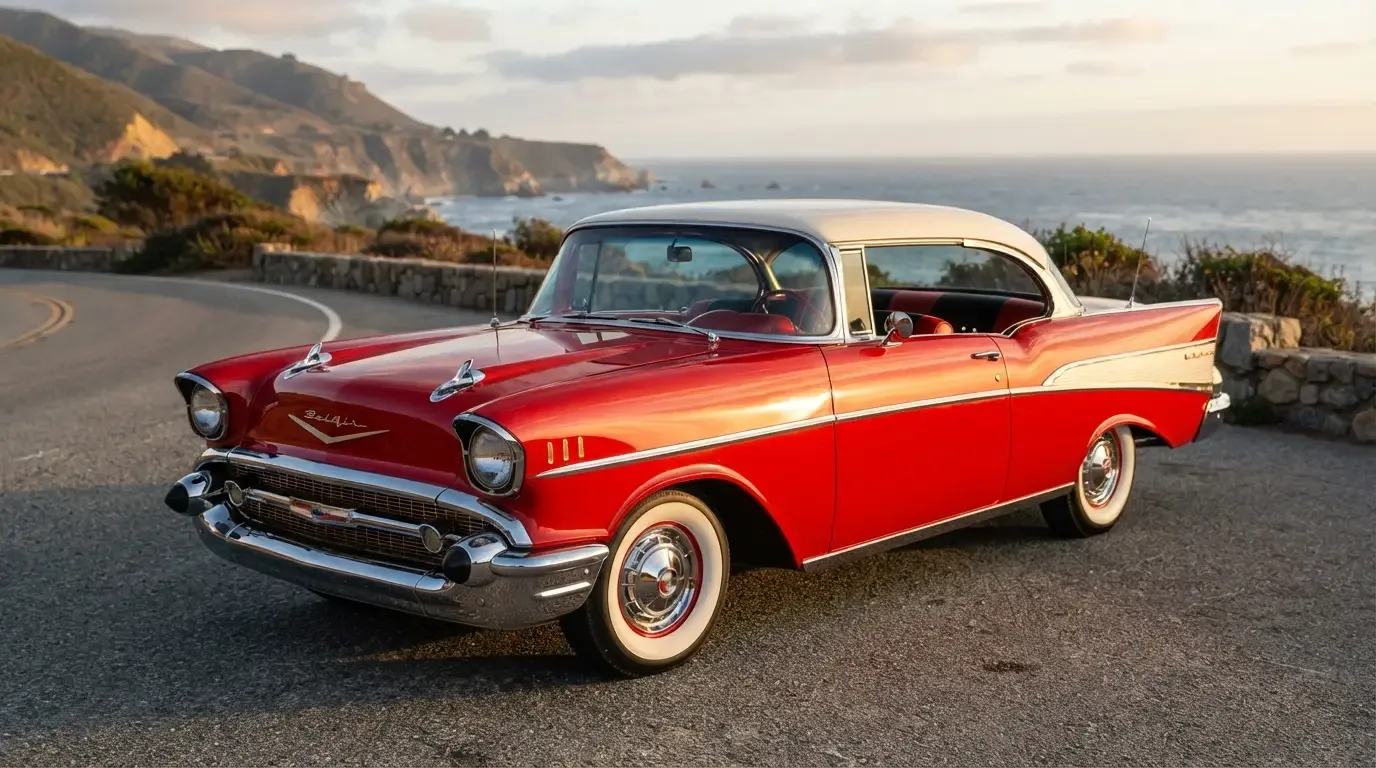
Every appraisal season I get at least one call about a 1957 fuelie real vs clone question, usually from a buyer who has already fallen in love with a car and wants me to confirm what they are hoping to hear. Fuel injection was the headline option on the 1957 Chevrolet lineup, and the Bel Air wearing it legitimately is one of the more collectible variants of the whole model year. It is also one of the most commonly misrepresented, intentionally or otherwise, and separating the real thing from a well-built clone is exactly the kind of risk-framed work I get paid to do.
Car Features
7 min read
1957 Fuelie: Real vs Clone and Why the Difference Costs Real Money
The 1957 fuelie real vs clone question comes down to documentation, not mechanical condition, and getting it wrong can cost a buyer real money.

Why fuel injection mattered so much in 1957
Chevrolet's Rochester mechanical fuel injection system, offered on the 283 cubic inch V8, was genuinely advanced technology for a mainstream American car in 1957. It promised improved throttle response and, in its highest state of tune, a genuine one horsepower per cubic inch claim that generated enormous marketing attention at the time. Very few buyers actually ordered the option compared to the far more common four-barrel carbureted 283, because it cost real money and required a dealer network still learning how to service the system properly. That combination of technical ambition and low original take rate is exactly what makes genuine Fuelie cars scarce and valuable today, and exactly what makes them worth faking.
What separates a documented Fuelie from a clone
A genuine factory Fuelie car should have casting numbers on the intake and fuel injection unit that correspond to the correct 1957 application, a VIN and trim tag consistent with the option being ordered, and ideally paperwork trail such as a build sheet or dealer invoice referencing the option. None of these checks are optional if real money is on the table. A clone, meaning a car that has had a period-correct or reproduction fuel injection unit installed later onto a car that did not originally have it, can look correct at a glance and still drive well, but it is not the same asset, and it should never be priced as one.
The distinction matters because the fuel injection hardware itself is not impossibly rare on the parts market; complete units and reproductions both circulate, which means a clone can be assembled by someone with the right connections and enough patience. What cannot be manufactured after the fact is the original casting and VIN correlation, which is why serious buyers insist on documentation rather than trusting the hardware sitting on the engine today. Correct casting numbers and application codes for a given production run are best confirmed against a current Corvette/Chevrolet fuel-injection parts reference or a marque specialist, since exact number ranges have been refined over the years as more original units have been documented.
How I actually evaluate one of these cars
My process starts before I even open the hood. I want the trim tag, the VIN, and any surviving paperwork first, because that establishes what the car is supposed to be before I look at what it currently has bolted to the engine. Only after that do I move to physical verification, checking casting numbers against known correct ranges and looking for signs of a fuel injection unit that has clearly been added later rather than installed on the assembly line.
Sellers are not always trying to deceive anyone. Plenty of clone cars started as an honest restoration choice decades ago, when a previous owner wanted the Fuelie look and performance without claiming factory originality, and the story simply got lost or exaggerated somewhere along the ownership chain. That does not change my job. Whether the misrepresentation is deliberate or accidental, the price has to reflect what the car actually is, and the risk of buying a clone at real-Fuelie money is entirely on the buyer who skipped the documentation step.
"A clone can be a beautifully built car and still be the wrong car to pay Fuelie money for. My job is not to tell you whether it is nice. My job is to tell you what it actually is, and what that means for what you should pay."
- Marcus Feld
Common red flags I see repeatedly
A few patterns show up often enough in my evaluations that they are worth naming directly. A fuel injection unit that appears freshly rebuilt while the rest of the engine bay shows decades of consistent wear is one signal worth investigating further, since it can indicate a unit swapped in relatively recently rather than one that aged alongside the rest of the car. A trim tag that has clearly been reattached, rather than showing the original factory rivets undisturbed, is another detail that should slow a buyer down, even if the seller has an innocent explanation ready.
Sellers who cannot produce a build sheet but insist verbally that the car was "always" fuel injected deserve polite skepticism rather than automatic distrust, since plenty of legitimate cars genuinely lack complete paperwork after this many decades. The difference is how a seller responds to a request for professional verification. A seller confident in the car's history will usually welcome a third-party inspection, while a seller pushing back hard against that request is telling you something important about how confident they actually are in their own claim.
What this means for buyers and sellers alike
If you are selling a genuine documented Fuelie car, the paperwork is your single best asset, more valuable to the sale than another coat of polish. If you are buying, budget time and, often, a modest fee for professional verification before you commit real money to a claimed Fuelie car, because the price gap between a documented original and a well-built clone is significant enough to justify the diligence. For background on where this whole generation of Bel Air fits into Chevrolet's broader story, where this started is worth reading before you go shopping. And when you are ready to look seriously, it is smart to shop classic Air listings with the documentation questions from this piece already in hand rather than figuring them out after you have made an offer.
When a clone is still a reasonable purchase
None of this means a clone is a bad car to own. A well-built clone, honestly represented and priced accordingly, can give an owner the performance and appearance of a genuine Fuelie car at a fraction of the cost, and plenty of enthusiasts are perfectly happy with that trade once they understand exactly what they are buying. The risk only materializes when a clone is sold, knowingly or not, as though it were the documented original, which is why my recommendation to buyers and sellers alike is always the same: be precise about what the car is, and let the price follow that honest description rather than the other way around.
The bottom line on risk
The 1957 fuelie real vs clone question is ultimately a documentation question, not a mechanical one. A clone can run beautifully and still represent a downside risk if it is misrepresented at sale, while a documented original, even a rough one, carries a floor value that a clone simply cannot match. Buyers who understand that distinction protect themselves. Buyers who do not tend to learn the difference the expensive way.
Sources and notes
Related Reading



About the author
Marcus Feld
Accredited collector-car appraiser who reads the market through hammer prices, condition tiers and risk.
Related Listings - Chevrolet Bel Air




Comments
Be the first to comment on this article.