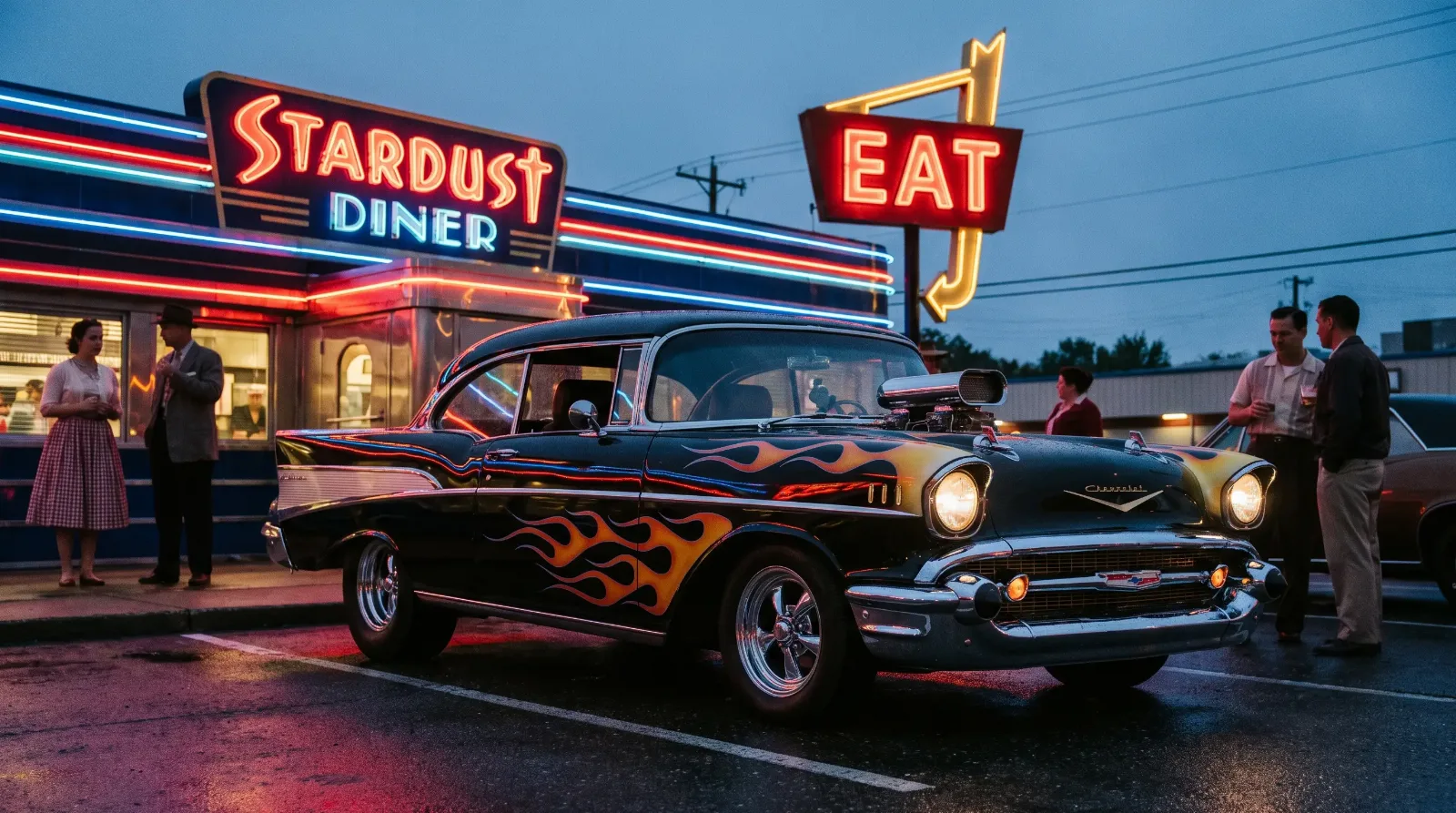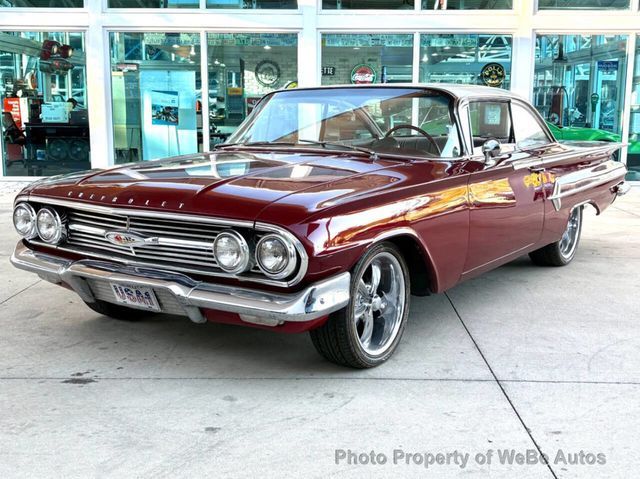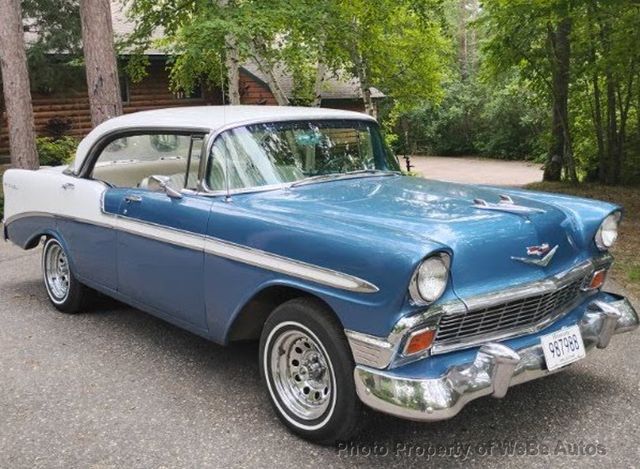
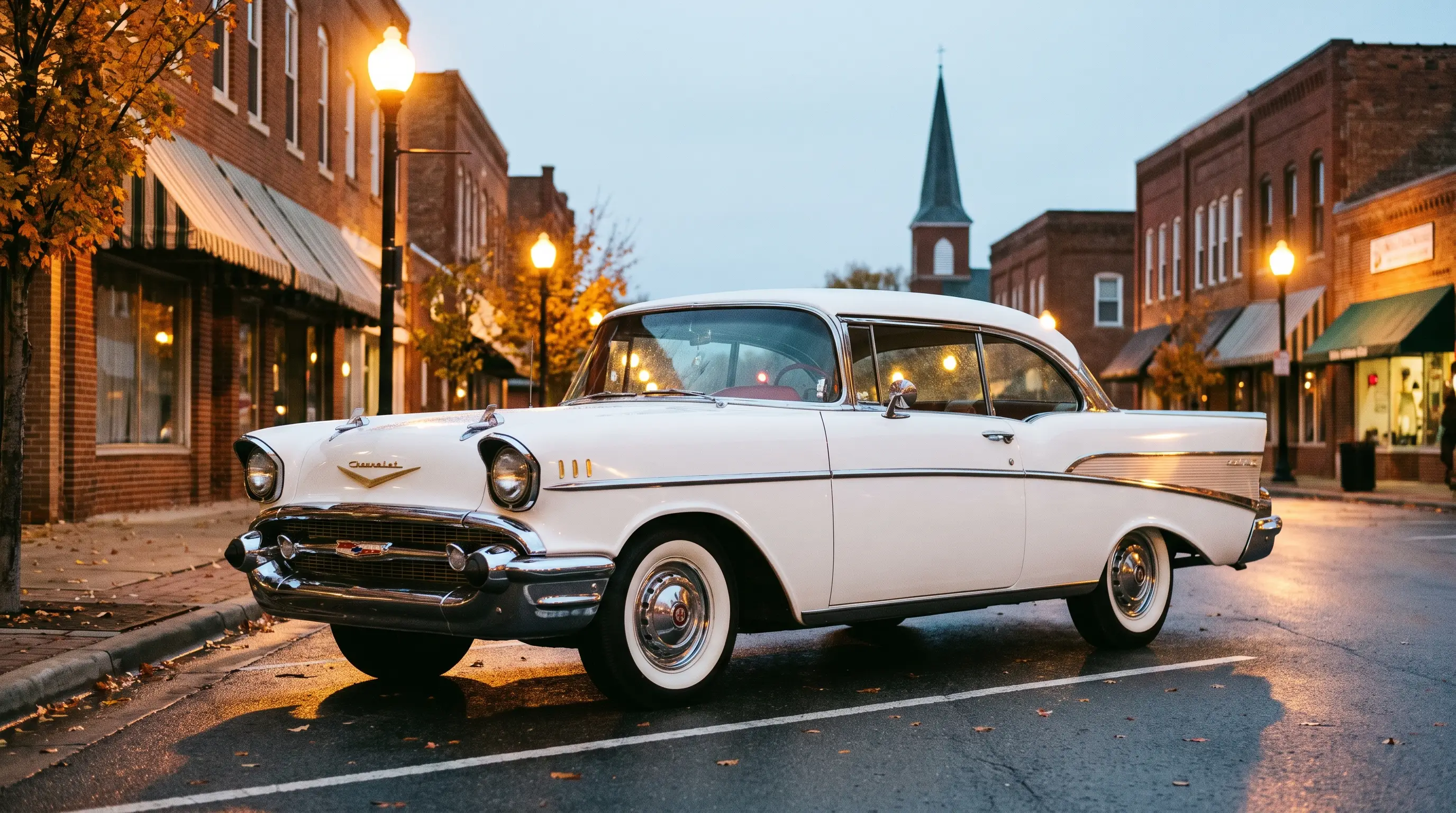
There is a particular kind of quiet that falls over a car show when a white Bel Air rolls past the gate with flames on the flanks. Somebody always says the same thing, half under their breath, like a password. "That's the American Graffiti car." Most people assume it is a 1957. It is not. The genuine "Bel Air" of the film is a 1958 Bel Air Impala, and even the real 1957 Bel Air that does appear on screen is a brief, background presence rather than a starring role. The association between the Bel Air name and that single summer night in a fictional Modesto is real, but the year most people picture is wrong, and that mix-up is its own small piece of the car's cultural life.
A single night, a single street
George Lucas set his 1973 film on one long night of cruising before a group of friends scatters into adulthood, and he built the whole atmosphere around cars that were already old by the time the film was made. The car most people misremember as a 1957 Bel Air is actually Steve Bolander's white 1958 Chevrolet Bel Air Impala, a hot rod with flame graphics down the sides that Ron Howard's character drives for most of the film before lending it to his friend Terry. It was chosen because it was recognizable, because a generation of American teenagers already associated that full-size Chevrolet silhouette with the exact kind of Friday night the film wanted to recreate. The car was cast the way an actor is cast. It had to look like it belonged on that street before the cameras ever rolled. A separate 1957 Bel Air Sport Coupe also turns up in the film, but only in a short scene, not as a character's primary ride.
What the film captured, almost by accident, is something car people had known for years and civilians were only starting to understand: a parked car can hold a whole social order in place. Who owns which model, who is watching whom, who is about to leave town and who never will. The Bel Air sat in the middle of that unspoken hierarchy, not the fastest or the flashiest car on the strip, but the one everyone recognized on sight.
Why the audience remembered the car
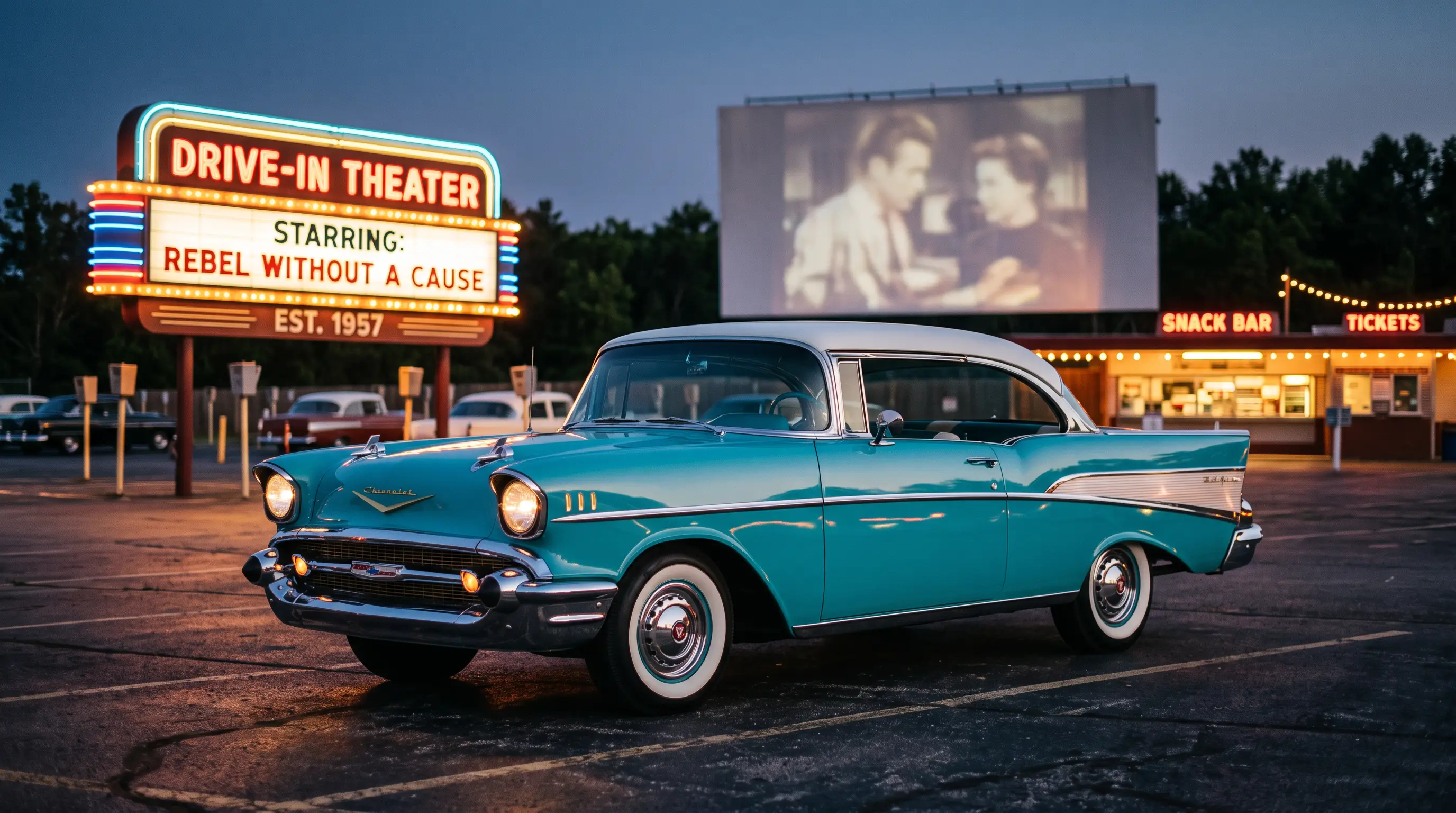
Movies rarely make a specific model year famous on their own. Most film cars are forgotten within a season. Steve Bolander's white 1958 Bel Air Impala became the exception because the film arrived at exactly the moment nostalgia for the late 1950s was becoming a cultural industry of its own, with oldies radio stations, drive-in revival nights, and a wave of writing about the lost innocence of the pre-Vietnam years. The car became a visual stand-in for all of it, and the Bel Air name attached to it carried the association back onto every earlier Bel Air, including the 1957. You did not need to have grown up in the late 1950s to feel something looking at that white Bel Air gliding under a string of drive-in lights. The image did the work that a thousand words of narration could not.
For a deeper look at how this single film moment sits inside the wider story of the model's cultural life, 1957 bel air american graffiti history traces the threads back further than the movie itself, into the actual teenage car culture the film was trying to recreate.
The real cars behind the myth
Multiple cars stood in for Steve Bolander's Bel Air Impala during filming, a common low-budget practice that keeps a hero car working through a demanding shoot, and decades of fan research and owner claims have not settled a single definitive count. What is certain is that the film's use of real, well-worn cars rather than pristine studio pieces gave the whole production a texture that a cleaner, more polished car could never have delivered. The paint had chips. The chrome had haze. It looked like a car that had actually been driven to a drive-in a hundred times, because in some sense, it had.
That authenticity mattered more than any single fact about the specific car's provenance. Audiences do not fall in love with a VIN number. They fall in love with the feeling a car creates on screen, and the feeling this one created was unmistakably real.
The afterlife of a movie car
Decades after the film's release, the association between the Bel Air name and that one summer night has only deepened, and it has drifted onto every Tri-Five year along the way. Owners who bring a correctly finished 1957 Bel Air to a show know exactly what conversation they are inviting, and most of them have made peace with explaining, gently, that no, this specific car was not in the movie, and it is not even the same model year as the one that was, but yes, it carries the spirit people remember. There are worse things for a car to be famous for than a story about friendship, longing, and one last night before everything changes.
If the film sparked your curiosity about how other Tri-Five Chevrolets have shown up on screen over the decades, a related story covers the wider pattern of these cars finding their way into American film and television long after their original showroom days ended.
A car that outlived its own decade
The 1957 Bel Air was never the top of Chevrolet's lineup and was already considered old-fashioned by some buyers within a decade of its release. It took a film about looking backward to remind an entire country why the car had mattered in the first place. That is the quiet power of good storytelling. It does not just document a moment. It decides which objects get to carry the memory of that moment forward, long after the people who first owned them are gone.
I think about this every time I see a restored Bel Air roll into a show with its owner standing a little apart from it, watching strangers react, whether it is a 1957 or the 1958 Bel Air Impala that actually rolled through the film. Some of those owners were not even born when the film came out. They inherited the association secondhand, from parents or grandparents who told them the story, or from late-night television reruns that kept the image circulating long after the theatrical run ended. That is unusual for a car. Most models fade from public memory once production ends and the last generation of original owners passes the vehicle along or lets it go. The Bel Air name got a second life, borrowed from a story that was never really about any single car at all, and it has held onto that borrowed fame for longer than anyone involved in making the film likely expected.
There is something worth sitting with in that fact. A film about the passage of time, about friends scattering into separate futures on the very night before it happens, ended up giving one particular car a kind of permanence none of its characters got to keep for themselves. The Bel Air stayed parked in the American imagination exactly where the film left it, under those drive-in lights, forever on the edge of a night that never quite has to end.
"Nobody cries over a spreadsheet of production numbers. They cry over a white car gliding past a drive-in marquee at midnight, because it looks exactly like the night they can't get back."
- Nora Beckett
If that image has stayed with you the way it has stayed with so many owners over the decades, there are real ones out there waiting. You can find Airs for sale now and decide for yourself whether the myth still holds up in daylight.